A 14-year-old Vedic student from Kumbakonam has successfully cleared one of the most demanding examinations in Vedic education, known as Ekaki Vaktha Shrotha, earning widespread appreciation from scholars.
The examination was conducted under the chairmanship of Brahmasri Yagnamani Dikshitar of Thiruvaiyaru, a noted Vedic scholar who presided as the examining authority. Chandrasekaran, a student of Brahmasri Gururama Ganapadi, a teacher at the Sri Mantra Peeteshwari Vedic School in Kumbakonam, passed the examination with exceptional merit.
The Ekaki Vaktha Shrotha examination is regarded as one of the most rigorous assessments in traditional Vedic learning and is especially associated with the scholarly traditions of Kashi (Varanasi). Unlike conventional written tests, the examination requires the candidate to recite extensive portions of the Vedas continuously, alone, without interruption or assistance, demonstrating complete mastery, concentration, and memorisation.
In this instance, Chandrasekaran undertook the recitation of the entire Brahmana portion, including the Aruna and Kaatakam sections. The recitation was carried out continuously over two days. On the final day, the examination began at 8 AM and concluded only at 10 PM, during which the student completed the entire prescribed portion without pause or error.
Observers noted that the examining authority was visibly impressed by the performance, particularly given the student’s young age. Scholars present described the achievement as rare and indicative of disciplined adhyayanam, systematic and traditional Vedic study.
Speaking about the accomplishment, it was noted that the success reflected not only the student’s dedication but also the sustained guidance of his teacher and family. Chandrasekaran’s father, who is also deeply involved in ritual practice, has reportedly been consistent in balancing traditional observances with the training of students over long hours.
The Sri Mantra Peeteshwari Vedic School in Kumbakonam has, in recent months, been conducting regular Vedic examinations alongside fortnightly scholarly sessions under the Vedo Nityam Adhiyatam… Dharma Samruddhitham initiative. According to those associated with the programme, every student who has appeared for these examinations so far has achieved a 100 percent success rate.
Vedic scholar Sarma Sastrigal credited the achievement to the collective efforts of the teacher, his wife, and the family, who have provided sustained academic and personal support.
Subscribe to our channels on Telegram, WhatsApp, and Instagram and get the best stories of the day delivered to you personally.
A woman property owner from Thiruvanmiyur has alleged prolonged harassment, administrative apathy, and illegal diversion of rental income in connection with a TASMAC liquor shop operating in her building, forcing her to stage a protest outside the premises.
Suganthi, a resident of Thiruvanmiyur, stated that in 2021 her husband had entered into a rental agreement to lease out the building, located adjacent to the Regional Transport Office (RTO), for a premium liquor shop. She said the lease was granted only after clear assurances were given that the premises would be used strictly for liquor sales and not for on-site consumption.
According to Suganthi, her husband passed away within seven to eight months of the agreement being signed. Thereafter, the situation at the premises deteriorated rapidly. She alleged that liquor consumers began drinking inside the premises, throwing bottles, engaging in fights, and using the surroundings as a public toilet while intoxicated, causing continuous disturbance and damage.
She said she had repeatedly approached the District Manager’s (DM) office over the last five years, requesting that the shop be vacated, but received no effective response. She alleged that employees of the liquor outlet refused to take responsibility for the behaviour occurring on the premises.
Suganthi further stated that she had lost faith in approaching the police, claiming that police personnel themselves consumed alcohol at the shop during visits by political leaders and VIPs. In view of this, she said she refrained from filing a formal police complaint and instead waited for the authorities to act.
According to her, the five-year rental agreement expired recently. After the expiry, the District Manager visited the site, during which she requested immediate vacating of the premises, citing pressure from the Highways Department to demolish the building and clear the land. Despite this, she alleged that the liquor shop continued to function for another five to six months beyond the agreement period.
She also alleged serious irregularities in the payment of rent. While the official rent for the premises was fixed at ₹1.5 lakh per month and authorised through official correspondence, she claimed that she was receiving only half the amount. The remaining portion, she alleged, was being paid to an unrelated individual named Saravanan, also referred to as “Thundu Saravanan”, whose role she said was never explained to her.
Suganthi stated that she became aware of the actual rent amount and the alleged diversion of funds only through her lawyer, nearly a year after her husband’s death. She claimed that even officials at the DM’s office failed to clarify why a third party was receiving a portion of the rent for a property owned solely by her family.
The situation worsened further following a major fire accident at the building earlier this week, she said. According to her, the fire destroyed old electrical wiring in a portion of the premises, leaving her unable to provide electricity to tenants or carry out rewiring due to financial constraints. She added that rewiring a building slated for demolition was impractical and unaffordable.
Suganthi said she was now facing a livelihood crisis and was unable to respond to the concerns of other tenants occupying the building. She asserted that closure of the liquor shop was the only way forward and that she had been compelled to spend money from her own pocket to lay rubble and sand at the entrance and stage a sit-in protest.
She alleged that the government’s inaction over several years had pushed her to the brink, forcing her to protest publicly at the entrance of her own property.
வாடகை ஒப்பந்தம் முடிந்தும் டாஸ்மாக் கடையை காலி செய்யாத உரிமையாளர்கள்.. ஸ்டேஷன்ல எந்த Complaint-ம் பண்ணாம 5 வருஷமா பொறுமையா காத்துட்டு இருக்கேன்.. டாஸ்மாக் கடையை காலி பண்ண சொன்னாலும் கேட்கல.. எனக்கு பாதி வாடகை பணம் தான் வருது.. மீதி பணம் இன்னொருத்தருக்கு போகுது.. அது ஏன் போகுதுனு… pic.twitter.com/p6ALpWX4kZ
A few days ago, makeup artist and distortionist Ruchika Sharma claimed Mariamman and Mary are the same – she did not speak history but peddled the same narrative as missionaries did.
She is once again back with another outrageous demand that exposes her knowledge of history.
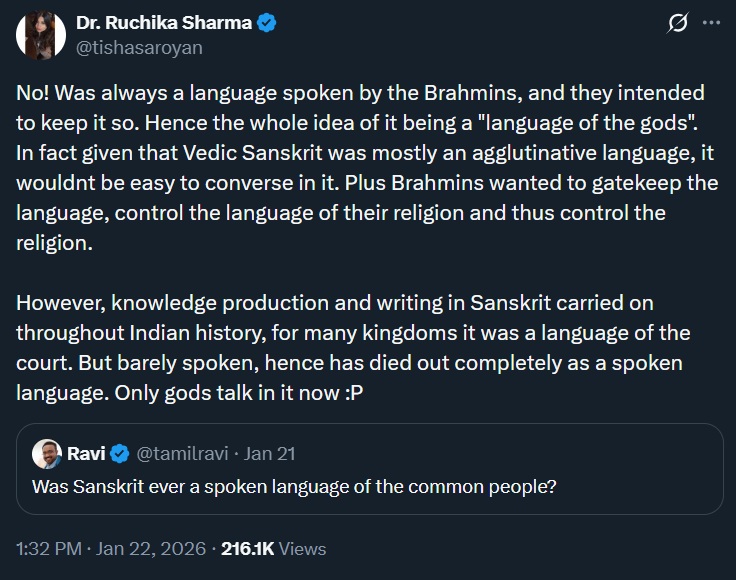
A social media argument triggered by makeup artist, who masquerades as a ‘historian’, Ruchika Sharma’s claim that Sanskrit was “always” spoken only by Brahmins has laid bare a bigger problem in today’s public history debates. Instead of discussing what ancient texts and inscriptions actually say, the discussion quickly shifted to who is “allowed” to speak on history and whose evidence can be dismissed outright. What should have been a simple question of reading sources turned into an exercise in ideological gatekeeping.
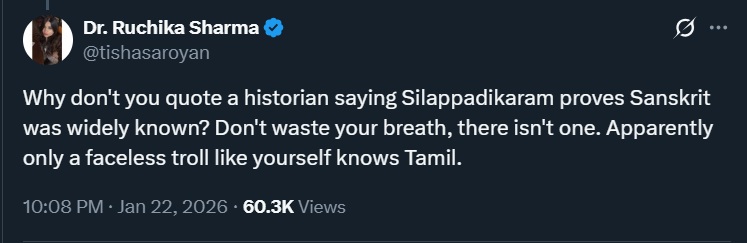
The controversy began with a question posed on X asking whether Sanskrit was ever a spoken language of the common people. Responding to this, makeup artist & self-proclaimed ‘historian’ Ruchika Sharma asserted that Sanskrit was “always a language spoken by the Brahmins”, that it was deliberately gatekept to control religion, and that while it functioned as a court language for many kingdoms, it was “barely spoken” and has therefore “died out completely as a spoken language”.
This sweeping claim was presented not as a hypothesis, but as settled historical truth.
It was then countered by author and historian TS Krishnan with a citation from Silappadikaram, one of the foundational Tamil epics, along with inscriptional and historical material showing Sanskrit’s social presence in Tamilakam.
Another entirely ignorant take from a so-called “history degree holder.”
Even in Tamilakam—where Sanskrit was not the primary spoken language—Sanskrit was widely known, spoken, and understood across sections of society. The commentary on the Tamil epic Silappadhikaram makes this… https://t.co/98h6xu66eipic.twitter.com/yc7O3swlH7
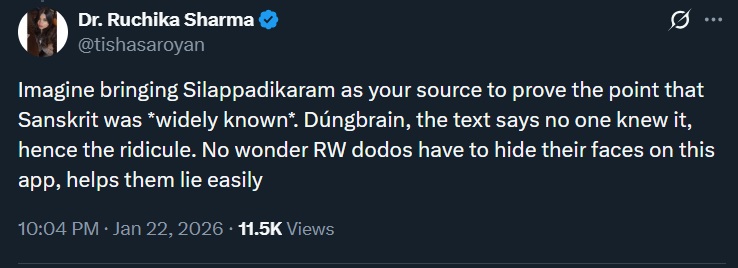
Rather than engaging with the evidence, Sharma dismissed the argument outright, demanding that a historian be quoted to “prove” that Silappadikaram shows Sanskrit was widely known, adding that “there isn’t one”, and resorting to personal derision.
That response reveals a fundamental scholarly error.
The verse states that when people speak Sanskrit (Āriyam) without proper knowledge, it becomes a source of ridicule to listeners.
The logic of the verse is inescapable. Ridicule presupposes comprehension. One cannot mock incorrect Sanskrit unless there exists an audience capable of recognising correct Sanskrit. The text assumes not rarity, but familiarity, both with the sound of the language and with standards of linguistic competence.
This is not a modern interpretation imposed on the text. It is the internal logic of the verse itself.
By demanding a modern historian’s endorsement instead of engaging with the primary source, Sharma commits a category error. Historians interpret evidence; they do not grant evidence its validity. A contemporaneous literary source does not cease to be evidence because a present-day academic has not tweeted about it.
History is not decided by citation politics.
Silence Is Not Refutation
Sharma’s claim that “there isn’t one” historian who says Silappadikaram proves Sanskrit was widely known is an argument from silence. Even if accepted at face value, it proves nothing. Absence of explicit articulation in secondary literature does not negate the implications of primary texts, especially when those implications are reinforced by independent material evidence.
Indeed, Sanskrit’s presence in Tamilakam is not inferred from literature alone.
Inscriptions and Institutions Contradict the Gatekeeping Myth
Medieval Tamil history offers overwhelming corroboration. Pandya kings such as Sundara Pandya authored works in Sanskrit. Rajendra Chola and Kulottunga I patronised Sanskrit learning extensively. The Pandyas maintained a Sanskrit academy at Madurai dedicated to advanced scholarship.
More decisively, inscriptions of the Chithiramezhi Sabha, a powerful Vellalar (non-Brahmin) mercantile and agrarian guild, routinely open with Sanskrit ślokas. Their Tamil inscriptions explicitly describe themselves as ‘செந்தமிழ் வடகலை கற்றுணர்ந்து’ – proficient in both refined Tamil and northern learning (Sanskrit).
These are not Brahminical priestly records. They are guild inscriptions. They demolish the claim that Sanskrit usage was confined to a closed caste circle.
A language systematically used in royal courts, guild charters, public inscriptions, and literary satire cannot simultaneously be “barely spoken” or socially inaccessible.
Strawmen and Personal Attacks Are Not Scholarship
Notably, the counter-argument by TS Krishnan never claimed that Sanskrit replaced Tamil as the primary spoken language of Tamilakam. It stated, accurately, that Sanskrit was widely known, heard, understood, and cultivated across sections of society, alongside Tamil.
By reframing this as a demand for proof of “common people speaking Sanskrit” in isolation, Sharma constructs a strawman while ignoring the actual claim.
When pressed with textual and inscriptional evidence, the response shifts from argument to dismissal, from sources to slur. Calling a renowned author (TS Krishnan) a “faceless troll” and questioning their knowledge of Tamil is not rebuttal. It is evasion.
What makes Ruchika Sharma’s claim even weaker is her clear inability, or refusal, to engage with Tamil itself. She does not analyse the Silappadikaram verse, does not explain its meaning, and offers no alternative reading of the Tamil lines cited. Anyone with even basic familiarity with Tamil literature would immediately see that the verse assumes an audience capable of recognising correct and incorrect Sanskrit. By skipping the Tamil entirely and instead demanding approval from “historians”, Sharma is making sweeping claims about Tamil society without demonstrating any working understanding of Tamil texts.
When someone who claims to be a historian ignores a clear Tamil verse, dismisses carved inscriptions, waves away Sanskrit academies in Madurai, and still insists that Sanskrit was “always” locked inside Brahmin homes, the issue is about her credibility. When argument collapses into derision and gatekeeping, it becomes clear that what is being defended is not history, but a narrative. And on the evidence, that narrative does not survive scrutiny.
Subscribe to our channels on Telegram, WhatsApp, and Instagram and get the best stories of the day delivered to you personally.
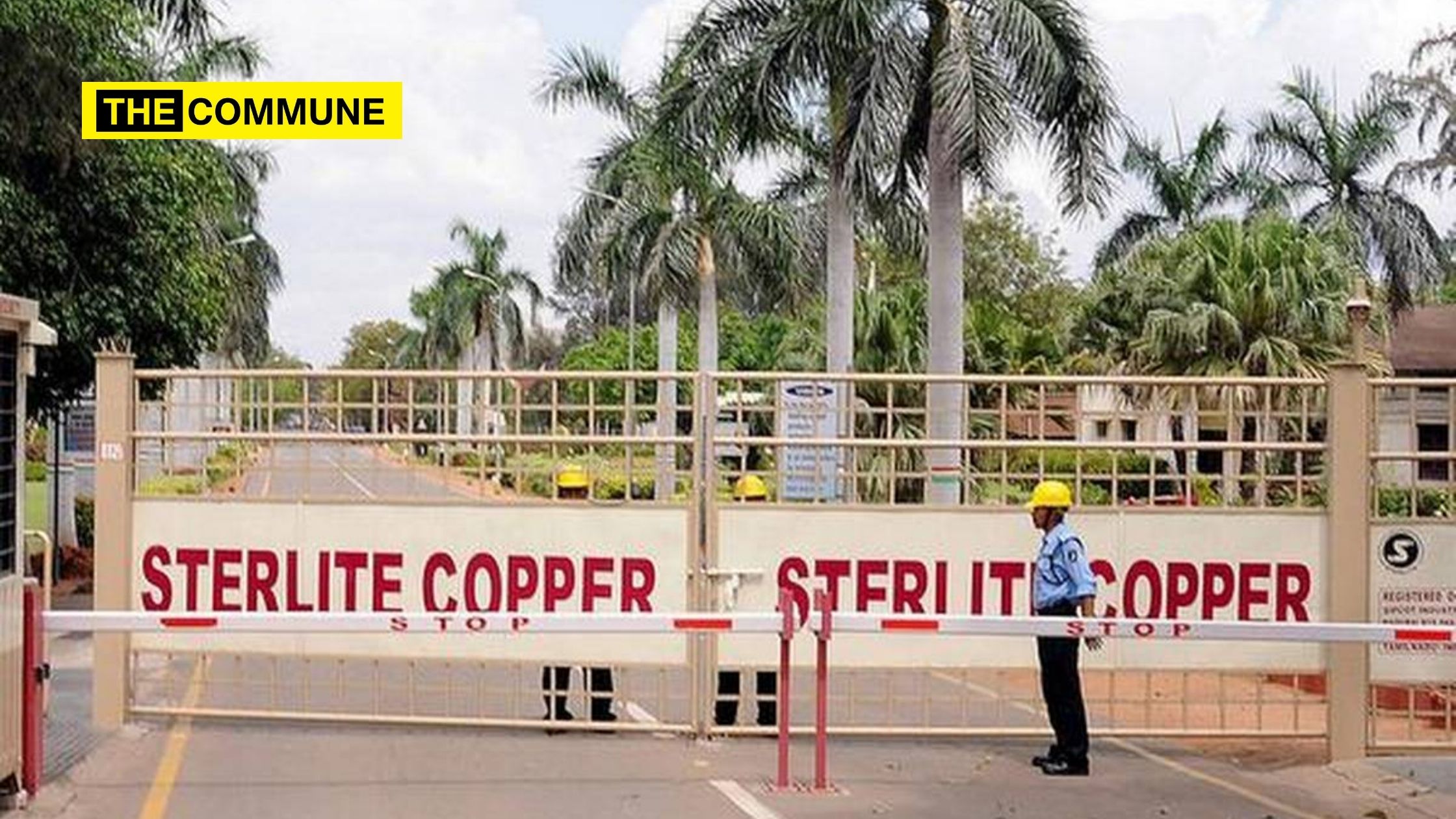
Industry representatives and regional stakeholders have welcomed a recent order of the Madras High Court permitting Vedanta’s Sterlite Copper unit to submit a fresh application for its proposed green copper plant in Thoothukudi, viewing the development as a potential boost for cleaner industrial practices, regional economic recovery, and India’s long-term copper strategy.
The First Bench of the Madras High Court, headed by Chief Justice Manindra Mohan Shrivastava and Justice G Arul Murugan, allowed Sterlite Copper to approach the competent authorities with a new proposal for the plant. The court directed that the matter be listed on January 29, 2026, along with a related petition filed in 2019, while clarifying that the pendency of the case would not prevent regulators from independently examining and deciding on any fresh application submitted by the company.
Observers have described the order as effectively reopening the regulatory process, enabling authorities to assess a revised production model that claims alignment with global environmental norms and India’s rising copper demand. The demand is being driven by sectors such as electric mobility, renewable energy, electronics, and infrastructure.
Responding to the court’s directive, Srikanth Rajagopalan, Chief Operating Officer of Finergy Transport Finance Limited, stated that cleaner copper production could have implications beyond a single facility by strengthening domestic supply resilience and supporting long-term industrial development.
According to information shared by the company, “green copper” refers to copper produced through significantly cleaner and more resource-efficient processes, including lower emissions, reduced waste, and improved water and energy efficiency. As part of the proposed transition, Sterlite Copper plans to move from a fully concentrate-based smelting process to a hybrid system using about 70% copper concentrate and 30% recycled copper. The company has indicated that the shift would be supported by advanced technologies sourced from Germany and Sweden, integrating circular economy principles and reducing the overall environmental footprint compared to conventional smelting.
The proposal also highlights community-oriented measures alongside environmental goals. These include plans to share surplus treated water with nearby villages, establish structured mechanisms for community participation through a local management committee, and create a dedicated corpus for sustained local development initiatives.
S Thyagarajan, president of the Thoothukudi People’s Livelihood Protection Association, said the proposed plant could help restore livelihoods in the region, noting that thousands of families depend directly and indirectly on industrial activity. He indicated that reopening the facility with cleaner technology could revive direct employment and support allied industries.
Placing the development in a national context, Mayur Karmarkar, a member of the International Copper Association India, said copper was essential for a decarbonising economy and that an environmentally responsible domestic supply was necessary to avoid price volatility and support India’s growth trajectory.
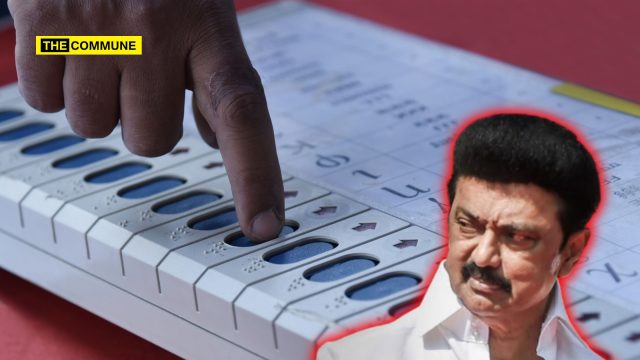
The Supreme Court is set to examine the extent to which the contents of electronic evidence must be proved after such evidence has been authenticated through a certificate under Section 65B of the Indian Evidence Act, in a case arising from a challenge to the 2011 election of former Deputy Chief Minister and DMK leader M K Stalin from the Kolathur Assembly constituency.
A Bench of Justices J K Maheshwari and Vijay Bishnoi is hearing an appeal filed by AIADMK leader Saidai S Duraisamy against a Madras High Court judgment that dismissed his election petition challenging Stalin’s victory in the 2011 Tamil Nadu Assembly elections. Stalin is now the Chief Minister of Tamil Nadu.
The dispute centres on video footage relied upon by Duraisamy to substantiate allegations of corrupt practices during the election campaign. According to the petitioner, videos of certain incidents were recorded and later transferred onto compact discs. These video CDs were challenged by Stalin on the ground that they lacked proper certification under Section 65B of the Indian Evidence Act.
Before the High Court, official witnesses testified regarding the production of the CDs. Relying on these testimonies, the High Court held that the authenticity of the CDs could not be doubted. The court also took into account a certificate issued under Section 65B (4) by one of the official witnesses and concluded that the CDs were admissible as secondary evidence.
However, despite holding the electronic evidence to be admissible, the High Court concluded that the allegations of distribution of money at the places identified by Duraisamy, with the consent of Stalin or his election agent, were not proved. The election petition was therefore dismissed, prompting Duraisamy to approach the Supreme Court.
Senior Advocates Kapil Sibal and Amit Anand Tiwari are appearing for Stalin, while Senior Advocate Dama Seshadri Naidu is representing Duraisamy.
During the hearing on the previous day, a broader concern regarding the capping of election expenditure was raised. Sibal submitted that it was for Parliament to address the issue of exorbitant election expenses. When arguments resumed, Sibal contended that while the CDs might have been produced and certified, the contents of the videos still required to be proved through cross-examination. He argued that such proof was lacking because the official witnesses could only depose about the production of the CDs, and not about the contents of the videos, including where and how the recordings were made.
Arguments were primarily advanced by Naidu, who took the Bench through the allegations made in the election petition and the evidence relied upon in support. He submitted that the High Court had erred by applying the standard of proof “beyond reasonable doubt” instead of the civil standard of “preponderance of probabilities” applicable to election petitions. The Bench specifically questioned him on the material relied upon to establish that the alleged distribution of money among voters was carried out with Stalin’s consent.
The Bench also indicated that the legal issue regarding the extent to which the contents of electronic evidence need to be proved, even after compliance with Section 65B, would require consideration.
In his election petition, Duraisamy had accused not only Stalin, but also his election agents and DMK party workers in Kolathur, of engaging in systematic bribery of voters. He alleged that the DMK employed the so-called “Thirumangalam Formula” and distributed money through methods such as “Community Feedings”, courier services, concealment of currency in newspapers, “Arathi Plate Contributions”, and slips issued to purchase consumer items.
According to the petition, Stalin, his election agent and party functionaries illegally distributed amounts ranging from Rs. 500 to Rs. 10,000 to voters from the date of nomination until the date of polling. It was further alleged that these activities took place with the consent and knowledge of Stalin, and that even on counting day, orders of the Election Commission of India were violated. Stalin was ultimately declared the returned candidate by a margin of 2,739 votes.
Duraisamy also claimed that on the eve of polling, the police seized a truckload of money intended for distribution among voters, and that DMK party workers objected to the inspection of the vehicle. He further alleged that Stalin’s wife, Durga Stalin, along with the then Mayor of Chennai, supervised the distribution of money and gifts to voters on behalf of Stalin.
In support of this allegation, Duraisamy referred to a Tamil magazine, Snehidhi, citing an interview of Durga Stalin in which she allegedly stated that after polling was over, she asked her husband, M K Stalin, to provide “cot” and necessary financial assistance to persons to whom she had made assurances during the campaign.
The Supreme Court is continuing to hear the matter.
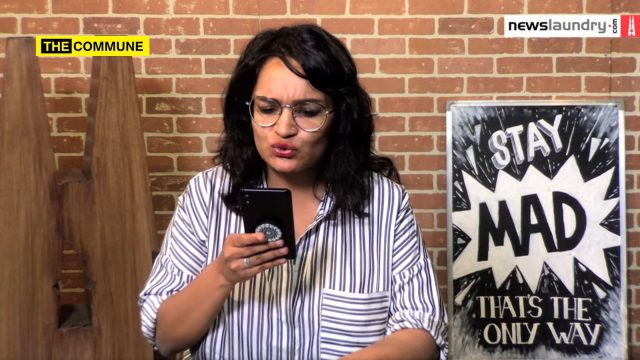
The Delhi High Court on Thursday (22 January 2026) sharply criticised the language used by Newslaundry journalist Manisha Pande in a video targeting the TV Today Network, which owns the news channels Aaj Tak and India Today.
According to a report by Bar & Bench, a Division Bench comprising Justices C Hari Shankar and Om Prakash Shukla described Pande’s use of the word “shit” while referring to a video about Good News Today, a TV Today channel, as “gross” and demeaning. The Bench made it clear that such language crossed acceptable limits of journalistic conduct.
The Court cautioned that it could make observations or issue directions that may seriously impact Pande’s professional future.
“Are you continuing with anchor? She should be thrown out. She has no business being a reporter. She doesn’t know the basics. She doesn’t know the fundamentals of decency in reporting. We will make this statement in open court. We will comment on her personally. We won’t mind impleading her as a party. There has to be a limit to everything… We may pass an order which will place her entire career in disarray,” the Bench observed.
Senior Advocate Rajshekhar Rao, appearing on behalf of Newslaundry, acknowledged that he did not endorse certain expressions used in the videos. However, he argued that the lawsuit initiated by TV Today — alleging defamation, disparagement, and copyright violation — was less about language and more about discomfort with media scrutiny.
“I take their clip and comment on it. Yes, I should have used better language. But somebody wants to shut me down,” Rao submitted.
These remarks were made while the High Court was hearing cross-appeals arising from a single-judge order in a suit filed by TV Today accusing Newslaundry of copyright infringement, defamation, and disparagement.
TV Today had instituted the case in October 2021, claiming that Newslaundry published content that damaged its reputation through what it described as “false, malicious and derogatory” statements directed at its channels, journalists, and management.
Newslaundry, on the other hand, maintained that its work constituted satire and media criticism protected under free speech principles.
On July 29, 2022, the High Court declined to grant interim relief to TV Today. Both sides subsequently appealed the order — TV Today objected to the denial of interim relief, while Newslaundry argued that the court’s prima facie observations could prejudice it.
During the hearing, advocate Hrishikesh Baruah, representing TV Today, referred to multiple Newslaundry videos and contended that comments made by Pande and Newslaundry co-founder Abhinandan Sekhri were derogatory. He further argued that extensive use of TV Today’s video clips exceeded the boundaries of fair use and amounted to copyright infringement.
While the Bench expressed disapproval of Pande’s use of the word “shit,” it also clarified that TV Today could not label every unfavourable critique as disparagement.
The Court held that phrases used by Newslaundry — such as “method anchoring,” “thoda drama thoda gimmick (little drama, little gimmick),” “soap opera,” or “killing sports journalism Aaj Tak style” — constituted criticism rather than disparagement.
“Every word that they say is ot disparaging. This is commenting on what youa are showing. This is criticism. How is this disparaging? She is saying that you are doing it for cheap thrills, that’s not disparaging… Even if he says your programme is absolute nonsense, that’s not disparaging, that’s a comment,” the Bench remarked.
Advocate Bani Dikshit, also appearing for Newslaundry, pointed out that the platform had never claimed ownership of Aaj Tak or India Today footage. She added that expressions such as “nanga nach (nude dance)” must be evaluated in the context in which they were used.
In his concluding submissions, Senior Advocate Rao stated that Newslaundry was founded on the belief that the media had historically stood firm during the nation’s most challenging moments, but that a transformation had occurred over time.
“We [media] are conscience keepers of democracy,” he said.
The Bench clarified that it did not wish to comment on the current state of the media.
“We don’t want to express our views about what the media is doing. We are restricting ourselves,” Justice Hari Shankar stated.
The Court subsequently reserved its judgment in the appeals.
Subscribe to our channels on Telegram, WhatsApp, and Instagram and get the best stories of the day delivered to you personally.
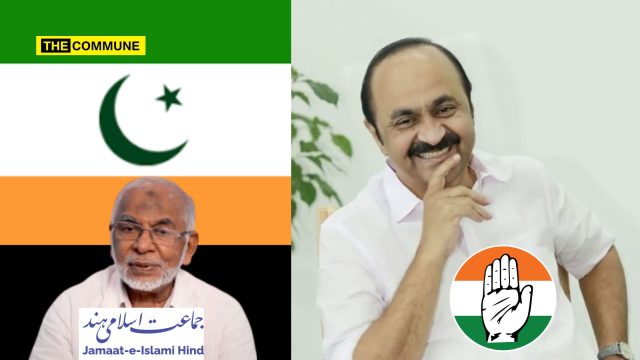
A statement by Jamaat-e-Islami leader Shaikh Muhammed Karakunnu defending the concept of an Islamic Republic has triggered a political controversy in Kerala, drawing criticism amid an ongoing debate over secularism and electoral alliances.
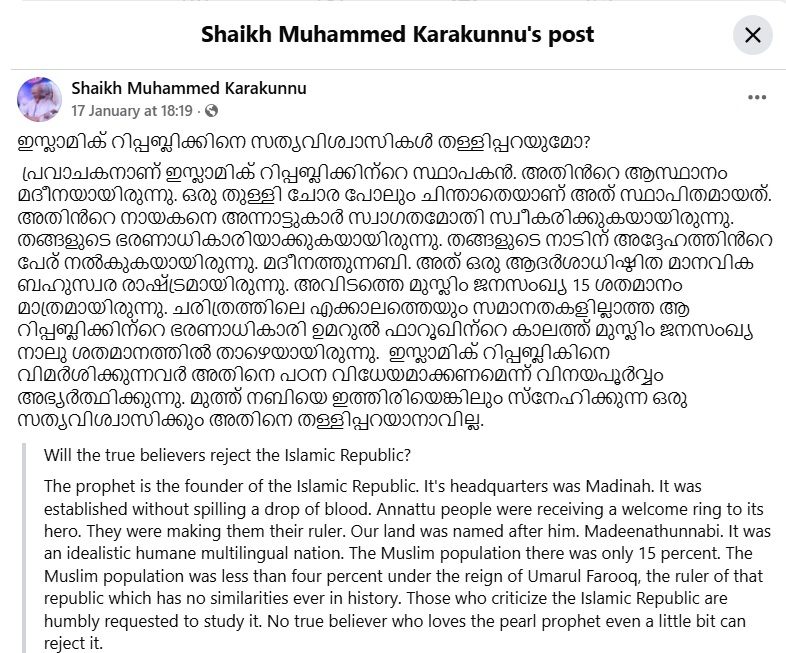
In a Facebook post titled “Would true believers reject Islamic Republic?”, published on 17 January 2026, Karakunnu stated that the Prophet Muhammad was the founder of the Islamic Republic and that its capital was Medina. He said the state was established without the shedding of blood and that the people of the land welcomed the Prophet and accepted him as their ruler, naming the city Madinatun Nabi (City of the Prophet). He described it as an ideal-based, humanitarian and pluralistic polity, claiming that Muslims constituted only about 15 per cent of the population at the time.
Karakunnu further stated that during the rule of Umarul Farook, whom he described as the ruler of that historically unparalleled republic, the Muslim population was less than four per cent. He urged critics of the concept of an Islamic Republic to study it carefully, adding that no true believer who loved the Prophet Muhammad could reject it.
Screenshot of Shaikh Muhammed Karakunnu Facebook Post
The controversy has also revived debate over political alliances following the 2025 Nilambur Assembly by-poll, in which the Jamaat-e-Islami-backed Welfare Party of India publicly announced its support for the Congress-led United Democratic Front candidate. Leaders of the Kerala Pradesh Congress Committee had stated that the UDF would accept “all support” to defeat the Left Democratic Front, a position that sparked criticism over the coalition’s secular credentials.
Critics alleged that the Indian National Congress leadership, including Rahul Gandhi, Priyanka Gandhi, and V D Satheesan, was fully aware of Jamaat-e-Islami’s ideological positions but continued to engage with the organisation for electoral support.
It is noteworthy that VD Satheesan had once defended its engagement with Jamaat-e-Islami. VD Satheesan, the Leader of the Opposition in Kerala, had previously taken a firm stand in support of accepting Jamaat-backed political support. Satheesan had publicly stated that Jamaat-e-Islami no longer advocated the establishment of a theocratic state and had undergone a shift in its ideological position.
He had said, “They are not raising the demand for a theocratic state anymore. They have made significant changes to their stance. Their support is now purely political. That support is for the Congress; it is for the UDF.”
A Jamaat-e-Islami leader openly calls for an Islamic Republic. They reject Indian democracy. They reject our Constitution.
Yet in Keralam, @RahulGandhi’s Congress is partnering with Jamaat for votes, while lying about constitutional values.
Opponents further argued that mainstreaming Jamaat-e-Islami risked legitimising ideologies that could threaten Kerala’s social and cultural fabric. It is noteworthy that in Bangladesh, Jamaat-backed politics has undermined democratic institutions and has contributed to violence against minorities.
A video clip showing a youth chasing another person with a weapon in the middle of a busy road in broad daylight has triggered fresh concerns over the deteriorating law-and-order situation in DMK-ruled Tamil Nadu.
The clip, reportedly from Trichy, shows a young man aggressively running on the road while shouting explicit death threats in Tamil – “If you are a man, come here”. The man is armed with a patta kathi (machete) and dangerously chasing another man in a public area.
While details are scarce, there is no clarity on the circumstances that led to the chase, the identities of those involved, or whether the police intervened. It is also not clear if the one wielding the machete was intoxicated.
The emergence of such violent visuals in public spaces has once again highlighted concerns about rising street-level crime and unchecked violence, adding to growing criticism over the state of law and order under the DMK government in Tamil Nadu.
Subscribe to our channels on Telegram, WhatsApp, and Instagram and get the best stories of the day delivered to you personally.
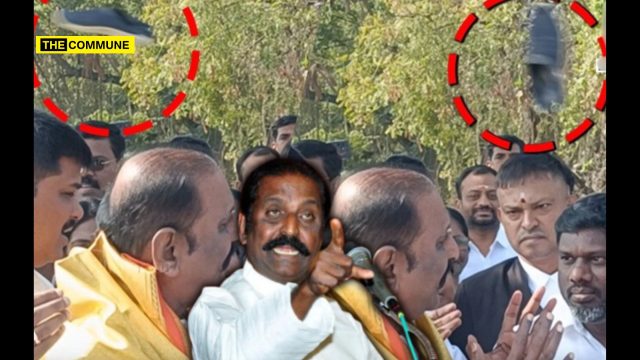
DMK-supporting sexual harassment accused “poet” Vairamuthu was reportedly targeted in a shoe-throwing incident during a public programme in Tiruppur on 22 January 2026, triggering chaos at the venue.
Vairamuthu had arrived in the city to participate in events organised by private bodies. As part of the visit, writers’ associations organised a reception for him near the Tiruppur District Collectorate. While he was being honoured with garlands and formal courtesies, a shoe was suddenly thrown from the crowd, leading to panic and disruption.
Those accompanying the poet immediately intervened and escorted him out of the venue, ensuring his departure in a car. No injuries were reported in the incident.
Police later identified the woman who threw the shoe as Jaya. Officials said she was taken in for questioning and that an inquiry is under way to ascertain the reasons behind the act.
Subscribe to our channels on Telegram, WhatsApp, and Instagram and get the best stories of the day delivered to you personally.
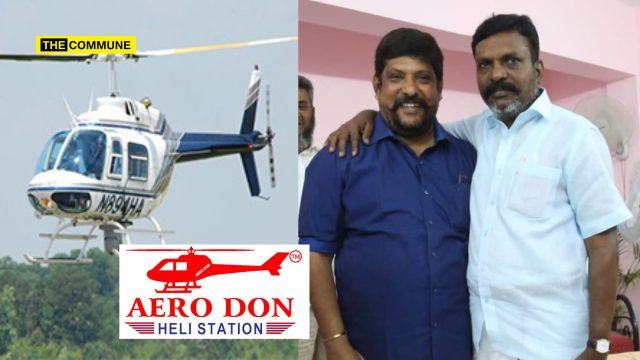
A private helicopter tourism operator has accused a sitting VCK legislator of harassment and extortion, prompting the company to approach Tamil Nadu Assembly Speaker M Appavu with a formal complaint seeking action.
Aero Don, a tourism helicopter company operating joy rides from Kovalam near Chennai, said its CEO Nisha submitted a petition at the State Secretariat alleging that Thiruporur VCK MLA SS Balaji had repeatedly threatened the company and demanded money, despite the service having obtained all statutory approvals. The company said the helicopter service was inaugurated by MSME Minister Tha Mo Anbarasan after securing clearances from the Union Ministry of Civil Aviation, the Directorate General of Civil Aviation (DGCA), and the district administration.
Speaking to the media, Nisha said the helipad and operations were established strictly in accordance with DGCA and Ministry of Civil Aviation norms, including mandatory intimations to the district collector and local authorities. She alleged that despite full compliance, the MLA had been “continuously creating problems” for the company and pressuring it for payments.
According to Nisha, the harassment escalated after the company refused to pay a bribe. She stated that the MLA made remarks suggesting that a private company was unfairly profiting and subsequently used his influence to create obstacles. The company further alleged that during the Pongal festival last year, the helicopter operations were sealed after the MLA complained to the district administration. Aero Don said it remained shut for nearly a year and resumed operations only after restarting the entire approval process from scratch and obtaining fresh clearances from the DGCA and the district collector.
Nisha also alleged that local disturbances were orchestrated, outsiders were brought in, and the company premises were locked without prior notice. She said these events forced the company to directly approach the Assembly Speaker, who, according to her, assured that the matter would be looked into. The company has sought disqualification proceedings against the MLA, citing alleged abuse of power and repeated intimidation.
Responding to the allegations, MLA S.S. Balaji denied wrongdoing and claimed his concerns were rooted in public safety. He said residents in his constituency were afraid of the helicopter operations and questioned whether the pilot held a valid licence, when the helicopter was manufactured, and whether proper safety certifications had been disclosed. The MLA said raising such questions in the interest of public safety was being misrepresented as harassment with political motives.
Balaji further stated that while tourism activities were welcome, authorities must ensure that all safety norms were strictly verified before permitting helicopter joy rides, especially in residential and coastal areas.
Subscribe to our channels on Telegram, WhatsApp, and Instagram and get the best stories of the day delivered to you personally.