Home Blog Page 16

DMK MP Kalanidhi Veerasamy’s Son Booked Under SC/ST Act In Alleged Anna Salai Property Fraud Case

DMK MP Kalanidhi Veerasamy's Son Booked Under SC/ST Act In Alleged Anna Salai Property Fraud Case

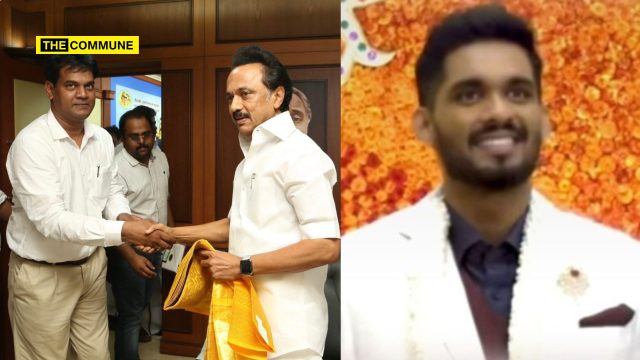
A case has been registered against four persons, including the son of North Chennai DMK MP Kalanidhi Veerasamy, a DMK councillor, the MP’s assistant, and another associate, following allegations of property fraud, criminal intimidation, cheating, and caste-based abuse, as reported in Daily Thanthi.

The Anna Nagar Police have registered the case based on a complaint filed by 67-year-old Anbarasu, a resident of Karur district, who alleged that he was cheated in a property transaction involving a prime property measuring 14 grounds along with a building located on Chennai’s Anna Salai.

According to the complaint, Anbarasu claimed that in 2024, Siddharth, Managing Director of a private company and son of DMK MP Kalanidhi Veerasamy, allegedly coerced him into handing over the Power of Attorney relating to the property standing in his name. He further alleged that the accused subsequently mortgaged the property documents with a bank and obtained a loan using the property as collateral.

The complainant alleged that despite securing funds through the mortgage, the accused failed to pay him the agreed consideration amount and thereby cheated him. He further claimed that when he approached them seeking payment, he was subjected to threats and intimidation.

Anbarasu also alleged that during one such confrontation near the Anna Nagar Roundtana area, he was verbally abused by referring to his caste and was assaulted. Based on these allegations, he approached the Anna Nagar Police and lodged a complaint in 2024.

The accused named in the complaint are:

  • Adhinarayanan, a resident of Virudhunagar district;
  • Rani Ravichandran, DMK councillor of Ward 102 in Anna Nagar;
  • Asaithambi, assistant to North Chennai MP Kalanidhi Veerasamy; and
  • Siddharth, son of MP Kalanidhi Veerasamy and Managing Director of a private company.

Police have registered the case under Sections 3(1)(r), 3(1)(s), and 3(2)(va) of the Scheduled Castes and Scheduled Tribes (Prevention of Atrocities) Act, 1989, along with Sections 420 (cheating) and 506(1) (criminal intimidation) of the Indian Penal Code.

According to police sources, the dispute centres on the ownership and transfer of the 14-ground property on Anna Salai, which the complainant alleges was fraudulently mortgaged to secure bank loans without honouring the agreed financial commitments made to him.

Notably, although the complaint was originally submitted in 2024, no case was reportedly registered during the previous DMK government. However, following the change in government and the assumption of office by the Tamilaga Vettri Kazhagam (TVK)-led administration, the complaint was revisited and a formal case has now been registered.

Subscribe to our channels on WhatsAppTelegram, Instagram and YouTube to get the best stories of the day delivered to you personally.

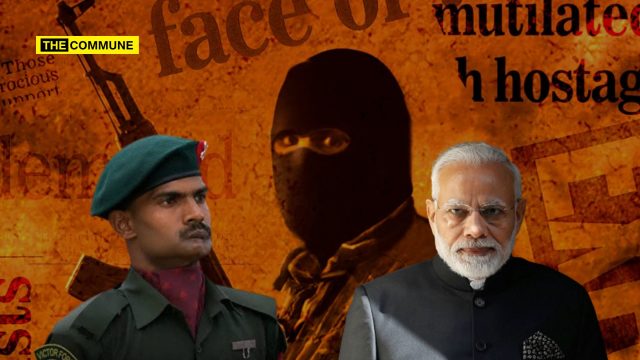
“Nowadays A Terrorist Cannot Operate For Even A Year In Kashmir”: Kirti Chakra Awardee Meenatchi Sundaram

"Nowadays A Terrorist Cannot Operate For Even A Year In Kashmir": Kirti Chakra Awardee Meenatchi Sundaram

An interview featuring Kirti Chakra awardee Lance Naik Meenatchi Sundaram, the Tamil Nadu soldier who continued fighting terrorists despite suffering bullet injuries to his face and shoulder during a counter-terror operation in Jammu and Kashmir, has gone viral on social media.

In the interview, Meenatchi Sundaram speaks about the transformation of the security situation in Jammu and Kashmir and credits the Indian government’s uncompromising counter-terrorism approach for significantly weakening terrorist networks operating in the region.

“Nowadays, if a new terrorist emerges in Kashmir, that individual cannot operate for even a year. The Indian government is that strict.”

The remarks have gained widespread attention online, with many users sharing the clip as an example of the confidence displayed by soldiers involved in India’s counter-terror operations.


View this post on Instagram


A post shared by Tamil Janam (@tamiljanam)

The Soldier Behind The Viral Statement

Meenatchi Sundaram hails from Theni district in Tamil Nadu and serves in the 34 Rashtriya Rifles, one of the Indian Army’s premier counter-insurgency formations operating in Jammu and Kashmir.

He recently came into the national spotlight after being awarded the Kirti Chakra, India’s second-highest peacetime gallantry award, for exceptional bravery during a counter-terror operation in Kulgam district.

On 19 December 2024, security forces received intelligence inputs regarding the presence of terrorists in Kulgam. Personnel from the 34 Rashtriya Rifles launched an operation, leading to a fierce gun battle with heavily armed terrorists hiding in the area.

According to accounts of the encounter, terrorists opened intense fire on Indian troops, resulting in several soldiers sustaining injuries.

Shot In The Face And Shoulder, Yet Continued Fighting

During the encounter, Meenatchi Sundaram emerged as one of the key figures leading the operation. At one stage of the firefight, terrorists reportedly concentrated their attack on him and opened fire.

Bullets struck Meenatchi Sundaram in both his face and shoulder, leaving him severely wounded and with blurred vision.

Despite the serious injuries, he refused to withdraw from the operation.

Realising that allowing the terrorists to escape could pose a serious threat to national security, he continued fighting while bleeding from his wounds. He encouraged fellow soldiers to press ahead with the assault and continued firing at the terrorists despite his condition.

His actions are credited with helping neutralise multiple terrorists and preventing them from escaping. The soldier’s courage also boosted the morale of fellow personnel who were battling under heavy fire.

Military accounts of the encounter note that his determination under extreme circumstances played a crucial role in the success of the operation and helped save the lives of fellow soldiers.

President Murmu Conferred Kirti Chakra

In recognition of his exceptional courage, devotion to duty and leadership under fire, Meenatchi Sundaram was awarded the Kirti Chakra.

The award was presented by President Droupadi Murmu at a ceremony held in New Delhi earlier this month.

The honour is India’s second-highest peacetime gallantry award and is conferred for acts of conspicuous bravery, valour and self-sacrifice away from the battlefield.

Subscribe to our channels on WhatsAppTelegram, Instagram and YouTube to get the best stories of the day delivered to you personally.
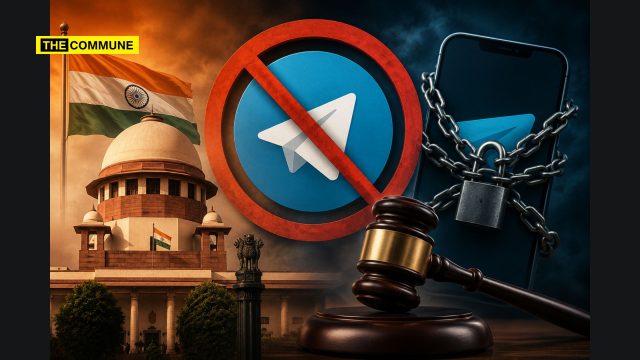
After Mocking India Over NEET Crackdown And Calling India’s Action ‘Authoritarian’; Telegram Loses Delhi High Court Battle As Ban Is Upheld

After Mocking India Over NEET Crackdown And Calling India's Action ‘Authoritarian’; Telegram Loses Delhi High Court Battle As Ban Is Upheld

In a significant victory for the Indian government’s efforts to safeguard the integrity of national examinations, the Delhi High Court has upheld the Centre’s temporary restriction on Telegram, rejecting the messaging platform’s challenge against emergency measures imposed ahead of the NEET-UG 2026 re-examination.

The ruling came days after Telegram launched an unusually aggressive public campaign against the government’s decision, openly mocking Indian authorities on social media and questioning the rationale behind the temporary restriction.

Government Blocks Telegram Ahead Of NEET Re-Exam

The controversy began on 16 June 2026, when the National Testing Agency (NTA) announced that the Ministry of Electronics and Information Technology (MeitY) had invoked emergency powers under Section 69A of the Information Technology Act, 2000, to temporarily restrict access to Telegram across India.

The move came amid concerns over the rapid spread of fake question paper leaks, misinformation campaigns and examination-related fraud ahead of the NEET-UG 2026 re-examination scheduled for June 21.

Telecom service providers, along with major app stores operated by Google and Apple, implemented the blocking order within hours of the announcement.

The restriction was initially imposed until June 22, immediately after the re-examination, while Telegram was also directed to disable its message-editing feature in India until June 30 to prevent the manipulation of messages claiming prior access to examination papers.

Government authorities argued that Telegram’s architecture, which allows large-scale dissemination of content through channels, groups, bots, cloud storage and anonymous usernames, had become a significant challenge in controlling misinformation surrounding the high-stakes examination.

Telegram Responds With Public Mockery

Rather than limiting itself to legal arguments, Telegram’s official X account launched a series of sarcastic attacks against the Indian government’s decision.

In one widely circulated post, Telegram mocked the rationale behind the restriction by comparing it to banning water.

“Over 300,000 people die of drowning each year. In order to protect society, it is now illegal to consume or possess water.”

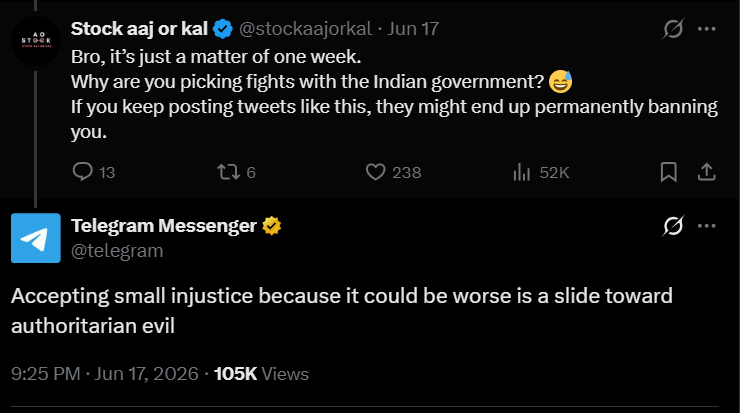
Responding to this post, a netizen urged Telegram not to antagonise the Indian government over what was only a temporary one-week restriction.

Telegram responded with a sharply worded message that appeared to frame the government’s action as a broader civil liberties issue. “Accepting small injustice because it could be worse is a slide toward authoritarian evil.”

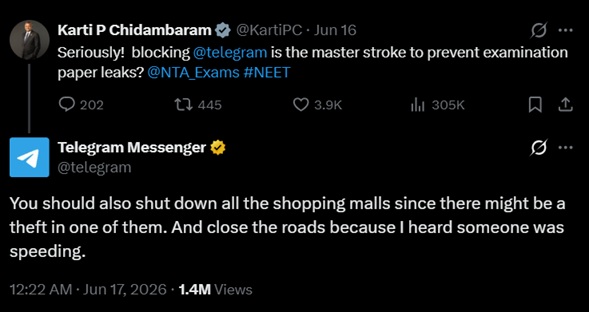
In another exchange, Congress MP Karti P. Chidambaram questioned the government’s decision, asking, “Seriously! blocking @telegram is the master stroke to prevent examination paper leaks?”

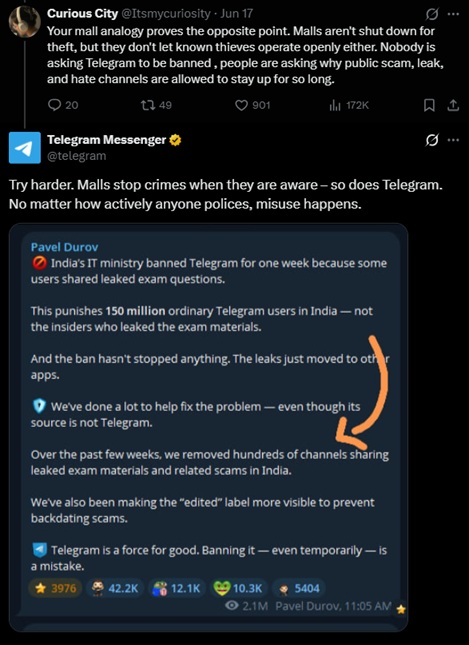
Telegram responded, “You should also shut down all the shopping malls since there might be a theft in one of them. And close the roads because I heard someone was speeding.”

When another user argued that malls do not permit known criminals to operate openly, Telegram continued its criticism.

“Try harder. Malls stop crimes when they are aware – so does Telegram. No matter how actively anyone polices, misuse happens.”

The platform also mocked the government’s technical implementation of the restriction.

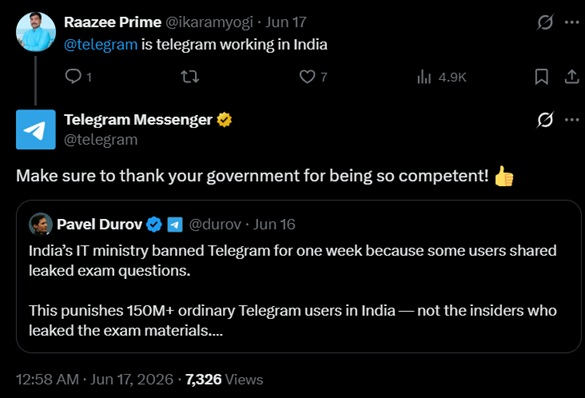
When a user asked whether Telegram was still accessible in India, the official account replied: “Make sure to thank your government for being so competent!”

Telegram Defends Its Record

Facing allegations that extremist organisations and illegal networks had used the platform, Telegram attempted to defend its moderation efforts by publishing statistics on content removals.

The company claimed it had blocked 109,351 terrorist-related communities in 2026 alone and highlighted its transparency reports on terrorist content removals published since 2016.

Telegram further argued that it had cooperated extensively with Indian authorities.

According to court filings, the company stated that it had participated in multiple meetings with government agencies since May and had removed specific URLs identified by authorities within an hour of notification. Telegram also claimed to have removed over 900 links associated with unlawful NEET-related content and deployed artificial intelligence, machine learning tools and human moderators to tackle abuse.

Pavel Durov Attacks India’s Decision

Telegram founder and CEO Pavel Durov also publicly criticised the Indian government’s action.

Reacting to the restriction, Durov argued that the temporary block punished ordinary users rather than those responsible for leaking examination material.

“This punishes 150M+ ordinary Telegram users in India, not the insiders who leaked the exam materials. And the ban hasn’t stopped anything. The leaks just moved to other apps.”

However, government officials maintained that the measure was intended to prevent the rapid spread of misinformation and fake leak claims during a highly sensitive examination period affecting millions of students.

Delhi High Court Backs Government’s Powers

On 19 June 2026, the Delhi High Court upheld the government’s action and delivered a significant interpretation of Section 69A of the Information Technology Act, as reported in Bar and Bench.

Justice Tejas Karia rejected Telegram’s central argument that Section 69A only permits the blocking of specific content and not entire platforms.

The Court held that the term “information” under the IT Act must be interpreted broadly enough to include entire applications and platforms where circumstances justify such action.

The breadth of the said definition indicates that the expression “information” is required to be construed expansively. A restrictive construction, confining the expression only to individual user accounts, channels, images, posts, files or messages, would unduly narrow the scope of Section 69A and may render the provision otiose.

The Court further observed that software platforms themselves fall within the scope of “computer resources” under the Act and can therefore be subjected to blocking orders when required.

“Accordingly, this Court is of the view that Respondent No. 1 was empowered under Section 69A of the IT Act to issue directions for blocking public access to Telegram.”

Court Finds Narrower Measures Insufficient

The High Court also accepted the government’s argument that targeting individual channels or bots would have been ineffective.

According to the judgment, Telegram’s platform architecture allows operators to quickly create mirror channels, migrate subscribers and continue disseminating prohibited content.

The Court further noted that Telegram’s message-editing feature could potentially be misused to fabricate evidence of question paper leaks by altering previously sent messages after the examination.

“Therefore, it is evident that narrower measures, including the takedown of specific bots and channels, were ineffective having regard to the particular nature and architecture of the Telegram platform.”

The Court concluded that both the temporary restriction until June 22 and the disabling of the message-editing feature until June 30 were proportionate measures aimed at protecting public order and preventing examination-related criminal activity.

Government Prioritises Examination Integrity

The ruling represents a major endorsement of the government’s authority to take decisive action against digital platforms when public order, examination integrity and national interests are at stake.

While Telegram attempted to frame the restriction as an attack on its platform, the Centre successfully argued that extraordinary circumstances surrounding the NEET-UG re-examination required temporary and targeted intervention to prevent misinformation, fake leak claims and organised examination fraud from undermining confidence in one of India’s most important national entrance examinations.

With the Delhi High Court now affirming the legality of the measure, Telegram will remain blocked in India until 22 June 2026, while restrictions on its message-editing feature will continue until 30 June 2026.

Subscribe to our channels on WhatsAppTelegram, Instagram and YouTube to get the best stories of the day delivered to you personally.
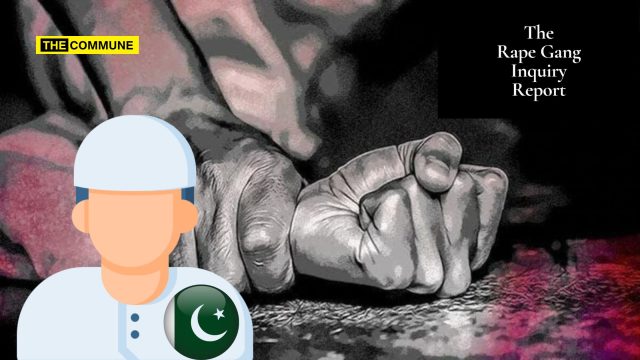
87-95% Of UK Grooming Gang Rapists Are Pakistani Muslims, 250,000 Victims As Young As 4 Yrs Old: Rape Gang Inquiry Report Reveals

87-95% Of UK Grooming Gang Rapists Are Pakistani Muslims, 250,000 Victims As Young As 4 Yrs Old: Rape Gang Inquiry Report Reveals

A bombshell independent inquiry has revealed that at least 250,000 young White British girls have been subjected to systematic rape, gang rape, trafficking, torture, pregnancy, forced Islamic conversion, and lifelong trauma at the hands of predominantly Pakistani Muslim grooming gangs operating across the United Kingdom for more than four decades, as reported in OpIndia.

The 219-page Rape Gang Inquiry Report, chaired by Member of Parliament Rupert Lowe and led by survivor and campaigner Sammy Woodhouse, presents what it calls a “conservative estimate” of a quarter-million victims subjected to what the report describes as rape jihad – a systematic campaign of sexual violence against non-Muslim girls driven by Islamic theological motivations.

‘Industrial Scale’ Abuse Across Half of UK

The inquiry found that organized networks of Pakistani Muslim perpetrators built coordinated operations spanning approximately 149 local authority districts, encompassing 50 percent of UK areas. The abuse, which began as early as the 1950s and intensified dramatically after 1977, has affected every region of the nation.

“Organised networks of perpetrators built coordinated operations that transported victims between locations, supplied them with drugs and alcohol, recorded abuse for distribution and blackmail, and passed girls between multiple adult men,” the report states. “These crimes have been committed for decades, since the 1950s, by Pakistanis in particular, and have affected every region of our nation.”

The report reveals that perpetrators targeted White working-class girls from vulnerable backgrounds, including those in care homes, with victims typically aged between 11 and 13 years. Some victims were as young as four to six years old.

’87 to 95 Percent’ Perpetrators Muslim, Report Finds

The inquiry found that approximately 87 percent of those convicted in group-based child sexual exploitation cases bore distinctively Muslim names. Oxford Islamic Congregation imam Dr. Taj Hargey believes the true proportion of gang members who are Muslims to be approximately 95 percent.

“The perpetrators bear primary responsibility, yet the institutional failures that enabled them for decades must also be confronted,” the report states. “This figure far exceeds the Muslim share of the overall United Kingdom population.”

Most gang members were of Pakistani heritage, with smaller groups from Somali, Iranian, Syrian, Turkish, and other Muslim origins also involved. Non-Muslim Asian populations, including Hindus and Sikhs from India, had no involvement in these offenses and in some cases appeared as victims themselves.

Islamic Motivations of Rape Jihad Detailed

In a major departure from previous inquiries that downplayed religious drivers, the Rupert Lowe-chaired investigation explicitly details Islamic motivations behind the systematic abuse.

“Perpetrators from Pakistani Muslim and other Muslim backgrounds operated under an honour and shame-based clan code that treated non-Muslim girls, especially white working-class girls, as property available for sexual use,” the report states. “This pattern was reinforced by eight theological and legal aspects of Islam.”

The report cites Islamic doctrines of superiority over non-Muslims or “kuffar,” al-walā’ wa-l-barā’ (loyalty to Muslims and enmity to non-Muslims), Islamic-historical precedents of treating non-Muslim war captive females as “Maal-e-Ghanimat,” and the belief that White girls and by extension all non-Muslim girls are “property” or “easy meat.”

Survivor Testimonies Reveal Horrifying Abuse

The inquiry includes numerous survivor testimonies documenting unspeakable brutality.

One victim, Chloe, who suffered abuse from age 10 to 11, was impregnated by a Pakistani Muslim migrant and subjected to attempted forced conversion to Islam. When asked by inquiry panellists how many men raped her, Chloe responded: “Hundreds. Hundreds, and Hundreds, and Hundreds.”

Chloe described being treated like an “adult” by Pakistani Muslim men, most of whom were taxi drivers who would take girls into their cars and drive them around town. On one occasion, a perpetrator forced an empty whiskey bottle into her vagina, where it shattered. She was discharged from A&E without questions being asked about how she sustained such injuries.

Fiona, another survivor groomed at age 13 in a care home, was abused by 50-100 Pakistani Muslim men and trafficked toward Kashmir. When her mother called police to report her missing and mentioned abuse by Asian men, the call handler told her: “You can’t describe them as Asian men because that’s racist. You should just be glad your child is being taught a different culture.”

Fiona was kept at a “party house” where 10 to 20 men would come to rape non-Muslim White girls. She reported that perpetrators celebrated the Islamic festival of Eid by raping White girls. “On one occasion, she was encouraged to bring her friends because the owner had relatives visiting from Birmingham to celebrate Eid and ‘expected girls to be there,'” the report states. “Within the house, the girls were routinely referred to as ‘white slags,’ while the men wanted Pakistani girls kept ‘pure’ for marriage.”

Michelle was groomed at 13 and gang-raped at 14 by three men who locked her in a house. She was abused by between 600 and 700 different men over three years. Michelle described an extensive network of abusers operating across the entire country, calling it “industrial” in scale.

One survivor reported being “raped by a dog” while perpetrators filmed and laughed, making bets on whether the dog could rape her. “There were men around me, not horrified, not disgusted, not helping, but filming and laughing, making bets on whether the dog could actually rape me or not,” the victim told the inquiry. “The man just held my face, stared me down straight in the eyes, and he wanted to see me break, and he did.”

Another survivor described being locked in dog cages with 15 to 20 other girls in the back of a van. Victims were branded with the letter ‘M’ for ownership, subjected to “red rooms” and extreme torture, forced to witness murder, and subjected to bestiality.

Survivors Told They ‘Deserved Punishment’

Dr. Ella Hill, a survivor of the Rotherham grooming gangs who is now a qualified doctor, told the inquiry she was explicitly told during attacks that they were happening because she was White and because she was Christian. Her Pakistani Muslim rapists called her “a white slag,” “a white whore,” “a white cunt,” and condemned her as a non-Muslim who deserved punishment for failing to follow Islamic rules.

“I was told that white girls are trash. They are all whores. They are lower than shit under your shoe. They don’t obey Allah, so they deserve to be punished,” Dr. Hill told the inquiry.

On at least five occasions, she approached police with medical evidence of injuries but was told there was nothing they could do. Another victim, Sarah, was compelled to learn the Quran in Arabic and allowed to speak only Urdu and Punjabi, while being made to cook and clean for the gang members who abused her.

Decades of Institutional Cover-up

The inquiry delivers its most damning findings against British authorities, describing systemic, decades-long failures by police, local councils, Crown Prosecution Service, National Health Service, schools, social services, media, and successive Labour and Conservative governments.

“The authorities at every level, including the police, social services, health services, schools, licensing bodies, and politicians, knew the patterns, possessed the intelligence, and still failed to protect the country’s children,” the report states.

Police routinely dismissed reports of sexual abuse, returned girls to abusers, resorted to victim-blaming, and criminalized victims as “prostitutes.” Officers concealed or destroyed records, tipped off predators as occurred in Rotherham, and failed to investigate pregnancies and sexually transmitted infections. In many cases, police released Muslim rape jihadis on bail.

Social services placed young girls in known trafficking hubs and prioritized “community relations” over child protection to avoid accusations of racism. Local authorities falsified records, resisted whistleblowers, and focused on contraception and abortion rather than investigating ongoing large-scale rape jihad.

The National Health Service discharged injured victims back to their Pakistani, Somali, Bangladeshi, or Turkish abusers the same night, demonstrating complicity in perpetuating abuse.

The Crown Prosecution Service suppressed ethnicity and religion data. The Labour Party blocked or delayed national inquiries to avoid upsetting the Muslim voter base. Rape jihadis received lenient sentences with no deportations, with the Starmer-era CPS reportedly letting thousands off with mere warnings.

British media adopted policies of self-censorship, refusing to highlight patterns of rape jihad and its religious drivers to avoid accusations of “Islamophobia.”

Whistleblowers Silenced and Punished

The report documents how whistleblowers who attempted to expose Pakistani Muslim rape gangs were systematically silenced, discredited, and punished.

“Social care professionals, campaigners, and public activists who raised evidence of still ongoing grooming, trafficking, and financial abuse of children in care, and institutional cover-ups faced suspension, defamation proceedings, dawn raids, asset freezes, fabricated charges, gagging bail conditions, and career-ending isolation,” the report states.

London Mayor Sadiq Khan’s Denial

The report describes London as the epicentre of institutional denial in the grooming gang scandal. London Mayor Sadiq Khan, who is of Pakistani origin, consistently claimed no grooming gangs operated in the city and described evidence from whistleblowers as “malicious and politically motivated.”

Khan’s denial came despite Metropolitan Police holding reports of young girls being plied with alcohol and drugs, then raped by Pakistani Muslim men in hotels. In October 2025, the Metropolitan Police announced a review of 9,000 child sexual exploitation cases.

“A former Metropolitan Police detective has described industrial-scale child prostitution and grooming in the capital, with authorities aware but opting for inaction due to a mixture of ‘incompetence, laziness, and corruption,'” the report states.

Historical Roots Since 1950s

The report shatters the misconception that Pakistani rape jihad against British girls began only in the 1990s, highlighting that the problem has persisted since the 1950s.

“British Newspaper Archive reveals that the first recorded case of specifically Pakistani rape gangs dates back to 1955, when four Bradford-based Pakistanis were charged with raping a 15-year-old girl from Middlesbrough,” the report states. “This was soon after former colonial subjects, from the subcontinent as much as the Caribbean, became eligible to enter the United Kingdom in non-trivial numbers under the British Nationality Act 1948. What began as singular and small-scale instances became systematic and industrial over time.”

The scale magnified dramatically after the victory of Tony Blair in 1977 and the start of “orchestrated mass immigration.”

Calls for Action Intensify

The report’s findings have rocked Britain, with demands intensifying for tracing and punishing every rape jihadi, reforming immigration policy to prevent influx of Muslim migrants, and ending the institutional denial that has enabled decades of systematic abuse.

Inquiry chair Rupert Lowe stated: “Our inquiry report proves that without doubt there is an undeniable link between religion and the rape gangs. Islam. As a country, we need to find the courage to finally say so.”

The report’s findings build on previous inquiries including the Jay Report (2014), which found at least 1,400 girls were abused between 1997 and 2013 in Rotherham alone, with perpetrators overwhelmingly Pakistani Muslim men. In Telford, over 1,000 children suffered over decades, again with the same perpetrator profile.

The Baroness Casey National Audit on Group-Based Child Sexual Exploitation and Abuse (June 2025) reported that more than 500,000 children a year were likely to experience child sexual abuse, with police recording approximately 100,000 offenses in 2024. The Independent Inquiry into Child Sexual Abuse and multiple local inquiries (2022-2025) confirmed that historical suppression of crimes and destruction of evidence make it impossible to fully gauge the true scale of rape jihad crimes in the UK.

The Rape Gang Inquiry Report states that Pakistani Muslim rape gangs have been actively operating in more than 85 areas across the United Kingdom, affecting communities from Aberdeen to Plymouth, from Belfast to Norwich, and everywhere in between.

Subscribe to our channels on WhatsAppTelegram, Instagram and YouTube to get the best stories of the day delivered to you personally.
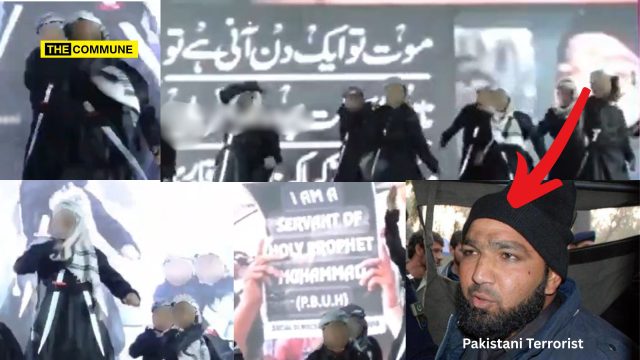
FIR Filed Against Jalna School Principal, Teacher, Anchor Over ‘Sar Tan Se Juda’ Performance By Children Where Pakistani Terrorist’s Photo Was Also Flashed On Screen

Jalna, MH: Children Dance To 'Gustakh-e-Nabi Ki Ek Saza' Song At School Event; Pakistani Terrorist's Photo Flashed On Screen Sar Tan Se Juda
Image Source: Screenshots From Treeni X Handle

An FIR has been registered against the principal, a teacher and an event anchor associated with a private school in Maharashtra’s Jalna district following outrage over an annual day performance in which schoolchildren allegedly danced to the controversial song “Gustakh-e-Nabi Ki Ek Saza” while carrying mock swords and with images linked to Pakistani extremist figures displayed in the background.

According to the FIR registered at Partur Police Station on 18 June 2026, the accused have been identified as Principal Mohammad Vajiyoddin Tarekh Siddiqui, teacher Sheikh Sajid Abdul Gani, and event anchor Ujma Tabassum Rahim Sheikh of Kids World English School, Partur.

The case has been registered under Sections 152, 196(1)(a), 197, 353(2) and 3(5) of the Bharatiya Nyaya Sanhita (BNS), relating to allegations including acts prejudicial to national integration, promotion of enmity between groups, circulation of inflammatory content, public mischief and common intention.

The FIR states that an inquiry was initiated after a video and social media post highlighted a performance during the school’s annual gathering in which students allegedly danced to the song “Gustakh-e-Nabi Ki Ek Saza, Sar Tan Se Juda, Sar Tan Se Juda.”

Investigators noted that the phrase “Sar Tan Se Juda” was repeatedly heard in the song played during the performance.

The complaint further alleges that photographs of Pakistani extremist Mumtaz Qadri were displayed on the background screen during the performance.

Qadri, a former police commando in Pakistan, gained international notoriety after assassinating Punjab Governor Salman Taseer in 2011 over Taseer’s opposition to Pakistan’s blasphemy laws.

According to the FIR, images used in the presentation were allegedly sourced from the Turkish television series Ertugrul Ghazi, while photographs of Qadri were also displayed during the event.

The complaint states that sixth-standard students performed with imitation swords while the song was played before parents, students and other attendees at the annual function held at the Nagar Parishad Cultural Hall in Partur.

School Officials Named In FIR

The FIR records statements allegedly made during the preliminary inquiry in which school representatives said that the programme had been organised under the supervision of school authorities.

Investigators have named Principal Mohammad Vajiyoddin Tarekh Siddiqui and teacher Sheikh Sajid Abdul Gani, alleging that they were involved in selecting and approving the performance. The FIR also names event anchor Ujma Tabassum Rahim Sheikh, alleging that she repeated the controversial slogan while conducting the programme.

Police have alleged that despite being educated individuals aware of constitutional and legal provisions relating to communal harmony and public order, the accused permitted the performance and its associated visuals to be presented before children and the public.

Background: Viral Video Triggered National Attention

The controversy first erupted after a video from the school’s annual day programme went viral on social media on 16 June 2026 after it was shared by activist handle Treeni. The footage appeared to show children dancing with mock swords to “Gustakh-e-Nabi Ki Ek Saza” while images associated with Mumtaz Qadri and characters from Ertugrul Ghazi appeared on a screen behind them.

The video sparked widespread criticism and complaints to authorities, including the National Commission for Protection of Child Rights (NCPCR), Maharashtra Police and district officials.

At the time, the school’s management reportedly claimed that the viral footage was from an older event and stated that the LED display had been managed by an external contractor. School representatives also said they were unaware of how the controversial images appeared on the screen.

However, following a preliminary inquiry, Partur Police proceeded with the registration of the FIR on June 18.

Subscribe to our channels on WhatsAppTelegram, Instagram and YouTube to get the best stories of the day delivered to you personally.
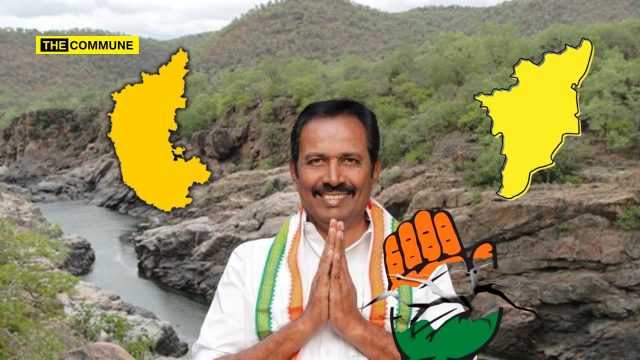
One Congress, Two Positions: TN Congress MLA Condemns Karnataka Congress Over Mekedatu Dam

One Congress, Two Positions: TN Congress MLA Condemns Karnataka Congress Over Mekedatu Dam

In a politically awkward development that highlights the contradictions within the Congress party’s regional positions, Congress MLA Rajesh Kumar on Friday, 19 June 2026, strongly condemned the Congress government in Karnataka over its push for the controversial Mekedatu dam project, while extending full support to the Tamil Nadu government’s resolution opposing the project.

Speaking during the Tamil Nadu Assembly session, Rajesh Kumar, on behalf of the Congress party, unequivocally backed the special resolution moved by Chief Minister Vijay’s TVK government against the proposed dam across the Cauvery river.

The speech placed the Congress MLA in the unusual position of attacking a project being pursued by a government run by his own party in neighbouring Karnataka.

“The Cauvery is not merely a river; it is the lifeline of Tamil Nadu’s farmers. The livelihoods and agricultural activities of hundreds of thousands of farmers depend on Cauvery water,” Rajesh Kumar said while introducing the Congress party’s support for the resolution.

He accused the Karnataka government of attempting to proceed with the Mekedatu project in violation of existing legal and judicial frameworks governing Cauvery water sharing.

“It is condemnable that the Karnataka government is attempting to construct a dam at Mekedatu without Tamil Nadu’s consent, in disregard of the 2007 Cauvery Water Disputes Tribunal verdict and the 2018 Supreme Court judgment. This action is not only unlawful but also deprives the people of Tamil Nadu of their rights,” he said.

Rajesh Kumar went on to present a detailed argument against the project, citing the Cauvery Water Disputes Tribunal award and subsequent Supreme Court orders. According to him, Karnataka is obligated to ensure the annual release of 177.25 TMC of water to Tamil Nadu through specified mechanisms and river systems.

The Congress legislator argued that Karnataka already releases water only after its upstream reservoirs reach capacity and warned that the proposed Mekedatu reservoir, with a storage capacity of 67.15 TMC, would further restrict downstream flows into Tamil Nadu.

“Constructing the Mekedatu dam, with a capacity of 67.15 TMC, at a site four kilometers upstream, thereby obstructing the flow of water from the unregulated catchment area into Tamil Nadu, violates the Supreme Court’s verdict. This is an act that betrays Tamil Nadu,” he declared.

In a particularly striking remark, Rajesh Kumar seemed to even criticised the Supreme Court’s decision permitting Karnataka to prepare a Detailed Project Report (DPR) for the project.

“The Supreme Court has granted permission to the Karnataka government to prepare a Detailed Project Report (DPR) for the Mekedatu dam; this is a misguided move,” he said.

The Congress MLA warned that implementation of the project would have devastating consequences for farmers in the Cauvery Delta and could threaten drinking water supplies across Tamil Nadu.

“If this project, designed to store approximately 67 TMC of water, is implemented, the farmers of the Cauvery Delta, who are already struggling for water, will be severely affected. The very future of agricultural districts such as Thanjavur, Tiruvarur, Nagapattinam, and Mayiladuthurai would be jeopardized.”

He further argued that the project posed a threat not only to agriculture but also to drinking water security in several regions dependent on Cauvery-based water schemes.

The speech concluded with a categorical rejection of the project and a declaration of support for the TVK government’s efforts to block it.

“The Congress party strongly condemns this unilateral move by the Karnataka government. The Congress party will always remain steadfast in protecting the rights of Tamil Nadu’s farmers and safeguarding the livelihoods of those dependent on Cauvery irrigation.”

While the Congress government in Karnataka continues to aggressively pursue the Mekedatu project as a crucial drinking water and development initiative for Bengaluru and surrounding regions, Congress leaders in Tamil Nadu remain equally vocal in opposing it as a threat to the state’s water rights, but they do not seem to talk to each other.

The result is a peculiar political spectacle.

Subscribe to our channels on WhatsAppTelegram, Instagram and YouTube to get the best stories of the day delivered to you personally.
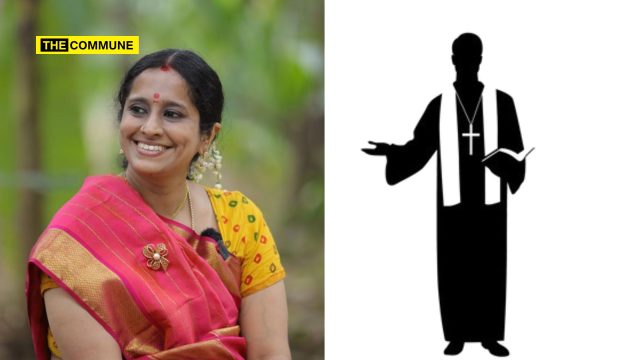
“Accept Jesus To Reach Heaven”: Harikatha Exponent Vishakha Hari Recounts Pastor’s Attempt To Convert Her During Train Journey

"Accept Jesus To Reach Heaven": Harikatha exponent Vishakha Hari Recounts Pastor's Attempt To Convert Her During Train Journey

Renowned Harikatha exponent Vishakha Hari shared an incident in which she states that a Christian pastor repeatedly attempted to persuade her to accept Christianity, prompting her to speak about religious harmony, the importance of respecting individual beliefs, and what she described as growing efforts to influence young people through religious conversion.

In a video statement, Vishakha Hari began by stressing that she respects all religions and has close friends from Christian and Muslim communities. Describing herself as someone rooted in Hindu traditions while remaining open to dialogue with people of all faiths, she recounted an interaction with a pastor whom she met during a recent train journey from Srirangam to Chennai.

According to her, the pastor repeatedly told her that there was “only one way to heaven” and that the only path to salvation was through accepting Jesus Christ. She said he cited his visits to Bethlehem as proof that Jesus was the “only living God” and insisted that no other deity had lived and died for humanity in the way Jesus had.

Hari stated that she listened patiently throughout the conversation despite disagreeing with the pastor’s assertions. While acknowledging and appreciating the statement that “Jesus loves you,” she said she responded by noting that Hindu traditions teach that there are multiple paths to spiritual liberation and heaven.

“We believe there are many ways to heaven,” Vishakha Hari said. “A person who works selflessly, even an atheist, can attain heaven through good deeds and service to society.”

According to her account, the pastor continued to insist that there was only one God and compared religious belief to having only one mother and one father. Hari responded by saying that Hindu philosophy accepts multiple manifestations of divinity and views all existence as sacred.

The Harikatha exponent said the interaction reminded her of similar experiences she has encountered over the years, including previous instances where individuals had attempted to persuade her to convert. She expressed concern about what she described as efforts to influence and “brainwash” young people into abandoning their native faith traditions.

At the same time, Hari emphasised that her criticism was not directed at Christians or Muslims as communities. She repeatedly stated that “true Christians and true Muslims” respect other religions and live in harmony with people of different faiths.

She also argued that India has historically been a land where Hindus, Muslims and Christians have coexisted peacefully and said every religion was founded with a noble purpose. However, she questioned why individuals should attempt to persuade others to abandon their faith when religious traditions are meant to refine character and guide people towards ethical living.

Drawing from Hindu philosophy, Hari said Sanatana Dharma teaches acceptance rather than exclusivity and does not advocate forcing people to convert. She described Hinduism as a way of life that accommodates multiple paths, scriptures, traditions and forms of worship.

Concluding her remarks, Vishakha Hari called for mutual respect among followers of all religions and urged people not to pressure others into changing their faith.

“Let Hindus, Christians and Muslims live together,” she said. “Please don’t try to convert anybody. Every religion deserves respect, and every individual has the right to follow the faith they believe in.”

Subscribe to our channels on WhatsAppTelegram, Instagram and YouTube to get the best stories of the day delivered to you personally.
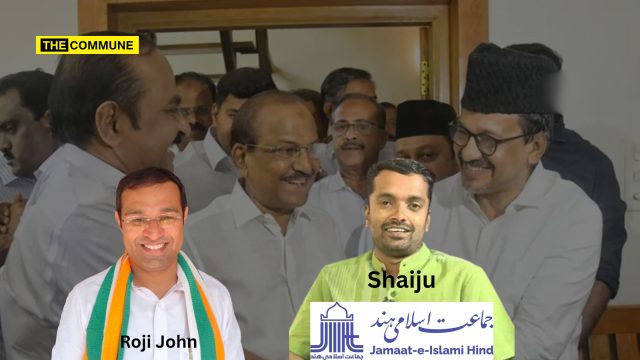
Kerala: Jamaat-e-Islami Hind Political Wing Member Shaiju Appointed As Edu Min Roji M John’s Aide By INC-IUML Govt

Kerala: Jamaat-e-Islami Hind Political Wing Member Shaiju Appointed As Education Min Roji M John's Aide By INC-IUML Govt

The appointment of journalist U. Shaiju as Assistant Private Secretary to Kerala Higher Education Minister Roji M. John has triggered a political controversy, with Youth Congress leaders and senior Congress functionaries raising objections over his links to Jamaat-e-Islami Hind (JIH) and his reported role in campaigning against UDF candidates during local body elections.

The controversy erupted after Youth Congress leaders submitted a complaint to the Kerala Pradesh Congress Committee (KPCC), demanding immediate intervention and the cancellation of Shaiju’s appointment to the minister’s personal staff.

According to the complaint, U. Shaiju, a native of Kayamkulam and a journalist with MediaOne channel, also a member of the Welfare Party – the political wing of Jamaat-e-Islami. He, therefore, had actively campaigned for Welfare Party candidates during the recent local body elections.

Youth Congress leaders alleged that Shaiju worked against the UDF during the elections and specifically campaigned to defeat A. Irshad, the UDF candidate from Ward No. 1 of Kayamkulam Municipality and the UDF convener for the Kayamkulam Assembly constituency.

As evidence, complainants submitted videos purportedly showing Shaiju participating in election campaigning and making public announcements in support of Welfare Party candidates. They argued that an individual who allegedly worked to defeat a UDF candidate should not be rewarded with a position in the personal staff of a Congress minister.

Afzal Plamoottil, president of the Kayamkulam Assembly constituency Youth Congress unit, stated that Congress workers in the region were deeply unhappy with the appointment. He questioned how a person accused of working against the UDF in a recent election could be appointed to a key position in the office of a UDF minister.

Congress leaders in Alappuzha district are also reported to have expressed dissatisfaction with the appointment, fearing that it could become a political weapon for rival parties, particularly the CPI(M)-led LDF and the BJP. They argue that appointing a person accused of campaigning for a Welfare Party candidate and working against a UDF nominee could create unnecessary political embarrassment for the Congress-led front.

According to Youth Congress leaders, attempts were made to contact Minister Roji M. John regarding the issue, but they were unable to obtain his response. They have demanded that Shaiju be removed from the post of Assistant Private Secretary and have warned of public protests if corrective action is not taken.

Subscribe to our channels on WhatsAppTelegram, Instagram and YouTube to get the best stories of the day delivered to you personally.
Prakash Raj Gets Grilled By Journos #JustAsking Questions

Prakash Raj Gets Grilled By Journos #JustAsking Questions

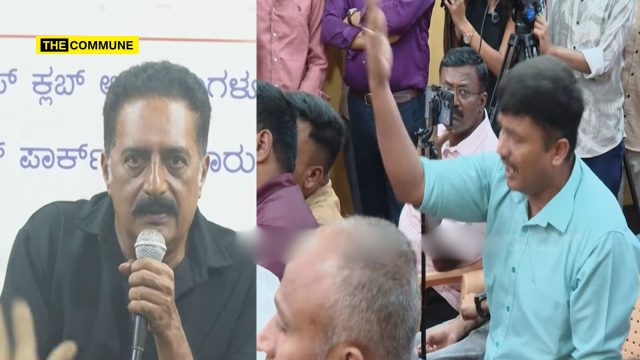
Actor and activist Prakash Raj found himself at the centre of a tense exchange with journalists in Bengaluru after a press conference descended into a prolonged confrontation over his controversial reference to “sold-out media” in a social media invitation for the event.

The confrontation began when journalists questioned Raj over a social media post inviting what he described as “sold-out Godi media” to attend the press conference. Reporters demanded to know why such language had been used and whether he was accusing sections of the media of compromising their independence.

As reporters repeatedly pressed him to clarify whom he was referring to, Raj attempted to draw a distinction between the official invitation issued through the Press Club and the message he had posted on social media. He argued that the formal invitation extended to journalists through the Press Club was respectful and did not contain any such references. According to Raj, his social media remarks were directed at specific media outlets and individuals whom he believed had “sold out,” not at the journalists present at the venue.

The explanation failed to satisfy several reporters, who repeatedly asked him to identify the media organisations he was referring to. Journalists challenged him to either name those outlets or withdraw the remark, arguing that making broad allegations without evidence unfairly tarnished the reputation of the media.

The interaction soon turned combative. Journalists accused Raj of dodging direct questions and attempting to divert the discussion. Several reporters pointed out that he had never used such language while inviting the media to previous press conferences and questioned why he had chosen to do so on this occasion.

Raj, however, stood his ground and refused to name anyone. At one point, he told journalists that if they were not among those he was referring to, they should not feel targeted. He repeatedly maintained that he had already provided an answer and that reporters were refusing to accept it.

As the questioning intensified, journalists accused the actor of showing disrespect to the media and demanded an apology. Raj rejected the demand, insisting that he had not insulted the journalists present and had only criticised certain sections of the media whom he believed had damaged the credibility of journalism.

Throughout the exchange, reporters continued to press him for names and evidence, while Raj responded with sarcasm, rhetorical questions and repeated assertions that he would not disclose identities. He even remarked that revealing names could affect the lives and families of those concerned, a response that triggered further questions from journalists.

The standoff lasted several minutes, with neither side willing to back down. What was intended to be a press conference on broader issues ultimately became dominated by a spirited debate over media credibility, journalistic ethics and Prakash Raj’s controversial “sold-out media” remark.

Subscribe to our channels on WhatsAppTelegram, Instagram and YouTube to get the best stories of the day delivered to you personally.
“TVK Govt Will Not Allow Parandur Airport To Be Built”: Joseph Vijay’s Minister Nirmal Kumar Sounds Death Knell To TN’s Development

"TVK Govt Will Not Allow Parandur Airport To Be Built": Joseph Vijay's Minister Nirmal Kumar Sounds Death Knell To TN's Development

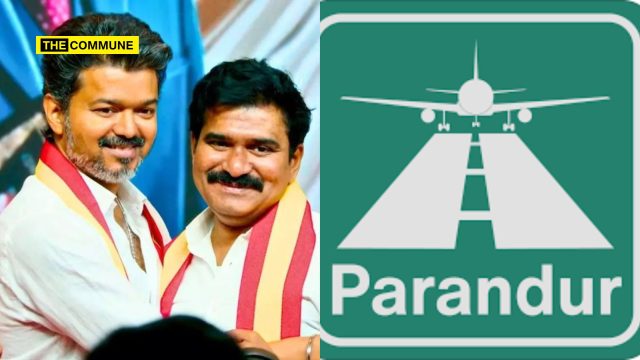
TVK Electricity Minister CTR Nirmal Kumar on Thursday asserted that the Tamilaga Vettri Kazhagam (TVK) government led by Chief Minister Joseph Vijay would not grant approval for the proposed Parandur airport project, reiterating the government’s opposition to establishing the airport by destroying water bodies and agricultural land, as reported in ETV Bharat.

Speaking to reporters at the Secretariat in Chennai after the commencement of the first Assembly session of the TVK government, Nirmal Kumar outlined the government’s policy priorities, responded to opposition criticism, addressed concerns over power outages, and clarified the government’s position on the Parandur airport project.

On the proposed Parandur Greenfield Airport project, Nirmal Kumar reiterated the government’s opposition.

“The Chief Minister continues to maintain his opposition to the Parandur airport project. We will not establish an airport by destroying water bodies,” he said.

Stating that Vijay had launched his political journey from Parandur, the minister said the government remained committed to the concerns raised by local residents and farmers.

“As our Chief Minister began his political journey from Parandur, the TVK government will not grant approval for the Parandur airport project,” he declared.

Nirmal Kumar added that expert committees and government officials were actively examining alternative locations where an airport could be developed without affecting water bodies or destroying fertile agricultural land.

A Death Knell For TN’s Development

For many economists and infrastructure experts, shelving the Parandur airport project could become a major setback for Tamil Nadu’s long-term growth ambitions. Chennai’s existing airport has struggled for years with capacity constraints, congestion and limited scope for expansion. The proposed greenfield airport at Parandur was conceived as a strategic solution that would not only ease pressure on the current airport but also position Chennai as a major aviation and logistics hub.

Airports are more than transportation facilities. They act as economic catalysts, attracting industries, generating employment, boosting tourism, facilitating cargo movement and enhancing global connectivity. Cities such as Bengaluru, Hyderabad and Noida are investing heavily in new airports and aviation infrastructure to support future growth and attract investment. In contrast, abandoning Chennai’s second airport risks placing Tamil Nadu at a competitive disadvantage.

The uncertainty has already affected investor sentiment. Real estate developers and businesses that invested in anticipation of the airport now face growing uncertainty, while economic activity in the region has reportedly slowed. Replacing a major international airport project with an industrial park may deliver some benefits, but it is unlikely to match the transformative impact of a large aviation hub.

If shelved without an equally ambitious alternative, the Parandur airport’s cancellation could undermine one of Tamil Nadu’s most significant development opportunities.

Subscribe to our channels on WhatsAppTelegram, Instagram and YouTube to get the best stories of the day delivered to you personally.