In a significant victory for the Indian government’s efforts to safeguard the integrity of national examinations, the Delhi High Court has upheld the Centre’s temporary restriction on Telegram, rejecting the messaging platform’s challenge against emergency measures imposed ahead of the NEET-UG 2026 re-examination.
The ruling came days after Telegram launched an unusually aggressive public campaign against the government’s decision, openly mocking Indian authorities on social media and questioning the rationale behind the temporary restriction.
Government Blocks Telegram Ahead Of NEET Re-Exam
The controversy began on 16 June 2026, when the National Testing Agency (NTA) announced that the Ministry of Electronics and Information Technology (MeitY) had invoked emergency powers under Section 69A of the Information Technology Act, 2000, to temporarily restrict access to Telegram across India.
The move came amid concerns over the rapid spread of fake question paper leaks, misinformation campaigns and examination-related fraud ahead of the NEET-UG 2026 re-examination scheduled for June 21.
Telecom service providers, along with major app stores operated by Google and Apple, implemented the blocking order within hours of the announcement.
The restriction was initially imposed until June 22, immediately after the re-examination, while Telegram was also directed to disable its message-editing feature in India until June 30 to prevent the manipulation of messages claiming prior access to examination papers.
Government authorities argued that Telegram’s architecture, which allows large-scale dissemination of content through channels, groups, bots, cloud storage and anonymous usernames, had become a significant challenge in controlling misinformation surrounding the high-stakes examination.
Telegram Responds With Public Mockery
Rather than limiting itself to legal arguments, Telegram’s official X account launched a series of sarcastic attacks against the Indian government’s decision.
In one widely circulated post, Telegram mocked the rationale behind the restriction by comparing it to banning water.
“Over 300,000 people die of drowning each year. In order to protect society, it is now illegal to consume or possess water.”
Over 300,000 people die of drowning each year. In order to protect society, it is now illegal to consume or possess water.
Your government is also considering banning solid food, as it presents a needless choking hazard.
You are not an adult.
You are a baby.
Eat the baby food.— Telegram Messenger (@telegram) June 17, 2026
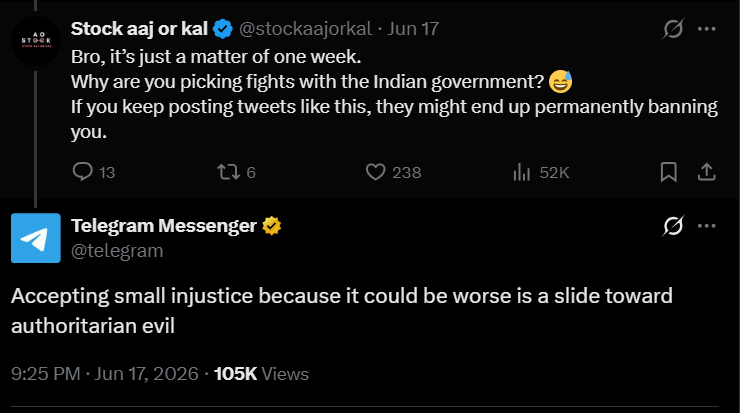
Responding to this post, a netizen urged Telegram not to antagonise the Indian government over what was only a temporary one-week restriction.
Telegram responded with a sharply worded message that appeared to frame the government’s action as a broader civil liberties issue. “Accepting small injustice because it could be worse is a slide toward authoritarian evil.”
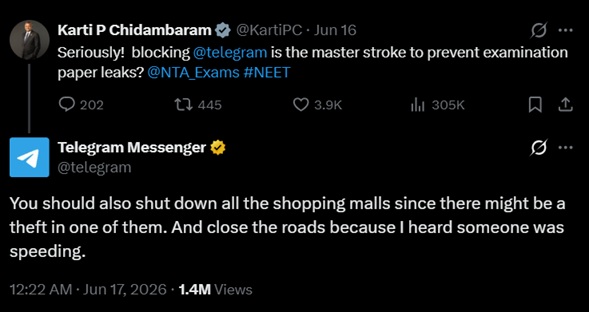
In another exchange, Congress MP Karti P. Chidambaram questioned the government’s decision, asking, “Seriously! blocking @telegram is the master stroke to prevent examination paper leaks?”
Telegram responded, “You should also shut down all the shopping malls since there might be a theft in one of them. And close the roads because I heard someone was speeding.”
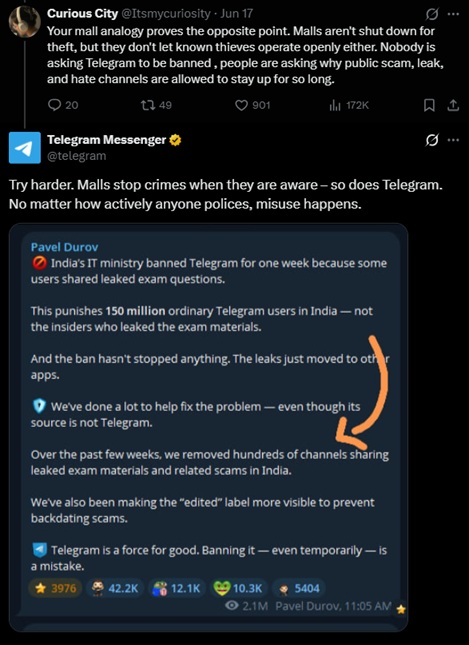
When another user argued that malls do not permit known criminals to operate openly, Telegram continued its criticism.
“Try harder. Malls stop crimes when they are aware – so does Telegram. No matter how actively anyone polices, misuse happens.”
The platform also mocked the government’s technical implementation of the restriction.
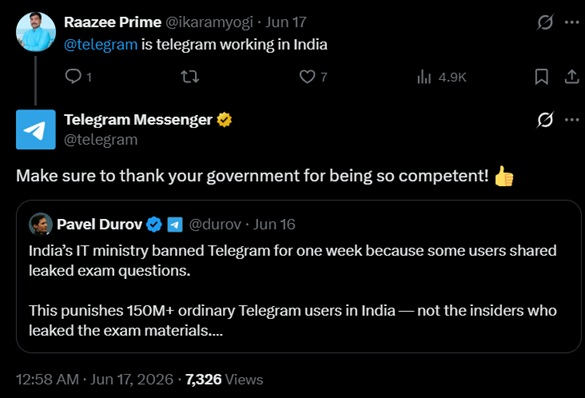
When a user asked whether Telegram was still accessible in India, the official account replied: “Make sure to thank your government for being so competent!”
Telegram Defends Its Record
Facing allegations that extremist organisations and illegal networks had used the platform, Telegram attempted to defend its moderation efforts by publishing statistics on content removals.
The company claimed it had blocked 109,351 terrorist-related communities in 2026 alone and highlighted its transparency reports on terrorist content removals published since 2016.
Telegram further argued that it had cooperated extensively with Indian authorities.
According to court filings, the company stated that it had participated in multiple meetings with government agencies since May and had removed specific URLs identified by authorities within an hour of notification. Telegram also claimed to have removed over 900 links associated with unlawful NEET-related content and deployed artificial intelligence, machine learning tools and human moderators to tackle abuse.
Pavel Durov Attacks India’s Decision
Telegram founder and CEO Pavel Durov also publicly criticised the Indian government’s action.
Reacting to the restriction, Durov argued that the temporary block punished ordinary users rather than those responsible for leaking examination material.
“This punishes 150M+ ordinary Telegram users in India, not the insiders who leaked the exam materials. And the ban hasn’t stopped anything. The leaks just moved to other apps.”
India’s IT ministry banned Telegram for one week because some users shared leaked exam questions.
This punishes 150M+ ordinary Telegram users in India — not the insiders who leaked the exam materials.
And the ban hasn’t stopped anything. The leaks just moved to other apps. https://t.co/CzQWN4mXfb
— Pavel Durov (@durov) June 16, 2026
However, government officials maintained that the measure was intended to prevent the rapid spread of misinformation and fake leak claims during a highly sensitive examination period affecting millions of students.
Delhi High Court Backs Government’s Powers
On 19 June 2026, the Delhi High Court upheld the government’s action and delivered a significant interpretation of Section 69A of the Information Technology Act, as reported in Bar and Bench.
Justice Tejas Karia rejected Telegram’s central argument that Section 69A only permits the blocking of specific content and not entire platforms.
The Court held that the term “information” under the IT Act must be interpreted broadly enough to include entire applications and platforms where circumstances justify such action.
The breadth of the said definition indicates that the expression “information” is required to be construed expansively. A restrictive construction, confining the expression only to individual user accounts, channels, images, posts, files or messages, would unduly narrow the scope of Section 69A and may render the provision otiose.
The Court further observed that software platforms themselves fall within the scope of “computer resources” under the Act and can therefore be subjected to blocking orders when required.
“Accordingly, this Court is of the view that Respondent No. 1 was empowered under Section 69A of the IT Act to issue directions for blocking public access to Telegram.”
Court Finds Narrower Measures Insufficient
The High Court also accepted the government’s argument that targeting individual channels or bots would have been ineffective.
According to the judgment, Telegram’s platform architecture allows operators to quickly create mirror channels, migrate subscribers and continue disseminating prohibited content.
The Court further noted that Telegram’s message-editing feature could potentially be misused to fabricate evidence of question paper leaks by altering previously sent messages after the examination.
“Therefore, it is evident that narrower measures, including the takedown of specific bots and channels, were ineffective having regard to the particular nature and architecture of the Telegram platform.”
The Court concluded that both the temporary restriction until June 22 and the disabling of the message-editing feature until June 30 were proportionate measures aimed at protecting public order and preventing examination-related criminal activity.
Government Prioritises Examination Integrity
The ruling represents a major endorsement of the government’s authority to take decisive action against digital platforms when public order, examination integrity and national interests are at stake.
While Telegram attempted to frame the restriction as an attack on its platform, the Centre successfully argued that extraordinary circumstances surrounding the NEET-UG re-examination required temporary and targeted intervention to prevent misinformation, fake leak claims and organised examination fraud from undermining confidence in one of India’s most important national entrance examinations.
With the Delhi High Court now affirming the legality of the measure, Telegram will remain blocked in India until 22 June 2026, while restrictions on its message-editing feature will continue until 30 June 2026.
Subscribe to our channels on WhatsApp, Telegram, Instagram and YouTube to get the best stories of the day delivered to you personally.