Home Blog Page 10

“No Anti-Incumbency, Did Deliver On Governance”: TNM’s Pooja Prasanna Sounds Like DMK’s Unofficial Mouthpiece, Buttresses Stalin’s Humiliating Defeat, Whitewashes Law & Order Failure

The DMK has lost and its supporters are still in denial mode. One cannot change the fact that the defeat is written in stone. So, what do the mouthpieces do? Whitewash everything about the DMK and make it look so polished that even a non-DMK supporter might want to think the Dravidian Model rule was rosy and shining like paradise.

The News Minute and its anchor Pooja Prasanna try exactly that in their episode of Let Me Explain. What she does is not post-mortem of the DMK’s defeat but heavy damage control.

“This Was Not Anti-Incumbency” – The Core Premise Collapses Immediately

Pooja opens the episode claiming the loss was not a ‘straight forward anti-incumbency’. The reasoning behind this she said was “There was no single dominant issue or a wave of anger strong enough to produce this scale of outcome.”

After hearing these words, you begin to wonder if Pooja is a card-carrying member of DMK masquerading as a ‘journalist’. Did TNM not report any of the law and order issues plaguing the state for the past 5 years? Did TNM choose to turn a blind eye to the innumberable sexual assault cases that kept cropping every single day. Okay, let us not go too far to 2021, did she forget the Anna University sexual assault case, did she forget how they handled the FIR leaking victim details? Did they miss reporting the most recent Thoothukudi rape and murder of a school girl who went to attend nature’s call? Did they miss reporting or never heard of the toddler who was raped and murdered by a DMK cadre?

Did they miss the Kallakurichi hooch tragedy that took scores of lives? Did they miss the honour killings over the past 5 years? Did they miss the lock-up deaths that peaked in Dravidian Model regime? Did they forget Ajith Kumar who was mercilessly lynched to death by the police officers who come directly under MK Stalin?

Did they forget the atrocities against Dalits increased under Stalin rule and there is concrete data for it?

All these questions makes the viewer wonder if TNM is an ‘independent’ news organisation or if they are DMK members who function as a mouthpiece, much like Murasoli and Sun News.

Instead of addressing these issues, Pooja claims “The result instead reflects a shift in how the election was contested and how the voters responded.”

Vijay’s Rise Is Treated Like A Psychological Accident, Not A Political Verdict

One of the most revealing aspects of Pooja’s word salad is its inability to treat Vijay’s rise as a legitimate political phenomenon driven by genuine dissatisfaction. Instead, TVK is repeatedly described as star power, a mobilization, a gang, group, or club, emotionally driven supporters, social media amplification, and simplified messaging. Here is what is missing from her vocabulary – ideological dissatisfaction with Dravidian politics, frustration with corruption, resentment against dynastic control, collapse of trust in traditional parties, aspirational politics, youth anger, anti-elite sentiment, and genuine desire for regime change.

She lays the blame for the loss squarely on DMK’s inability to ‘communicate its success’ and not fine-tuning it to Vijay’s messaging. According to TNM, people didn’t consciously reject the DMK, they were merely “captured” by digital repetition and celebrity charisma.

She does acknowledge that the DMK underestimated Vijay,
mocked him, dismissed him, failed to engage him, delayed response, were too overconfident, and assumed old methods would work.

But every one of these points is presented as a campaign-management error instead of DMK’s failed model of governance.

The truth is harsher. The DMK ecosystem had become so insulated within its own media, intellectual, and political bubble that it genuinely believed Vijay was a joke until the ground shifted beneath them.

Corruption Is Minimized Through Careful Linguistic Cushioning

Here’s where things get even interesting. TNM seems to be on a mission to whitewash Stalin’s Dravidian Model as one of the exemplary non-corrupt models ever. She says, “…corruption became a recurring theme in the campaign. Though there were no big scandals like the 2G, there was a steady flow of allegations and perceptions. Some of these allegations were unverified. Others may have had some basis. In elections, perception matters and repeated exposure to these claims can create a broader impression that is hard to counter.” 

She fails to confront why corruption narratives resonated so strongly with the public. Why did those allegations feel believable to people? Because years of political culture had already eroded trust and there was one scam or the other cropping up each day. Did she miss reading about KN Nehru’s MAWS scam? Did the TASMAC scam not reach her ears? Or are these ‘too miniscule’ a scam according to the ‘scale of corruption’ of TNM’s political masters?

Instead of examining whether the DMK had acquired a reputation for entitlement, patronage politics, opaque networks, or concentration of influence, she reduces the issue to “circulation” and “perception.” Again, the emphasis is not on whether DMK indulged in corruption, but on how narratives spread digitally. This is deflection at best.

DMK Delivered On Governance According To Pooja Prasanna

Pooja repeatedly insists that welfare schemes were implemented,
administrative continuity existed, and governance delivery happened. She also claims the implementation was not properly communicated. Is she selectively blind or does she not read newspapers? Has she not seen how media in TN works and how many advertisements were regularly published by the DMK government?

She also says, “There were also gaps in governance. There were localized grievances and all this led to some anger. Could some of these voters have been retained if their concerns were acknowledged or solved?”

What Pooja fails to spout from her mouth is the people-establishment disconnect! The DMK government was unempathetic to the people, refused to treat people even humanly, leave alone addressing grievances.

Also, governance is not a spreadsheet exercise.

A government can deliver schemes and still lose public trust if voters are met with arrogance from their leaders, corruption,
disconnect, selective governance, ideological fatigue,
suppression of dissent, breakdown of law and order, lack of employment, inability for a layman to lead a normal life.

Pooja treats governance as though electoral rejection becomes irrational unless measurable administrative collapse occurs. But voters are not auditors. They are political beings reacting emotionally, culturally, socially, and psychologically to power.

The video never truly accepts that the electorate may simply have wanted the DMK removed.

The “Digital Shift” Explanation Conveniently Avoids Political Accountability

Once again, DMK’s loss is squarely blamed on TVK’s social media game. She claims the DMK remained ‘conventional’. Basic 101 of marketing – you have a worthy product, it will sell. But if you have a hopeless and shitty one, you cannot package it in gold and sell it as diamond to the people.

Why did TVK’s social media game win and why did it resonate with the public? Social media cannot manufacture mass anger out of thin air for an entire state. Digital amplification works only when underlying dissatisfaction already exists. She treats technology as though it independently created political reality. In truth, digital media merely accelerated and reflected sentiments already brewing on the ground. The messenger succeeded because the message resonated.

For once, DMK got a taste of its own medicine, going by her words.

In this short 9 minute video also, she does not forget one thing – to sing paens of the paymaster. She says, “MK Stalin’s leadership style has been consistent. It’s been marked by gradual political growth and administrative focus.”

Being oblivious to the people’s grievances is called consistent leadership?

Once again she repeats that anti-incumbency was not the original issue. She says, “His (Stalin’s) defeat in Kolathur is significant and it should be seen in the context of wider losses across the party. This was not solely a referendum on his leadership. It reflected a broader shift in voter behavior and campaign dynamics. The 2026 verdict does not fit the pattern of strong anti-incumbency driven by clear public anger. Instead, it reflects a more diffused sentiment.”

Therefore ultimately, social media marketing aced the game and DMK lost because of it ‘despite’ the glorious 5 years.

The Biggest Omission: No Serious Examination Of DMK Political Culture

Perhaps the most glaring omission in the entire analysis is what it refuses to deeply interrogate cadre excesses, ecosystem arrogance, ideological fatigue, media patronage networks,
dynasty fatigue, suppression narratives, corruption perception,
intolerance toward criticism, and the growing perception that the DMK system had become too entrenched and self-referential.

These are not minor issues. They were central to the election mood.

But confronting them honestly would require abandoning the comforting narrative that the DMK merely lost a “communications battle.”

Ignoring Public Anger, Explaining Away Electoral Rejection

What makes the omission even more glaring is that some of the most politically damaging issues faced by the DMK government are almost entirely absent from the analysis. There is barely any serious discussion on th real problems such as crimes against women and children, rising law-and-order anxieties, the drug menace, caste violence, custodial deaths, or the growing perception that the state had become increasingly unsafe under the DMK’s watch. Every single crime was erased. Any honest political post-mortem would have treated these as central factors behind public anger. Instead, Pooja replaces real governance failures with abstract jargon about “structures,” “narratives,” and “communication shifts,” while the lived anxieties of ordinary voters disappear entirely.

Even towards the end, she attempts to describe the verdict as merely “anti-establishment” instead of anti-incumbency, this just feels like rhetorical cushioning. In 2026 Tamil Nadu, the establishment was the incumbent DMK government. Voters were not hypnotised by social media clips or celebrity charisma alone; they were responding to accumulated frustration, distrust, and fatigue with the ruling dispensation. By refusing to confront that directly, Pooja Prasanna just vomited a passage written by a PRO for narrative management of a defeated political establishment.

Please Change Your Names And Profession To TN Murasoli & PR Agency Of DMK

One word of advice to The News Minute. Just change your names to TN Murasoli, become the official PR of the DMK, enroll yourselves officially as cadre/party members. Then, people will not question you. Acting like bootlicking cheerleaders for a political party while claiming to be ‘independent journalists’ is hypocrisy at its highest. Atleast be truthful to yourselves and to the people who pay you.

Subscribe to our channels on WhatsAppTelegram, Instagram and YouTube to get the best stories of the day delivered to you personally.
Odd Day – Vijay RSS Product, Even Day – He Is RSS Victim; Calling Out Thiruma And Dravidianists Double Talk

Odd Day - Vijay RSS Product, Even Day - He Is RSS Victim; Calling Out Thiruma And Dravidianists Double Talk

Dravidianist political hypocrisy is often exposed very quickly. Here is yet another example.

A while back, they thundered that Vijay was an RSS creation. DMK ally Thirumavalavan in a speech said, “It has now been exposed that younger brother Seeman and younger brother Vijay are, today, children brought forth by the RSS. It has been exposed that they are children of the BJP.”

Even a couple of days ago, when the TVK members went to meet the governor to stake claim to form the government, Dravidianists claimed all the members were somehow linked to the RSS.

Today, the very same ecosystem wants Tamil Nadu to believe that an “RSS Governor” is preventing Vijay from becoming Chief Minister.

So, which is it? Was Vijay an RSS project yesterday, or is he an RSS victim today?

If Vijay was truly the creation of RSS-BJP forces, then the current delay in government formation should logically be the easiest moment for that establishment to install him in office.

Instead, Governor Rajendra Arlekar is reported to have told Vijay to return only with letters of support from 118 MLAs before any swearing-in can happen. That means the hold-up, at least on the public record, is not ideology but numbers.

Former Solicitor General Harish Salve has also defended that position, saying there is “nothing unconstitutional” in the Governor asking for something more than Vijay’s word and that the Constitution does not automatically entitle the single largest party to be invited first. In Salve’s view, asking for written support in a fractured mandate is within the Governor’s discretion.

So what are we watching here? A familiar Dravidianist political trick. When Vijay needed to be discredited, he was branded an RSS man. When Vijay could not immediately cross the constitutional hurdle to form the government, the same side suddenly discovered that RSS forces were blocking him.

Whatever be the case, make RSS the villain – this is the narrative laundering that is being done.

Subscribe to our channels on WhatsAppTelegram, Instagram and YouTube to get the best stories of the day delivered to you personally.
Even Before Swearing In, TVK Reveals Its Fascist Nature: X Handle Gets Police Notice For Exposing TVK Thanjavur MLA’s Drunken Dancing

Even Before Swearing In TVK's Reveals Its Fascist Nature: X Handle Gets Police Notice For Exposing TVK Thanjavur MLA's Drunken Dancing

Back in 2024, the year Joseph Vijay launched his party, the Tamilaga Vettri Kazhagam (TVK), he made several punch dialogues in his speeches. During his speech at a massive rally at V. Salai near Vikravandi in Vizhupuram district, Tamil Nadu, he addressed the huge crowd of his supporters, not only elaborated on his party’s ideologies but also fixed who his political enemies were.

Taking potshots at the DMK/Dravidianists indirectly, Vijay said that there is a “crowd” that tries to paint a colour to anyone who makes a political entry.

There is a crowd here that for sometime has been singing the same paeans. Anybody who comes into the politics is given ‘one particular colour’. They keep fearmongering people and cheat them. But ‘these people’ (indirect reference to DMK) will put underground dealing with ‘them’ (indirect reference to BJP). During elections, they will give statements and give sounds. For them, it’s always ‘fascism’, ‘fascism’, ‘fascism’. Among the people who are united here, they fearmonger by splitting people as majority-minority and keep putting a full-time scene with it. I’m asking you – If ‘they’re fascism’, are you ‘payasam’?. You’re no better than them. You call this anti-people government as a ‘Dravida Model’ government and cheating people.“, Vijay blasted the DMK.

Cut to 2026, post-result scenario. Social media was abuzz with videos of a recently elected TVK MLA from Thanjavur who was reportedly drunk and was dancing to a Tamil film song with a bottle of alcohol.

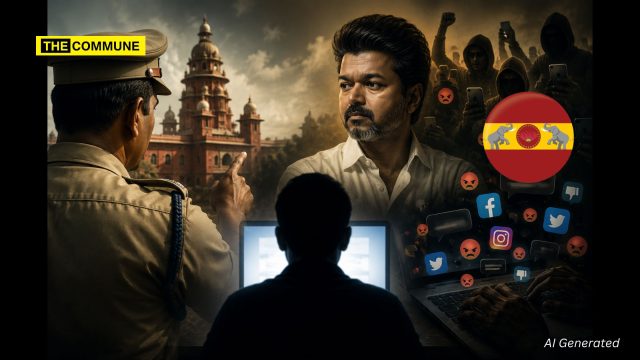
The video was shared by a handle named @SparkPluz_ and several other news channels also reported. However, the handle stated that they received a notice from the police department issued by the Cyber Crime Police Station, Thanjavur District, on 6 May 2026 and addressed to Twitter, Inc. According to the notice, a complaint from a Thanjavur resident alleged that the account @SparkPluz_ had shared a video concerning Vijay Saravanan with the intention of defaming and demoralizing him, prompting police to seek IP logs and activity details from the platform.

There were a few handles claiming the video was 5 years old.

This was the same modus operandi of the DMK and its IT Wing – both official and unofficial. Several people across the spectrum have been targeted and cases dumped on them in the past 5 years.

For a party that rose by attacking “fascism,” political intimidation, and fear-driven politics, TVK seems to be doing exactly what it accused the DMK of doing – being ‘fascist’ and not permitting freedom of speech. When criticism or embarrassing content is immediately met with cyber crime complaints and attempts to trace anonymous users, the optics begin to resemble the very political culture Vijay once mocked on stage. The issue is no longer just about one video. It is about whether TVK can truly handle criticism differently from the parties it promised to replace.

So, does this mean that TVK is DMK 2.0?

Subscribe to our channels on WhatsAppTelegram, Instagram and YouTube to get the best stories of the day delivered to you personally.

From Illegal Mining Barons To Cash-For-Votes Distributers: TVK Is Not Thooya Sakthi But The Same Old Dravidianist Rotten Wine In A New Bottle

Vijay sold voters a promise of clean politics and honest governance, but scratch the surface, you find that TVK is like any other party that the people did not want in power.

A little scrutiny around some TVK winners already shows how fragile that moral claim is. The available public record shows a gap between the party’s ethical branding and the questions now hanging over a few of the people elevated to office.

The Promise and the Problem

TVK’s rise was built in part on the idea that Vijay represented a break from the corrupt style of Tamil Nadu politics. That image matters because when a party asks the public to trust its moral intent, the backgrounds, disclosures, and associations of its elected MLAs become part of the test.

And people are not just making allegations. There is publicly available information that explains why the criticism is growing by the day. Just as the TVK emerged as the single largest party, news of their members caught for sexual assault of minor, kidnapping and theft, assault and extortion, cheating are hitting the headlines. If this is the case, what is the difference that Vijay promised?

Now let us take a look at a few candidates, their affidavits and the allegations.

Auto Driver With Luxury Car Royapuram MLA

One of TVK’s most marketable stories was the rise of K.V. Vijay Damu, celebrated as an “ex-auto driver” who defeated heavyweight rivals in Royapuram. But news reports indicate that the same MLA does not own an auto and instead owns an Innova Crysta, undercutting the simplicity of the narrative that helped sell him to voters. If one thought he purchased the vehicles with a loan, no, the affidavit does not show a debt even.

His affidavit on Myneta identifies him as the TVK candidate from Royapuram, lists his profession as “Auto Consulting Business,” and shows total assets of roughly Rs 28.86 lakh.

He also has 4 criminal cases on himself. Well, owning a luxury vehicle does not by itself establish wrongdoing, but it does show that the public-relations image surrounding him deserves far more scrutiny than the slogan-driven storytelling it received during the campaign.

Illegal Quarrying Tirunelveli MLA

The more serious concern comes from Tirunelveli – R.S. Murugan, a TVK MLA publicly linked by anti-corruption campaigners to quarry-related allegations. Jayaram Venkatesan of Arappor stated that a quarry run in the name of Murugan’s wife, Sindhu, was accused of illegal quarrying of 96,000 cubic metres of rough stone, with a reported penalty of Rs 5.7 crore cited from an official report.

This is not an isolated backdrop. The New Indian Express reported in February 2024 that Arappor Iyakkam alleged illegal quarrying in Tirunelveli caused a loss of over Rs 700 crore to the state exchequer, and later political demands for action drew on the same complaint. Even if individual legal liability must still be separated from broader district-level allegations, the optics are devastating for any party that claims to be ushering in cleaner politics.

The Humble Driver Who Became The Benami?

One of the most popular personal background stories of the TVK candidates was that of Vijay’s former driver Rajendran’s son getting a ticket.

Now one would think this was very magnanimous of Vijay to recognise the driver’s services. But company filings tell a very different story. Rajendran, presented publicly as merely a driver, appears in Ministry of Corporate Affairs records as a director and shareholder in Vijay-linked firm Jaya Nagar Properties alongside Joseph Vijay and Sangeetha Vijay.

These documents show Rajendran featuring not as an employee but as part of the ownership and management structure of Vijay-linked entities. Sources point out that he also appears as a shareholder in other Vijay-associated companies, though the extent of his role in various private trusts is unclear.

This undercuts the popular social media claim that Vijay has “elevated a mere driver” into politics. At the very least, Rajendran has been positioned as a business associate in formal records.

Clean Politics Needs Cleaner Candidates

There is another irony here. Vijay himself is known for evading taxes – be it his Rolls Royce Ghost car or admitting to taking payment in cash for the film Puli and then filing petitions in the court so that IT department do not charge him the tax?

The Rolls-Royce Ghost

Vijay imported a Rolls-Royce Ghost from England. When the state levied entry tax on the vehicle, he refused to pay and challenged it in court. He dragged the litigation for years. In July 2021, the Madras High Court dismissed his petition and imposed a ₹1 lakh fine, directed to the Tamil Nadu Chief Minister’s Covid-19 Public Relief Fund.

The court’s words bear repeating verbatim: “Tax evasion is to be construed as an anti-national habit, attitude and mindset, and unconstitutional.”

The court further stated that a reputed film actor whom fans look up to as a “real hero” is expected to pay taxes promptly and punctually – “he cannot be a mere reel-life hero.”

The Hidden Income and the ₹1.5 Crore Penalty

On 30 September 2015, Income Tax Department officers conducted a search at Vijay’s residence. What investigators found was that nearly ₹5 crore paid to him in cash as part of his remuneration for the film Puli had not been disclosed in his original tax returns.

Only after the IT department’s search, not voluntarily, not out of conscience, did Vijay file a revised return on 29 July 2016, declaring total income of ₹35.42 crore, now incorporating what had previously been concealed.

The Income Tax Department correctly treated this as a non-voluntary disclosure meaning it was triggered by a search, not by Vijay’s own initiative, and imposed a penalty of ₹1.5 crore under Section 271AAB(1) of the Income Tax Act.

Did Vijay pay and move on? No. He challenged the penalty in the Madras High Court. He fought it for years. Then, on 5 February 2026, just seven weeks before he filed his nomination as Tamil Nadu’s anti-corruption candidate, the Madras High Court dismissed his appeal in its entirety and upheld the full ₹1.5 crore penalty.

If Vijay wants TVK to remain more than a mood, a fandom, or a protest vehicle, he has to do what Tamil Nadu’s major parties have long avoided: subject his own MLAs and associates to the same ruthless transparency he promised the system. Otherwise, “clean politics” will start to look like a campaign costume – useful on stage, but quickly discarded once power is won, and it will only prove that TVK is another DMK.

Subscribe to our channels on WhatsAppTelegram, Instagram and YouTube to get the best stories of the day delivered to you personally.
“Tharkuri Vetri Kazhagam” For A Reason: How TVK Vijay Messed Up Swearing In As CM

vijay tvk

Despite emerging as the single largest party with 108 seats in the Tamil Nadu Assembly election, Tamilaga Vettri Kazhagam leader Vijay squandered a historic opportunity to smoothly stake claim to government formation after his party reportedly chose the wrong constitutional route before Governor Rajendra Arlekar.

The controversy erupted after TVK, instead of seeking an invitation as the single largest party, reportedly approached the Governor claiming majority support through a post-poll alliance. Under constitutional convention, a post-poll alliance claim requires demonstrated support from at least 118 MLAs in the 234-member Assembly. TVK currently has 108 seats of its own along with support from Congress’s five MLAs, taking the tally only to 113.

Three Possible Routes

Tamil Nadu’s post-election government formation controversy has intensified after Tamilaga Vettri Kazhagam leader Vijay chose the wrong constitutional route to stake claim before Governor Rajendra Arlekar.

According to constitutional conventions, there are broadly three possible routes through which a government can be formed after an election.

The first route applies when a pre-poll alliance secures a clear majority. In such a situation, the Governor may invite that alliance to form the government and facilitate the swearing-in of the Chief Minister.

The second route is when the single largest party stakes claim to form the government. In the present election, TVK emerged as the largest party with 108 seats and could have sought an invitation on that basis.

The third route is the post-poll alliance model, where parties that contested separately after the election come together and demonstrate majority support before the Governor. Under this route, the coalition must show backing from at least 118 MLAs in the 234-member Assembly.


View this post on Instagram


A post shared by Dr.SG Suryah (@suryahsg)

The controversy arose because Vijay, despite leading the single largest party, reportedly approached the Governor through the third route by claiming post-poll alliance support instead of directly staking claim as the single largest party. However, TVK’s 108 seats combined with Congress’s five MLAs only took the tally to 113, falling short of the majority mark.

This procedural choice weakened TVK’s position and handed the Governor constitutional grounds to seek additional proof of support before inviting Vijay to form the government.

Governor Arlekar’s Statement

Governor Rajendra Arlekar has publicly said he is ready to administer the oath immediately if a claimant satisfies him on numbers, but that he cannot invite someone to form the government merely on assertion. He has also said he is not demanding a parade of MLAs at Lok Bhavan, only verifiable support showing how a party or coalition reaches the majority mark.

The Governor also expressed concern over possible horse-trading if a minority government were sworn in without confirmed support. He warned that prolonged uncertainty could encourage attempts to lure MLAs from rival parties including DMK and AIADMK.

Harish Salve Statement

Former Solicitor General Harish Salve has backed that broad view, saying there is nothing unconstitutional in a Governor asking for greater certainty in a fractured mandate and that the Constitution does not automatically entitle the single largest party to be called first. Salve argued that while one Governor may choose to give the leading party a chance, another may reasonably seek support signatures before extending the invitation.

Hypocrisy Of Congress

The episode has also made people take a relook at Congress hypocrisy. In Karnataka in 2018, Congress and JD(S) challenged Governor Vajubhai Vala’s decision to invite the BJP as the single largest party, with Congress leaders including Abhishek Manu Singhvi and P. Chidambaram arguing that a majority-backed post-poll alliance should have been preferred and warning that inviting a minority party would encourage poaching.

Had Vijay initially sought government formation strictly as the single largest party, the constitutional and political debate may have evolved differently. Instead, by opting for a post-poll alliance claim without crossing the majority mark, TVK’s leadership triggered a legal and procedural deadlock at the very moment it appeared closest to power. Thus, Tharkuri Vetri Kazhagam seems to have squandered its chances.

Subscribe to our channels on WhatsAppTelegram, Instagram and YouTube to get the best stories of the day delivered to you personally.

Trichy: Musiri TVK MLA, Wife Accused Of Taking Money And Abandoning Building Project

A woman from Trichy has filed a cheating complaint against engineer Vignesh, a TVK MLA from Musiri constituency, alleging that he and his wife failed to complete construction work despite receiving money, as reported in Dinamalar.

According to the complaint submitted to the Trichy City Police Commissioner, Lakshmi (41), wife of Karpaganathan and a resident of Ranga Nagar in K.K. Nagar, stated that she had planned to expand the institution where she serves as Managing Director. As part of the expansion, she rented the second floor of an existing building and also planned construction of a new building in Balaji Nagar.

For the project, she entered into an agreement with engineer Vignesh and his wife Sivaranjani, who operate under the name “CM Builders.”

Lakshmi alleged that the couple received money for the construction work but failed to complete the project and also did not return the amount received. She urged the police to take action against them for cheating.

The complaint names engineer Vignesh, who was elected from the Musiri Assembly constituency representing TVK.

The K.K. Nagar Crime Branch police are investigating the complaint.

Subscribe to our channels on WhatsAppTelegram, Instagram and YouTube to get the best stories of the day delivered to you personally.

TVK Branch Secretary Among Accused In Aaduthurai Extortion Assault

TVK Branch Secretary Among Accused In Aaduthurai Extortion Assault

A shop owner from Aaduthurai has alleged that he and his family members were assaulted by a gang led by a local man over refusal to pay “mamool” (extortion money), and has sought immediate police action.

According to the complaint, the victim, who runs Eswar Utensils Shop in Aaduthurai, stated that a man identified as Chandran had been repeatedly visiting the shop over the past few months and allegedly demanding protection money. When the family refused to pay, Chandran allegedly arrived at the shop along with his son, a relative identified as Edison, said to be a TVK branch secretary, and a gang of around 10 to 15 people.

The complainant alleged that the group attacked him and his family members and also snatched Rs. 68,500 before fleeing from the spot.

The victim further stated that his father, who had previously undergone heart surgery and has a medical device implanted in his chest, was also assaulted during the incident. His younger brother reportedly suffered severe blood loss in the attack.

All the injured persons have been admitted to the Government Hospital in Kumbakonam for treatment.

The family has urged the police to register a case and take swift action against those involved in the alleged attack and robbery.

Subscribe to our channels on WhatsAppTelegram, Instagram and YouTube to get the best stories of the day delivered to you personally.

Is Joseph Vijay’s TVK A Deep State Project?

Is Joseph Vijay's TVK A Deep State Project?

The most striking feature of Tamil Nadu’s post-poll realignment was not just TVK’s emergence as the single largest party, but the speed with which a support structure appeared to form around it. After the results, TVK sought support from Congress and are looking to secure backing from VCK, CPI and CPM, all parties aligned with the broader anti-BJP opposition space, while Congress moved unusually fast to extend support after Vijay’s request. That sequence makes one ask whether TVK’s rise was entirely organic or whether it was always meant to fit into a larger arrangement, orchestrated by the Deep State.

Political Parties & Their Moves

The pattern has raised eyebrows because the early post-result outreach appeared selective. TVK wrote to VCK, CPI and CPM seeking support to form the government, and Congress quickly confirmed that Vijay had requested its backing within a short period of time. The first documented moves were not toward every available party in the state, but toward Congress and specific parties from the DMK alliance orbit, strengthening the perception that this was not improvisation under pressure but the activation of a prepared script.

As of publishing this report, the DMK has ‘given permission’ to smaller parties to join TVK in forming the government.

Congress’s speed made the picture even more intriguing. Reports said Rahul Gandhi was in favour of supporting TVK and that a late-night virtual meeting of the Congress Political Affairs Committee cleared the Tamil Nadu unit to move ahead. Other reporting indicated that Congress had already begun reassessing its political options as ties with the DMK came under strain, suggesting that the pivot to Vijay may have been politically anticipated rather than suddenly discovered after the verdict.

Media Projecting Vijay As The Hero Politician

Aside from the political parties, the way the media functioned during the run up to the polls leaves a lot of questions than answers.

TVK chief Joseph Vijay met with NDTV team and the India Today head Rajdeep Sardesai when they were in Chennai for their respective conclaves.


View this post on Instagram


A post shared by Bhavesh (@itsdearbhavesh)

Over the past couple of months, media that is based in Delhi seemed to have stationed themselves in TN and closely monitored the situation while projecting Vijay as a king/kingmaker in the elections.

Several Tamil speaking journalists also attended U.S. State Department-linked International Visitor Leadership Program initiatives, including a media-focused programmes in 2025.


View this post on Instagram


A post shared by WMPG 90.9FM (@wmpgfm)

It is a known fact that the US state department has regularly hosted anti-national/anti-India influencers and journalists often. The US Embassy had invited The Deshbhakt for an event in July 2024.

The journalists who were part of such events were seen speaking in favour of TVK and Vijay in the run up to the polls and after. So is there a connection?

The pattern is difficult to ignore. Sections of the Tamil media that were once deeply embedded in the Dravidian ecosystem appeared unusually quick to normalise Vijay’s rise and frame him as the inevitable “alternative.” These are not isolated events but interconnected developments within a larger political realignment.

The suspicion, increasingly voiced in political circles, is that Vijay is being positioned as a “safe disruptor” – disruptive enough to weaken the old Dravidian order, but acceptable enough to fit into a broader national opposition framework ahead of 2029. In that reading, TVK is not a full outsider movement but a carefully managed transition vehicle: anti-establishment in branding, but system-compatible in practice.

And that is why the question will continue to linger: was Vijay’s rise purely organic, or was it also aided by a wider ecosystem, media, political, and institutional that saw him as the ideal vehicle for reshaping Tamil Nadu’s political future?

Subscribe to our channels on WhatsAppTelegram, Instagram and YouTube to get the best stories of the day delivered to you personally.

TVK Promised Political Change But Data Shows 40% Of Candidates Had Criminal Cases

vijay tvk

Joseph Vijay launched Tamilaga Vettri Kazhagam with a promise of political change. But is it really a change? Are his MLAs really the change we want to see? Or is it old wine in a new bottle?

An Association for Democratic Reforms analysis shows that 92 of the party’s 231 analysed candidates had self-declared criminal cases, while 43 had declared serious criminal cases. The ADR-Tamil Nadu Election Watch report said this translates to 40% of TVK candidates with criminal cases and 19% with serious criminal cases.

The figures place TVK close to the DMK on both measures. ADR said 70 of DMK’s 175 analysed candidates had declared criminal cases and 32 had declared serious criminal cases, or 40% and 18% respectively.

AIADMK’s numbers were higher than both parties. According to the same ADR analysis, 118 of AIADMK’s 170 analysed candidates had declared criminal cases and 60 had declared serious criminal cases, which amounts to 69% and 35%.

Across Tamil Nadu, ADR said it analysed 3,992 of 4,023 candidates contesting the 2026 Assembly election. Of those, 722 candidates, or 18%, had declared criminal cases, while 404, or 10%, had declared serious criminal cases, marking an increase over the 2021 election, when the corresponding figures were 13% and 6%.

ADR’s classification is based on candidates’ self-sworn affidavits. Reports citing the ADR analysis said the serious-criminal-case category includes offences such as murder, attempt to murder, crimes against women and children, corruption-related offences, electoral offences, and other cognisable or non-bailable offences carrying a maximum punishment of five years or more.

The data has drawn attention because TVK entered the election projecting itself as an alternative to Tamil Nadu’s established parties. While the ADR numbers do not by themselves establish guilt, they indicate that TVK’s candidate profile on criminal-case disclosures was broadly comparable to that of some major rivals, particularly the DMK.

Subscribe to our channels on WhatsAppTelegram, Instagram and YouTube to get the best stories of the day delivered to you personally.

Madras High Court Clears Way For Hearing On Plea Seeking FIR And PMLA Probe Against Joseph Vijay

vijay madras high court tvk rally public pregnant

The Madras High Court has directed its Registry to number and list a petition seeking an investigation into alleged suppression of income by Tamilaga Vettri Kazhagam (TVK) chief and Chief Minister-elect Joseph Vijay, while also clarifying that questions regarding the maintainability of cases must be decided by the judiciary and not by the Registry, as reported in LiveLaw.

A division bench comprising Chief Justice Sanjay V. Gangapurwala Dharmadhikari and Justice G. Arul Murugan passed the direction after noting that the Registry had declined to number the petition due to doubts over its maintainability.

The bench observed that determining whether a case is maintainable is a judicial function and not an administrative one. The judges stated that if the Registry had doubts regarding maintainability, it could still assign a case number with an endorsement reading “numbered subject to maintainability” and place it before the appropriate roster judge along with the objections raised.

“In view of the decision of the Hon’ble Apex Court, the directions and circular already issued, we hereby direct the Registry not to refuse to number any case raising the issue of maintainability. If the cases filed are otherwise in order but the Registry still has a doubt regarding maintainability, the case shall be numbered with an endorsement ‘numbered subject to maintainability’ and shall be listed before the concerned Hon’ble Roster Judge, separately under the caption ‘for maintainability’, along with the objections raised and compliance reported. It is for the Court to decide on maintainability of the case and if found maintainable, then to consider the case on merits,” the court said.

The petition was filed by Chennai resident M. Rajkumar, who sought directions to the Director General of Income Tax (Investigation) and the Principal Commissioner of Income Tax (Central) to examine materials and findings allegedly recorded during income tax search proceedings, sworn statements recorded during assessment proceedings, and penalty orders passed under the Income Tax Act against Joseph Vijay.

The petitioner further requested that authorities initiate prosecution proceedings against Vijay under the relevant provisions of the Income Tax Act based on the findings allegedly arising from those proceedings.

In addition to income tax-related action, the plea sought directions for an appropriate law enforcement agency to register a First Information Report (FIR) against Vijay and investigate alleged cognizable offences under the Indian Penal Code, including Sections 420, 467, 470, 471 and 120B. The petition alleged suppression of income, receipt of unaccounted cash remuneration and concealment of financial transactions that were allegedly disclosed during search and statutory proceedings.

The plea also sought directions to the Director General of Income Tax (Investigation) and the Principal Commissioner of Income Tax to place the materials gathered during the search proceedings before the authorities functioning under the Prevention of Money Laundering Act (PMLA) to examine whether any scheduled predicate offence and “proceeds of crime” existed, and to take appropriate action under the Act.

This is reportedly the third legal proceeding connected to alleged discrepancies in Vijay’s declared financial assets.

In the first petition, which sought an inquiry by the Income Tax Department, the Madras High Court had earlier issued notice to Vijay and directed the department to file its response.

In the second petition, which sought an inquiry by the Election Commission of India into Vijay’s asset declarations, the court dismissed the plea, observing that such directions could not be issued after the election process had commenced and stating that the petitioner would have to pursue the matter through an election petition.

Subscribe to our channels on WhatsAppTelegram, Instagram and YouTube to get the best stories of the day delivered to you personally.