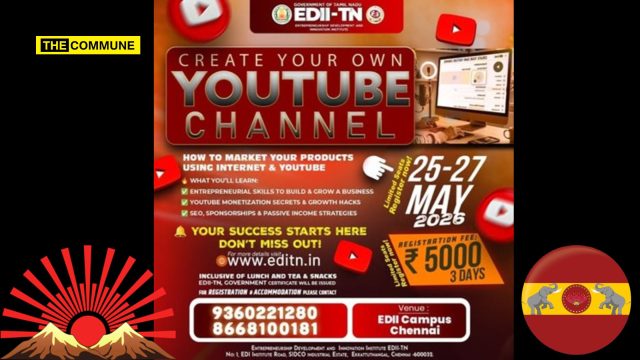
The Entrepreneurship Development and Innovation Institute – Tamil Nadu (EDII‑TN), a government institute under the MSME department, has announced a three‑day “Create Your Own YouTube Channel” training programme from 25–27 May 2026 at its Ekkattuthangal campus in Chennai. The course runs 10 a.m. to 5 p.m., charges ₹5,000 for three days (hostel extra), and promises lunch, tea, snacks, a government‑issued certificate and even guidance on loan schemes.
View this post on Instagram
On the brochure, it reads like a regular harmless skill‑development initiative. But in a state where TVK’s shock rise is reported to be because of an aggressive online campaign, it is hard not to see this as something more than “just” entrepreneurship. When the state trains citizens in the precise tools that today’s parties use to manufacture virality and crush dissent, ought we to treat it as neutral capacity building – or as quiet investment in a propaganda infrastructure that survives electoral change?
What makes this continuity especially striking is that the idea did not begin with TVK. EDII‑TN’s YouTube training courses started under the previous DMK government and has simply rolled over into the new regime.
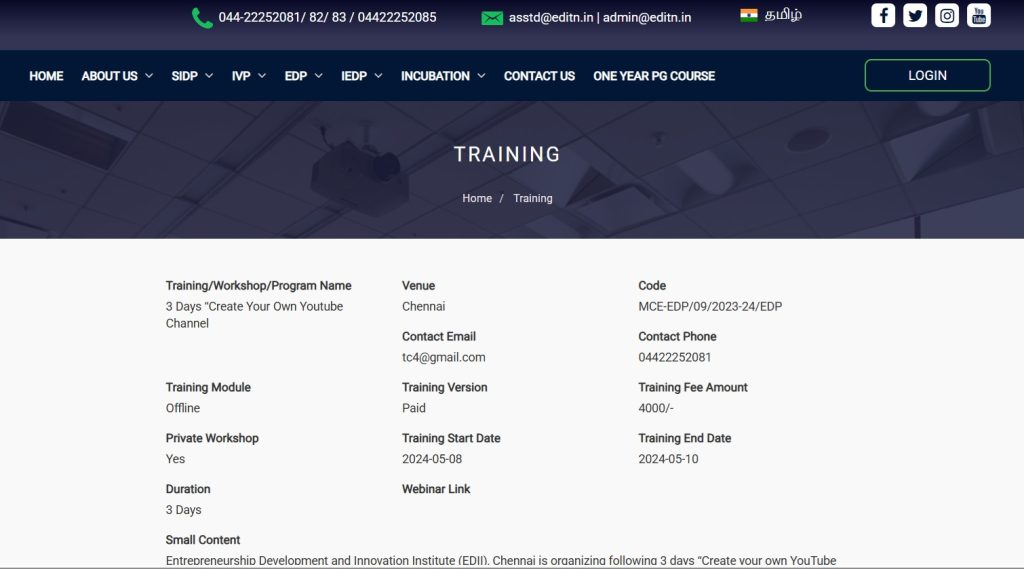
Government press‑release archives show EDII‑TN running a three‑day “Create Your Own YouTube Channel and Marketing” course as far back as 2023. EDII‑TN’s own training pages list multiple batches of YouTube‑themed Entrepreneurship Development Programmes in 2023–24 and 2024–25, all under DMK’s watch.
In July 2025, the institute proudly announced it had “successfully concluded” a three‑day EDP titled “Create Your Own YouTube Channel & Market Your Products Using Internet & YouTube” at the Chennai campus.
View this post on Instagram
Today, an internal “Training of Trainers (EDP)” document lists “Create your own YouTube Channel” as a standard, digitised EDII‑TN module alongside bakery and advanced digital marketing. In other words, the DMK government did not merely allow one off‑beat workshop; it helped institutionalise state‑run YouTube training inside a permanent government framework.
Look at the skill set being sold for ₹5,000. The current programme offers promotion of videos and slideshows, social‑media marketing and platform integration, strategies to increase “customer network” and “audience reach,” effective promotional techniques, and online marketing fundamentals, alongside domain, hosting and basic website design. This is textbook digital‑marketing content. It is also exactly what political IT cells use daily to engineer trends, suppress uncomfortable stories and keep their leader’s face on every screen.
Recent reports have flagged how TVK supporters allegedly weaponise this ecosystem – from coordinated online abuse to mass reporting of critical accounts. Analyses of the election have highlighted how Vijay’s party rode a wave of YouTube videos, Shorts and Reels carefully crafted to present a heroic narrative and drown out counter‑voices. In that context, a government institute training a new cohort in social‑media promotion and audience‑reach tactics is not a politically innocent act. It creates a ready‑to‑tap pool of technically skilled creators who owe their certificate, contacts and in some cases hostel and loan guidance to the state.
When the state invests in shaping this cohort’s skills, without parallel investment in media ethics, fact‑checking or hate‑speech awareness, whose interests are ultimately served?
To be clear: there is no public proof that EDII‑TN graduates from the DMK years were formally absorbed into party IT cells, nor that TVK has a documented plan to turn the May 2026 batch into an official digital army. But the structural risk is obvious. The state has built and is now preserving a taxpayer‑supported training line that produces exactly the skills required for sophisticated political propaganda, with no visible firewall against partisan use.
A few questions follow naturally. What safeguards exist to ensure that EDII‑TN’s YouTube alumni are not informally channelled into the ruling party’s online campaigns? Has any government issued clear guidelines preventing state‑trained digital entrepreneurs from being turned into unpaid party amplifiers? And if the concern is genuinely entrepreneurship, why do we not see equally aggressive state programmes on media literacy, verification and democratic responsibilities of content creators?
On this issue at least, DMK and TVK begin to look less like ideological opposites and more like successive managers of the same state‑run digital machine – one that can, at any moment, be tuned from “capacity building” to “narrative management” without ever needing a new policy note.
Subscribe to our channels on WhatsApp, Telegram, Instagram and YouTube to get the best stories of the day delivered to you personally.