On 12 May 2026, Udhayanidhi Stalin, making his maiden speech as Leader of the Opposition in the Tamil Nadu Legislative Assembly, repeated a now-familiar line: “Sanatana Dharma, which divides people, must certainly be abolished.” It was a deliberate echo of his 2023 remarks, when he had compared Sanatan Dharma to dengue and malaria and called for its outright eradication. The repetition was a statement of ideological identity.
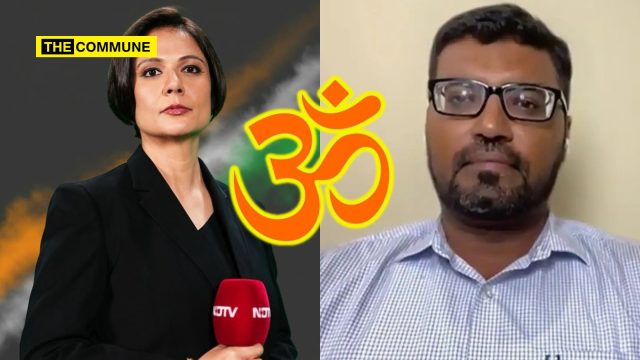
That evening, NDTV’s The Buck Stops Here, anchored by Padmaja Joshi, brought in DMK-aligned political analyst Hareesh Mohamed Ibrahim to defend the remark. What followed was about 7 minutes of evasion, slogan shouting, deflection and ideological jargon, but not a single source.
When asked directly by Padmaja Joshi why there was a need to once again call for the eradication of Sanatana Dharma during his debut speech as Leader of Opposition, Hareesh Mohamed Ibrahim attempted to defend the remarks by claiming that Sanatana Dharma represented “divisiveness with caste hierarchy” and “Varnashrama Dharma.”
But when Joshi repeatedly asked him to quote a source, any source, where Sanatana Dharma itself was defined as caste hierarchy, he simply could not answer.
The debate reached a telling moment when Ibrahim accused Joshi, a Hindu woman anchoring a national news programme, of conducting a one-sided interview and told her she needed to “first learn” how to conduct a debate. Joshi’s response was sharp:
“I will be damned if I take instructions from anyone who makes statements without quoting a single source, is defending a statement asking for the eradication of an entire religion and then decides to play victim by saying ‘we have withstood threats.’ You are the ones threatening.”
When Ibrahim ran out of road on the sourcing question, he pivoted. He argued that “Brahmanical patriarchy” still dominates every institution in India, including the Supreme Court, because its judges disproportionately come from one community that “hails from the head.” Joshi noted the irony immediately: “It’s so amusing; whenever you don’t have an answer, these same big words. You have gone around the world in the last 180 seconds, but you haven’t answered my question.”
Ibrahim’s response, “I can’t answer”, was the most honest thing said in the exchange. Joshi was withering: “Right now I am being subjected to Brahmanical patriarchy and patronization because you refuse to answer my one simple straightforward question.”
A Muslim man invoking “Brahmanical patriarchy” to deflect a Hindu woman’s demand for a source citation – the debate had, at that point, illustrated its own thesis.
That moment perfectly captured what the DMK ecosystem has increasingly become: an ideological structure where Hindu traditions can be endlessly demonised, caricatured and attacked in the name of “social justice,” while even basic questions demanding evidence are treated as oppression.
Padmaja Joshi’s question was not complicated. She did not ask for a philosophical dissertation. She asked for one source. One text. One citation. One authority that explicitly defines “Sanatana Dharma” as equivalent to caste hierarchy.
No answer came.
Instead, Hareesh Mohamed Ibrahim repeatedly shifted the discussion toward “Brahmins from the head,” “Shudras from the feet,” the judiciary, patriarchy, and broad social grievances. But even after multiple opportunities, he failed to establish the central claim underpinning the DMK’s rhetoric that Sanatana Dharma itself is nothing more than caste oppression.
Because what Udhayanidhi Stalin said was not a criticism of caste discrimination alone. He did not say “eradicate caste hierarchy.” He said, “eradicate Sanatana Dharma.” There is a vast difference between criticising social evils and calling for the eradication of a civilisational faith tradition followed by millions.
And this is precisely where the DMK ecosystem repeatedly reveals its selective standards.
Throughout the debate, Padmaja Joshi pointedly asked whether Udhayanidhi Stalin had ever called for the eradication of any other religion or “Dharma” because of hierarchies or discrimination within them. Hareesh Mohamed Ibrahim could not provide a single example.
That silence was revealing.
The DMK and its ideological defenders routinely present themselves as fearless critics of oppression everywhere. But in practice, their aggression appears overwhelmingly directed at Hindu traditions, Hindu symbols and Hindu religious identity. The same language, tone and rhetoric is almost never applied toward other religions with similar intensity.
What made the exchange particularly striking was the inversion at play. A Hindu woman anchor asking for evidence was framed as embodying “Brahmanical patriarchy,” while a male political panellist refusing to answer basic questions positioned himself as the victim.
Within sections of the Dravidian ideological framework, terms like “Brahmanical patriarchy” are often deployed less as analytical concepts and more as rhetorical weapons – labels used to delegitimise dissent, shut down questioning and morally corner opponents without engaging substantively with the argument being raised.
DMK defends Udhayanidhi Stalin’s call to ‘eradicate Sanatan Dharma’, saying all Tamil Nadu LoP was referring to was the caste hierarchy in the Sanatan Dharma.
On #TheBuckStopsHere, @PadmajaJoshi asks one simple question to political analyst Hareesh Mohamed Ibrahim (@hihareesh)… pic.twitter.com/nJZFj1vOe1
— NDTV (@ndtv) May 12, 2026
The NDTV exchange inadvertently exposed how fragile the intellectual foundation behind the “eradicate Sanatana Dharma” slogan actually is. Once pressed for textual basis, definitional clarity or philosophical grounding, the argument collapsed into emotional rhetoric and ideological catchphrases.
And that is perhaps the most significant takeaway from the debate.
For years, the DMK ecosystem has attempted to frame attacks on Sanatana Dharma as merely progressive anti-caste activism. But the moment someone calmly asks for sources, definitions and consistency, the conversation rapidly shifts from evidence to intimidation, from scholarship to slogans, and from debate to accusation.
Subscribe to our channels on WhatsApp, Telegram, Instagram and YouTube to get the best stories of the day delivered to you personally.