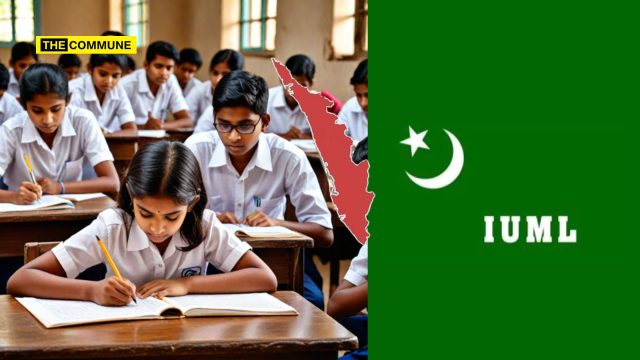
The Indian Union Muslim League (IUML) has once again made it clear that it considers Kerala’s education department its political stronghold, refusing to give up control of the powerful portfolio in any future United Democratic Front (UDF) government and triggering renewed concerns among critics over the growing communalisation of the education sector in the state, as reported in The New Indian Express.
Senior IUML leader and likely ministerial candidate K M Shaji openly declared that the League would not compromise on the department under any circumstances and was instead planning to further consolidate its influence by merging the General Education and Higher Education departments into one super ministry under the next UDF government.
The statement comes amid reports that the Congress leadership had internally explored reclaiming the education portfolio this time by offering the IUML another major department in exchange. However, the League has now firmly shut the door on any such possibility.
The controversy intensified after BJP leader and newly elected Kazhakoottam MLA V Muraleedharan warned that once again handing over the education department to the IUML would have “far-reaching consequences” and would further strengthen “communal interests” within Kerala’s education system.
Muraleedharan’s remarks struck at a long-running criticism in Kerala politics – that the education sector, which shapes generations of students, should not remain under the prolonged political influence of a party openly rooted in community-based identity politics.
However, instead of softening its stand, the IUML doubled down. Responding sharply, Shaji claimed that Muraleedharan’s criticism had only strengthened the League politically within the UDF alliance.
Drawing a comparison with former SNDP Yogam general secretary Vellappally Natesan, Shaji said every attack from Natesan in the past had only increased public support for the IUML and that Muraleedharan was now playing a similar role.
Shaji further revealed that even before Muraleedharan’s remarks, the League had already internally decided that the education portfolio would not be exchanged with the Congress under any formula. He also confirmed that the IUML intended to unify both school and higher education under one ministry, thereby centralising even greater control over Kerala’s education sector.
Sources inside the League said the party leadership had internally debated whether continuing to hold such a politically sensitive department could become a burden amid repeated allegations of community-driven influence in education. Despite this, the IUML leadership reportedly concluded that surrendering the portfolio would weaken the party’s long-standing institutional grip within the UDF power structure.
The party is now finalising its list of five ministerial nominees for a future UDF cabinet. Shaji categorically stated that there was “no question” of the IUML accepting fewer than five cabinet berths.
The education department has historically remained closely tied to the IUML ever since the formation of the UDF coalition in Kerala. Over the decades, this arrangement has repeatedly triggered accusations from rival parties and sections of civil society that a critical public institution was being steadily transformed into a political and ideological sphere of influence for a community-based party.
The repeated control of the education sector by the IUML raises larger questions about the secular functioning of educational administration in Kerala, particularly when curriculum influence, institutional appointments and educational policy shape the cultural outlook of future generations.
C H Mohammed Koya was among the earliest IUML leaders to control the education portfolio between 1967 and 1973 under the governments led by E. M. S. Namboodiripad and C. Achutha Menon. Decades later, P. K. Abdu Rabb handled the department during the last UDF government between 2011 and 2016.
The renewed debate has also reopened historical discussions about Muslim leaders handling India’s education ministry after Independence.
Maulana Abul Kalam Azad was India’s first Education Minister from 1947 to 1958 who was trusted personally by Jawaharlal Nehru during the formative years of the Republic.
Additionally, figures like Humayun Kabir, M. C. Chagla and Syed Nurul Hasan also held education-related roles at different points. Now whether these appointments can be viewed as part of an organised community-based political bargaining structure is something that must be debated.
Overall, the IUML’s present insistence on permanently retaining Kerala’s education portfolio reflects a far more explicit attempt to preserve political and institutional influence over one of the state’s most sensitive sectors.
Subscribe to our channels on WhatsApp, Telegram, Instagram and YouTube to get the best stories of the day delivered to you personally.