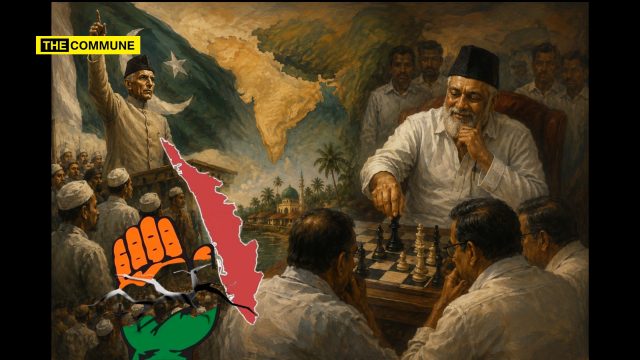
Kerala’s latest power struggle has thrown up an uncomfortable truth that many would rather dress up in secular jargon: in 2026, a party born out of the pre-Partition Muslim League is effectively acting as veto power over who becomes Chief Minister of a Hindu-majority state. This is not just about coalition compulsions; it is about historical memory, political asymmetry, and a long habit of treating Hindu votes as negotiable while treating minority blocs as sacrosanct.
1946: When Malabar voted with Jinnah
Let us start with the history lesson the forwards talk about – because unlike many secular homilies, this one at least gets the basic outline right. Elections were held to the provincial assemblies in early 1946 under the British, with separate electorates for Muslims. Congress campaigned for complete independence and a united India; the All India Muslim League under Jinnah made Pakistan its central political project and sought to prove it represented Muslims as a whole.
The hatred didn’t start in 2014. It started in 1946 when Tamil Muslims gave 100% of the Muslim seats for Jinnah’s Pakistan.
And then decided to stay back in india. https://t.co/sz3AFnF8e1 pic.twitter.com/dyhYNA0ebR
— Puyangan Adiyan (@Puyangan5) May 15, 2026
The numbers are stark. Across British India, the Muslim League won 429 of 492 Muslim-reserved seats – a near sweep in its category, giving it the legitimacy to sit across the table with the British and Congress as “the” Muslim voice. In the Madras Presidency, which then included Malabar, the League won all the Muslim seats – 28 out of 28. Malabar Muslims did not vaguely “sympathise” with Jinnah; they voted in disciplined fashion for the party whose declared programme was the partition of India and the creation of Pakistan.
While Congress leaders were in and out of prison, and while many Hindu voters were trusting the “national movement” to deliver freedom, a significant chunk of Muslims, including in Malabar, were building an alternative political project that ended with India being cut in two. That has consequences for trust, for memory, and for how we understand “minority rights” today.
1947: They Stayed, The Party Stayed, The Leverage Stayed
The slogan goes: “Malabar Muslims voted for Pakistan, but after Pakistan was formed, they never left India.” It is crude, but the core point is difficult to deny. There was no mass migration of Kerala Muslims to Pakistan. Instead, the same social base that had made the Muslim League unbeatable in the Muslim constituencies stayed put, reorganised and adapted to the new Indian reality.
The Indian Union Muslim League that emerged in the early 1950s was not some brand-new organisation born out of thin air. It was built by the same leadership layers and social networks that had worked under the pre-Partition League, especially in Malabar. The name changed, the flag changed, the rhetoric was tuned to “constitutional participation”, but the core logic remained: a religiously defined political bloc bargaining with the state for maximum advantage.
Over time, IUML embedded itself as the permanent Muslim bargaining agent in Kerala politics. It pushed for a separate Malappuram district, used its clout in education and minority welfare, and made itself indispensable in coalition arithmetic. None of this makes it “holy” or “moderate” in some abstract sense; it simply shows a hard-nosed power strategy: convert disciplined community voting into permanent leverage in a fragmented multi-party system.
2026: Congress Majority, IUML Supremacy
Fast forward to 2026. Kerala votes the Congress-led UDF back to power after a decade of Left rule. On paper, Congress has the numbers to form government. In reality, three camps inside the party – backing K. C. Venugopal, V. D. Satheesan and Ramesh Chennithala – are locked in a power struggle that paralyses decision-making. Into this vacuum walks IUML, with its solid block of MLAs and its swing vote in Malabar, essentially saying: “No CM without our consent.”
Reports from national media speak openly of IUML “blocking” certain names and “signalling approval” for others. KC Venugopal – blocked. Ramesh Chennithala – blocked. V. D. Satheesan – after weeks of back and forth, finally green-lit. Congress has the majority; IUML has the decisive veto.
This is not a neutral fact of coalition politics. It means that in a state like Kerala, the final say on who heads the government is being shaped by a party whose reason for existence is to maximise the interests of one religious community and whose organisational ancestry lies in the very movement that demanded the carving up of India. This is not “inclusive democracy”; it is asymmetric democracy, where Hindu voters are expected to behave like a diffuse, divided majority, while Muslim voters are encouraged to consolidate behind a communally defined formation and then dictate terms.
The Double Standard Hindus Must Name
If a Hindu party today ran explicitly as the “Hindu Union League”, claimed to represent all Hindus, and openly bargained for ministries and CM posts on that basis, it would be called communal, majoritarian, dangerous. It would be lectured on the need to “rise above identity” and “respect the secular fabric.” Yet IUML’s entire political brand is precisely that – a religiously defined formation, speaking explicitly in the name of Muslims, wielding bargaining power over state policy – and it is treated as a normal, even respectable, coalition partner.
The same ecosystem that screams about “Hindu majoritarianism” has no problem with a party structurally locked into Muslim communitarian politics deciding who can and cannot be Chief Minister. Hindus are told to forget 1946, forget Partition, forget the ideological roots of the League, and see IUML as just another regional outfit like any other. But history does not evaporate simply because the English commentary class finds it inconvenient.
Kerala Hindus have every right to remember that Malabar’s Muslim League once voted overwhelmingly with Jinnah, that its successors stayed back, rebranded and now exercise kingmaker power; they have every right to question why their votes end up subordinated to a party that never hides its communitarian basis.
To “connect the dots” is not to call for hatred or violence. It is to recognise the political reality: when Hindus remain divided, ashamed to organise as Hindus, and happy to outsource their representation to “national” parties that are terrified of being called communal, space opens up for disciplined, communally organised blocs like IUML to punch far above their numerical weight. In 1946, that logic helped birth Pakistan. In 2026, it allows a party with roots in that very history to sit in judgement over Kerala’s Chief Minister.
The question is not whether the past can be changed; it cannot. The question is whether Hindus in Kerala will continue to pretend this asymmetry does not exist – or whether they will finally name it, confront it, and vote with the clarity that their opponents have displayed for nearly a century.
A small history lesson Kerala HINDUS
needs to remember !!🚨🚨Elections were held across 11 provinces of India in March 1946. The two main parties were the Indian National Congress and the All India Muslim League (Jinnah).
There were two types of constituencies — General seats… pic.twitter.com/HCkWiIdJwd
— MAHARATHI (@MahaRathii) May 14, 2026
Subscribe to our channels on WhatsApp, Telegram, Instagram and YouTube to get the best stories of the day delivered to you personally.