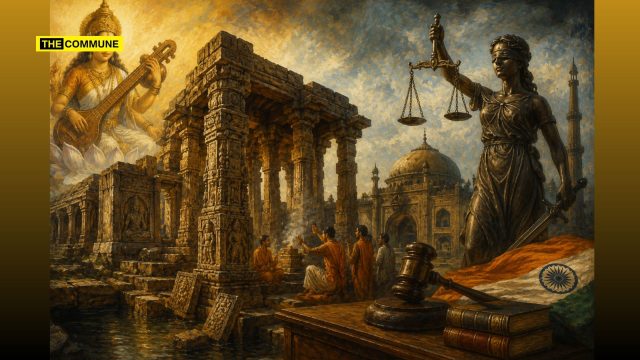
In a major judgment on one of central India’s most contested religious and heritage disputes, the Indore Bench of the Madhya Pradesh High Court on Friday, 15 May 2026, declared that the disputed Bhojshala-Kamal Maula complex at Dhar is fundamentally a Bhojshala with a temple dedicated to Goddess Vagdevi (Maa Saraswati), established in 1034 AD by Raja Bhoj of the Paramara dynasty as a centre of Sanskrit learning, as reported in OpIndia.
A Division Bench comprising Justices Vijay Kumar Shukla and Alok Awasthi accepted the pleas of the Hindu petitioners and rejected the claims advanced by the Muslim side that the structure was inherently or exclusively a mosque. The court also upheld the site’s status as a centrally protected monument under the Ancient Monuments and Archaeological Sites and Remains Act, 1958.
The judgment was delivered in a batch of writ petitions and a writ appeal, including the lead petition filed by Hindu Front for Justice. The bench said its conclusions were based on historical records, archaeological material, the 2024 Archaeological Survey of India (ASI) scientific survey ordered by the court, revenue documents, inscriptions and constitutional principles concerning religious and cultural rights.
The court partially quashed the 7 April 2003 order issued by the ASI Director that had restricted Hindu worship while permitting Friday namaz by the Muslim community in the disputed premises. Hindus have now been granted the right to conduct daily pooja without restriction, while the government has been directed to create a trust for temple administration and pursue efforts to repatriate the Saraswati idol currently housed in the British Museum.
Court Relies On Historical And Literary Records
The High Court placed substantial reliance on historical literature, inscriptions and epigraphic material to conclude that Raja Bhoj had constructed the Bhojshala in 1034 AD as both a Sanskrit Gurukul and a temple dedicated to Goddess Saraswati.
The judgment referred to sources including the Imperial Gazetteer of India (1908), the Royal Asiatic Society Journal (1904), and G. Yazdani’s Mandu: The City of Joy (1929), along with inscriptions such as the Sarpabandha grammatical charts and the Vijayasrimatika drama fragment. According to the court, these materials described the site as a Saraswati temple containing sculptures, educational inscriptions and Sanskrit-learning material.
The bench observed that the structure contained features associated with Vedic sciences, grammar, astronomy and poetics, which it said were incompatible with original mosque architecture. It also recorded that later Muslim rulers, including Allauddin Khilji in 1305 AD and Mahmood Shah Khilji in 1514 AD, damaged portions of the temple but reused temple pillars, slabs and carvings in later construction.
The court further noted Sanskrit grammar inscriptions, Prakrit verses, references to Raja Bhoj, inscriptions praising Paramara rulers and Sanskrit dramatic compositions embedded in the structure. It referred to findings of the Royal Asiatic Society describing serpent-shaped Sanskrit grammatical diagrams and educational carvings connected to Sanskrit learning.
According to the bench, these inscriptions and carvings were characteristic of a Sanskrit educational and religious institution rather than a mosque.
ASI Survey Finds Temple Remains Beneath Structure
A central basis for the ruling was the 2024 ASI scientific survey and excavation conducted under directions of the High Court. The investigation, which included multiple-volume reports, found evidence of a pre-existing Paramara-period temple structure beneath the current building.
The court recorded that the structure contained carved Hindu pillars, temple-style ceilings, mutilated Hindu idols, Vishnu-related inscriptions, Sanskrit inscriptions, temple architectural fragments, Hindu iconography and reused temple material in later construction phases.
The ASI report identified 94 sculptures and fragments depicting Hindu deities, including Vishnu and Narasimha, along with mutilated human and animal figures. It also documented 106 temple-style pillars and pilasters reused from an earlier structure. Other findings included Havan Kunds, Jal Kunds, Shikhara motifs, pranala water spouts and Kirtimukha carvings associated with Hindu temple architecture.
The court also referred to stratigraphic analysis, GPR-GPS surveys and epigraphic studies that identified a 15th-century Khilji-period inscription referring to the destruction of idols and conversion of a temple into a mosque. It further noted that earlier excavations conducted during 1972-73 had uncovered temple fragments and a Vishnu sculpture.
Based on these findings, the bench held that the present structure had been modified from and built over an original Bhojshala temple complex and was not originally constructed as a mosque. The court stated that the structure contained “all trappings” of a Hindu temple and substantially accepted the petitioners’ argument on that point.
Revenue Records Mention “Bhojshala & Temple”
The High Court also relied on revenue records produced by the State Government, which consistently described the disputed property as “Bhojshala & Temple” up to 1935-36. The bench noted that these records contained no reference to a “Jama Masjid” or mosque.
The judgment further recorded that the dargah of Hazrat Kamaluddin Chishti stood on a separate survey number outside the Bhojshala complex itself. Accepting the State Government’s submissions, the court held that the Bhojshala land had remained under the ownership and management of the State Government and ASI since before Independence.
The bench said the property had never belonged to any Muslim individual or entity in a manner that would permit valid waqf dedication under the Waqf Act. It treated the revenue records as corroborative evidence supporting the archaeological and historical conclusion that the site retained its character as a Hindu temple and Sanskrit learning centre.
Court Rejects Waqf Claim
The bench rejected the mosque’s claim over the property on grounds rooted in Muhammadan Law and Hindu jurisprudence. It observed that a valid mosque requires waqf property dedicated by its owner to the Almighty and said no evidence existed of any such dedication over the Bhojshala land.
The court held that after Pran Pratishtha, the property vested perpetually in the deity of Goddess Saraswati and that damage or reuse of temple material by invaders did not extinguish those rights. The judgment also noted that graves and maqbara structures adjacent to the site were later additions that could not alter the original religious character of the premises.
The bench further observed that records did not establish continuous ancient namaz at the site and said permissions for Friday prayers originated only from a 1935 Dhar State notification and the 2003 ASI order. According to the court, neither of these could override the site’s original temple identity.
Kamal Maula Maqbara Constructed Later, Court Says
The High Court accepted the historical timeline advanced by the Hindu petitioners concerning the Kamal Maula maqbara. According to the judgment, Maulana Kamaluddin died in 1310 AD in present-day Ahmedabad and was buried there. The maqbara at Dhar bearing his name was constructed only in 1514 AD by Mahmood Shah Khilji.
The bench said the maqbara was built more than 200 years after Kamaluddin’s death and on a separate adjacent plot outside the main Bhojshala temple complex. The court observed that the graves and tombs in the area were later additions made after Muslim rulers damaged parts of the original temple.
The judgment stated that the mere existence of the later maqbara could not convert the original Bhojshala temple into a mosque or extinguish the deity’s rights over the property.
Court Recognises Continuity Of Hindu Worship
The High Court observed that Hindu worship at the Bhojshala complex had continued since its establishment in 1034 AD despite invasions, desecration and administrative restrictions. The bench recorded that devotees continued to regard the premises as a temple of Goddess Vagdevi and conducted rituals such as Havan and offerings at the Jal Kund during occasions like Basant Panchami.
The judgment referred to a 1997 writ petition filed by Vimal Kumar challenging restrictions on Hindu entry and worship. The court held that the 2003 ASI order restricting Hindu pooja to Tuesdays and Basant Panchami while permitting Friday namaz imposed impermissible limitations that could not override the site’s original character or extinguish rights protected under Article 25 of the Constitution.
By quashing the restrictive portions of the 2003 order, the court restored the right of Hindus to perform daily pooja, darshan and rituals without limitation. The bench said continuity of worship had remained unbroken in practice and legal assertion.
Court Invokes Constitutional Duty To Correct Historical Wrong
The judgment also invoked Articles 25 and 29 of the Constitution concerning religious freedom and protection of cultural heritage. The court described the temple’s desecration as a “continued trauma” for Hindu worshippers extending over centuries.
Invoking Article 13(1), the bench observed that pre-Independence wrongs involving destruction and partial conversion of sacred sites required rectification in the post-Constitutional era. The court acknowledged submissions by Jain petitioners concerning shared educational and religious heritage but ultimately affirmed the dominant Saraswati temple character based on the evidence before it.
The High Court rejected arguments that the monument’s protected status or earlier ASI notifications conclusively established mosque character, holding that administrative labels could not override scientific and historical findings.
In its final directions, the court declared the disputed area a Bhojshala with Saraswati Temple, quashed the restrictive portions of the 2003 ASI order and directed the formation of a trust under the Indian Trusts Act, 1882, for temple administration and Sanskrit education while retaining ASI custodianship over the protected monument.
The Madhya Pradesh Government has also been asked to consider alternative arrangements for Muslim prayer if a valid claim is pursued, while the monument itself will continue to remain protected from unauthorised alterations.
Subscribe to our channels on WhatsApp, Telegram, Instagram and YouTube to get the best stories of the day delivered to you personally.