The DMK has lost and its supporters are still in denial mode. One cannot change the fact that the defeat is written in stone. So, what do the mouthpieces do? Whitewash everything about the DMK and make it look so polished that even a non-DMK supporter might want to think the Dravidian Model rule was rosy and shining like paradise.
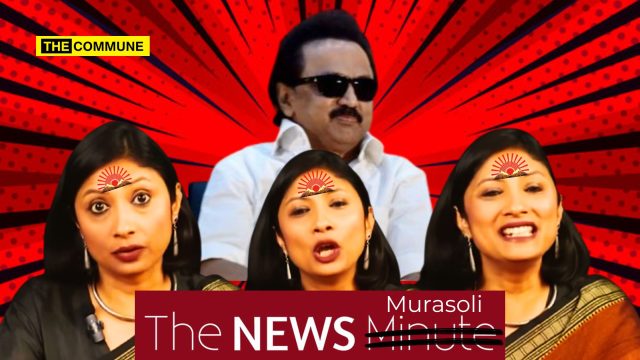
The News Minute and its anchor Pooja Prasanna try exactly that in their episode of Let Me Explain. What she does is not post-mortem of the DMK’s defeat but heavy damage control.
“This Was Not Anti-Incumbency” – The Core Premise Collapses Immediately
Pooja opens the episode claiming the loss was not a ‘straight forward anti-incumbency’. The reasoning behind this she said was “There was no single dominant issue or a wave of anger strong enough to produce this scale of outcome.”
After hearing these words, you begin to wonder if Pooja is a card-carrying member of DMK masquerading as a ‘journalist’. Did TNM not report any of the law and order issues plaguing the state for the past 5 years? Did TNM choose to turn a blind eye to the innumberable sexual assault cases that kept cropping every single day. Okay, let us not go too far to 2021, did she forget the Anna University sexual assault case, did she forget how they handled the FIR leaking victim details? Did they miss reporting the most recent Thoothukudi rape and murder of a school girl who went to attend nature’s call? Did they miss reporting or never heard of the toddler who was raped and murdered by a DMK cadre?
Did they miss the Kallakurichi hooch tragedy that took scores of lives? Did they miss the honour killings over the past 5 years? Did they miss the lock-up deaths that peaked in Dravidian Model regime? Did they forget Ajith Kumar who was mercilessly lynched to death by the police officers who come directly under MK Stalin?
Did they forget the atrocities against Dalits increased under Stalin rule and there is concrete data for it?
All these questions makes the viewer wonder if TNM is an ‘independent’ news organisation or if they are DMK members who function as a mouthpiece, much like Murasoli and Sun News.
Instead of addressing these issues, Pooja claims “The result instead reflects a shift in how the election was contested and how the voters responded.”
Vijay’s Rise Is Treated Like A Psychological Accident, Not A Political Verdict
One of the most revealing aspects of Pooja’s word salad is its inability to treat Vijay’s rise as a legitimate political phenomenon driven by genuine dissatisfaction. Instead, TVK is repeatedly described as star power, a mobilization, a gang, group, or club, emotionally driven supporters, social media amplification, and simplified messaging. Here is what is missing from her vocabulary – ideological dissatisfaction with Dravidian politics, frustration with corruption, resentment against dynastic control, collapse of trust in traditional parties, aspirational politics, youth anger, anti-elite sentiment, and genuine desire for regime change.
She lays the blame for the loss squarely on DMK’s inability to ‘communicate its success’ and not fine-tuning it to Vijay’s messaging. According to TNM, people didn’t consciously reject the DMK, they were merely “captured” by digital repetition and celebrity charisma.
She does acknowledge that the DMK underestimated Vijay,
mocked him, dismissed him, failed to engage him, delayed response, were too overconfident, and assumed old methods would work.
But every one of these points is presented as a campaign-management error instead of DMK’s failed model of governance.
The truth is harsher. The DMK ecosystem had become so insulated within its own media, intellectual, and political bubble that it genuinely believed Vijay was a joke until the ground shifted beneath them.
Corruption Is Minimized Through Careful Linguistic Cushioning
Here’s where things get even interesting. TNM seems to be on a mission to whitewash Stalin’s Dravidian Model as one of the exemplary non-corrupt models ever. She says, “…corruption became a recurring theme in the campaign. Though there were no big scandals like the 2G, there was a steady flow of allegations and perceptions. Some of these allegations were unverified. Others may have had some basis. In elections, perception matters and repeated exposure to these claims can create a broader impression that is hard to counter.”
She fails to confront why corruption narratives resonated so strongly with the public. Why did those allegations feel believable to people? Because years of political culture had already eroded trust and there was one scam or the other cropping up each day. Did she miss reading about KN Nehru’s MAWS scam? Did the TASMAC scam not reach her ears? Or are these ‘too miniscule’ a scam according to the ‘scale of corruption’ of TNM’s political masters?
Instead of examining whether the DMK had acquired a reputation for entitlement, patronage politics, opaque networks, or concentration of influence, she reduces the issue to “circulation” and “perception.” Again, the emphasis is not on whether DMK indulged in corruption, but on how narratives spread digitally. This is deflection at best.
DMK Delivered On Governance According To Pooja Prasanna
Pooja repeatedly insists that welfare schemes were implemented,
administrative continuity existed, and governance delivery happened. She also claims the implementation was not properly communicated. Is she selectively blind or does she not read newspapers? Has she not seen how media in TN works and how many advertisements were regularly published by the DMK government?
She also says, “There were also gaps in governance. There were localized grievances and all this led to some anger. Could some of these voters have been retained if their concerns were acknowledged or solved?”
What Pooja fails to spout from her mouth is the people-establishment disconnect! The DMK government was unempathetic to the people, refused to treat people even humanly, leave alone addressing grievances.
Also, governance is not a spreadsheet exercise.
A government can deliver schemes and still lose public trust if voters are met with arrogance from their leaders, corruption,
disconnect, selective governance, ideological fatigue,
suppression of dissent, breakdown of law and order, lack of employment, inability for a layman to lead a normal life.
Pooja treats governance as though electoral rejection becomes irrational unless measurable administrative collapse occurs. But voters are not auditors. They are political beings reacting emotionally, culturally, socially, and psychologically to power.
The video never truly accepts that the electorate may simply have wanted the DMK removed.
The “Digital Shift” Explanation Conveniently Avoids Political Accountability
Once again, DMK’s loss is squarely blamed on TVK’s social media game. She claims the DMK remained ‘conventional’. Basic 101 of marketing – you have a worthy product, it will sell. But if you have a hopeless and shitty one, you cannot package it in gold and sell it as diamond to the people.
Why did TVK’s social media game win and why did it resonate with the public? Social media cannot manufacture mass anger out of thin air for an entire state. Digital amplification works only when underlying dissatisfaction already exists. She treats technology as though it independently created political reality. In truth, digital media merely accelerated and reflected sentiments already brewing on the ground. The messenger succeeded because the message resonated.
For once, DMK got a taste of its own medicine, going by her words.
In this short 9 minute video also, she does not forget one thing – to sing paens of the paymaster. She says, “MK Stalin’s leadership style has been consistent. It’s been marked by gradual political growth and administrative focus.”
Being oblivious to the people’s grievances is called consistent leadership?
Once again she repeats that anti-incumbency was not the original issue. She says, “His (Stalin’s) defeat in Kolathur is significant and it should be seen in the context of wider losses across the party. This was not solely a referendum on his leadership. It reflected a broader shift in voter behavior and campaign dynamics. The 2026 verdict does not fit the pattern of strong anti-incumbency driven by clear public anger. Instead, it reflects a more diffused sentiment.”
Therefore ultimately, social media marketing aced the game and DMK lost because of it ‘despite’ the glorious 5 years.
The Biggest Omission: No Serious Examination Of DMK Political Culture
Perhaps the most glaring omission in the entire analysis is what it refuses to deeply interrogate cadre excesses, ecosystem arrogance, ideological fatigue, media patronage networks,
dynasty fatigue, suppression narratives, corruption perception,
intolerance toward criticism, and the growing perception that the DMK system had become too entrenched and self-referential.
These are not minor issues. They were central to the election mood.
But confronting them honestly would require abandoning the comforting narrative that the DMK merely lost a “communications battle.”
Ignoring Public Anger, Explaining Away Electoral Rejection
What makes the omission even more glaring is that some of the most politically damaging issues faced by the DMK government are almost entirely absent from the analysis. There is barely any serious discussion on th real problems such as crimes against women and children, rising law-and-order anxieties, the drug menace, caste violence, custodial deaths, or the growing perception that the state had become increasingly unsafe under the DMK’s watch. Every single crime was erased. Any honest political post-mortem would have treated these as central factors behind public anger. Instead, Pooja replaces real governance failures with abstract jargon about “structures,” “narratives,” and “communication shifts,” while the lived anxieties of ordinary voters disappear entirely.
Even towards the end, she attempts to describe the verdict as merely “anti-establishment” instead of anti-incumbency, this just feels like rhetorical cushioning. In 2026 Tamil Nadu, the establishment was the incumbent DMK government. Voters were not hypnotised by social media clips or celebrity charisma alone; they were responding to accumulated frustration, distrust, and fatigue with the ruling dispensation. By refusing to confront that directly, Pooja Prasanna just vomited a passage written by a PRO for narrative management of a defeated political establishment.
Please Change Your Names And Profession To TN Murasoli & PR Agency Of DMK
One word of advice to The News Minute. Just change your names to TN Murasoli, become the official PR of the DMK, enroll yourselves officially as cadre/party members. Then, people will not question you. Acting like bootlicking cheerleaders for a political party while claiming to be ‘independent journalists’ is hypocrisy at its highest. Atleast be truthful to yourselves and to the people who pay you.
Subscribe to our channels on WhatsApp, Telegram, Instagram and YouTube to get the best stories of the day delivered to you personally.