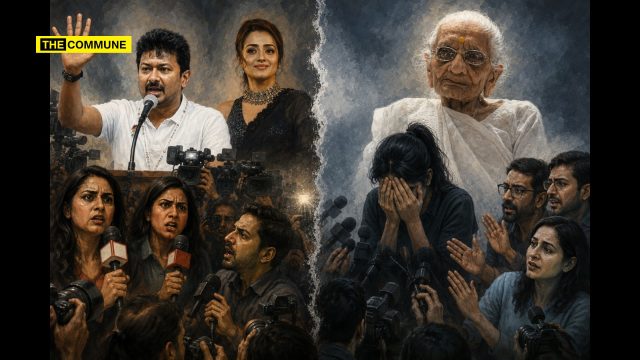
Compare the past seven days in Indian mainstream media, and a pattern falls out that no outlet has had the honesty to name: how loudly the press condemns cruelty toward a woman appears to depend far more on who’s inconvenienced by the outrage than on the cruelty itself.
When Udhayanidhi Stalin delivered a calculated, smirking double entendre about actor Trisha Krishnan at a Thanjavur rally, the coverage was immediate, wall-to-wall, and unsparing. NDTV, India Today, News18, Times of India – every major outlet deconstructed the moment frame by frame, catalogued the nine penal sections filed against him, and gave sustained airtime to condemnation from TVK, BJP, AIADMK, and even Congress’s Karti Chidambaram.
Disgusting, derogatory, and sickening comments by #Udhayanidhi but does it warrant an arrest over speech? The hypocrisy! Slow clap for those applauding this arrest while simultaneously encouraging or excusing the most vile language being directed at girls as young as 15.
— Preeti Choudhry (@PreetiChoudhry) August 4, 2026
Where is the line between offensive speech and a criminal offence? CJP spokesperson @SauravDassss joins @PreetiChoudhry on #TTP to discuss the debate over profanity, free speech, and why he argues that standards of morality are subjective.#FreeSpeech #ZeroFIR #DelhiProtest… pic.twitter.com/VEnzmcoT1v
— IndiaToday (@IndiaToday) July 31, 2026
Will LoP Udhayanidhi apologise for his obscene remark at actor Trisha? At 6pm on @IndiaToday pic.twitter.com/mgsn9f0MCE
— Akshita Nandagopal (@Akshita_N) August 3, 2026
Disappointing to see the TN LoP use such despicable language against a woman. Attack the government all you want, but don’t drag women or their personal lives into political battles. There should be some lines we simply do not cross…..
— Vasudha Venugopal (@Vasudha156) August 3, 2026
Why is the media censoring what Tamil Nadu’s Leader of Opposition Udhayanidhi Stalin said about CM Vijay & Trisha today?
Let everyone hear it. pic.twitter.com/vEulrNuf7D
— Shiv Aroor (@ShivAroor) August 3, 2026
Anchors on camera called it “far too below the belt,” “despicable,” “terrible.” The framing was unambiguous: a powerful man had dragged an unwilling woman into a political fight to score points off a rival, and the press treated that as a serious institutional failure worth days of scrutiny.
That instinct, that dragging a woman into a political dispute to humiliate her is a genuine harm deserving real accountability, is the correct one. Nobody should quarrel with the press holding Udhayanidhi to that standard.
So, it’s worth asking why that same instinct evaporated so completely at Jantar Mantar, when a protester used abusive, sexualised language not about a rival’s family friend, but about a sitting Prime Minister’s late mother. There, the coverage pivoted almost instantly away from the abuse itself and into a story about “state overreach,” online vigilantism, and the dangers of doxxing. Outlets that spent replaying Udhayanidhi’s video clip declined to dwell on what was actually said in Delhi. The story became about protecting the person who said it, not about the person the abuse was directed at.
And where free-speech absolutism was nowhere to be found in the Udhayanidhi case – where the same commentariat that now invokes “FreeSpeech” and “ZeroFIR” hashtags stayed conspicuously silent, it suddenly became the framing of choice once the target was a Prime Minister’s dead mother. India Today ran an entire segment debating “the line between offensive speech and a criminal offence,” featuring a CJP spokesperson arguing that “standards of morality are subjective.” Preeti Choudhry called out the “hypocrisy” of applauding an arrest over speech in one case while excusing “the most vile language being directed at girls as young as 15” in another – a fair point about inconsistency, but one that ran in exactly the opposite direction from where it should have: toward demanding an arrest be justified, not toward demanding the abuse itself be named and reckoned with. The same press that treated Udhayanidhi’s “innuendo” as self-evidently indefensible, requiring no philosophical hand-wringing about where free expression ends, suddenly discovered nuance and civil-liberties concern the moment the target was inconvenient to the prevailing political mood in the room.
To be clear: a minor should never be doxxed, and a child’s home address and phone number being circulated online is genuinely dangerous – the press was right to condemn that, full stop. Nobody is arguing for a teenager to face the legal machinery that came for a sitting Leader of the Opposition. Those are different situations and deserve different responses.
But notice what got lost in that entirely reasonable protective instinct: almost no coverage sat with the actual cruelty of invoking a dead woman – the Prime Minister’s mother, who cannot defend herself and has nothing to do with any policy dispute to score a political point.
The ones who gave the abuses were ‘naughty kids’.
Language matters. No one should call our youngsters names. They are our children, they are the future. Dialogue cannot begin with contempt. At the same time, there is no need to insult anyone with “gau-mutra” lingo. It is absolutely unwarranted. We can protest, disagree and…
— Vasudha Venugopal (@Vasudha156) July 29, 2026
Some naughty kids gave abuses. My mother was abused too. But mistakes happen when you are young. It’s a cultural shock to society but it’s time to direct the kids on the right path. I want to forgive the kids..they are ours..PM Modi in his latest video….
— Vasudha Venugopal (@Vasudha156) July 31, 2026
This is outrageous. Adult men gathering in packs to literally hunt down a young girl. The anger of the entire ecosystem is directed at women who dared to dissent. It has now reached a point where the safety of this girl is under threat. https://t.co/i3YPpJncyK
— Rohini Singh (@rohini_sgh) July 30, 2026
Dear @PMOIndia before you a three term PM play victim please tell us how a man who slandered & defamed women journalists via an anonymous handle here has a tax paid job in the Information & broadcast ministry paid for by us the tax payers. How a Tihar journalist extortion…
— Swati Chaturvedi (@bainjal) August 1, 2026
But girls abusing is a cultural shock…. https://t.co/xDHcJP8CG6
— Rohini Singh (@rohini_sgh) August 1, 2026
When Trisha was invoked, outlets treated the underlying disrespect as the story. When a Prime Minister’s late mother was invoked, outlets treated the backlash to the disrespect as the story. One incident produced a national conversation about political leaders weaponising women for cheap point-scoring. The other produced a redemption arc, complete with folded hands and a “second life” narrative, that closed the book before anyone had to reckon with what was actually said.
The press doesn’t need to choose between compassion for a child and honesty and freedom of expression about what she said. It needed to hold both – the same way it managed to hold both nuance and condemnation in the Udhayanidhi case, covering his arrest as high drama while still detailing the substance of what triggered it. Instead, one incident got sustained scrutiny of the words themselves. The other got scrutiny of everyone except the words.
If demeaning a woman in public life is a story worth days of coverage when the target is a film actor and the offender is a rival politician, it should be exactly as much of a story minus any pursuit of a minor, but not minus the honesty about what was said, when the target is a Prime Minister’s dead mother. Selective outrage isn’t a principle. It’s a tell.
Subscribe to our channels on WhatsApp, Telegram, Instagram and YouTube to get the best stories of the day delivered to you personally.