We thought the decision to scrap Parandur airport project was the worst decision taken by the Joseph Vijay TVK government. But this one new scheme seems to be affecting people a lot more.
Yes, we are talking about the free bus for women – Vettri Payanam scheme launched by the Joseph Vijay government on 2 October 2026.
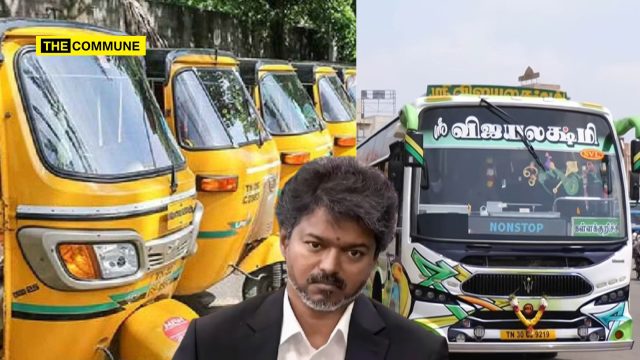
The expansion of the free-bus travel scheme for women is increasingly drawing criticism from private transport operators and auto-rickshaw drivers, who say the policy is severely affecting their earnings and threatening the viability of an already fragile transport ecosystem.
The scheme, originally introduced under the previous DMK government led by MK Stalin, under the name ‘Magalir Vidiyal Payanam’ scheme has now been expanded by the TVK government. While the government presents free travel as a welfare measure for women, private bus operators and auto drivers argue that the expanded scheme is effectively diverting their paying passengers to government buses without providing any corresponding compensation to the private transport sector.
The result is a sharp fall in revenue, mounting financial pressure and a growing threat to thousands of livelihoods.
The controversy comes after the TVK government’s decision to cancel the proposed Parandur greenfield airport, making the free-bus expansion one of the government’s most consequential policy decisions with a direct impact on private infrastructure and livelihoods.
Private Bus Operators Face Revenue Shock
Tamil Nadu has nearly 7,200 private buses, apart from more than 5,000 mini-buses, taking the total private bus ecosystem to around 12,000 vehicles.
Operators say the sector was already under pressure because of rising diesel prices. According to the claims cited in the discussion, private bus operators had already suffered around an 8% decline in revenue before the latest expansion of the free-bus scheme.
They now say that the expanded free travel scheme has resulted in a further and sustained 12% decline in revenue. For a transport business operating on relatively thin margins, even a seemingly modest fall in revenue can have a disproportionate effect on profits. Operators estimate that the decline in revenue could translate into a 42% to 48% reduction in profits.
And the impact does not stop with bus owners.
Private bus operations support an entire network of drivers, conductors, mechanics, workshops, service centres and body-building units. Industry representatives estimate that around 2.2 lakh direct and indirect jobs depend on the private bus sector in Tamil Nadu.
If private buses begin cutting services or shutting down, the consequences could therefore spread well beyond the operators themselves.
From Fewer Trips To Fewer Jobs
The financial pressure is already changing how operators maintain their vehicles, according to the claims made by the sector.
A bus that would previously be sent for servicing after around 60 trips could now be kept on the road for nearly 100 trips because operators are trying to reduce maintenance expenditure amid falling revenues. That creates a chain reaction.
Fewer vehicles being sent for servicing means lower business for service centres. Lower business could eventually mean workforce reductions in workshops and maintenance facilities.
The same pressure can extend to drivers and conductors if operators are forced to reduce the number of services they operate.
Private operators estimate that the sector could face annual losses ranging from ₹600 crore to ₹1,800 crore if the current situation continues.
Their demand is straightforward: if the government wants private buses to transport women under the free-travel scheme, the operators should receive the corresponding fare from the government.
In other words, rather than allowing government buses to compete with private operators using a free-fare model, private operators want the government to compensate them for carrying eligible passengers.
Without such a mechanism, they fear that the combination of rising fuel costs and free government bus travel could gradually make private bus operations financially unviable.
Auto Drivers Are Taking Another Hit
The second group bearing the impact is Tamil Nadu’s auto-rickshaw drivers.
The state’s auto sector was already facing pressure from the rise of bike-taxi services. According to the figures cited by auto drivers, their revenue had already declined by around 12% following the growth of bike taxis.
Tamil Nadu has approximately 3.45 lakh auto-rickshaws, with Chennai accounting for a substantial share. The problem created by the free-bus expansion is different.
Auto drivers say the passengers most likely to shift to free government buses are precisely those who would otherwise use autos for longer journeys.
For example, a passenger travelling 30–40 km who might previously have paid around ₹300 for an auto can now choose to take a government bus without paying a fare. The result, auto drivers claim, is a significant decline in their customer base.
According to the estimates cited by them, auto drivers could be losing around ₹7,200 to ₹8,600 a month. For a driver supporting a family, that is not a minor reduction.
“First 20 Days For EMI, Last 10 Days For Family”
The financial model of an auto driver makes the loss particularly serious. Many drivers who have purchased their vehicles through loans say they spend the first part of every month earning enough to cover their EMIs, which can require them to set aside around ₹25,000–₹30,000.
The income earned during the remaining days is then used for household expenses such as rent, children’s education and groceries. Even before the free-bus expansion, the final days of the month were financially difficult for many drivers.
With passenger numbers falling from the beginning of the month, drivers now fear that they may not even be able to secure the money needed for their monthly loan repayments.
Share-auto operators are reportedly facing an even more difficult situation because their business depends almost entirely on regular passenger movement along specific routes.
For these workers, the issue is therefore not simply about losing a few passengers. It is about whether they can continue to pay their loans and support their families.
But What About The Government Transport System?
The biggest irony is that while private bus operators and auto drivers are taking a hit, the Tamil Nadu government itself is not operating a financially healthy transport system. The state transport corporations are already carrying a massive debt burden.
The figures cited put the Tamil Nadu transport sector’s loan debt at around ₹43,800 crore, with total liabilities estimated at approximately ₹62,642 crore and the overall burden placed at around ₹72,660 crore.
The transport corporations are also already operating at an annual loss of around ₹4,000 crore, according to the figures cited.
Against this backdrop, the expansion of free travel raises another question: how sustainable is the model for the government itself?
The estimated annual impact of the free-travel scheme has been put at around ₹6,400–₹6,800 crore.
Instead of reducing the existing losses of the transport corporations, the policy risks adding another substantial financial burden.
Rising Debt Could Hurt Bus Maintenance
The concern is not limited to accounting figures. A transport corporation carrying tens of thousands of crores in debt requires continuous borrowing to purchase new buses, replace spare parts and maintain its existing fleet. The transport corporations have to regularly spend on tyres, engines, body repairs, servicing and replacement of ageing vehicles.
If their financial position deteriorates further, access to credit could become increasingly difficult. That could create a vicious cycle.
Higher losses → greater debt → higher interest burden → reduced borrowing capacity → lower investment in new buses → deterioration of the existing fleet.
The consequence could eventually be visible to passengers themselves. Instead of replacing ageing buses with newer vehicles, the government could be forced to keep older buses on the road for longer periods because of financial constraints. That would mean poorer maintenance, deteriorating passenger facilities and an ageing public transport fleet.
The Larger Question: Welfare Or Unsustainable Freebies?
The central issue is not whether women should receive support for public transport. The question is who ultimately pays for that support and whether the policy has been designed to protect the larger transport ecosystem.
A welfare programme that reduces the earnings of private bus operators, cuts the income of auto drivers and simultaneously adds to the losses of government transport corporations could end up hurting multiple sections of the same population it is supposed to benefit.
There is also a fundamental difference between providing targeted assistance to those who genuinely need it and making an entire category of services free for everyone, regardless of their ability to pay.
Those who cannot afford public transport should receive support, while passengers who can afford to pay should continue paying for the service. That would allow the government to protect vulnerable sections without completely distorting the economics of the transport sector.
For the TVK government, the challenge is therefore bigger than the popularity of a free-travel announcement. If the policy continues without compensating private operators or addressing the financial condition of government transport corporations, the government could end up weakening private transport, squeezing auto drivers and further burdening its own transport corporations at the same time.
After the cancellation of the Parandur airport project, the free-bus expansion could prove to be another major policy decision whose economic consequences extend far beyond the immediate political benefits.
The question for the Joseph Vijay government is no longer simply whether free travel is popular. It is whether Tamil Nadu can afford the way it is being implemented.
Subscribe to our channels on WhatsApp, Telegram, Instagram and YouTube to get the best stories of the day delivered to you personally.