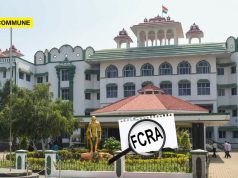
The Madras High Court, while examining the denial of FCRA registration to a Kodaikanal-based trust, has raised concerns over the use of foreign funds for religious conversion and observed that “radical Christian Institutions are notorious for indulging in such activities,” as reported in LiveLaw.
A Division Bench of Justice GR Swaminathan and Justice MD Sumathi made the observations while dismissing an appeal filed by Kanzeon Public Charitable Trust, which runs a Montessori School and a Zen Meditation Centre in Kodaikanal.
The Court upheld the rejection of the trust’s application for registration under the Foreign Contribution (Regulation) Act, 2010 (FCRA), after finding that the trust had failed to correctly disclose its religious character.
However, the Bench specifically clarified that it was not accusing the appellant trust of having any conversion agenda.
Court Flags Conversion As A Concern Under FCRA
While explaining the rationale behind restrictions on foreign contributions to religious organisations, the Court said that unrestricted foreign funding could facilitate religious conversion and potentially affect the country’s sovereignty and secular fabric.
“We are a pluralist nation. Unlike USA, we are not a melting pot but a salad bowl, a beautiful metaphor credited to Justice Ruma Pal. This status quo would be upset, if one religious group gains ascendency. In Kerala, one recently witnessed friction between the Christians and the Muslims. If foreign funds are freely allowed inside to facilitate conversion activities, the sovereignty of the nation would be imperilled. We specifically highlight the issue of conversion because radical Christian Institutions are notorious for indulging in such activities,” the Court said.
The Bench was referring to Section 12(4)(a)(ii) of the FCRA, which deals with eligibility for registration and specifically addresses organisations involved in religious conversion through inducement or force.
The Court stressed that the provision applies across religions and is not directed exclusively at Christian organisations.
“A fundamentalist Hindu Organisation engaged in Ghar Wapsi cannot be registered under FCRA,” it remarked.
Court Links Concern To Foreign Funding
The observations came as the Court examined the government’s argument that FCRA regulation was intended to prevent foreign funds from being deployed for activities such as religious conversion that could affect India’s secular character.
The Court also noted that the person behind the Kanzeon organisation was an ordained Christian priest and that the trust’s meditation centre displayed a Christian cross alongside a Buddha statue. The trust, however, maintained that its activities were not religious and that Zen practices formed part of the Dhyana tradition of India.
The Bench rejected the trust’s attempt to classify itself as non-religious, holding that its own stated adherence to Zen Buddhist philosophy placed it within the broad category of Buddhism.
“The appellant trust claims to subscribe to Zen Buddhist philosophy… The authority rightly states that Zen Buddhism is a variant of Mahayana Buddhist School… Applying the same logic, every Buddhist school will come under the broad umbrella of Buddhism. Zen can be no exception. Since the appellant’s application did not correctly identify its nature as religious, the application was rightly negatived,” the Court said.
“Christianity Is A Messianic Religion”
The Court also made a broader observation about Christianity while discussing the religious character of the organisation.
“One cannot forget the fact that Christianity is a messianic religion. Their theological and religious mission is to bring everyone within the fold of Jesus Christ. There is a saying ‘a leopard will not change its spots’. Unlike Hinduism which is inclusive, the Abrahamic religions are inherently exclusive. The devout Jews, Christians and Muslims believe that theirs is the one true and complete revelation because that is what their Holy books say of themselves,” the Bench observed.
The Court’s observations were made in the context of determining the nature of the organisation and the safeguards governing foreign contributions.
FCRA Registration Is Not A Right
The Court further held that FCRA registration is not an automatic entitlement and that considerable discretion must be available to the authorities while deciding applications.
At the same time, the Bench clarified that religious organisations are not barred from applying for FCRA registration merely because they are religious.
“The appellant need not have been so coy. Section 12 of the FCRA bars only an unregistered religious organisation from accepting foreign contribution. An organisation having a definite religious program is entitled to apply for a certificate of registration from the central government under Sections 11 and 12 of the Act. But one has to make a clean breast of everything. One cannot keep any card up one’s sleeve. This is no game of hide and seek,” the Court said.
The Bench ultimately dismissed the trust’s appeal, holding that its application had correctly been rejected because it had failed to disclose its religious character.
Subscribe to our channels on WhatsApp, Telegram, Instagram and YouTube to get the best stories of the day delivered to you personally.