There is an old rule in our trade: do not watch events, watch the sequence in which they occur. A protest can be spontaneous.
An allegation against the Election Commission is routine in any democracy. Taken one at a time, none of it means anything sinister. But when events start arriving in a familiar order, an analyst who does not ask “where have I seen this before?” is not
doing his job.
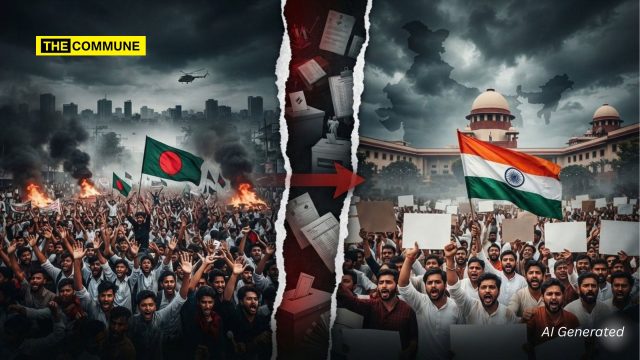
I have seen this order before. It played out next door, and it ended on 5 August 2024 with a Prime Minister leaving her country in a helicopter. Let me be clear. India is not Bangladesh. And
every citizen who questions the Election Commission is not a foreign agent; to say so would be unfair and lazy. My argument is
narrower and more troubling. The method being used on India today is the method that was used on Bangladesh. The template is the same. Only the stage has changed.
How Bangladesh Was Actually Brought Down
The popular story says Sheikh Hasina fell because students protested against job quotas. That is the last chapter, not the book. The book begins in 2014, when the BNP boycotted the election after the caretaker government system was scrapped. It continues in 2018, when the Awami League alliance won a
near-total victory amid allegations of ballot stuffing and intimidation. By January 2024 the opposition boycotted again, and Washington said openly that the election was not free or fair.
Months earlier, the United States had announced visa restrictions on Bangladeshis it accused of undermining the democratic process.
Whatever one thinks of Hasina, a large section of Bangladeshis had stopped believing that a government could be changed through the ballot. That was the dry grass. The quota agitation of
July 2024 was only the matchstick. Students came out, clashes followed, people died, the internet was shut. Then came the moment every student of destabilisation should mark in red.
The Supreme Court cut the quota drastically. The original demand was substantially met. The protests did not stop.
The movement was no longer about quotas. It was about the deaths, the police, the regime. Within a fortnight there was one demand: Hasina must go.
The Template
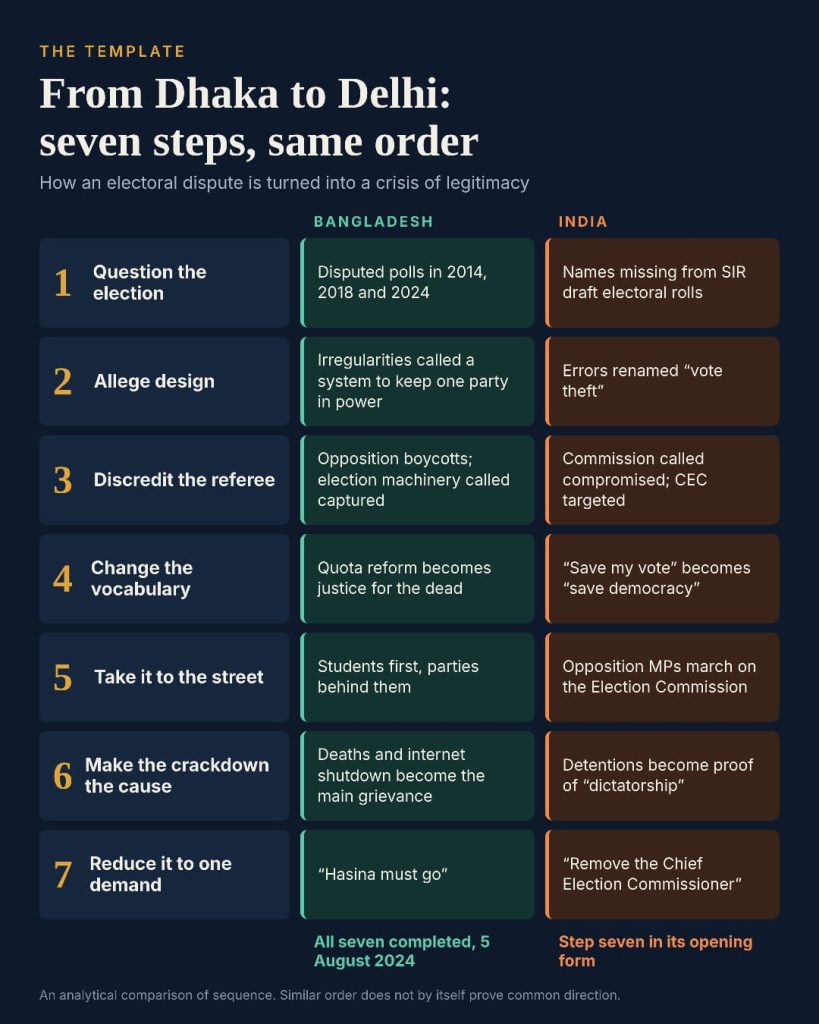
Strip away the local colour and Bangladesh gives us seven steps.
#1 Question the election. Irregularities are alleged.
#2 Allege design. They are said to be deliberate, and to favour the ruling side.
#3 Discredit the referee. The election body is declared captured.
#4 Change the vocabulary. A technical dispute is renamed a battle for democracy.
#5 Take it to the street. Students, civil society and parties converge.
#6 Make the crackdown the cause. Police action becomes a bigger grievance than the original one.
#7 Reduce it to one demand. A person must go.
Bangladesh completed all seven.
India Has Seen A Rehearsal
This is not the first time the method has been tried here. In 2019, the Citizenship Amendment Act took citizenship from no Indian. Its text only fast-tracked citizenship for persecuted minorities from three neighbouring countries. Yet on the street it was presented as a law that would make Indian Muslims stateless.
How? A hypothetical about a future nationwide NRC, which was never notified, was sold as a present fact about CAA. The anxiety was real; the claim was not. And it travelled the full circuit: campus, hashtag, Shaheen Bagh, foreign editorial, and back home as “global concern”.
That was the trial run. The distrust was aimed at Parliament’s law. This time it is aimed at the institution that conducts our elections, which is a far more valuable target.
Now Place India Beside Bangladesh
Take the seven steps one at a time.
Step 1: Question the election
In Bangladesh it began with complaints about how elections were run: who supervised them, and who was kept away from the booths. In India it has begun with the Election Commission’s Special Intensive Revision of electoral rolls. Large numbers of names went missing from the draft rolls. The questions here
are legitimate. A voter wrongly deleted is a citizen wronged, and he is entitled to an answer.
Step 2: Allege design
The second step is a change of one word: error becomes intent. In Dhaka, irregularities were soon described as a system built to keep one party in power. In India, the missing names stopped being called mistakes. They became “vote theft”. Note what this does. A mistake can be corrected by the same office that made it. A theft needs a thief, and so the argument now needs a culprit.
Step 3: Discredit the referee
The culprit is the referee. Bangladesh’s opposition declared that no election held under the existing arrangement could be fair, and
boycotted. In India, reports emerged that Election Commissioners Sukhbir Singh Sandhu and Vivek Joshi had recorded objections to
decisions associated with Chief Election Commissioner Gyanesh Kumar. Overnight the question changed from “are the rolls accurate?” to “is the Commission compromised?” Once the
referee is called partisan, every decision he takes, right or wrong, becomes suspect.
Step 4: Change the vocabulary
Watch the slogans. In Bangladesh, quota reform became justice for the dead, and then “Hasina must go”. In India, “vote theft” became “save my vote”, and “save my vote” became “save
democracy”. Each slogan is wider than the last. A voter-list dispute interests only those whose names are missing. “Save democracy” recruits everyone. A dispute about lists has become a
referendum on the Republic.
Step 5: Take it to the street
Then the streets. Opposition MPs marched on the Election Commission. Barricades went up. Leaders were detained.
Step 6: Make the crackdown the cause
Within hours the detentions themselves became the headline, the new proof of “dictatorship”. Dhaka knew this multiplier well: the state’s
response becomes a bigger grievance than the issue that started it.
Step 7: Reduce it to one demand
And now the single demand: remove the Chief Election Commissioner. This is step seven in its opening form. The spark differs: quotas there, voter rolls here. Everything after it matches. Anyone who calls this coincidence should explain why the order is
identical.
The Invisible Grid
This is what I call the Invisible Grid. Do not imagine a dark room with ten men deciding tomorrow’s headlines. Modern influence is not so crude. It works through a network: political outfits, activist groups, NGOs, student bodies, lawyers, academics, digital
influencers, friendly journalists, think tanks, diaspora organisations, international advocacy groups and the funding that keeps them running. Each node has its own motive. Many have never met. They do not need to. Their narratives converge.
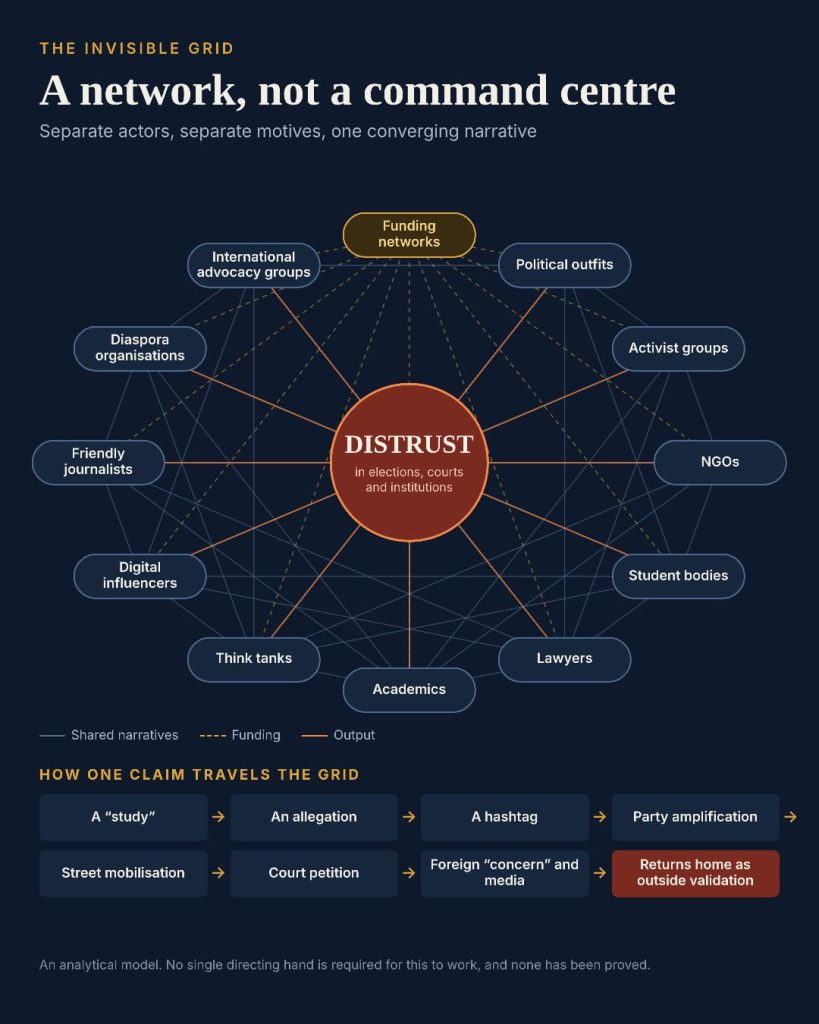
One produces a “study”. Another turns it into an allegation. A third makes it a hashtag. Parties amplify it, influencers simplify it, activists mobilise on it, lawyers carry it to court. International organisations express “concern”. Foreign newspapers report that Indian democracy is “under strain”. And that report returns to Indian social media as outside certification that the system is rotten.
The Grid’s product is not protest. Its product is distrust. Protest is only what distrust looks like once it reaches the road. A word of caution, because my critics will demand it and they are right to. That one command centre directed Dhaka and now directs Delhi is yet to be proved. Hasina blamed foreign powers; that is her allegation, not established fact. But a grid does not need a
commander. It needs a template that works and people willing to run it. The template worked in our neighbourhood. It was rehearsed here in 2019. It is being run again.
Where India Differs
There is one decisive difference. In Bangladesh every institutional exit had been sealed. People trusted neither the election nor the courts, so politics moved to the street.
In India the exits are open. The Supreme Court is examining the matter. It has not struck down SIR. It has not found “vote theft”. It has not held the CEC guilty of anything. Rolls can be corrected, objections filed, names restored. That is exactly why the real target is not the voter list. It is the belief that these remedies mean anything. Convince enough Indians that the Commission is captured and the courts are useless, and the street becomes the only court left.
What India Must Do
The answer is not to crush criticism. That was Dhaka’s mistake, and every lathi blow there fed step six.
The answer is sunlight. Publish the deletion data. Explain every exclusion. Restore genuine voters quickly. Allow lawful protest. Let the Court finish its work. Alongside, investigate the network: follow the money, the organisations, the personnel and the timing, and see who appears at every stage.
Two mistakes will hurt us equally. One is to treat every critic as an enemy. The other is to ignore an influence operation because some of its foot soldiers have genuine complaints.
Modern political warfare is not fought over territory. It is fought over trust. Destroy enough of it and no invasion is needed. The country starts fighting itself.
Bangladesh did not fall when its students came out on the road. It fell when its people stopped believing that any institution could give them justice.
That is the line. India must not be walked across it.
AK works for Global MNC having 25+years of exp in BFSI Risk&Fraud Analytics in Cybersecurity. Founder @dharmic_indians and Governing committee member of @AalayamKaappom
Subscribe to our channels on WhatsApp, Telegram, Instagram and YouTube to get the best stories of the day delivered to you personally.