The Vijay government asked for six months before it was judged. That time is up. Measured against its own promises, the record shows quick welfare announcements but little progress on education, law and order, finances, jobs, or clean politics.
On 10 May 2026, C. Joseph Vijay was sworn in as Chief Minister of Tamil Nadu. His party, the Tamilaga Vettri Kazhagam (TVK), had won 108 of the 234 Assembly seats and about 35 per cent of the vote in its very first election. Ten seats short of a majority, it formed the government with the support of the Congress, the VCK, the IUML and the MDMK, while the CPI and CPI(M) backed it from outside. It won the confidence vote on May 13 with 144 votes. From the start, the government asked the people to give it at least six months before judging its performance. That period ended on November 10. It is a fair moment to ask a simple question: what has the government done with the mandate it received? Measured against its own promises, the answer is uncomfortable.
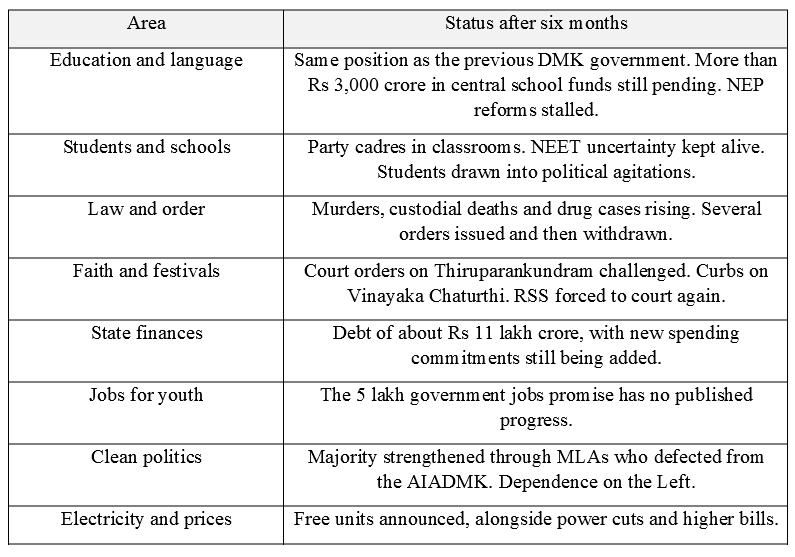
The Six-Month Report at a Glance
 The Same Old Script
 The Same Old Script
Many voters, especially first-time voters, backed TVK expecting a break from the DMK’s style of politics. Education was the natural place to show that difference. Instead, on May 19, just nine days after taking office, School Education Minister A Rajmohan said Tamil Nadu would continue with only Tamil and English in its schools, calling the two-language policy “TVK’s declared ideology”. He said the government would study the conditions of the Centre’s PM SHRI scheme before deciding whether to join it. On June 18, the Governor’s address to the Assembly, which sets out a new government’s policy, went further. The government would strongly oppose the National Education Policy (NEP) 2020, continue to seek exemption from NEET, and work to move education from the Concurrent List to the State List. At the NITI Aayog Governing Council, the Chief Minister asked for Samagra Shiksha funds of Rs 3,284 crore to be released without conditions, and repeated the NEET demand. These are exactly the positions the DMK government held from 2021 to 2026. The party in power has changed; the education policy has not. The cost falls on children. Samagra Shiksha is the main central scheme that funds school infrastructure, teacher training, inclusive education, and free textbooks and uniforms in government schools; the Governor’s address itself put the amount due to Tamil Nadu at Rs 3,458 crore. PM SHRI upgrades existing government schools into model schools with better laboratories, libraries and digital classrooms. As long as the standoff continues, it is children in government schools, mostly from poorer families, who go without.
The government’s objection rests on the idea that a third language means forcing Hindi on Tamil Nadu. NEP 2020 says otherwise. It states that no language will be imposed on any State, and that the three languages a child learns will be chosen by States, regions and students themselves, with at least two native to India. A student in Tamil Nadu could just as well learn Tamil, English and Malayalam, Telugu or Kannada. Nor is the idea new: it goes back to the University Education Commission of 1949, chaired by Dr S Radhakrishnan, and was adopted nationally in 1968. There is also a contradiction close to the Chief Minister. Vijay Vidyashram, a CBSE school owned by Vijay, has been reported to follow a three-language pattern that includes Hindi. If a third language is useful for children in private CBSE schools, families in government schools may fairly ask why their children should be denied the same choice.
The language row also hides a larger loss. NEP 2020 is not only about languages. Its core reforms include play-based foundational learning in the early years, teaching in the mother tongue at least up to Class 5 (which Tamil Nadu should welcome), a flexible 5+3+3+4 school structure, and vocational exposure from Class 6. By rejecting the framework wholesale, the government keeps all of these away from its own students. On NEET, it has chosen slogans over preparation. Vijay has said that scrapping NEET is “the only way out”, a position analysts note is identical to the DMK’s. No State can abolish a national examination on its own. Every year, students in Tamil Nadu are told the exam may go, and every year they must still sit it. Keeping that false hope alive is playing with their futures.
Worse, the government’s party has treated schools as stages for publicity. On Vijay’s birthday, June 22, TVK workers held celebrations in schools in which children were reportedly made to raise political slogans; the Madras High Court issued notice to the government on July 9, and the School Education Department issued a circular the next day barring political celebrations on campuses. Even so, a TVK union secretary and more than 20 party workers walked into a government school classroom near Uthiramerur in Kancheepuram district during class hours, hung up a portrait of the Chief Minister and filmed reels. The functionary was expelled only after a public outcry. Parents have since complained of cadres entering elementary schools in Chengalpattu and Tiruttani to film reels with students, with teachers forced to go along. Meanwhile, the Madurai Bench of the High Court had to order the government to stop government schools from collecting question paper fees from students, a fee that had officially been abolished.
Governance: orders, Debts and Pending Promises
TVK campaigned hard on women’s safety and on ending police excesses. Six months on, the record is worrying. On Diwali day, November 8, about ten people, including a police Special Sub-Inspector, were killed in separate incidents across the State, and at least 17 murder cases were reported over November 8 and 9. The opposition has called the government’s new women’s-safety initiative, “Singappen”, weak in practice. In October, an attack on a family at Mudalur near Sathankulam in Thoothukudi district left a 39-year-old woman dead. Just as revealing is how decisions are made. The government issued an order exempting the Public (Law and Order) department from the Right to Information Act, and it was withdrawn after criticism.
Custodial deaths, which Vijay himself protested against on the streets of Chennai as an opposition leader when he was outside the power politics, have continued under his own government, with Vijay also holding the Home portfolio. In July, 24-year-old N Arunachalam of Thoothukudi died after arrest, with his family alleging assault in custody. It was the fourth alleged custodial death in the State within five weeks. The human rights organisation People’s Watch has said that eight people died in police custody or prison during the government’s first 100 days, and questioned why the State Human Rights Commission took no action on its own. The drug trade has also come close to the ruling party: opposition leaders have pointed to the arrest of a TVK union secretary in Vedaranyam for smuggling ganja, and of another TVK functionary for alleged methamphetamine manufacture.
The State’s finances tell a similar story. Soon after taking office, Vijay said Tamil Nadu was burdened with debt of over Rs 10 lakh crore and that the treasury had been “completely emptied”. The government’s June white paper said direct debt had nearly doubled in five years, from Rs 4.8 lakh crore to almost Rs 10 lakh crore, and that the revenue deficit had grown from Rs 46,538 crore to Rs 78,324 crore. The August 5 budget then put outstanding debt at Rs 10.98 lakh crore and the revenue deficit at Rs 55,775 crore, with a fiscal deficit of Rs 1,21,819 crore, or 3 per cent of GSDP. Two official documents painting different pictures within two months is itself a concern. Economists had estimated that the TVK manifesto would cost close to Rs 1 lakh crore a year. Yet new commitments keep coming: a one-gram gold ring for every baby born in a government hospital, an eight-gram gold coin with a silk saree for eligible brides, and a crop loan waiver of up to Rs 75,000 per farmer covering 14.43 lakh farmers. Each scheme may be welcome on its own, but together they add to a debt that every family in Tamil Nadu will eventually help repay.
For young people, the biggest promise has seen the least progress. TVK promised five lakh new government jobs, five lakh paid internships, and up to Rs 4,000 a month for unemployed graduates. Six months later, there is no published progress on any of the three. The government signed 97 memoranda of understanding worth a proposed Rs 67,542 crore at its investment conclave, claiming employment potential for over one lakh people. But MoUs are also promises, and no tracking has been offered of how many projects have begun or how many jobs actually exist. Even the much-advertised free electricity, raised from 100 to 200 units for eligible households, has come alongside unannounced power cuts, higher bills, increased property taxes and costly spot-market power purchases.
Faith, Festivals and Freedom
On matters of faith, too, the new government has followed the old one. In December 2025 and again in January 2026, the Madras High Court allowed devotees to light the Karthigai Deepam at the Deepathoon, the ancient stone lamp pillar atop Thiruparankundram hill in Madurai. In opposition, TVK had dismissed the dispute as “shadow boxing” between the DMK and the BJP. In power, it filed an appeal in the Supreme Court on June 11, barely a month after taking office. On August 3, the Supreme Court refused to stay the High Court’s orders and questioned the State’s delay in pursuing its appeal.
During Vinayaka Chaturthi in September, Hindu organisations faced a series of conditions: a mandatory no-objection certificate for temporary electricity connections to pandals, conditions on immersion processions, and, according to Hindu Munnani, restrictions on women and children taking part. In Tirunelveli, police seized Vinayaka murtis, saying they were made of Plaster of Paris. In Tiruppur, devotees had to go to the High Court, which on September 10 directed the police to permit a murti installation, holding that worship is a fundamental right.
The Rashtriya Swayamsevak Sangh, which has had to fight in court every year for permission to hold route marches in Tamil Nadu, found nothing had changed. In October 2026, its North Tamil Nadu secretary told the Madras High Court that the police had issued no directions after his application to the DGP on October 3. On October 16, the court directed the police not to reject such applications by citing religious structures, traffic, or the presence of organisations with differing views, and warned them against delaying decisions. That a court must keep repeating this to the police is itself a comment on the government.
Politics of Numbers
Releasing his manifesto, Vijay told voters: “I will not cheat people with false promises. Not a paisa of public money will be misused.” Yet the new politics he promised has quickly turned into the old one. Within three weeks of the results, two AIADMK MLAs, P Sathyabama of Dharapuram and Maragatham Kumaravel of Madurantakam, resigned from the Assembly and joined TVK, helping a government that was short of a majority. Both won the October 6 by-elections on TVK tickets. In Dharapuram, Sathyabama’s margin fell to 9,471 votes, from 16,727 when she won as an AIADMK candidate in May; in Madurantakam, Kumaravel won by 19,241 votes.
The alliance itself is under strain. The CPI and CPI(M), which keep the government afloat from outside, fielded their own candidates against TVK in both by-elections, and have warned that they could reconsider their support if major decisions continue to be taken without consulting them. The Congress objected publicly after senior TVK leader K A Sengottaiyan projected Vijay as a possible Prime Minister candidate for 2029. On November 11, the Chief Minister called his MLAs to a resort in Mahabalipuram for one-on-one meetings, where they were reportedly urged to stay loyal and resist inducements, amid fears of a no-confidence motion. A government that should be focused on governing is spending its energy protecting its numbers.
Tamil Nadu voted for change in May 2026. Six months later, it has the DMK’s education policy, the DMK’s approach to temples and festivals, the old parties’ politics of defection, and a law and order record that worries ordinary families. The government still has four and a half years. The first test of whether it means to change is simple: put the students of Tamil Nadu ahead of its politics.
Induchoodan Ramesh is the National Convener of the SHoDH Foundation and a Central Working Committee member of the Akhil Bharatiya Vidyarthi Parishad.
Subscribe to our channels on WhatsApp, Telegram, Instagram and YouTube to get the best stories of the day delivered to you personally.