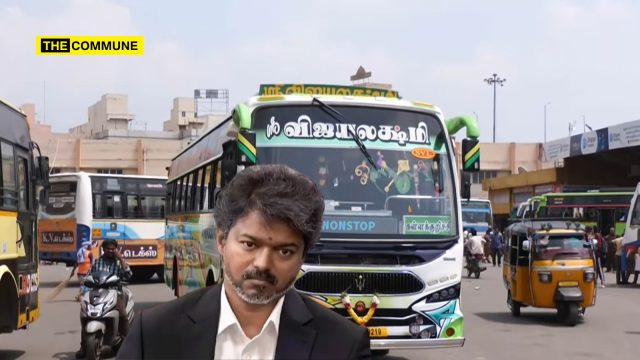
The TVK government’s expanded Vettri Payanam free bus travel scheme for women has triggered growing concern among private bus operators and workers, with private buses reportedly witnessing a revenue decline of up to 50 per cent in the first three days of its implementation.
The scheme was launched by Chief Minister C. Joseph Vijay on 2 October 2026, coinciding with Gandhi Jayanti. While private bus workers say they do not oppose the objective of providing free travel to women, they have raised concerns over the impact of the scheme on their livelihoods.
Periyasamy, State Secretary of the Tamil Nadu Private Bus Drivers and Conductors Association, speaking to Tamil Janam said the decline in collections had directly affected the daily allowances paid to drivers and conductors. According to him, workers who previously earned around ₹800 a day were now receiving as little as ₹300 in some cases.
The association represents a workforce of more than two lakh employees whose livelihoods depend on the private bus sector. Workers fear that continued losses could force operators to withdraw buses from service, leaving thousands of drivers, conductors and their families without an income.
Workers Warn Of Buses Being Taken Off Roads
According to the association, private bus owners may be able to absorb losses for a few days by funding operations from their own pockets. However, if the revenue decline continues for 10 to 15 days, operators could find it impossible to meet expenses such as diesel, wages and other operational costs.
Workers said some buses had already been parked because their daily collections were reportedly insufficient even to cover fuel expenses. They warned that if owners begin permanently or temporarily stopping services, the impact would extend beyond the operators to the workers and their families.
The association said the private bus workforce had already faced severe financial difficulties during the COVID-19 pandemic and subsequently due to the earlier Vidiyal Payanam free travel scheme. Workers now fear that the expanded Vettri Payanam scheme could deepen the crisis.
They pointed out that private buses had traditionally attracted significant numbers of passengers, including women, but the expansion of free travel has resulted in passengers shifting towards government buses.
The association said the impact had become visible within days, with women reportedly choosing government buses specifically because they could travel without paying fares.
Private Bus Permits Lose Value
The crisis has also reportedly affected the value of private bus route permits across Tamil Nadu.
A private bus permit on the Salem-Attur route, which had previously commanded a value of up to ₹4 crore, is now reportedly being offered for around ₹1.5 crore. Even at that price, there are reportedly no buyers.
A similar situation has been reported in the Hosur region of Krishnagiri district, one of Tamil Nadu’s major private bus operating hubs because of its proximity to Karnataka. Route permits that were earlier valued at around ₹10 crore are now reportedly being offered for less than ₹1 crore, with no takers.
The sector has around 5,000 private buses, and workers fear that a prolonged revenue crisis could result in a large number of vehicles being sold or taken off the roads.
Workers Seek Subsidy, Welfare Support
The drivers and conductors have urged the state government to intervene before the crisis worsens.
Among their demands is a mechanism to compensate private bus operators for the revenue loss caused by the free travel scheme. They have also suggested that the government either extend a similar subsidy or free-travel compensation mechanism to private operators or provide direct financial support to ensure that the services remain viable.
Workers have also highlighted the absence of adequate welfare and insurance coverage.
According to the association, private bus drivers and conductors do not have access to a dedicated welfare board or comprehensive insurance protection. In the event of a worker’s death due to an accident or health emergency, families may receive only limited funeral assistance from the employer, with no assured welfare support.
The association has therefore sought rehabilitation measures and formal welfare protection for the workforce, arguing that thousands of families depend entirely on private bus employment for their livelihood and their children’s education.
Strike Threat Looms
Private bus operators had earlier announced a one-day strike over the impact of the free travel scheme but subsequently withdrew the proposal. Workers have also staged protests, claiming that their concerns have not received adequate attention from the government.
The drivers and conductors’ association has now indicated that it plans to hold discussions with private bus owners before deciding on its next course of action. If the talks fail, the association has warned that a one-day strike could be held.
Workers have maintained that the survival of drivers and conductors is directly linked to the financial viability of the private bus operators. They have warned that if owners are forced to stop services because of mounting losses, the consequences will be felt by the entire workforce.
Private Operators Move High Court
The dispute has also reached the Madras High Court, with private bus operators challenging the state’s free bus travel scheme for women.
As reported by MoneyControl, the petitioners have sought a stay on the implementation of the scheme and its withdrawal across Tamil Nadu. They have claimed that the scheme has caused substantial financial losses to private bus operators and questioned how the government intends to compensate them for the loss of fare revenue.
The operators have also challenged the legal basis of allowing women to travel without paying fares and raised concerns about the increasing financial burden on the state.
The petitioners have further alleged that the expanded scheme was implemented without a formal government order and have questioned the legal basis for its continuation.
Vettri Payanam Expanded Across Tamil Nadu
Chief Minister C. Joseph Vijay launched the expanded Vettri Payanam scheme on October 2 at the Koyambedu Bus Terminus in Chennai by issuing zero-fare tickets to women passengers.
The scheme was originally announced by the Chief Minister under Rule 110 in the Tamil Nadu Assembly on August 24. It aims to ensure that women are not denied social and economic opportunities because of transport costs.
Before the latest expansion, free travel for women was available on ordinary city and town buses and on services covering up to 40 km in hilly areas.
The expanded scheme now covers Express, Limited Stop Services, Deluxe, Suburban Ordinary or Mofussil Ordinary, and Ghat Ordinary services travelling beyond 40 km, operated by Tamil Nadu’s seven State Transport Corporations.
Following the expansion, 12,695 buses are expected to operate around 1,68,500 single trips every day under the scheme. The government estimates that approximately 84.32 lakh women passengers will benefit from the initiative daily.
While the government has positioned Vettri Payanam as an expansion of women’s access to affordable public transport, private bus operators and workers argue that the financial consequences for their sector need to be addressed alongside the welfare objectives of the scheme.
Subscribe to our channels on WhatsApp, Telegram, Instagram and YouTube to get the best stories of the day delivered to you personally.