Two-bit film reviewing Tamil YouTuber and political turncoat Prashanth Rangaswamy has once again demonstrated the dangers of speaking with absolute confidence about subjects one clearly does not understand.
As Elon Musk pushes for Starlink’s entry into India, Rangaswamy has been busy parroting the billionaire’s claims, dismissing legitimate security concerns as “hypocrisy” and making wildly exaggerated claims about satellite technology wiping out India’s mobile operators.
His argument is not merely technically flawed. It displays a staggering inability to distinguish between personal data privacy, telecommunications infrastructure and national security.
Elon Musk had been repeatedly posting about why Starlink must be in India.
Unfortunately, we are being blocked by certain oligarchs in order to maintain their monopolistic chokehold on the Indian people. You can guess who they are …
This is a crime against the people of India!
— Elon Musk (@elonmusk) October 7, 2026
🇮🇳 Starlink will help the least-served in India 🇮🇳
— Elon Musk (@elonmusk) October 8, 2026
Starlink saves lives during natural disasters
— Elon Musk (@elonmusk) October 8, 2026
After Musk repeatedly posted about Starlink’s entry into India, Rangaswamy took to X and wrote, “80% of Indians life time data from photos to private messages are sitting in huge servers located in America. And Indians are suddenly worried about @starlink breaching their privacy ! Hypocrisy at its best !!”
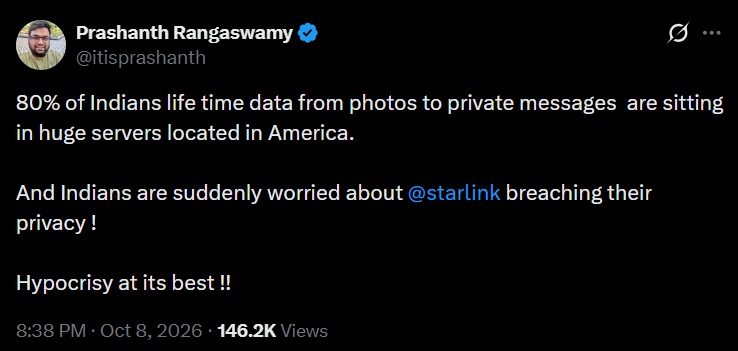
This is the sort of argument one makes when one has no serious answer to the actual question.
If some Indian users’ personal data is already stored on servers in the United States, does that mean India should stop worrying about every other security vulnerability? By that logic, because one door is unlocked, the sensible response is to leave every door in the house wide open.
The argument is idiotic because it conflates two entirely different things. Data stored by online platforms and a foreign-controlled satellite communications network are not the same security issue. The former raises questions about data access, privacy and jurisdiction. The latter also raises questions about communications infrastructure, network control, traffic routing, lawful interception and the ability of Indian authorities to enforce the law.
An existing vulnerability is not an argument for creating another. It is an argument for fixing both.
Yet Rangaswamy seems to believe that pointing out one potential privacy problem somehow demolishes every concern about Starlink. It does nothing of the sort. He has not answered the security argument. He has simply pretended it does not exist.
Worse, by reducing objections to Starlink to “hypocrisy”, he effectively asks Indians to stop questioning a powerful American corporation because their data may already be exposed elsewhere. That is not a defence of technological progress. It is a spectacularly careless attitude towards national security.
From Film Reviews to Satellite Engineering: Confidence Without Comprehension
Rangaswamy did not stop there. Musk’s remarks about Indian oligarchs protecting their monopolies where he named Mukesh Ambani caught everyone’s attention.
Starlink is licensed in over 165 countries and has spent five years complying with every single law and requirement of the government of India, so why still no license?
Is Ambani the real boss of India?
— Elon Musk (@elonmusk) October 8, 2026
Taking this opportunity again, the film reviewer jumped in, eagerly pushing the narrative that Starlink was being blocked because it threatened the telecom industry.
He wrote, “Starlinks V2 satellite has the capability to connect direct to phone and give seamless and high quality voice and data service irrespective of the terrain. This is what Ambani is afraid off . Just a chip alteration in the phone and all smartphones will be able to connect to the satellite link. Whole mobile operators will be wiped out. Hence they are making every effort to stop Starlink .”
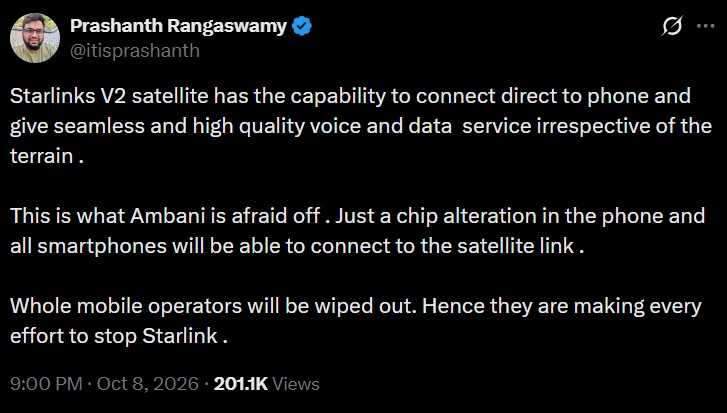
Almost every part of this argument is either exaggerated or presented without the qualifications necessary to make it meaningful.
Starlink’s Direct to Cell technology can connect compatible, ordinary LTE smartphones to satellites without requiring a special satellite phone. But that does not mean every smartphone can obtain seamless, high-quality voice and data connectivity everywhere. Satellite connectivity faces limitations involving capacity, coverage, line of sight and the availability of compatible services.
Nor does the technology automatically render terrestrial mobile networks obsolete. Satellite connectivity can extend service to remote areas and locations without conventional coverage. It is not a magic replacement for the dense network infrastructure needed to serve millions of people in busy cities.
Rangaswamy’s claim that a simple chip alteration will connect all smartphones to Starlink, followed by his prediction that the entire mobile industry will be wiped out, is not serious technological analysis. It is breathless speculation dressed up as expertise.
He has taken a real technological development, stripped away its limitations and presented Musk’s commercial ambitions as an inevitable revolution that India’s telecom industry is desperately trying to suppress.
That is precisely why technical claims should be examined rather than blindly repeated.
Has He Forgotten 26/11?
Perhaps the most disturbing aspect of Rangaswamy’s argument is his casual dismissal of the security concerns surrounding communications technology.
India has already paid an appalling price for failing to prevent terrorist operations. During the 26/11 Mumbai attacks, the terrorists and their handlers used communications technology, including satellite phones, to coordinate and maintain contact during the assault.
That history does not prove that Starlink will be used by terrorists. But it should make any responsible commentator understand why the government must scrutinise communications systems before allowing them to operate.
Satellite networks can provide valuable connectivity during emergencies and when conventional infrastructure fails. Those same strategic capabilities make questions of control, monitoring, jurisdiction and potential misuse important.
A network’s ability to provide connectivity across difficult terrain is a technological advantage. It is not, by itself, a guarantee that every security concern has been resolved.
And no, pointing out that Google, Meta or other technology companies may store data abroad does not answer any of these questions.
National security is not a game of “someone else already has our data, so let everyone in.”
India must assess each system on its own risks and merits. If Starlink meets the necessary security requirements, its services can be considered on that basis. If it does not, the commercial pressure to launch should not override those requirements.
That is not hostility towards American technology. It is the minimum responsibility of a sovereign government.
Is Prashanth Naive Or Just Stupid?
The pattern is glaring. Musk accuses Indian ‘oligarchs’ of blocking Starlink, and Rangaswamy parrots the monopoly narrative. Indians raise security concerns, and he dismisses them as hypocrites.
His argument that Indians should not worry about Starlink because their personal data is already stored on American servers is breathtakingly stupid. An existing security vulnerability is not a justification for creating another. Personal data storage and foreign-controlled satellite communications infrastructure raise different security concerns.
His claim that a simple chip alteration will enable seamless satellite connectivity on every smartphone and wipe out mobile operators is equally exaggerated, exposing his ignorance of the technology he confidently promotes.
Rangaswamy is entitled to support Starlink, but repeating Musk’s commercial grievances is not expertise, and a foreign billionaire’s business interests are not India’s national interests. After 26/11, dismissing communications security concerns so casually is particularly reckless.
Subscribe to our channels on WhatsApp, Telegram, Instagram and YouTube to get the best stories of the day delivered to you personally.