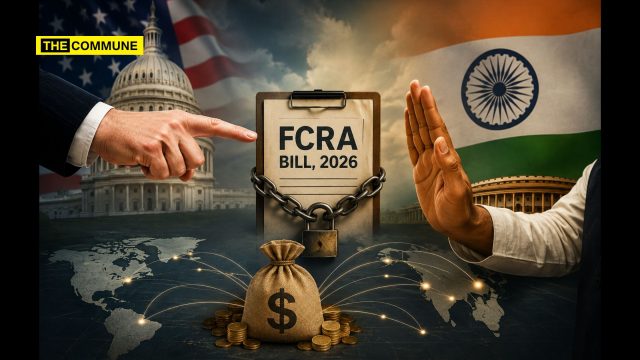
As US Congressman Riley Moore criticised India’s proposed amendments to the Foreign Contribution (Regulation) Act (FCRA), alleging they would enable government takeovers of churches and religious charities, the remarks have triggered a broader debate over what critics describe as Washington’s double standards on regulating foreign funding.
The criticism comes even as the United States, along with several other democracies including the United Kingdom, Australia, Canada, Israel, Singapore and members of the European Union, enforces stringent laws governing foreign influence, foreign agents and overseas funding.
While the US has objected to India’s proposed FCRA amendments, countries across the democratic world have enacted legislation requiring registration, disclosure and, in many cases, imposing criminal penalties for undisclosed foreign influence activities.
US Lawmaker Calls FCRA Amendments ‘Attack Against Christians’
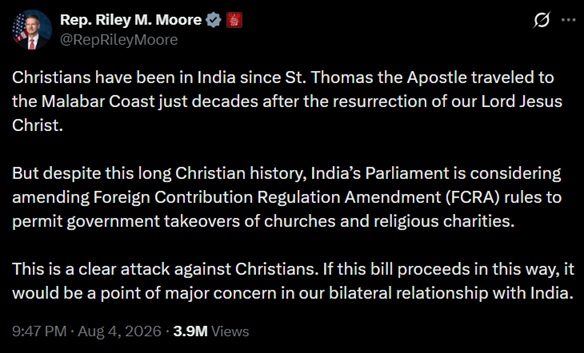
Republican Congressman Riley Moore of West Virginia criticised the proposed amendments in a post on X, claiming they would allow the Indian government to take over churches and religious charities.
Referring to Christianity’s long history in India, Moore said Christians have been present in the country since the arrival of St. Thomas the Apostle on the Malabar Coast.
He described the proposed amendments as “a clear attack against Christians” and warned that if enacted in their present form, they could become “a point of major concern” in India-US bilateral relations.
What the Proposed FCRA Amendment Seeks to Do
As reported in NDTV, the Foreign Contribution (Regulation) Amendment Bill, 2026, expected to be introduced during the Monsoon Session of Parliament, proposes the creation of a Designated Authority to manage foreign contributions and assets created through foreign funding when an organisation’s FCRA registration is cancelled, surrendered or expires due to non-renewal.
The Bill further states that where such assets include a place of worship, the Designated Authority must preserve its religious character while managing the property.
The proposed legislation also reduces the maximum punishment for FCRA violations from five years’ imprisonment to one year, effectively lowering the penal consequences under the Act.
Similar Laws Exist Across Democracies
Moore’s criticism has prompted comparisons with foreign influence laws already in force across several democratic countries.
The United States enforces the Foreign Agents Registration Act (FARA), which requires individuals acting on behalf of foreign principals in political or lobbying activities to register and publicly disclose their activities. Violations can attract both civil and criminal penalties, including imprisonment.
Australia operates the Foreign Influence Transparency Scheme Act, 2018, requiring disclosure of activities undertaken on behalf of foreign principals to influence political or governmental processes.
The United Kingdom has introduced the Foreign Influence Registration Scheme (FIRS) under the National Security Act, mandating registration of certain political influence arrangements involving foreign powers.
Canada recently enacted the Foreign Influence Transparency and Accountability Act, establishing a public registry for individuals acting on behalf of foreign principals to influence governmental decision-making.
The European Union has proposed the Defence of Democracy Package, which would require entities representing the interests of third countries to register and disclose their activities. The proposal complements the EU Transparency Register and broader anti-money laundering and counter-terror financing framework, with enforcement backed by penalties, asset freezes and national laws across member states.
Israel’s NGO Transparency Law requires organisations receiving the majority of their funding from foreign governments to publicly disclose such funding in official communications and reports.
Singapore’s Foreign Interference (Countermeasures) Act (FICA) empowers authorities to counter foreign interference through disclosure requirements, restrictions on foreign funding, removal of hostile online content and criminal penalties for violations.
USA OPPOSES #FCRA Laws REGULATING FOREIGN MONEY IN INDIA
but
Every Country controls foreign money by law, just some examples pic.twitter.com/TzKPwoLt9m
— Ishkaran Singh Bhandari (@ishkarnBHANDARI) August 5, 2026
India’s proposed framework is consistent with international practices adopted by several democracies to regulate foreign funding, ensure transparency and safeguard national interests.
Foreign Funding Under FCRA
According to data from the Ministry of Home Affairs, 13,520 organisations received ₹55,741 crore in foreign contributions between 2019 and 2022.
The FCRA portal shows that as of 15 July 2026, India had:
- 14,449 active FCRA registrations
- 22,498 cancelled registrations
- 15,212 registrations deemed expired
The proposed amendments are expected to be debated in Parliament in the coming days, with the legislation likely to generate discussion over the balance between national security, regulation of foreign funding, religious freedom and India’s sovereign authority to oversee organisations receiving overseas contributions.
Subscribe to our channels on WhatsApp, Telegram, Instagram and YouTube to get the best stories of the day delivered to you personally.