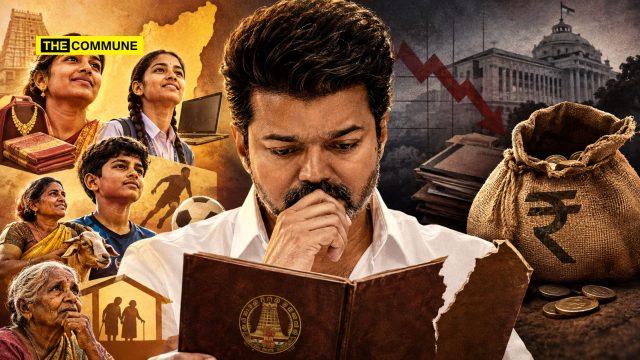
The TVK government’s maiden Budget under Chief Minister C. Joseph Vijay has been widely publicised for unveiling a host of welfare schemes targeting women, students, fisherfolk, senior citizens, sportspersons and other sections of society. While the announcements have generated significant attention, questions arise over several of the flagship promises whether they are backed by adequate financial allocations, as many of the schemes appear fiscally unviable when compared with the number of intended beneficiaries.
Do the allocations announced in the Budget match the scale of the promises being made?
Marriage Assistance Scheme: 8 Grams of Gold and Silk Saree
Among the Budget’s biggest announcements was a revised marriage assistance scheme under which every eligible bride would receive eight grams (one sovereign) of gold along with a silk saree as part of the traditional Annan Seer.
The government has presented the scheme as the fulfilment of its electoral commitment, expanding upon the earlier Thalikku Thangam (gold for thali) scheme that has existed in Tamil Nadu since 2011, albeit with interruptions over the years.
However, the Budget allocation raises serious questions about implementation.
The Budget earmarks ₹812 crore for the scheme.
According to estimates, Tamil Nadu records nearly six to seven lakh marriages every year. Based on prevailing gold prices, providing eight grams of gold alone to every beneficiary would require an estimated ₹6,000-7,000 crore annually.
Once the cost of the promised silk saree is added, the total requirement is estimated to rise to nearly ₹4,500 crore even under conservative calculations, with some estimates placing the overall expenditure significantly higher depending on beneficiary numbers and market prices.
So, the question naturally arises – how can a scheme projected to require several thousand crore rupees be implemented with an allocation of just ₹812 crore?
Comparison With Previous Marriage Assistance Scheme
One can compare this scheme with the same scheme of the previous governments.
The State allocated approximately ₹720 crore in 2024 for providing four grams of gold under the earlier marriage assistance programme.
At the time, gold prices stood at around ₹77,000 per 10 grams.
Since then, gold prices have nearly doubled to approximately ₹1.45 lakh per 10 grams.
Now if ₹720 crore was considered necessary for distributing four grams when gold prices were substantially lower, promising eight grams plus a silk saree today would require allocations running into several thousand crore rupees rather than the ₹812 crore provided in the Budget.
International Sports Training Scheme
Another announcement that has drawn scrutiny is the government’s proposal to identify talented children and provide them with international-level sports training.
The Budget allocates ₹5 crore for the initiative.
The allocation appears insufficient when viewed against the scale of competitive sports in Tamil Nadu.
There are nearly 25,000 to 35,000 students who compete annually at the State level, while another 3,000 to 4,000 participate in national-level competitions.
Based on those numbers, critics argue that the allocation translates into only a few thousand rupees per athlete, questioning whether such funding can realistically provide international-standard coaching, infrastructure, equipment and exposure.
They argue that while the announcement has been widely publicised, the financial commitment does not appear proportionate to the stated objective.
Women’s Goat and Sheep Distribution Scheme
The Budget also announced a livestock distribution programme under which eligible women would receive five goats or sheep.
The proposed beneficiaries include:
- Widows
- Destitute women
- Differently-abled women
- Transgender persons
The eligible population far exceeds the financial allocation.
Tamil Nadu roughly has:
- Around 35 lakh widows
- Nearly 4-5 lakh destitute women
- Around 3.75-4 lakh differently-abled women
- More than one lakh transgender persons, besides those yet to be registered
Based on these figures, the total eligible population at approximately 48 lakh people.
However, the Budget allocates ₹110 crore for the scheme.
Even if only the most economically vulnerable beneficiaries were selected, the allocation would remain inadequate.
Purchasing livestock for all intended beneficiaries would require approximately ₹6,800-8,000 crore, while the present allocation would cover only around 30,000 beneficiaries, representing less than one per cent of the estimated eligible population.
The criteria that will be adopted to identify beneficiaries from such a large pool of eligible applicants is also questionable.
Library Modernisation Programme
The government also announced plans to modernise public libraries across Tamil Nadu, highlighting libraries as an important component of educational development.
The Budget allocates a paltry ₹10 crore for the initiative for a state that has more than 4,600 public libraries.
The allocation works out to roughly ₹21,000 per library, or around ₹2,000 per month if spread across a year.
Such an amount would be insufficient even for basic infrastructure upgrades, acquisition of new books or technological improvements, raising questions about how meaningful modernisation can be achieved.
Laptop Scheme for College Students
The Budget also announced the provision of laptops for college students.
The State has allocated ₹2,000 crore for the programme and there are approximately 35 lakh college students in TN.
Based on these numbers, the allocation amounts to roughly ₹5,000 per student, raising the question whether laptops can realistically be procured and distributed at that cost.
While the announcement has received considerable publicity, the Budget does not clearly explain how the scheme will be implemented or whether all eligible students will actually benefit.
Old-Age Home Initiative
The government has also proposed expanding institutional support for senior citizens through old-age homes.
The Budget allocates ₹6 crore for the programme.
Now, Tamil Nadu has approximately 1.35 lakh elderly persons requiring institutional care, particularly those living alone or without family support. It is very evident that the allocation is insufficient not only for constructing facilities but also for operating them.
Would it be adequate to establish and maintain old-age homes across the State, given the size of the intended beneficiary population?
Several Schemes Are Rebranded Versions of Existing Programmes?
It is alleged that many of the welfare initiatives announced in the Budget are not new schemes but existing government programmes that have simply been renamed with the “Vetri” prefix. The government has reportedly rebranded older initiatives instead of introducing substantive new welfare measures.
Budget a Publicity Exercise?
The government seems to be prioritising publicity over meaningful allocations. Several schemes widely promoted after the Budget received allocations of just ₹3 crore, ₹5 crore, ₹10 crore and ₹25 crore, and such amounts are absolutely insufficient to deliver the promises being advertised.
Sections of the media also very merrily highlighted the announcements without examining whether the allocations were adequate to implement the schemes on the scale promised.
Budget’s Financial Credibility
There is a mismatch between the promises made and the funds allocated. Several flagship welfare schemes lack the financial backing required for statewide implementation and it is unclear how the government intends to cover all eligible beneficiaries with the allocations announced.
Unless allocations are proportionate to the number of beneficiaries and the actual cost of implementation, the schemes risk remaining announcements on paper rather than translating into tangible benefits.
Subscribe to our channels on WhatsApp, Telegram, Instagram and YouTube to get the best stories of the day delivered to you personally.