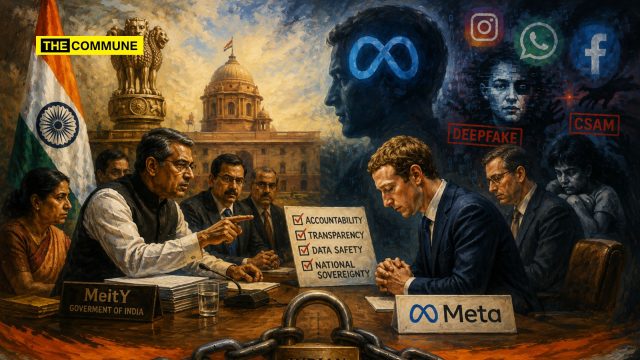
On 5 August 2026, in the Meta-MeitY showdown, Meta CEO Mark Zuckerberg officially tendered an apology to the Government of India. But this wasn’t just a corporate email or a PR statement. It was a high-stakes, 45-minute face-to-face showdown at the MeitY headquarters in New Delhi, and the details coming out are wild.
Here is a structured, data-driven breakdown of what went down, the structural threats India is facing from these tech monopolies, and whether pulling the plug on them is actually the answer.
The New Delhi Showdown
The confrontation culminated today when a high-level global delegation from Meta, flying in directly from Washington and led by Chief Global Affairs Officer Joel Kaplan, was grilled by MeitY Secretary S. Krishnan and top IT officials. The government immediately rejected Meta’s initial written excuses attributing the recent restriction on the Prime Minister’s verified account to a routine “technical glitch,” demanding absolute accountability for overriding an authorized head-of-government communication.
What Really is the Issue? (The Hidden Data)
While the immediate spark was a 3-day ultimatum issued by the Parliamentary Standing Committee on IT regarding the 5-hour automated block of Prime Minister Narendra Modi’s video addressing students on the NEET controversy, MeitY broadened the scope to force an admission on far more dangerous systemic failures.
When you look at the raw numbers, the scale of what these social media (SM) platforms are failing to control on Indian cyberspace is staggering:
The Censorship ‘Glitch’: Meta’s automated machine-learning systems wrongfully flagged and hid an official VVIP broadcast, showing a random “withheld due to a legal request” screen to millions of Indian netizens.
The CSAM Nightmare: According to data discussed during the briefing, India remains one of the largest global targets for the proliferation of Child Sexual Abuse Material (CSAM). Tech platforms are consistently failing to deploy localized hashes to intercept this content before it circulates on encrypted apps like WhatsApp and Instagram.
Deepfakes as a Service: Over the last year, India has witnessed a massive surge in hyper-realistic, AI-generated synthetic media targeting public figures, financial institutions, and elections.
The Apology and the Admissions
Because the Parliamentary Panel led by BJP MP Nishikant Dubey held a firm, uncompromising line, the Meta delegation abandoned their standard corporate talking points and made major admissions during the closed-door session today:
Admission of Wrongful Action: Meta formally admitted that the block on the Prime Minister’s account was a “serious error” and acknowledged that their machine-learning systems acted “wrongfully” with an overzealous automated loop.
The Revenue Admission: Meta executives explicitly admitted that rogue actors had successfully paid money to exploit their ad-review safety infrastructure, allowing harmful synthetic content and deepfake scams to bypass security protocols because the platform accepted the ad revenue.
Expressing Regret: The global delegation expressed deep regret for the operational lapse, explicitly stating that “India remains an incredibly important country for Meta” and confirming that their automated protocols should never have bypassed standard operating parameters for verified public safety messages.
The Ongoing Structural Threats India Faces
The Modi video glitch is just a symptom of a much larger disease. India’s digital ecosystem faces continuous, evolving threats from unregulated SM algorithms:
Algorithmic Bias & Foreign Interference: These platforms are built on Western code and ethics. When a Silicon Valley algorithm arbitrarily decides what constitutes “free speech” or “misinformation” in an Indian context, it strips an elected Indian government of its communication channels while amplifying coordinated, cross-border psychological operations.
The Weaponization of Fake News: Fact-checking infrastructure on these platforms for regional Indian languages is practically non-existent. A fake video or a morphed audio clip can trigger real-world law and order situations in tier-2 and tier-3 cities within minutes, long before a human moderator in Menlo Park even looks at the report.
Sovereign Leverage: By controlling the digital town square of over 800 million Indian internet users, a handful of foreign tech executives hold asymmetric leverage over India’s geopolitical narratives, narrative warfare, and internal policy debates.
Next Steps and What Else GoI Can Do
The verbal admissions made today are only the beginning of a strict enforcement roadmap laid out by New Delhi:
The 3-Day Ultimatum Stands: The Parliamentary Standing Committee is maintaining its strict deadline. Mark Zuckerberg must personally submit an unqualified, written apology within 3 days. Failure to do so will result in the immediate withdrawal of Section 79 Safe Harbour protection, legally reclassifying Meta from an “intermediary” to a “publisher” and exposing its global executives to direct criminal prosecution under Indian law.
The Mandatory VVIP Manual Bypass: Meta has agreed to immediately implement a separate, permanent manual human-review tier for high-profile public, verified state, and government accounts to ensure AI automated takedowns can never block a state communication again.
Mandatory Forensic Audit: Meta must submit a comprehensive, step-by-step forensic technical audit to MeitY within the week detailing the exact algorithmic gaps that allowed paid deepfakes and CSAM to bypass their systems.
But Is This Enough?
GoI needs to go further than just demanding apologies:
Sovereign Source Code Audits: India should mandate that any platform with over 10 million users must submit its core recommendation and moderation algorithms for independent, sovereign auditing by Indian cybersecurity agencies.
Local Data & Infrastructure Mandates: Complete data localization isn’t just about privacy; it’s about control. Platforms must maintain localized engineering and moderation hubs within Indian jurisdiction that are legally bound to act within hours of a state directive.
Heavy Financial Penalties linked to Revenue: Currently, fines are capped at nominal amounts under the IT Act. India should mimic the EU’s GDPR or Digital Services Act, penalizing systematic compliance failures with fines up to 4% to 6% of the platform’s global annual turnover. That is the only language Big Tech truly understands.
Is Banning or Restricting the Right Choice?
Whenever a standoff like this happens, the immediate reaction on our feeds is: “Just ban them!” But is pulling the plug a correct decision?
A complete ban is a double-edged sword. On one hand, it abruptly cuts off foreign leverage and protects national security during critical hyper-sensitive periods. We saw how effectively India handled the TikTok ban by replacing it with domestic alternatives.
On the other hand, a permanent blanket ban on platforms like WhatsApp or Instagram would completely disrupt India’s thriving creator economy, digital MSMEs, and localized businesses that depend entirely on these networks for customer acquisition. It risks painting India as an authoritarian digital regime to global investors, potentially slowing down tech capital inflows. Restrictions, targeted throttling of bandwidth, or the complete removal of Safe Harbour immunity are far more surgical and effective weapons. Stripping Section 79 makes the platform legally responsible for the filth it hosts, forcing them to clean up their act rather than forcing the government to shut down the digital town square.
Closing with Open Questions
As we watch this geopolitical chess match play out over the next 72 hours, we need to ask ourselves some serious questions about the future of our internet:
If Western nations believe so deeply that disclosure and strict tracking are prerequisites for democratic health on their own soil through laws like FARA, why do they resist it so fiercely when India demands accountability through FCRA and MeitY directives?
If overseas tech giants have nothing to hide in their algorithms, why are they so terrified of sovereign, independent source-code audits?
At what point does a global social media platform stop being a neutral digital utility and officially become an instrument of foreign ideological interference?
AK works for Global MNC having 25+years of exp in BFSI Risk&Fraud Analytics in Cybersecurity. Founder @dharmic_indians and Governing committee member of @AalayamKaappom
Subscribe to our channels on WhatsApp, Telegram, Instagram and YouTube to get the best stories of the day delivered to you personally.