Personal faith is constitutionally protected. But a Budget, the Speaker’s Chair and the Chief Minister’s Office belong to citizens of every faith.
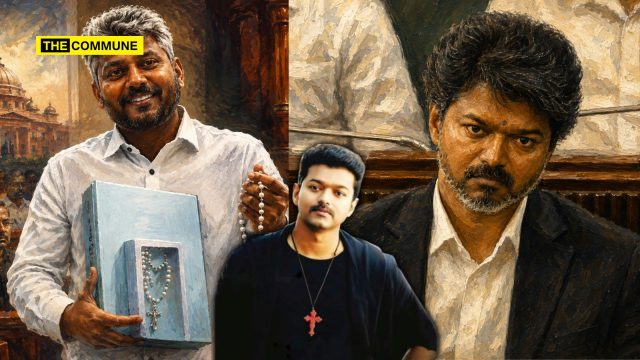
When Tamil Nadu Finance Minister N. Marie Wilson entered the Legislative Assembly to present the TVK Government’s first full Budget on 5 August 2026, attention was naturally expected to remain on the State’s finances. Instead, viral visuals showed him carrying what appeared to be a Christian rosary alongside the Budget documents. Reports also noted the rosary’s presence, while footage circulating online appeared to show the Minister making the sign of the cross before commencing his speech.
Had this been an isolated and entirely private expression of faith, it would scarcely have merited a political controversy. Ministers do not surrender their religious freedom upon assuming office. A Christian minister may carry a rosary, just as a Hindu may wear rudraksha or vibhuti, a Muslim may wear a prayer cap, and a Sikh may observe the articles of his faith.
But the question becomes more serious when religious symbolism repeatedly enters spaces and ceremonies that are unmistakably governmental.
Earlier, Tamil Nadu Assembly Speaker J.C.D. Prabhakar reportedly began proceedings from the Speaker’s Chair by quoting a passage from the Bible. The Speaker is not merely another legislator expressing a personal opinion. Once seated in the Chair, he represents the entire House and must conduct its proceedings on behalf of members belonging to every religion and those professing none.
A separate controversy arose over what critics identified as a cross-like symbol placed on Chief Minister C. Joseph Vijay’s official desk. Whether deliberately positioned as a religious symbol or not, the controversy demonstrated how even the appearance of denominational identification can acquire constitutional significance when it forms part of an official government setting.
Viewed separately, each incident may be defended as personal expression. Viewed together, however, they raise a legitimate question: Is the new Tamil Nadu Government sufficiently conscious of the religious neutrality demanded by constitutional office?
Secularism Does Not Mean That Ministers Must Be Atheists
The objection cannot be that Christians are participating visibly in public life. That would itself be contrary to the Constitution.
Article 25 protects the freedom of conscience and the right freely to profess, practise and propagate religion. These protections extend to ministers, Chief Ministers and Speakers as individuals. The Constitution does not require a public servant to erase his identity, conceal his beliefs or behave as though faith does not exist.
Indian secularism has never meant hostility towards religion. It means that the State itself cannot acquire a religion or accord preferential identification to one faith.
In S.R. Bommai v. Union of India, the Supreme Court recognised secularism as part of the Constitution’s basic structure. More recently, the Court reiterated that the State maintains no religion of its own and must extend equal freedom to citizens irrespective of their religious beliefs.
That distinction is crucial. The Finance Minister may be Christian; the Tamil Nadu Budget cannot be Christian. The Speaker may read the Bible privately; the Speaker’s Chair cannot become a Christian pulpit. The Chief Minister may retain his faith; the Chief Minister’s Office cannot acquire a denominational identity.
Not Every Impropriety Is Immediately Unconstitutional
It would be legally inaccurate to claim that merely holding a rosary while presenting the Budget automatically violates the Constitution. Article 27 prohibits compelling citizens to pay taxes whose proceeds are specifically appropriated for promoting or maintaining a particular religion. No such direct use of public revenue has presently been established merely from the Minister’s gesture.
But constitutional governance is not confined to conduct that can immediately be struck down by a court.
Conventions, institutional restraint and public perception also matter. A constitutional authority may act in a manner that is not technically illegal but remains improper because it creates a reasonable perception that the State is aligning itself with one religious identity.
The Budget is among the most important secular instruments of government. It determines how money collected from Hindus, Christians, Muslims, Sikhs, Jains, Buddhists, atheists and others will be spent. Carrying a distinctly religious object together with that document and performing a religious gesture immediately before presenting it, inevitably merges personal devotion with an official constitutional act.
The Minister was free to pray before leaving his residence, inside a place of worship or privately within his office. The objection arises when the religious act becomes part of the public presentation of the State Budget.
Would The Reaction Be The Same For A Hindu Symbol?
The controversy also exposes Tamil Nadu’s deeply selective political vocabulary on secularism.
Had a BJP Finance Minister entered the Assembly carrying a Bhagavad Gita, performed an elaborate Hindu prayer and then presented the Budget, the event would almost certainly have been described by Dravidian commentators as “saffronisation”, “majoritarianism” or a threat to constitutional secularism.
Had a Speaker commenced Assembly proceedings by reciting verses from the Bhagavad Gita, demands for his removal might already have arisen.
Christian symbolism, by contrast, is often treated as harmless personal faith even when displayed within an official institutional setting. This double standard cannot be defended as secularism. Neutrality must operate equally, irrespective of whether the religious symbol is a cross, a rosary, a rudraksha, a Quran or a sacred Hindu text.
The principled objection is therefore not anti-Christian. It is anti-preferential.
The Same Rule Must Apply To Tirupati Too
Consistency also requires acknowledging another recent incident. Tamil Nadu Agriculture Minister R. Vinoth reportedly took the Agriculture Budget document to the Tirumala temple and offered prayers while holding it. That, too, attracted controversy.
The answer to Christian symbolism in official spaces cannot be greater Hindu symbolism in competing official spaces. Constitutional neutrality cannot become a contest in which every minister ceremonially dedicates a government document to his preferred deity.
A Budget document is prepared by public officials, funded by taxpayers and presented to a constitutional legislature. It should neither be taken to a temple as though it were a religious offering nor accompanied into the Assembly by denominational ritual.
Personal prayer is protected. Official sacralisation is not desirable.
The Government Must Establish A Neutral Convention
Chief Minister Vijay’s Government should not dismiss these concerns as communal criticism. It should instead adopt a simple and universally applicable convention:
Official government ceremonies, legislative proceedings, Budget presentations, press backdrops and institutional offices must remain religiously neutral. Ministers may freely practise their faith in their personal capacity, but religious objects and rituals should not be incorporated into the performance of official constitutional duties.
The Speaker should avoid opening proceedings with scripture belonging to any particular religion. The Chief Minister’s official desk should display the Constitution, the national flag, the State emblem or culturally inclusive material—not a symbol reasonably capable of being interpreted as the Government’s religious identification.
The Finance Minister need not apologise for being Christian. But he must appreciate that, while presenting the Budget, he was not appearing as a private devotee. He was speaking for the Government of Tamil Nadu.
The State Has No Rosary, Rudraksha Or Religion
The Constitution protects a believer’s right to carry his faith. It simultaneously requires the State to maintain sufficient distance from every religion.
Tamil Nadu’s leaders are entitled to pray. They are entitled to enter churches, temples and mosques. They may read the Bible, Bhagavad Gita or Quran in their private lives. What they cannot afford to do is allow personal devotion to become the visual language of constitutional authority.
A rosary in a minister’s pocket is personal faith. A rosary displayed alongside the State Budget creates a public constitutional question.
The TVK Government must understand that distinction before repeated symbolism hardens into an institutional pattern. Tamil Nadu belongs equally to the devout Hindu, Christian, Muslim, adherent of every other faith, agnostic and atheist. Its Government must therefore look and act as though it belongs to them all.
Shailendar Karthikeyan is the Editor of Nyayavimarsha.
Subscribe to our channels on WhatsApp, Telegram, Instagram and YouTube to get the best stories of the day delivered to you personally.