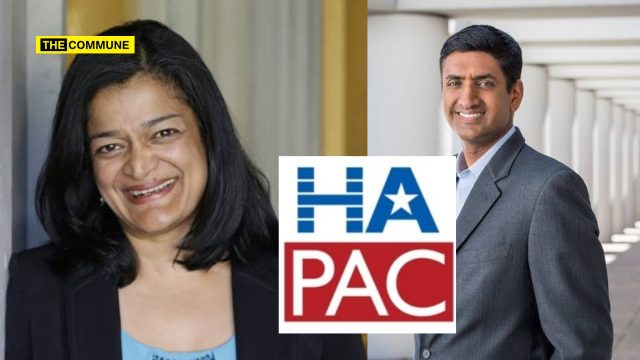
The campaign against the Rashtriya Swayamsevak Sangh (RSS) has now moved into American campaign finance.
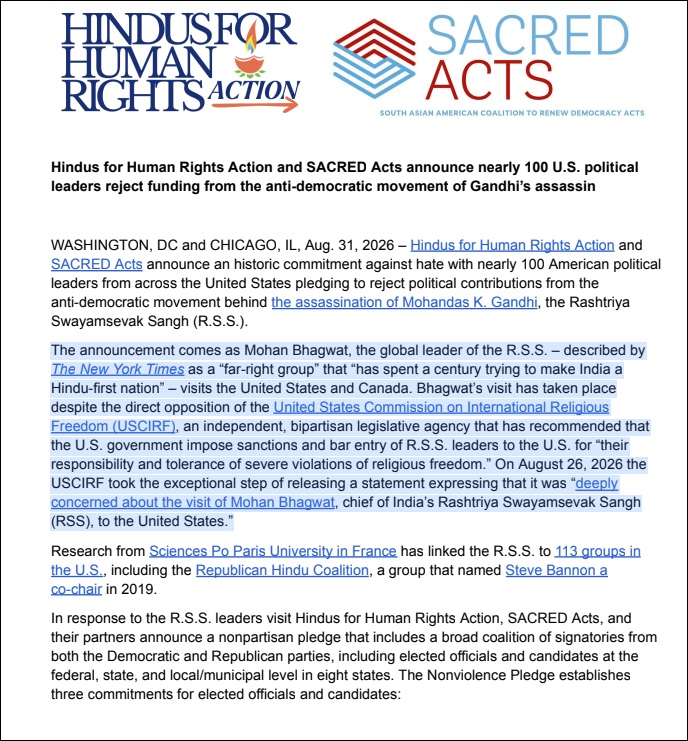
Nearly 100 US politicians and candidates have signed a pledge promoted by Hindus for Human Rights Action and SACRED Acts, committing themselves to reject political contributions allegedly linked to the RSS, its affiliates or its supporters, as reported in OpIndia.
The pledge was announced on August 31, shortly after RSS chief Mohan Bhagwat’s visit to the United States and his appearance at New York City’s Madison Square Garden.
The signatories include members of Congress, state legislators, mayors, local elected officials and candidates across eight states, from both Democratic and Republican circles.
The six-page pledge makes three commitments: rejecting political violence and intimidation, refusing donations linked to the RSS and its affiliates, and returning or redirecting such contributions to organisations described as supporting democracy.
Hindus for Human Rights Action and SACRED Acts also called on American political leaders to support a US Commission on International Religious Freedom (USCIRF) recommendation for sanctions against RSS leaders and restrictions on their entry into the United States.
Hindu-American Groups Push Back
The pledge has triggered a sharp response from Hindu-American organisations.
Hindu American PAC accused the organisers of singling out Hindu-American donors and argued that the campaign effectively creates a political loyalty test for American Hindus.
The organisation said Hindu Americans were being asked to prove that they had no links to an organisation that the pledge’s organisers oppose, while no comparable scrutiny was being imposed on donors from other communities.
It urged Hindu Americans to review the list of politicians who had signed the pledge, reconsider political contributions to them and demand that the campaign be rejected.
The criticism also focuses on the wording of the pledge. It does not simply target direct donations from the RSS. It extends to affiliates and individuals deemed to be connected to the organisation.
That raises a basic question: who determines whether an American Hindu donor is “RSS-linked”?
US campaign funding can move through individuals, PACs and organisations. There is no simple RSS label attached to a donor’s contribution. Yet the pledge could potentially subject donors to scrutiny based on their associations, political views or support for Hindu organisations.
SACRED Acts Executive Director Pushkar Sharma has claimed that individuals linked to the RSS funnelled at least $2.5 million into political campaigns in Illinois over the past decade. The organisation describes this as support for an “anti-democratic, extremist agenda”.
Hindu-American groups dispute this framing and say legitimate Hindu political participation should not be treated as suspicious merely because a donor supports Hindutva or associates with Hindu organisations.
🚨@hinduampac is issuing an alert that in response to pressure from radical far left outfits with a record of anti-Hindu targeting, the listed political candidates have pledged NOT to accept contributions specifically from certain Hindu American citizens. 🧵
— Hindu American PAC (@hinduampac) September 2, 2026
SACRED Acts And Its Political Network
SACRED Acts, or the South Asian American Coalition to Renew Democracy, first launched its Nonviolence Pledge in Illinois in 2023.
The initiative was backed by groups including the Indian American Muslim Council (IAMC), Asian American Midwest Progressives, India Civil Watch International and Hindus for Human Rights.
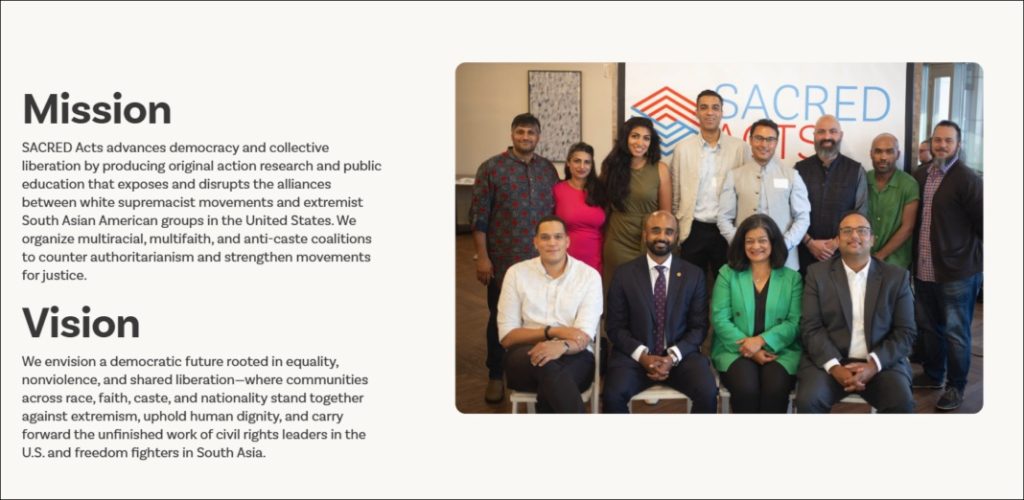
Since then, the pledge has attracted around 90 officials and candidates across federal, state and local races. The latest campaign has expanded that effort to nearly 100 signatories.
Hindus for Human Rights Action, the political advocacy arm of Hindus for Human Rights, was publicly launched in 2026. It describes itself as a movement seeking to protect democracy, human rights and pluralism while opposing caste and Hindu nationalism.
Its critics, however, point to the organisation’s close cooperation with groups such as IAMC and its repeated campaigns against the RSS, the Modi government and policies associated with Hindutva.
Hindus for Human Rights has also endorsed an IAMC petition seeking the revocation of Bhagwat’s US visa, arguing that allowing him to enter would undermine America’s commitment to religious freedom and minority safety.
USCIRF Joins The Campaign
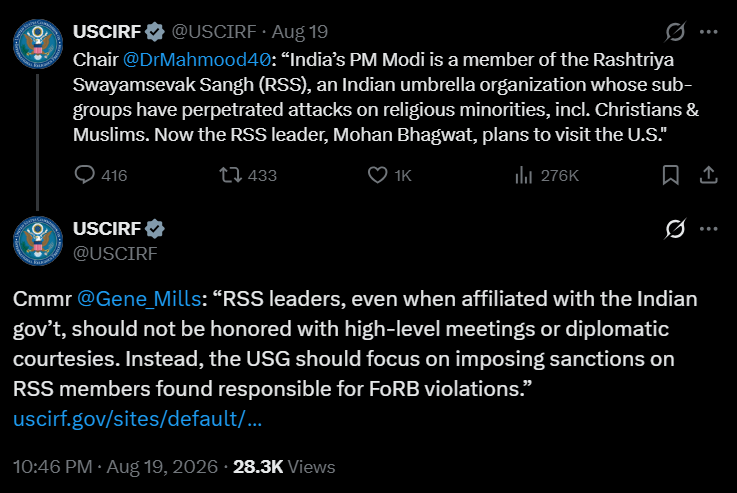
The pledge came amid a parallel campaign by USCIRF against the RSS.
Ahead of Bhagwat’s visit, USCIRF called for sanctions against RSS members and argued that RSS leaders should not receive diplomatic courtesies or high-level meetings in the United States.
USCIRF Commissioner Gene Mills called for sanctions against RSS members allegedly responsible for religious-freedom violations.
The organisation has also repeatedly criticised India and recommended that Washington designate India as a “Country of Particular Concern” over alleged religious-freedom violations.
The Indian government has rejected such assessments, describing USCIRF as a biased organisation with a record of making disparaging and inflammatory remarks against India.
Bhagwat nevertheless proceeded with his US visit and addressed the Madison Square Garden event.
The failure of efforts to stop his appearance has now been followed by a different strategy: targeting the financial relationship between American politicians and donors considered sympathetic to the RSS.
The Signatories
Among the prominent signatories are Democratic Congresswoman Pramila Jayapal, Congressmen Ro Khanna and Robin Kelly, California Senator Aisha Wahab, Michigan Senate candidate Abdul El-Sayed, New York congressional candidate Brad Lander and former Seattle City Council member Kshama Sawant.
Several of these politicians have previously taken positions that have drawn criticism from sections of the Indian and Hindu-American communities.
Jayapal has been a vocal critic of the Indian government, including its handling of Jammu and Kashmir and the Citizenship Amendment Act. She was also among US lawmakers who in 2026 called for the release and trial of activist Umar Khalid in connection with the 2020 Delhi riots case.
Aisha Wahab was the sponsor of California’s SB 403, which sought to explicitly add caste to the state’s civil-rights protections. The legislation faced strong opposition from sections of the Hindu-American community before Governor Gavin Newsom vetoed it in 2023.
Kshama Sawant, during her tenure on the Seattle City Council, backed resolutions attacking India’s Citizenship Amendment Act and National Register of Citizens and later supported the inclusion of caste as a protected category in Seattle’s anti-discrimination framework.
Ro Khanna Returns $6,600 Donation
Among the signatories, Ro Khanna has already taken concrete financial action.
Khanna said he was returning a $6,600 contribution from what he described as a “pro-MAGA, billionaire with ties to the RSS”.
“I’m proud to lead on this pledge,” Khanna said, claiming the RSS sought to influence US elections.
Khanna has previously maintained links with sections of the Hindu-American community and received campaign contributions from Hindu-American donors.
His political positions on India and Hindutva have nevertheless attracted criticism from Hindu-American activists.
In 2019, Khanna urged American politicians of Hindu faith to “reject Hindutva”, presenting it as incompatible with pluralism. Critics have accused him of reducing a complex Indian civilisational and political concept to a caricature.
Khanna has also supported positions critical of the Indian government and has engaged with groups and activists campaigning on issues such as Kashmir, the CAA and caste.
His decision to return the $6,600 contribution therefore raises another question: if a donor is being rejected because of alleged RSS links, what exactly constitutes such a link: organisational membership, political support, ideological sympathy or simply association with Hindu causes?
Targeting RSS, Or Targeting Hindu Americans?
The campaign against the RSS has now entered American campaign finance, with politicians pledging to reject donations from people deemed to have links with the organisation or its affiliates. But who decides who is “RSS-linked”? The pledge leaves that determination open, creating the possibility of Hindu-American donors being singled out and scrutinised over their beliefs, associations or political views.
Hindu American PAC has called out the pledge as discriminatory, arguing that no other American community is being subjected to such a loyalty test. The issue is therefore bigger than the RSS. It is about whether Hindu Americans can participate in American politics without being forced to prove that they are sufficiently “acceptable” because of their religious or ideological associations.
This cannot stand.
Nearly 100 political candidates—all @TheDemocrats—have signed a pledge that they will investigate all campaign contributions from Hindu American citizens to check if they have “ties to the RSS.”
No other American citizens’ contributions will be scrutinized.… https://t.co/n4tKOIx3eD
— Suhag A. Shukla (@SuhagAShukla) September 2, 2026
For a campaign that claims to defend democracy, singling out Hindu-American donors for ideological scrutiny raises an uncomfortable question: is this really about opposing the RSS, or is it about policing the political participation of Hindu Americans?
Subscribe to our channels on WhatsApp, Telegram, Instagram and YouTube to get the best stories of the day delivered to you personally.