About 72 hours ago, chatter on social media focused on a March 2022 World Bank Group report titled “Beyond Money: Does Migration Experience Transfer Gender Norms?” The crux of the report was about the effect of social norms and attitudes on a Kerala NRI returning to his roots from Saudi Arabia. It argued that the Muslim NRI who returns home brings back more conservative views on certain gender-related issues than their non-migrant counterparts.
I argued that while the report is a good starting point for a discussion about the conservative Wahhabi, radicalised form of Islam that has taken over the minds of Muslims in Kerala, especially the returning NRI, the core issue is that the Wahhabi thinking has taken over a vast majority of our Muslim brethren a few decades back. We are seeing the results all around us.
Deep-Rooted Victimhood Complex and Weaponisation of “Islamophobia”
The victimhood complex that the radical thinking has driven into the minds of the Indian Muslim is beyond unthinkable. Mohammad Azharuddin was my favourite cricket player when I was growing up. I am sure the world remembers his first reaction when he was accused of match fixing. He claimed that he was targeted because he was from the minority Muslim community in India. He ceased to be a sportsman in my vocabulary that day, let alone his being my favourite.
The word Islamophobia first appeared in colonial-era French writing in 1910, in works by Alain Quellien and Maurice Delafosse. It was popularised through the Runnymede Trust’s report, “Islamophobia: A Challenge for Us All” (1997). Thanks to the deep victimhood complex that was already prevalent, the word Islamophobia got weaponised.
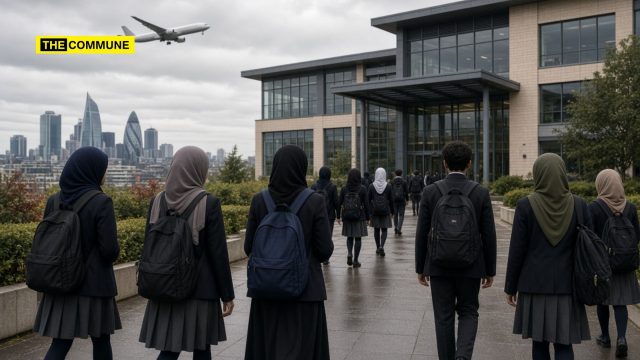
In the last 24 hours, chatter on social media has focused on an April 2024 UK High Court ruling. This is a shining example of how Islamic migrants take along social norms and attitudes from their distant shores and thrust them into the throats of their hosts under the garb of free speech by weaponising Islamophobia. The case centred around Michaela Community School in Greater London and its strict ethos of discipline and secularism.
Michaela Community School and Its Ethos
Founded by Katharine Birbalsingh in September 2014, Michaela Community School is located in Wembley, Greater London. It is a mixed, free secondary and sixth-form school that admits students aged 11 to 18. The school is known for its “Michaela Way”: strict discipline, silent corridors, family lunches, and a strong emphasis on traditional values such as gratitude, responsibility, and unity. More than 40% of its students are siblings. When it started in 2014, it had 120 Year 7 students, 30% of whom were Muslim. In 2024, the number of Muslim students crossed 50%.
With “Knowledge is power” and “Work hard, be kind” as mottoes, Michaela has consistently achieved top academic results nationwide, with Progress 8 scores among the best in the UK. It was rated “outstanding” in all categories by the Office for Standards in Education, Children’s Services and Skills (Ofsted) in 2017 and 2023. The school’s philosophy is that shared values and compromise across faiths and backgrounds create harmony, rather than catering to separate religious or identity-based groups.
The Case of Infringement of Religious Freedom and Expression
A student, through her parent, challenged the school’s ban on prayer during school hours, arguing it infringed on her religious freedom under Article 9 of the European Convention on Human Rights.
Before this case was filed:
- In March 2023, a small group of Muslim pupils began praying in the schoolyard, which the leadership saw as undermining its ethos of unity and secularism
- The school argued that this led to intimidation and segregation pressures among Muslim pupils, with some being coerced into fasting, wearing hijabs, or withdrawing from activities
- Campaigners framed the issue as Islamophobia, attempting to portray the school as hostile to Muslim identity
The UK High Court ruling
In its April 2024 verdict, the court found no unlawful interference, noting the school’s policy was even-handed, applied to all students, and justified by legitimate aims of promoting integration and maintaining an intimidation-free environment.
It ruled that Michaela’s ban on prayer rituals was not unlawful. Justice Linden’s 83-page judgment stated that pupils implicitly accepted restrictions on religious expression when enrolling, given the school’s clearly stated ethos. The judgement emphasised that the ban was justified to protect inclusivity and prevent division. It affirmed that non-religious schools have the right to decide whether to provide prayer facilities. Justice Linden also observed that the prayer ban did not interfere with the pupil’s religious freedom, as they could have moved to another school that allowed prayer at lunchtime.
The ruling was hailed as a victory for all schools, reinforcing the principle that institutions should not be forced to alter their ethos to meet individual demands.
Michaela’s ethos of strict secular discipline was challenged by a minority of Muslim pupils invoking freedom of religion and Islamophobia. The High Court sided with the school, ruling that its prayer ban was lawful and essential to preserving its inclusive, unified environment.
Furthering the Victimhood Complex
Reacting to the verdict, the student who filed the case is reported to have said that it was like somebody saying that she didn’t properly belong here (the UK) and this is the kind of discrimination that makes religious minorities feel alienated from society.
Runnymede Trust, which popularised the word Islamophobia, reacted by saying that this verdict sets a dangerous precedent. In a post on its X handle, the trust said, “It targets Muslim students and cannot be removed from the ramping up of Prevent and recent govt extremism definition. No child should be policed for the peaceful practice of their faith.”
Today’s High Court ruling sets a dangerous precedent.
It targets Muslim students, and cannot be removed from the ramping up of Prevent and recent govt extremism definition.
No child should be policed for the peaceful practice of their faith.https://t.co/lHUuTRoeo8
— Runnymede Trust (@RunnymedeTrust) April 16, 2024
This reminds us of the Karnataka hijab ban case from February 2022, when some Muslim girls were banned from classrooms for wearing hijab. As usual, there were cries of denial of religious freedom and Islamophobia.
The Karnataka High Court in its March 2022 verdict upheld the ban, saying:
- Wearing the hijab is not mandatory in Islam and therefore not protected as an essential religious practice under Article 25 of the Constitution.
- The government order mandating strict uniforms was a reasonable restriction to maintain discipline, equality, and secularism in educational institutions.
But the appeal before the Indian Supreme Court returned a split verdict from a two-judge bench, and the case was subsequently referred to a larger bench; the case is still not settled. The Karnataka state government, however, rolled back the 2022 ban and introduced new guidelines allowing students to wear hijabs, turbans, sacred threads, and other faith-based symbols alongside prescribed uniforms.
In the previous piece, I mentioned the two hypotheses the world has been toying with over the last 30+ years.
1. Higher education and radicalisation have no correlation
2. Economic mobility and liberal thinking have no correlation
Now it is time to add a third: Attitudinal liberalisation is not correlated with where you live or your lifestyle.
Dr Babasaheb Ambedkar, in his book, Thoughts on Pakistan, says thus about Indian National Congress’ Muslim appeasement policies, “Appeasement means to offer to buy off the aggressor by conceiving at or collaborating with him in the rape, murder and arson on innocent Hindus who happen for the moment to be the victims of his displeasure. On the other hand settlement means laying down the bounds which neither party to it can transgress. Appeasement sets no limits to the demands and aspirations of the aggressor. Settlement does. The second thing the Congress has failed to realise is that the policy of concession has increased their aggressiveness and what is worse the Muslims interpret these concessions as a sign of defeatism on the part of the Hindus and the absence of will to resist. This policy of appeasement will involve the Hindus in the same fearful situation in which the Allies found themselves as a result of the policy of appeasement which they adopted towards Hitler.”
In the above quote from Dr Ambedkar, substitute Hindus with Jews, Yazdis, Christians or anyone else and Congress with “the liberal world”, you will see how relevant Babasaheb’s words are in today’s world.
It is time the world stops pandering to non-existent phobias and a perennial victimhood complex and calls the spade a spade.
Thiruvalluvar emphasises the virtue of patiently accepting uncomfortably sharp or critical truths thus:
செவிகைப்பச் சொற்பொறுக்கும் பண்புடை வேந்தன்
கவிகைக்கீழ்த் தங்கும் உலகு
Sevikaippach Chorporukkum Panputai Vendhan
Kavikaikkeezhth Thangum Ulaku
(Thirukkural, The Qualifications of a Ruler, 389)
“Behold the prince (ruler*) who hath the virtue to bear with words that are bitter to the ear: the world will rest permanently under his umbrella.” – The Kural or The Maxims of Thiruvalluvar by VVS Aiyar.
*My exposition
Raja Baradwaj is a marketing communications professional who works with a leading technology multinational company. He is an avid reader, history buff, cricket player, writer, and Sanskrit and Dharma Sastra student.
Subscribe to our channels on WhatsApp, Telegram, Instagram and YouTube to get the best stories of the day delivered to you personally.