
The TVK government’s decision to scrap the proposed Parandur greenfield airport has raised a fundamental question: what does the government intend to do about Chennai’s long-term aviation capacity?
Instead of examining that question, leftist propaganda outlet The News Minute has published a report claiming that Tamil Nadu can reach a $1.5 trillion economy without Parandur.
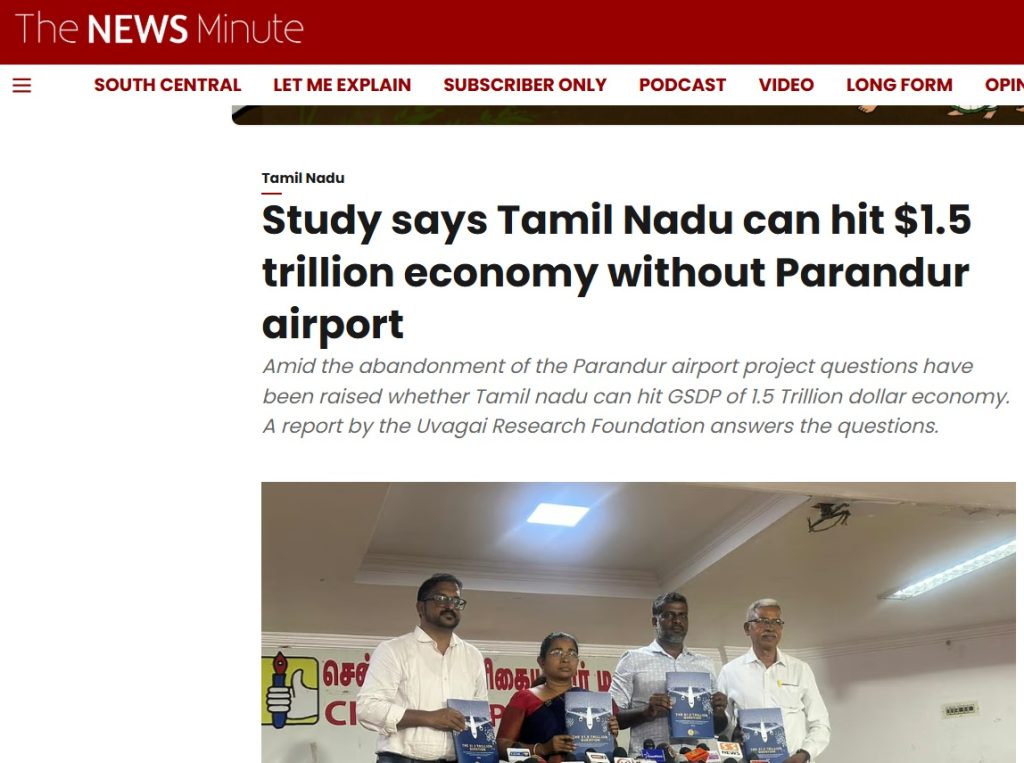
The problem is that the report does not establish this claim. It largely reproduces the argument made by a seemingly unknown Uvakai Research Foundation, which itself relies heavily on current airport utilisation figures and assumptions about future demand.
In effect, a study that says existing airport capacity is currently underutilised has been transformed into a headline claiming Tamil Nadu does not need Parandur to become a $1.5 trillion economy.
That is a substantial logical leap.
Current Spare Capacity Does Not Settle A 20-year Infrastructure Question
The central argument is that Tamil Nadu’s six airports have a combined annual capacity of 51.1 million passengers but handled around 29.4 million passengers in 2024-25.
But Parandur was not being planned because Tamil Nadu had run out of airport capacity in 2026.
It was being planned as a long-term second airport for the Chennai metropolitan region.
The relevant question is therefore not whether existing airports have spare capacity today. It is whether Chennai will have sufficient passenger, runway, cargo and international connectivity capacity as Tamil Nadu’s economy expands over the next two or three decades.
The Uvakai study does not adequately establish that.
Nor does aggregating the capacity of airports across Tamil Nadu answer the Chennai question. Spare capacity at Coimbatore, Madurai or Tiruchirappalli cannot simply be treated as equivalent to spare capacity at Chennai.
Annual Capacity Is Not Same As Operational Capacity
The report calculates that Chennai airport handled around 22.4 million passengers against a stated capacity of 35 million.
Therefore, it concludes that 12.6 million passengers of capacity remain.
But airport capacity is not simply a number that can be subtracted from annual passenger traffic.
Peak-hour movements, runway utilisation, terminal processing, gates, aircraft stands, baggage handling, immigration, apron capacity and airline slots all determine how much traffic an airport can practically handle.
The study itself admits that Chennai’s secondary runway is underutilised and says its constraints need to be examined.
That should have triggered another question: If the study has not established why that runway is underutilised or whether those constraints can be removed, how can it confidently conclude that existing capacity is sufficient?
Air Cargo Cannot Be Compared With Port Cargo by Tonnes
Another argument cited by the report is that Chennai has enormous sea-cargo capacity through its ports.
This is hardly a substitute for air cargo.
A tonne of sea freight and a tonne of air freight do not represent the same logistics market.
Air freight is used precisely because certain goods require speed, reliability and time-sensitive delivery. Electronics, pharmaceuticals, precision components and other high-value goods cannot simply be shifted to sea freight because Chennai has ports.
Comparing 0.379 million tonnes of airport cargo with more than 100 million tonnes of port cargo therefore makes air cargo look insignificant without actually establishing that it is economically insignificant.
For a state seeking to expand electronics, advanced manufacturing, pharmaceuticals and other globally integrated industries, the value and nature of cargo matter, not just the number of tonnes.
COVID-era Numbers Cannot Become A Long-term Aviation Forecast
The Uvakai study also points out that Tamil Nadu’s GSDP grew by around 137% between 2016-17 and 2024-25 while air passenger traffic grew by only 27%.
But this period includes the COVID-19 pandemic, which severely disrupted aviation.
More importantly, there is no reason why GSDP and passenger traffic must grow at identical rates.
The statistic establishes a historical difference in growth rates. It does not establish that future aviation infrastructure will never become a constraint on economic growth.
An economy can outgrow infrastructure gradually and only encounter the constraint later.
High-speed Rail Is Not An Airport Substitute
The report also suggests that some passengers travelling between Chennai, Bengaluru and Hyderabad could eventually shift to high-speed rail.
Could they? Possibly.
But that is not an argument against building future airport capacity.
More importantly, high-speed rail does not replace international aviation.
A global manufacturing and services hub needs international connectivity for investors, executives, tourists, exporters and international businesses.
A future rail connection to Bengaluru cannot replace direct international connectivity from Chennai.
Using a prospective transport alternative to justify abandoning a real airport project is therefore hardly a substitute for a proper aviation demand forecast.
The 2046-47 Projection Neds Its Assumptions
The report says Chennai’s existing cargo capacity could be sufficient until 2046-47 under the current growth scenario.
But the important words are “under the current growth scenario.”
What growth rate is being assumed?
Does it account for the expansion of electronics and EV manufacturing? Does it account for pharmaceuticals, e-commerce and express logistics? Does it factor in the additional cargo that new international routes could generate?
Infrastructure itself can create demand.
If airlines and logistics operators know that additional capacity and facilities are available, new routes and services can follow.
A projection based primarily on existing utilisation cannot automatically be treated as a projection of what demand will be two decades from now.
What Exactly Is TNM Adding To The Parandur Debate?
The problem with The News Minute’s report is not that it published the Uvakai Research Foundation study.
The problem is that it appears to have published the study without doing the questioning that a news organisation is supposed to do.
Times of India also reported the publication of the Uvakai study. That is standard journalism: a research organisation releases a report, and a newspaper reports what the report says.
For those having a go at @Ahmedshabbir20 for The News Minute reporting the study by an NGO on Parandur:
Even Times of India carried the report in today’s edition 👇
Pls be equally generous with your love to others as well 😊 pic.twitter.com/5F0dvq9oKM— Siddharth Prabhakar (@Sidprabhakar7) August 28, 2026
But TNM positions itself differently. It markets itself as independent and committed to journalism that goes beyond what mainstream media offers.
So what exactly is it offering here?
The TNM report, written by a student intern, largely reproduces the Uvakai Foundation’s arguments: existing airports are underutilised, Chennai has spare cargo capacity, high-speed rail could absorb some air traffic and Tamil Nadu’s GSDP has grown faster than passenger traffic.
But where are the questions?
Why does current airport utilisation establish that Chennai will have adequate capacity decades from now?
Why are the capacities of airports across Tamil Nadu being clubbed together when the Parandur debate concerns Chennai’s long-term aviation needs?
Why is air cargo being compared with vastly larger volumes of sea cargo when the two serve very different logistics requirements?
What assumptions produced the projection that existing cargo capacity will suffice until 2046-47?
Can high-speed rail, which does not yet exist on these corridors, really be treated as an alternative to future aviation capacity?
What are the operational constraints on Chennai’s secondary runway, which the study itself admits need to be examined?
And most importantly, if Chennai does not need Parandur, why does the TVK government itself continue to say that Chennai needs a second airport and that an alternative site will be identified?
These are not obscure questions. They are the obvious questions that arise from the study itself.
Yet the article does not appear to seriously interrogate them.
Netizens, TNM Supporters Reactions
Upon seeing the post, several supporters and subscribers came down heavily on the platform for betraying their trust. Some reactions are given below:
It is not TVK that will destroy TN. It will be the likes of this ‘sold’ journalist, thirumavalan, etc will be the real reason https://t.co/LCbbDuygSS
— Ashok R (@idonashok) August 28, 2026
Man the narratives these journalists try to set. Never ever see the real impact. Also the report is by Uvakai foundation NGO…🤧 https://t.co/XXXG4i7VA2
— Chennai Updates (@UpdatesChennai) August 28, 2026
Nice. What a convenient time for a report from a relatively unknown Organization to come out……
Check out the Directors and Promoters of this Agency…… https://t.co/imHRG1wTqy— Sumanth Raman (@sumanthraman) August 28, 2026
@dhanyarajendran is this really the standard of The News Minute? And Shabbir sharing this shitty article as some data insights.. https://t.co/yjyZGt35oY pic.twitter.com/s7oBuUgXBt
— Dravidian Insights (@dstock_insights) August 28, 2026
When it comes to muttu kuduthufying for the current govt, no one can beat Shabbir. https://t.co/4FozTr3wJ5 pic.twitter.com/2Is2YxmRVj
— Gojo (@G_o_j_o_s) August 28, 2026
I subscribed to the News Minute for unbiased reporting and for independent journalism that holds the power to account and not for this trash that relies on an unknown NGO report. How is this news report diff from biased mainstream newspaper reportage, @dhanyarajendran? https://t.co/UoPhl9rkEx
— R. Prasad (@RPrasad12) August 28, 2026
Study says #TN can hit $1.5 Tn without #Parandur because airports are only 58% used. 🙃
By this logic, Marina is empty at 4am so #Chennai has no crowding problem. #Salem has spare seats, so Foxconn CXOs can take a connecting flight from there and still make the board meeting.… https://t.co/93SxNiiwTi
— Srinivas (@Srinivas_091294) August 28, 2026
Ama yaaru intha Uvakai Research Foundation? IMF-la economist-ah velai paathangala? World Bank-la economist-ah velai paathangala? Adam Smith, Keynes, Friedman, Hayek, Rothbard ivanga kitta tuition padichangala?Airport illaama epdi $1.5 trillion vadai?🤡 epdi vidha vidhamana… https://t.co/eldJSIvCdO pic.twitter.com/LaMFBksq01
— INDICIST (@Indicfederr0d) August 28, 2026
Shabbir Ahmed Buttressing TVK
Interestingly, this report was shared on X by Shabbir Ahmed, who has been largely supportive of the TVK government in recent months.
Study says Tamil Nadu can hit $1.5 trillion economy without Parandur airporthttps://t.co/UIN0yJZ5US
— Shabbir Ahmed (@Ahmedshabbir20) August 28, 2026
Despite the government’s decision to scrap Parandur, he has so far not publicly questioned the government over the decision or its long-term implications for Chennai’s aviation infrastructure. Instead, he has hailed it as a ‘bold decision’.
In this interview, Shabbir Ahmed argued that scrapping Parandur was a bold decision by the TVK government, questioning the claims that the project would automatically bring investment and raising concerns over land acquisition, real estate interests, water bodies and whether aviation-safety considerations were adequately examined. He also said the government should instead focus on properly utilising and expanding Chennai airport while developing alternative airports at different locations, and questioned the projections being used to justify the need for Parandur.
With TNM now amplifying the same argument that justifies the government’s position, the question is whether this is independent scrutiny or simply providing another platform for the government’s narrative.
Subscribe to our channels on WhatsApp, Telegram, Instagram and YouTube to get the best stories of the day delivered to you personally.