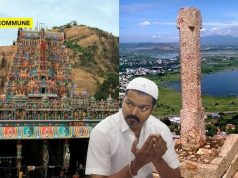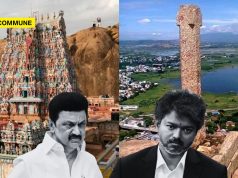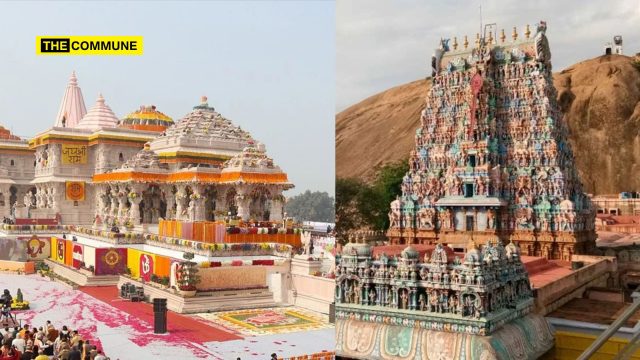
I am writing this on the auspicious day of Karthigai, against the backdrop of the Thirupparankundram Deepathoon controversy. Once again, the Tamil Nadu government has prevented Hindus from exercising their religious rights, despite the Supreme Court, the highest judicial authority in the country, granting permission to light the lamp at the Deepathoon. The Hindu majority in this country appears not to enjoy even the basic religious rights that one would expect to be available to citizens in other countries. This is not merely sad; it is a disturbing reflection of how successive governments in Tamil Nadu have consistently accorded the least importance to Hindus and their religious beliefs.
The structure at the centre of this dispute, a stone pillar atop Thirupparankundram hill, has been successively described as a Jain pillar, a neutral secular object, and, now, a British trigonometric survey marker. Each new label appears to have been introduced not to deepen historical understanding, but to defer, dilute, or deny Hindu claims to ritual access.
The pattern is telling.
From Ayodhya to Thirupparankundram: A familiar pattern
In Ayodhya, an extensive historical and public debate centred on a seemingly straightforward question: what lay beneath the Babri structure? Despite considerable archaeological and documentary evidence indicating an earlier temple, several alternative theories were advanced. The underlying structure was variously described as Buddhist, Jain, secular, or merely a collection of inconclusive ruins.
The underlying purpose of these competing narratives often appeared less about genuine scholarly inquiry and more about political evasion: anything but a Hindu temple.
A similar pattern seems to be unfolding at Thirupparankundram.
The Madras High Court (Madurai Bench), through its orders dated December 1 and 3, 2025, and the subsequent Division Bench judgment of 6 January 2026, addressed the matter primarily as one concerning the Hindu right to worship under Articles 25 and 26 of the Constitution. Justice G.R. Swaminathan specifically recognised that the custom of lighting the Deepam had been discontinued nearly a century ago due to invasions by alien forces, and that such an interruption did not extinguish Hindu religious rights.
In the face of this judicially recognised continuity, the state’s shifting interpretations of the pillar’s identity appear to serve to divert attention from the central issue. If the pillar is characterised merely as a British survey marker, the Hindu ritual associated with it can be dismissed as religious superstition intruding on a site of scientific heritage. If, on the other hand, it is labelled a Jain pillar, Hindu religious observance can be portrayed as an attempt to encroach upon another community’s sacred space.
Either way, the consequence remains the same: Hindu religious claims are repeatedly questioned, undermined, and ultimately delegitimised, even when the courts have already acknowledged and upheld those rights.
A History of Litigation and Resistance
The modern controversy surrounding the Deepathoon has developed through several rounds of litigation.
1994–1996: The first major modern dispute
In 1994, a petition was filed before the Madras High Court concerning attempts by Hindu organisations to light the Karthigai Deepam at the hilltop near the dargah.
In its 1996 decision, the High Court directed that the lamp be lit at the established mandapam near the Uchi Pillaiyar Temple. It also contemplated the temple administration considering another suitable location, subject to certain restrictions, including a 15-meter distance from the dargah.
2014–2017: Further litigation
Further petitions sought permission to light the lamp at the hilltop or at another location known as Kuthirai Sunai.
These petitions were dismissed, and Division Benches of the Madras High Court subsequently upheld the decisions.
2025: The dispute returns to court
In November 2025, devotee Rama Ravikumar approached the Madurai Bench of the Madras High Court, seeking permission to light the Karthigai Deepam at the disputed pillar.
On December 1, 2025, Justice G.R. Swaminathan directed the temple administration to light the lamp at the Deepathoon in addition to the customary location.
However, the direction was not implemented on the festival day, December 3, 2025, amid disagreements over the order and concerns relating to law and order.
6 January 2026: Division Bench judgment
A Division Bench of the Madras High Court upheld the direction to light the lamp at the Deepathoon.
The judgment examined earlier property litigation, historical records, previous judicial decisions, and the pillar’s physical characteristics.
The decision subsequently became the subject of appeals before the Supreme Court.
20 November 2026: Supreme Court intervention
The Supreme Court issued an interim order permitting the ceremonial lamp to be lit at the disputed pillar on November 24, 2026, subject to restricted conditions.
The conditions included:
- Only an authorised team from the temple administration could light the lamp.
- There would be no general public access to the pillar.
- No processions, demonstrations, or public gatherings would be permitted.
- The exercise would take place under police and district administration supervision.
- Archaeological protection of the monument would be ensured.
Existing religious observances at customary locations would continue. - The dargah’s lawful religious activities and access would not be disturbed.
Most importantly, the Supreme Court explicitly clarified that this temporary permission did not establish any customary, religious, or proprietary right over the site.
Yet, despite this explicit permission from the country’s highest court, these neo-colonial agents have once again restricted Hindus from exercising their religious rights.
A Wider pattern Across Tamil Nadu
This is not an isolated incident. Similar patterns appear across the state. Cases documented from different parts of Tamil Nadu reveal recurring instances in which Hindu religious practices and access to traditional sacred spaces have been restricted.
Consider a few examples:
Kanyakumari: A traditional sacred hillock, where the Karthigai Deepam was historically lit, was reportedly taken over shortly after the UPA came to power. Today, it is said to be under the complete control of the Catholic Church, which has constructed a massive church on its summit.
Restrictions on religious processions: On several occasions, Hindu religious processions have been stopped and traditional routes obstructed simply because they pass by a church or a pastor’s residence. Such incidents have resulted in police intervention and, in some cases, tragic loss of life. The Pillaiyar Vilai Mutharamman procession is one such example, where a Hindu woman reportedly lost her life following a police lathi charge.
Mandaikadu: The Hindu religious practice of carrying sacred water was reportedly subjected to humiliating restrictions and intimidation by a radical Christian mob, interfering with the community’s ability to observe its traditional ritual.
Perumalkovilpatti, Dindigul: Those who have stood up to protect Hindu temple rights have also faced extreme violence. Thiru Aandi, an activist who vocally championed Hindu rights, was brutally murdered in broad daylight, just a day before his daughter’s engagement.
In each of these situations, the administrative justifications may differ—public safety, law and order, secularism, or heritage protection. Yet, the outcome appears remarkably consistent: Hindu access to sacred spaces and the freedom to practice traditional religious customs continue to shrink.
The Deepathoon controversy reproduces this same pattern.
Courts have examined the pillar in the context of the Hindu ritual landscape of Thirupparankundram, a site whose Hindu sacredness predates colonial rule and modern communal politics by centuries. The controversy surrounding the lighting of the Karthigai Deepam demonstrates how administrative manoeuvres, shifting historical labels, and selective interpretations of secularism can be used to delay or delegitimise Hindu religious rights, even after courts have recognised and protected them.
The Political Reality: A Communal Majority, Not a Political Majority
Viewed through a political lens, the deliberate disregard for Hindu rights at a religiously significant and high-profile site is hardly surprising.
As Dr B.R. Ambedkar observed, Hindus may constitute a numerical or communal majority, but that does not necessarily translate into a cohesive political majority.
If Hindus had truly constituted a political majority, the state would have accepted the December 1 order, facilitated the lighting of the lamp, and treated it as a routine matter of religious administration. There would have been no prolonged legal battles, repeated administrative obstruction, or constant attempts to manufacture alternative justifications for denying Hindus the right to observe a traditional religious practice.
The larger question, therefore, is not merely about lighting a lamp at a stone pillar. It is about the place of Hindu religious rights in a state that constitutionally guarantees freedom of religion to all its citizens. Why should Hindus repeatedly have to approach the courts to exercise rights that should be protected as a matter of principle?
Why should the practice of Hindu traditions become a law-and-order problem, while the religious sentiments and practices of other communities are treated with greater sensitivity?
Sustained Hindu Unity Is The Answer
Unless Hindus recognise the importance of standing together, setting aside their internal differences, and asserting their constitutional and religious rights through democratic means, these patterns will continue. Religious rights cannot survive on judicial interventions alone. They also require a society that is aware of those rights and a community prepared to stand up for them.
The lighting of the Karthigai Deepam at Thirupparankundram is about much more than a flame. It is about religious freedom, historical continuity, equality before the law, and the right of Hindus to practice their faith without discrimination.
On this Karthigai day, that is the larger issue we must not lose sight of.
Dr Santha Kumar is an education leader, author, and public commentator on civilizational history, geopolitics, and contemporary issues affecting Sanatana Dharma.
Subscribe to our channels on WhatsApp, Telegram, Instagram and YouTube to get the best stories of the day delivered to you personally.