A 22-year-old Lashkar-e-Taiba (LeT) terrorist is killed in an encounter. He was involved in attacks on security personnel. Police had announced a ₹15 lakh reward for information leading to his capture. When security forces finally cornered him, they offered him an opportunity to surrender. He refused and opened fire.
How does The Wire report this?
Not as the elimination of a Pakistan-backed terrorist. Not as the culmination of an operation against a man involved in attacks on Indian security forces. Instead, it gives readers a deeply sympathetic portrait of a grieving father, a family torn apart and a young man who was once its breadwinner.
In its November 23 report titled ‘In Kashmir, the Last Local LeT Militant Is Killed, Leaving His Father Searching for Answers’, The Wire turns the death of Tawseef Ahmad Bhat, also known as Lateef, into an extended human-interest narrative.
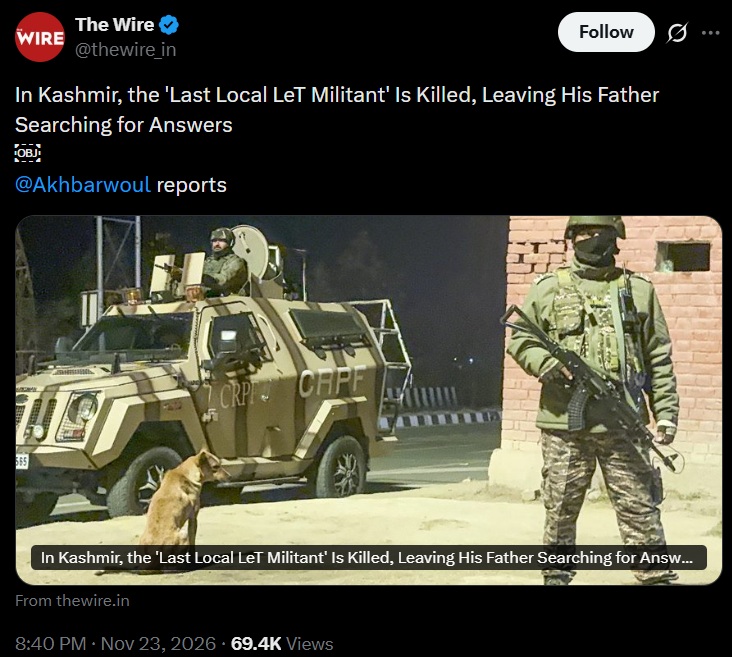
The report repeatedly reminds readers that he was hardworking, looked after his family, worked at a wood-beading factory and never participated in stone-pelting. It describes his father’s anguish, his family’s financial difficulties, his twin brother’s arrest and the uncertainty surrounding his disappearance.
The issue is how The Wire frames the terrorist while relegating the victims and the security threat to the margins.
Where Are The Victims?
According to the security forces, Lateef was associated with the Pakistan-based Lashkar-e-Taiba and its shadow organisation, the Kashmir Revolution Army. He was suspected of involvement in the November 11 attack on a CRPF post at Akhran in Kulgam, in which three personnel were injured.
Police had announced a reward of ₹15 lakh for information leading to his capture. He was also suspected of involvement in earlier attacks in Anantnag and Kilam.
The report itself records that security forces contacted him during the November 18 operation and urged him to surrender. According to Kulgam SSP Inayat Ali Choudhary, he rejected repeated appeals and opened fire at around 3 AM.
Yet, the report’s emotional centre is not the three injured CRPF personnel, the attacks or the danger posed by an armed LeT operative.
The centre of this piece is the grieving father who lost his breadwinner.
The report even reproduces the militant’s final exchange with security forces, in which he invokes the Quran and speaks about meeting Allah and the Prophet.
Why does the reader need such an extended emotional reconstruction of a terrorist’s final moments, while the people allegedly targeted by him receive so little attention?
Grief Does Not Make A Terrorist A Martyr
Lateef’s father may be grieving but it does not transform a Lashkar terrorist into a victim of terrorism.
The Wire gives extensive space to the militant’s family, his life as a breadwinner and his final religious declarations. Yet the CRPF personnel injured in the attack barely register in this emotional framing. The ordinary people living under the threat of Pakistan-backed terrorism are even further pushed out of view.
Where is the same empathy for the victims of terrorism? Where is the concern for the families of those who face the guns of Lashkar operatives?
The Wire seems far more interested in humanising the terrorist than examining the threat he posed.
Subscribe to our channels on WhatsApp, Telegram, Instagram and YouTube to get the best stories of the day delivered to you personally.