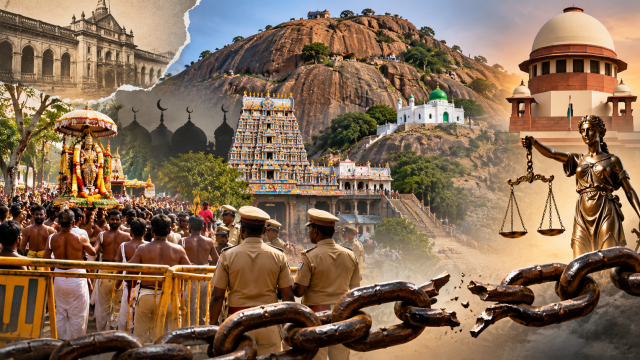
For more than a century, Hindu religious processions and temple practices in Tamil Nadu have repeatedly faced restrictions following objections from sections of the Muslim community and warnings of communal tension. Instead of consistently protecting the lawful rights of devotees and providing security, successive governments and local administrations have often resorted to restrictions, route changes and prohibitory orders.
The pattern predates the DMK, the AIADMK and the present TVK government. A series of court rulings, stretching from colonial India to contemporary Tamil Nadu, exposes the recurring problem: why should Hindu devotees be made to surrender their religious rights because someone threatens to disturb public order?
The legal record offers several striking examples.
1. Salem Mariamman Temple Procession: Madras High Court, 1883
In Sundram Chetti and Others v. The Queen, decided on 9 January 1883, the Madras High Court examined the Salem riots surrounding Hindu temple processions carrying music past a mosque during the Mariamman festival and Ramadan.
The District Magistrate had prohibited the Hindu procession from passing the mosque with music following objections and apprehensions of disturbances.
Chief Justice Charles Turner examined the limits of executive authority and held that lawful religious rights could not simply be curtailed through arbitrary restrictions. The judgment also recognised the authorities’ responsibility to protect congregational worship and regulate competing rights.
The Court specifically observed that religious congregations should inform authorities of their customary prayer timings so that the rights of others were not unnecessarily curtailed.
2. V. Kalathur: Hindu Temple Processions Challenged, 2021
Nearly 140 years later, the same issue surfaced in V. Kalathur village in Perambalur district.
In Ramasamy Udayar v. District Collector, decided on April 30, 2021, a Division Bench comprising Justices N. Kirubakaran and P. Velmurugan examined objections to traditional Hindu temple processions passing through streets predominantly inhabited by Muslims.
The judgment recorded that objections to the Hindu festivals had emerged from 2012 onwards, including objections to processions passing through Muslim-majority streets. The authorities had imposed restrictions citing potential law-and-order problems.
The Bench made its position unmistakable, “People can be religious; Men may be communal; Whether roads could be communal?”
It ruled that public roads and streets were secular spaces and that religious processions could not be prohibited merely because another religious community lived in the area in greater numbers. The police could regulate processions and provide protection but not prohibit them on that ground.
The judgment also declared that the presence of another community’s place of worship could not, by itself, justify denying a religious procession its traditional route.
3. Nellore Procession Dispute: The 1926 Ruling that Condemned Administrative Helplessness
In Venkata Subbaya v. Muhammad Falauddin Khaji, decided on 8 January 1926, Justice Phillips examined a long-running dispute over Hindu processions carrying music past mosques in Nellore.
Hindus had obtained a civil court decree in 1918 recognising their right to conduct such processions, subject to conditions concerning timings. However, a procession in 1919 was followed by a riot in which three people were killed. Subsequently, authorities restricted further processions under Section 144 of the Criminal Procedure Code.
Justice Phillips described the administration’s refusal to allow the exercise of an established lawful right as a “confession of impotence on the part of the authorities.”
The ruling was reproduced in the Madras High Court’s July 2024 judgment in the Ervadi Muharram dispute.
4. Thirupparankundram: Temple Ownership Upheld by the Privy Council, 1931
The dispute over Thirupparankundram Hill also has a long judicial history.
In 1920, the Subramania Swamy Temple filed a suit seeking ownership of the hill, following a dispute involving the Sikkandar Dargah management. In 1923, the trial court ruled in favour of the temple over the hill, except for the Nellithoppu area and the specific site occupied by the mosque, its flagstaff and the steps leading to it.
The matter eventually reached the Privy Council, which upheld the temple’s claim in 1931.
This historical ruling is particularly significant in the present Thirupparankundram controversy, where the rights of the temple and the religious practices of Hindu devotees have once again become subjects of litigation. The property dispute was also discussed in the Supreme Court’s November 2019 Ayodhya judgment.
5. Ram Mandir Pran Pratishtha: DMK Government Questioned, 2024
On 22 January 2024, allegations emerged that Tamil Nadu authorities were preventing live telecasts of the Ayodhya Ram Mandir Pran Pratishtha ceremony and restricting special pujas, bhajans and annadhanam programmes.
The matter reached the Supreme Court in Vinoj v. Union of India. During the hearing, the Tamil Nadu government told the Court that there was no ban on live screenings or religious programmes. The Bench recorded the government’s statement and issued notice in the petition.
The episode raised serious questions about attempts to restrict Hindu religious celebrations and the need for judicial intervention to protect devotees’ rights.
6. Ervadi Muharram: High Court Protects Muslim Devotees Against Objections from Another Muslim Group, 2024
Interestingly, the principle of protecting religious freedom was applied in the opposite direction in July 2024.
In Thameem Sindha Madar v. District Collector, Justice G.R. Swaminathan overturned restrictions on traditional Muharram ceremonies at Ervadi Dargah, including drumbeats, Santhanakoodu and Kuthirai Pancha processions.
The objections had come from members of the Thowheed Jamath, who opposed these practices. The Court held that one religious group could not dictate how another group practised its faith.
It observed that the administration had a duty to protect fundamental rights rather than yield to threats and pressure.
A Century Of Restrictions, The Same Administrative Failure
From colonial-era Salem to V. Kalathur and Thirupparankundram, the pattern is difficult to ignore. Objections from Muslim groups to Hindu religious practices have repeatedly resulted in restrictions on Hindu devotees, with successive administrations citing law and order to justify their decisions.
Even court decrees recognising religious rights have not always prevented authorities from imposing fresh restrictions. The judiciary has repeatedly reminded governments that maintaining public order means protecting lawful religious practices, not surrendering to threats of unrest.
The Ervadi judgment reinforces that this principle applies equally to every religious community.
Yet, more than a century after the Salem dispute, the same questions continue to arise in Tamil Nadu. Whether under colonial administrators, the DMK or the present TVK government, the recurring criticism is that authorities find it easier to restrict religious practices than confront those threatening disorder.
Law and order cannot become an excuse for denying lawful religious rights.
This article is based on an X thread by S Gurumurthy.
Subscribe to our channels on WhatsApp, Telegram, Instagram and YouTube to get the best stories of the day delivered to you personally.