The Joseph Vijay TVK government appointed a new Board of Trustees for the Thirupparankundram Subramaniya Swamy Temple just 11 days before the Karthigai Deepam festival. This very board subsequently passed the resolution that the Tamil Nadu government cited to justify not lighting the lamp at the hilltop Deepathoon, despite the Supreme Court’s November 20 order.
The sequence raises serious questions about the timing of the appointments and the role of the newly constituted board in the Deepam controversy.
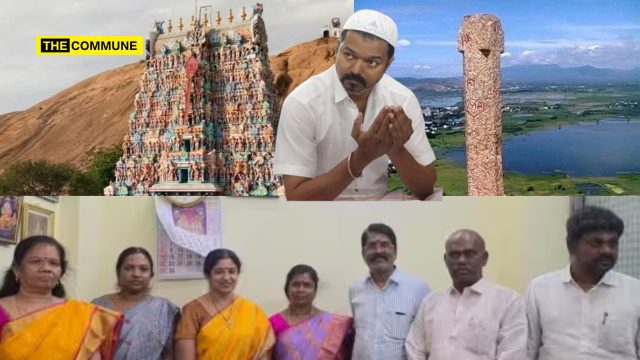
On 13 November 2026, the TVK government issued a government order appointing five trustees to the temple: V. Shanmugasundaram, C. Rajapandian, C.K. Azhagappan, K. Reginadevi and K. Chitra.
The trustees assumed office at 7 PM that evening. An election was subsequently held, in which Shanmugasundaram was chosen as the chairman. Notably, he had also served as a trustee in the previous board.
The appointments came barely days before the annual Karthigai Deepam festival on November 24.
A Board Resolution To Override The Deepathoon Direction
On November 20, the Supreme Court permitted the lighting of the Karthigai Deepam at the hilltop Deepathoon as a one-time arrangement on November 24.
The temple administration was required to authorise the team that would perform the ritual. The District Collector was tasked with coordinating the arrangements.
But four days later, the newly appointed trustee board reportedly passed a resolution insisting that the lamp be lit at the traditional Deepa Mandapam near the Uchi Pillayar Temple instead.
The resolution claimed that the temple’s age-old customs, religious practices and Agama rules required the Deepam to be lit at that location. It further claimed that the decision was supported by historical records and the opinions of the temple’s Sthaanika priests.
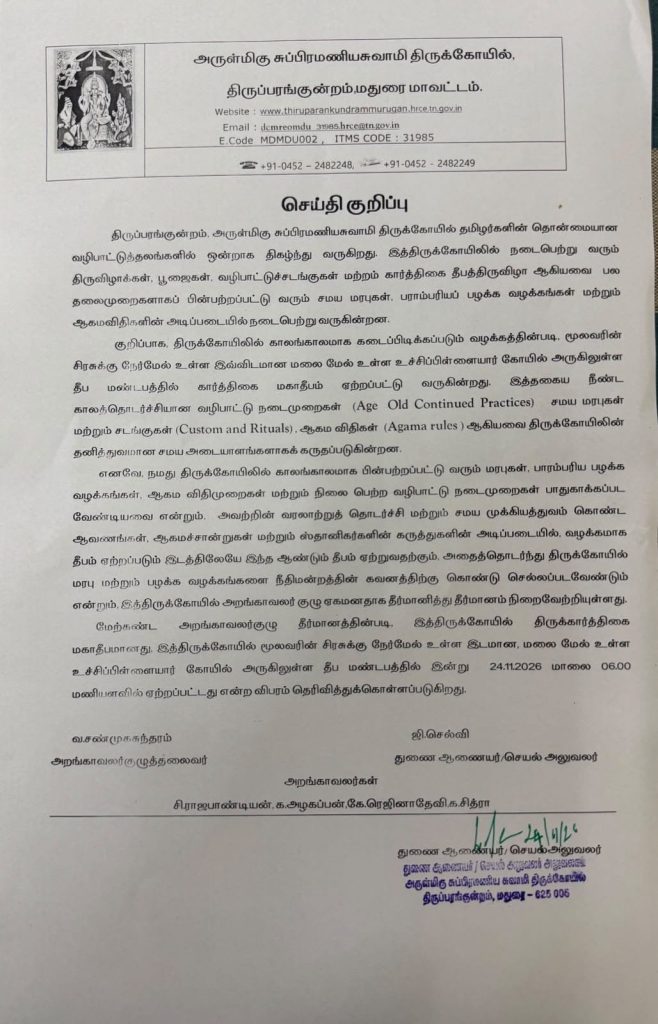
The board’s resolution became the justification for withholding authorisation for the team meant to light the lamp at the Deepathoon.
In his report to the Supreme Court, Madurai District Collector Nishant Krishna stated that his administration had completed the arrangements and repeatedly sought authorisation from the temple administration. However, the board refused to authorise the team.
The Collector acknowledged that the Deepathoon remained unlit and apologised to the Supreme Court for the failure to implement its directions.
The lamp was instead lit at the Deepa Mandapam near Uchi Pillayar Temple at around 6 PM on November 24.
Whose Opinion Did The Trustees Rely On?
The board’s claim that its resolution was based on the opinions of the Sthaanika priests has itself been challenged.
On November 24, four temple priests – Swaminatha Bhattar, Balasubramani Bhattar, Sokku Subramania Bhattar and Shanmuga Sundaram Bhattar – submitted a letter to the temple administration.
They categorically stated that they had never expressed any opinion on lighting the Deepathoon in accordance with the Supreme Court’s directions. They also objected to the administration using their names in its communication to the media without consulting them.
The following day, temple officials, including Deputy Commissioner G. Selvi and chairman Shanmugasundaram, visited the residence of chief priest Swaminatha Bhattar. The visit triggered a confrontation with local residents, who alleged that officials were attempting to obtain signatures from the priests on the controversial resolution. Six people, including BJP Youth Wing State Vice-President Vetrivel Murugan, were arrested.
The priests’ written clarification directly calls into question the board’s claim that their opinions formed the basis of its November 24 resolution.
Who Constitutes The New Board?
The five trustees appointed by the TVK government are:
- V. Shanmugasundaram – Chairman
- C. Rajapandian – Trustee
- C.K. Azhagappan – Trustee
- K. Reginadevi – Trustee
- K. Chitra – Trustee
G. Selvi serves as the temple’s Deputy Commissioner/Executive Officer.
It is noteworthy that these trustees are neither hereditary nor traditional devotees nor are they independent.
Questions have also been raised over the political affiliations and religious credentials of the appointed trustees. C.K. Azhagappan, in particular, has faced allegations of being an atheist and a CPI(M) member, raising questions about his eligibility and suitability for a position in temple administration.
The larger concern is the extent to which a government-appointed trustee board can determine the course of a religious practice when a specific judicial direction is already in force.
The sequence is difficult to ignore: the TVK government appoints a new board 11 days before Deepam; the Supreme Court issues its direction; the board passes a resolution on the very day the ritual is to be performed; the temple withholds authorisation; and the Collector cites the board’s resolution to explain why the Supreme Court’s direction was not implemented.
The government cannot wash its hands of the matter by pointing to a trustee board whose members it appointed.
The TVK government cannot hide behind a board it appointed to defy the Supreme Court. The trustees’ resolution became the government’s excuse to deny devotees the very Deepathoon lighting the Supreme Court had permitted. This was no ordinary temple administrative decision. It was the executive using its own appointees as a shield to frustrate a judicial order denying Hindus their rights.
Subscribe to our channels on WhatsApp, Telegram, Instagram and YouTube to get the best stories of the day delivered to you personally.