On 29 September 2026, leftist rag The Quint published former bureaucrat Subhash Chandra Garg’s opinion piece or rather an uninformed piece on one of NDA goverment’s flagship schemes, the PM-Jan Dhan Yojana.
Subhash Chandra Garg’s piece hides behind a paywall and is titled “Millions of Jan-Dhan Accounts Are Inactive. How Inclusive is Modi Govt’s Scheme?”. The opinion piece attempts to undermine the monumental success of the Pradhan Mantri Jan-Dhan Yojana (PMJDY) by focusing exclusively on a single metric – inactive accounts, while ignoring the scheme’s transformative impact.
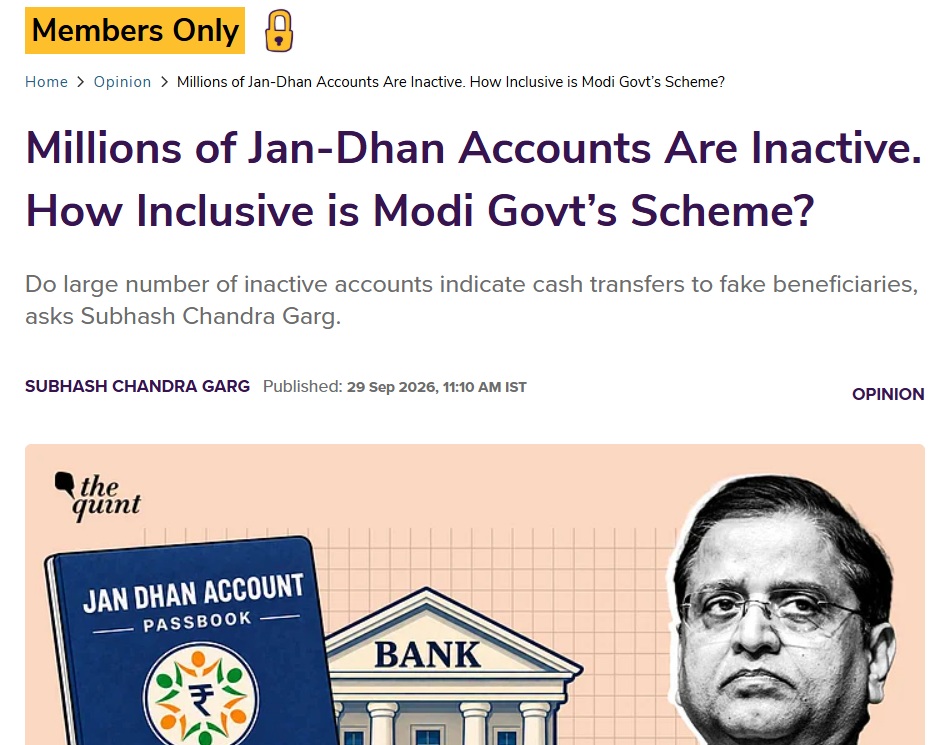
The article’s accusatory and dismissive tone, marked by the use of derogatory labels like “cow belt,” detracts from a serious policy debate and misrepresents the nature of financial inclusion.
While the scheme has its challenges, they are second-generation issues that are being actively addressed. To dismiss the world’s largest financial inclusion drive as a failure based on the natural lifecycle of bank accounts is both misleading and contrary to the author’s own past acknowledgements of the scheme’s success.
The Biggest Problem: Inactive Does Not Mean Fake
Garg links the large number of inactive accounts to the possibility of money being transferred to “non-existent and fake beneficiaries.”
But an inactive or inoperative account is a banking status, not a fraud finding.
Under RBI rules, an account can be classified as inoperative when there has been no customer-induced transaction for two years. That can happen for many perfectly ordinary reasons.
A person may have moved to another city for work. They may have another bank account. They may use a family member’s account for regular transactions. They may live far from a bank branch. Or they may simply not use that particular account regularly.
In other words, no transaction does not mean no person.
An inactive account is a dormant account. It is not automatically a fake account.
Therefore, using the number of inactive accounts as evidence of fake beneficiaries requires additional evidence showing that these accounts actually belong to fictitious people. A banking-status figure by itself cannot establish that.
Look at the Bigger Picture, Not Just the Number of Inactive Accounts
The absolute number of inactive accounts has to be viewed alongside the enormous growth in the number of bank accounts in India.
Before 2014, nearly 43% of bank accounts in India were dormant. By 2026, that figure has fallen to roughly 16%.
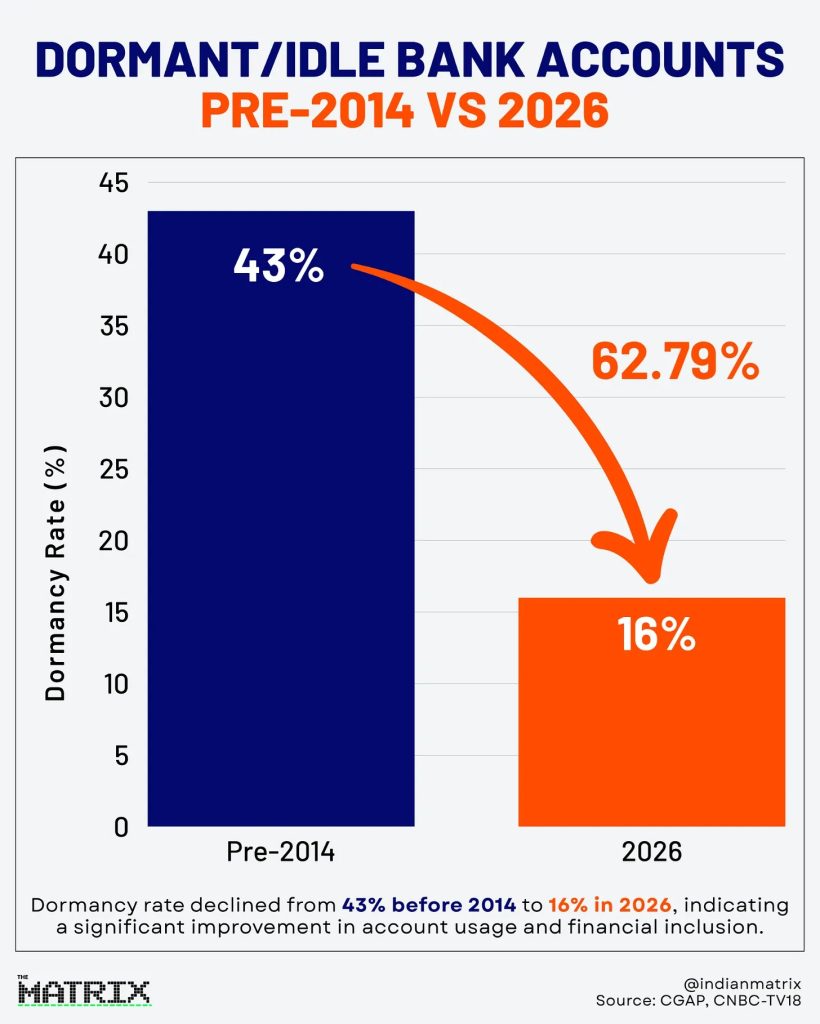
That is a major change.
The point of PMJDY was not merely to open accounts. It was to bring people who had previously remained outside the formal banking system into it.
The scale is unprecedented. PMJDY now has more than 59 crore accounts, giving millions of poor and rural Indians access to formal banking, RuPay cards, insurance benefits and, where eligible, overdraft facilities.
So the rise in the absolute number of inactive accounts cannot be looked at without considering the enormous increase in the overall account base.
More Accounts With Public Sector Banks Does Not Mean Dummy Accounts
Garg also points to the large concentration of Jan-Dhan accounts in Public Sector Banks (PSBs) and describes these banks as “weaklings.”
But this misses how the scheme was designed.
PMJDY was deliberately implemented through Public Sector Banks, Regional Rural Banks and Business Correspondents because these networks already had a large presence in rural and semi-urban India.
According to the Department of Financial Services dashboard as of 16 September 2026:
- PSBs: 45.72 crore accounts
- RRBs: 11.13 crore accounts
- Private banks: 2.26 crore accounts
The dominance of PSBs and RRBs is therefore not evidence that the accounts are fake. It reflects the banking network used to take financial services into areas where private banks had limited presence.
Garg also claims that most Jan-Dhan account holders already have regular savings accounts elsewhere. But that claim needs supporting official data. Without such evidence, it remains an assertion rather than an established fact.
Jan-Dhan Deposits Are Not “Trapped Government Funds”
Another important point concerns the ₹3.16 lakh crore deposited in Jan-Dhan accounts.
These are not government funds sitting uselessly in bank accounts.
They are deposits belonging to account holders.
Banks owe that money to their customers. It is therefore misleading to describe the deposits as “trapped government funds.”
PIB data puts the average balance at around ₹5,356 per account. That is consistent with millions of account holders maintaining money in these accounts.
There is also a standard banking process for genuinely unclaimed deposits. A balance becomes unclaimed only after 10 years, after which it is transferred to the RBI’s Depositor Education and Awareness Fund. Even then, the depositor or their legal heirs can claim the money.
So an unused balance is not the same thing as government money that has disappeared or become permanently trapped.
Zero Balance Does Not Mean the Scheme Has Failed
The article also points to zero-balance accounts. But zero-balance accounts were part of the design of PMJDY.
The whole purpose was to remove the minimum-balance barrier that often prevented poorer households from opening and maintaining bank accounts.
As of 12 August 2026, around 5.72 crore PMJDY accounts had zero balance, or roughly 10% of the total.
That number deserves attention, but it needs to be understood correctly.
A zero-balance account does not necessarily mean an unused account. A person may have received a benefit, withdrawn the money and brought the balance back to zero.
Similarly, zero-balance accounts and inoperative accounts should not simply be added together to produce a larger “inactive” figure.
Lok Sabha Question No. 2557 also makes clear that the government does not centrally maintain account counts for every balance bracket below ₹1,000. Therefore, figures such as 14% or 25% in the article are calculations made by the author rather than official government figures.
The Small-Account Limits Are KYC Safeguards
Garg also refers to limits on certain Jan-Dhan accounts, including:
- ₹50,000 maximum balance
- ₹1 lakh annual credits
- ₹10,000 monthly withdrawals
But these limits apply to “small accounts” opened under relaxed KYC requirements.
They are not universal limits on every fully KYC-compliant Jan-Dhan or basic savings account.
These restrictions exist as part of KYC and anti-money-laundering safeguards.
Once full KYC requirements are completed, the account operates under the applicable rules for a fully KYC-compliant account.
Therefore, presenting these safeguards as though they are restrictions imposed on every Jan-Dhan account gives the reader an incomplete picture.
The Data Has Not Been “Blacked Out”
The claim that the government has not published information on inactive accounts is also difficult to sustain.
The government has provided data on the subject through several official channels.
Inactivity figures have appeared in:
- Lok Sabha Question No. 2304
- Lok Sabha Question No. 4090
- Lok Sabha Question No. 1333
- Rajya Sabha Question No. 2636
- An August 2026 RTI response
The PMJDY dashboard also provides regularly updated information on the number of accounts, deposits and the rural-urban and male-female distribution.
The government has therefore not simply “blacked out” the data.
There is certainly room for more granular public data, particularly on account usage and UPI linkage. But that is different from saying that the government has provided no information.
The Rise in Inactive Accounts Is a Second-Generation Challenge
The number of inoperative PMJDY accounts rose from 5.94 crore in March 2021 to 11.94 crore in March 2025.
That deserves attention.
But it does not automatically mean that the scheme itself has failed.
As a banking system expands to hundreds of millions of people, the next challenge is naturally to ensure that those accounts remain active and useful.
That means tackling issues such as:
- Re-KYC
- Duplicate accounts
- Migration of workers
- Low usage
- Digital literacy
- Better access to banking services
These are second-generation financial-inclusion challenges.
Importantly, the Department of Financial Services has also stated that no direction was issued to close inactive PMJDY accounts.
The challenge, therefore, is to make existing accounts more useful, not to conclude that the original financial-inclusion effort was meaningless.
Garg Himself Previously Acknowledged PMJDY’s Impact
There is another important piece of context. Garg himself has previously acknowledged the impact of Jan-Dhan.
At the 97th Meeting of the Development Committee of the World Bank in April 2018, he said, “In the arena of financial inclusion, the Jan-Dhan Yojana, launched in August, 2014, has rapidly expanded banking services for the hitherto deprived sections.”
In October 2018, he also noted that account ownership among rural adults had more than doubled from 33% in 2011 to 79% in 2017, significantly narrowing the rural-urban gap.
That does not mean PMJDY has no problems today. It means the present criticism needs to be viewed alongside the scheme’s documented progress.
PM Jan Dhan Yojana Is A Success
Subhash Chandra Garg’s criticism focuses heavily on the problems while overlooking the bigger picture. Jan-Dhan is a massive financial-inclusion scheme that has helped bring millions of people who were earlier outside the formal banking system into it.
PMJDY has brought more than 59 crore people into the formal banking system. India’s account ownership has risen from around 35% in 2011 to 89% in 2024, while the share of dormant accounts has also fallen substantially. The government has also reported that Direct Benefit Transfer (DBT) has helped prevent large-scale leakages and saved the exchequer more than ₹4.3 lakh crore by reducing the role of middlemen.
The basic point is simple: an inactive bank account does not mean a fake person or a fake beneficiary. Jan-Dhan Yojana has brought millions into formal banking, given them access to insurance and other financial services, and made it easier for government benefits to reach them directly.
The scheme, like any programme of this size, has challenges. The next step is to get more inactive accounts working through re-KYC, better banking access and digital awareness. The focus should be on fixing these problems, not ignoring the huge progress Jan-Dhan has already made.
Subscribe to our channels on WhatsApp, Telegram, Instagram and YouTube to get the best stories of the day delivered to you personally.