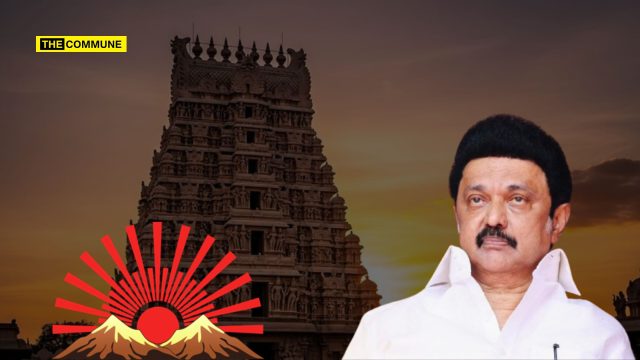
The DMK is reportedly considering dropping its long-standing anti-Hindu political approach after its humiliating defeat in the recent Tamil Nadu Assembly elections, with a Maalai Malar report claiming that the party’s leadership believes the shift of a substantial section of Muslim and Christian votes to the ruling Tamilaga Vettri Kazhagam (TVK) was a key factor behind its loss.
The DMK, which traces its ideological roots to the Dravidar Kazhagam movement, has traditionally pursued politics perceived as being opposed to Hindu religious orthodoxy, a strategy that helped it consolidate minority votes over the years.
However, the political landscape in Tamil Nadu is said to have changed dramatically after the Tamilaga Vettri Kazhagam (TVK), led by Chief Minister C. Joseph Vijay, came to power. Several key constituents of the former DMK alliance including the Congress, Viduthalai Chiruthaigal Katchi (VCK), the Communist parties and the Indian Union Muslim League (IUML) have now shifted to form an alliance with the TVK government, with a majority of them being a part of the cabinet.
The current political situation can be contrasted with the 1999 Lok Sabha elections, when the DMK allied with the BJP. Although the alliance reportedly resulted in a marginal decline in minority votes, it is claimed that the party did not suffer any significant electoral setback at the time. The current situation, however, is seen to be fundamentally different.
One of the biggest setbacks for the DMK leadership has been the Indian Union Muslim League ending its alliance with the party after maintaining close ties for nearly six decades.
It is reported that nearly 80 percent of Christian votes and around 50 percent of Muslim votes, which had long formed a crucial part of the DMK’s electoral base, shifted in favour of the TVK during the Assembly elections and this was one of the principal reasons the DMK failed to return to power.
While electoral defeats are not new to the DMK, this is the first time the party has allegedly lost large sections of both its minority vote bank and its Scheduled Caste support simultaneously.
Even senior Congress leader Peter Alphonse, who has long been regarded as a steadfast supporter of the DMK irrespective of the political climate, has reportedly begun describing the TVK government as a government for minorities and has called for it to be protected. Such developments have further intensified concerns within the DMK leadership.
Indian Union Muslim League national president Kader Mohideen was reportedly cited as saying, “There was tremendous pressure from the Muslim community asking us to extend support to the TVK government. I have never seen this level of support for Vijay among Muslims in my lifetime.”
With a significant section of minority voters having shifted towards the TVK, the DMK leadership fears that continuing what it describes as “Hindu opposition” politics could ultimately benefit BJP.
Against this backdrop, the DMK president M.K. Stalin and party leader Udhayanidhi Stalin are holding intensive discussions with senior party functionaries on whether to adopt a “soft” spiritual approach modelled on the political styles of former Chief Ministers M.G. Ramachandran (MGR) and J. Jayalalithaa.
The reported strategic shift is said to be aimed at preparing the party for the upcoming local body elections, by-elections and the 2029 Lok Sabha elections.
According to party sources cited in the report, a clearer picture of the DMK’s evolving political strategy is likely to emerge after the results of the forthcoming by-elections.
Subscribe to our channels on WhatsApp, Telegram, Instagram and YouTube to get the best stories of the day delivered to you personally.