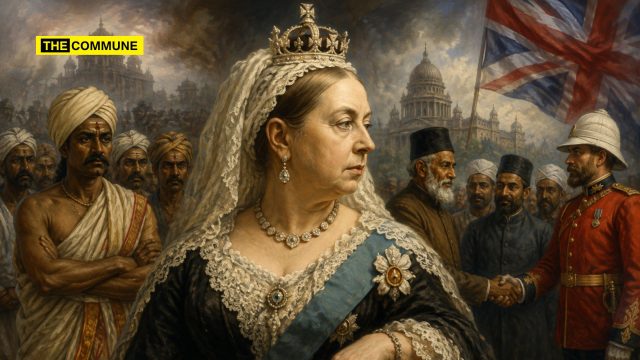
On India’s Independence Day, a passage from a historical study of British colonial rule offers a revealing glimpse into how the British establishment viewed different religious communities in colonial India with Queen Victoria herself expressing suspicion towards Brahmins and describing Muslims as “the real supporters of the British rule.”
The passage appears in historian Venkat Dhulipala’s book Creating a New Medina: State Power, Islam, and the Quest for Pakistan in Late Colonial India, published by Cambridge University Press.
The section examines communal clashes that took place in the Bombay Presidency in 1893–94, particularly in the towns of Yeola and Poona, against the backdrop of disputes involving religious processions and music played near mosques.
According to Dhulipala, the violence prompted considerable attention in Britain, including from Queen Victoria. The Queen-Empress communicated her views directly to the Indian government and insisted that British officials protect Muslims from what she described as Hindu extremism.
The book records a private communication in which Victoria wrote: “The Queen-Empress entirely concurs in the necessity and wisdom of a policy of religious impartiality; but she cannot help feeling that the Brahmins are those who incite the people against us, and that the Mahomedans are the real supporters of the British rule; and she does think that they should be protected from insults and disturbance in their very peaceful and quiet worship, which is so opposed to idolatry.”
The remark is significant not merely for its religious language but for the political distinction Victoria drew between the two communities. She explicitly characterised Brahmins as those who “incite the people against us”, while describing Muslims as “the real supporters of the British rule.”
The correspondence came after communal disturbances in Yeola and Poona. In Yeola, according to the book, a Hindu boycott of Muslim businesses developed into a dispute over religious processions and music before culminating in a pig carcass being thrown into a mosque.
The Poona violence similarly emerged from a dispute over music being played before mosques. Muslims attacked a Hindu procession, following which Hindus retaliated by rampaging through a mosque.
The British response, however, was not simply one of enforcing a uniform policy of religious neutrality. Dhulipala’s account shows that the highest levels of the colonial administration were actively considering how different communities related to British political authority.
Victoria’s correspondence is particularly striking because it openly frames the issue in political terms. Her concern was not merely about preventing communal violence. She believed that Brahmins were hostile to British rule while Muslims were among its principal supporters.
The historical record therefore provides an important window into the political environment in which communal identities and divisions developed under colonial rule.
It also complicates any simplistic account of the origins of anti-Brahmin politics in modern India. British administrators and political thinkers did not operate as detached observers of caste and religious divisions. Their own assessments of which communities were loyal or hostile to the Raj inevitably influenced the way colonial power interacted with Indian society.
Victoria’s words are especially revealing in this context. The British monarch was explicitly identifying one section of Indian society as a political threat and another as a constituency whose interests required protection.
That does not, by itself, establish that British policy was solely responsible for every later strand of anti-Brahmin politics in India. But it does establish something historically important: the British Empire itself viewed Brahmins as potential opponents of colonial rule and Muslims as an important source of support for that rule.
More than a century later, the passage serves as a reminder that the politics of caste and community in colonial India cannot be separated from the interests and strategies of the colonial state.
The British eventually left India. But the political categories and divisions shaped during colonial rule continued to influence Indian public life long after the Union Jack came down.
On Independence day, remember what the Queen Of England Victoria said:
“Brahmins are the real opponents of British rule. They instigate the people against us. Muslims are the real supporters of British rule.
We (British) should side with the Muslims as their religion is very… pic.twitter.com/z3VEqAQU2C— True Indology (@TrueIndology) August 15, 2026
Subscribe to our channels on WhatsApp, Telegram, Instagram and YouTube to get the best stories of the day delivered to you personally.