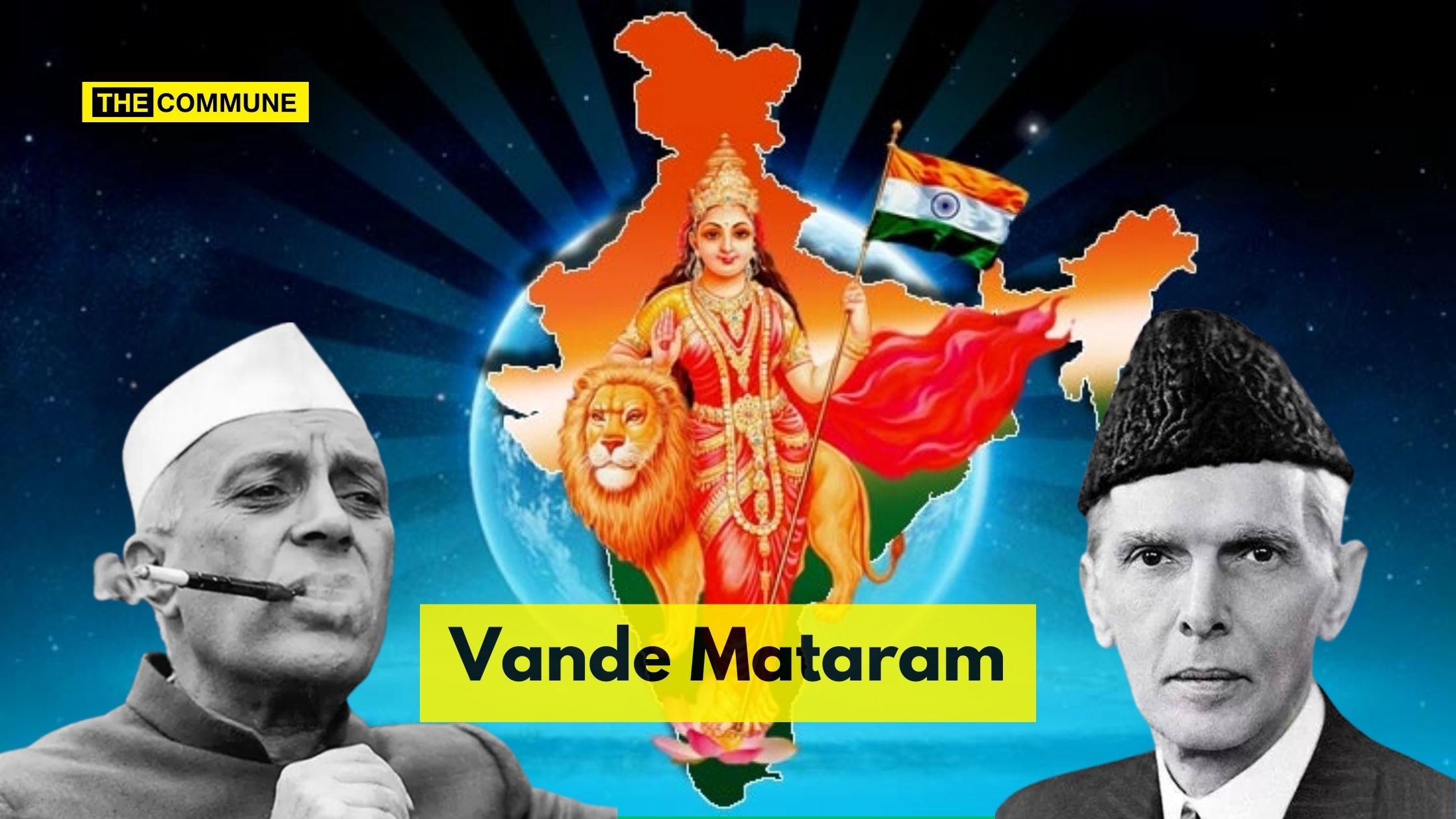
The Congress Parliamentary Party chairperson Sonia Gandhi, on 15 August 2026, stirred controversy by objecting to the full rendition of Vande Mataram during an Independence Day event. Videos available on social media clearly indicate that she was telling the singers to stop after they continued beyond the first two traditional stanzas into the remaining four.
This behaviour has rekindled memories of a nearly century-old controversy surrounding India’s National Song and Congress’s historic decisions regarding its public rendition.
The 1923 Kakinada Congress Confrontation
The roots of the controversy stretch back to the Indian National Congress session held at Kakinada in 1923.
Maulana Mohamed Ali was brought to the venue in a procession accompanied by a musical band. As per Congress tradition, the session was scheduled to begin with a rendition of Vande Mataram by renowned classical vocalist Pandit Vishnu Digambar Paluskar.
When Paluskar rose to sing, Maulana Mohamed Ali objected, arguing that music was forbidden in Islam and that singing Vande Mataram would hurt his religious sentiments.
Paluskar refused to yield.
He reportedly responded that the Congress session was a public political gathering, not a religious congregation of any one faith. He further pointed out that since the Maulana had not objected to the band that had led his own procession, he could not reasonably object to the singing of Vande Mataram.
The song was ultimately performed despite the protest.
From Resistance To Compromise
While the 1923 objection did not succeed, the political landscape changed dramatically over the next decade.
By 1937, Vande Mataram had increasingly become a point of contention in Congress-Muslim League politics.
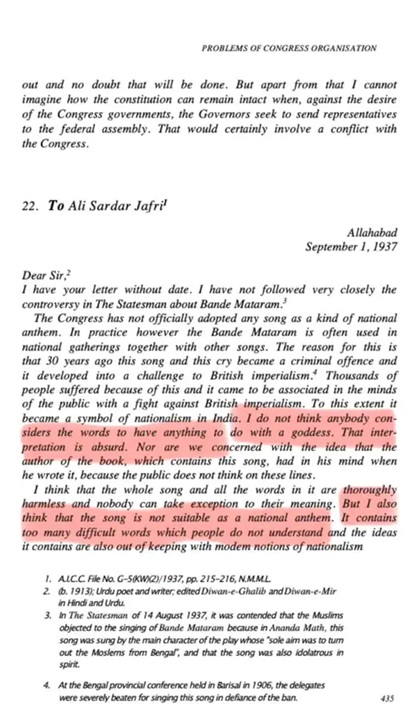
According to historical accounts, poet Ali Sardar Jafri argued before Jawaharlal Nehru that the song, which had inspired generations of freedom fighters, including revolutionary Khudiram Bose, was “idolatrous in spirit.”
Nehru himself expressed reservations about the song, reportedly describing it as “out of keeping with modern notions of nationalism and progress.”
Muslim League Resolution Against The Song
The Muslim League quickly adopted the issue.
On 17 October 1937, at its Lucknow session, the League passed a resolution condemning the Congress for allegedly imposing Vande Mataram upon the country “in callous disregard of the feelings of Muslims.”
The resolution marked a significant escalation, framing the National Song itself as a communal grievance.
Congress Officially Limits The Rendition
Later that year, when the Congress Working Committee met in Calcutta under Jawaharlal Nehru’s presidency, it formally accepted objections to portions of the song.
The committee recognised what it described as ‘the validity of the objections raised by the Muslims to certain parts of the Vande Mataram song’ and recommended that ‘at national gatherings the first two stanzas only of the song should be sung.’
That recommendation would go on to shape the public convention surrounding Vande Mataram, with the first two stanzas becoming the standard rendition at official functions.
Muslim League Remained Unsatisfied
The Congress concession did not end the controversy.
Despite Nehru’s assurance that Vande Mataram would “in future become less important,” the Muslim League continued treating the song as a grievance.
On 15 November 1938, the League’s Pirpur Committee, constituted to document what it described as “atrocities against Muslims”, submitted its report.
Among the grievances listed in the report was Vande Mataram itself.
Against this historical backdrop, the recent Independence Day incident involving Sonia Gandhi is only a continuation of the long-standing Congress pattern of yielding to objections over the full rendition of Vande Mataram.
The fatwa against Rishi Bankim Chandra Chattopadhyay’s ‘Vande Mataram’ is not without history and can be traced to Congress’s capitulation in the face of Islamist opposition.
In 1923, the Congress met at Kakinada and Maulana Mohamed Ali was brought to the venue in a procession… pic.twitter.com/5V7QhgzqFk
— Kanchan Gupta 🇮🇳 (@KanchanGupta) August 16, 2026
Subscribe to our channels on WhatsApp, Telegram, Instagram and YouTube to get the best stories of the day delivered to you personally.