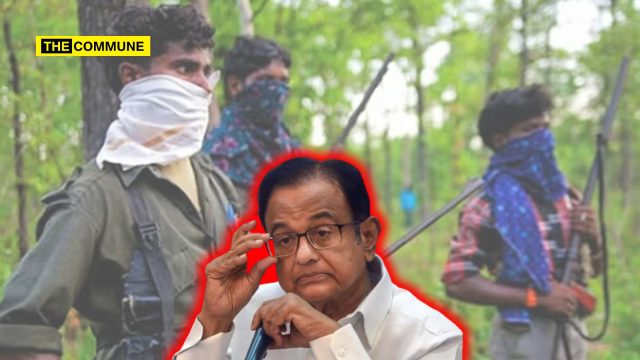
Senior Congress leader and former Union Home Minister P. Chidambaram on Sunday declared that he was “proud” to be a “dimagi naxal” after Prime Minister Narendra Modi warned against what he described as “dimagi naxals” — people with a Maoist mindset who, according to him, have entrenched themselves in institutions and influenced public policy.
“I am proud to be a dimagi naxal!” Chidambaram said in a post on X, responding to Modi’s Independence Day remarks.
I am proud to be a dimagi naxal !
— P. Chidambaram (@PChidambaram_IN) August 16, 2026
As reported in The Hindu, the Prime Minister, speaking from the ramparts of the Red Fort, said that while armed Naxalism had been largely removed from the forests, its ideological supporters continued to pose a threat by seeking opportunities to promote violence and anarchy.
Modi said that people with a Maoist mindset had established themselves in positions of influence over the years.
“For years, people with a Maoist mindset had established themselves in the corridors of power. They had served as advisers on government committees and influenced public policy.”
He urged citizens to “identify and isolate” such individuals and warned against underestimating the challenge.
Modi also highlighted the human cost of decades of Naxal and Maoist violence, saying that more than 3,500 police and security personnel had been killed in the conflict.
“Naxalism held a very large part of India and a huge population in its grip, at gunpoint,” he said.
The Prime Minister said the Narendra Modi government had made ending Naxalism a priority after coming to power in 2014 and claimed that violence was now being brought to an end in areas that were previously affected by Maoist insurgency.
“Decades-old challenges must be brought to an end. Naxalism and Maoism have destroyed the future of millions of young people. They have taken away the sons of countless mothers, ruined families, and shattered the dreams of parents,” Modi said.
“Today, I am happy that Naxalite and Maoist violence is being brought to an end. In areas where the bullets of Naxalites once rang out, where bloodshed was once commonplace, the tricolour of development, trust, and effort is now flying because these areas have been freed from Naxalism,” he added.
Chidambaram’s declaration that he was “proud” to be a “dimagi naxal” is particularly notable in light of his own position on Maoist insurgency during the UPA government.
Chidambaram’s 2010 Stand On Maoist Talks
In May 2010, in the immediate aftermath of the brutal Dantewada massacre where 76 CRPF personnel were killed by Maoists, then Union Home Minister P. Chidambaram found himself at the centre of India’s most pressing internal security debate. On one hand, the UPA government had launched Operation Green Hunt to confront the armed insurgents; on the other, Chidambaram was under pressure to open a dialogue with the Naxals.
That month, Chidambaram took his case directly to students at Jawaharlal Nehru University (JNU), traditionally a stronghold of Left politics. The event, organised by the Congress-backed National Students’ Union of India (NSUI), was titled “Naxalism: Threat to Indian Democracy and Internal Security.” Speaking at the packed School of Social Sciences auditorium late in the evening, the Home Minister received a mixed reception of applause and protests.
Addressing the Maoist insurgency, Chidambaram described it as both a serious law-and-order issue and a problem rooted in socio-economic grievances. He assured students that the government was prepared to review mining contracts in tribal areas and that New Delhi was not blind to the economic causes feeding the rebellion.
But his most striking line came when he made clear that the government’s invitation for talks did not require Maoists to first surrender their weapons.
“It is a serious law and order issue. There are socio-economic causes that we will address, the talks for dialogue. The government is willing to relook at the mining contracts. I was the first minister in this government who said we are ready for talks, we are not asking you to lay down arms because we know you won’t do that, because you believe in armed liberation struggle, you will not lay down arms,” Chidambaram told the students.
More than 16 years later, Chidambaram is proudly embracing the “dimagi naxal” label that Prime Minister Modi used for those influenced by Maoist ideology. But his own record shows why the description has struck a nerve.
As Home Minister in 2010, Chidambaram openly acknowledged that Maoists believed in an “armed liberation struggle” and nevertheless said the government was prepared to negotiate with them without first asking them to surrender their weapons.
Subscribe to our channels on WhatsApp, Telegram, Instagram and YouTube to get the best stories of the day delivered to you personally.