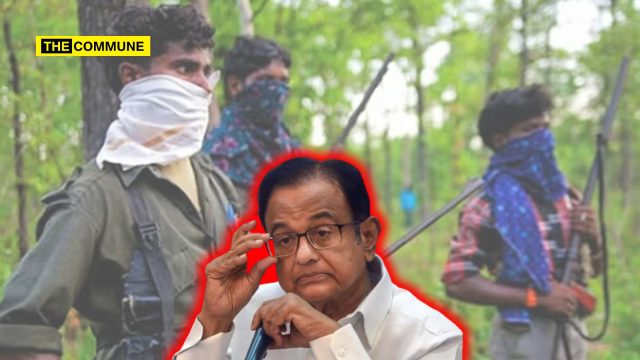
A political war of words has erupted between BJP leader Rajeev Chandrasekhar and senior Congress leader P. Chidambaram over the latter’s reference to himself as a “Dimagi Naxal”, with Chandrasekhar linking the remark to the Congress’ handling of Left-Wing Extremism during the UPA era.
The exchange began after Chandrasekhar pointed to the recent conviction of 10 people in connection with the 2013 Naxal attack in Chhattisgarh that killed several senior Congress leaders.
Chandrasekhar wrote on X, “In 2013, Naxals killed and wiped out Cong party leadership in Chattisgarh.
A few days ago, 10 convicted by Court.
Then Home Minister @PChidambaram_IN admits he was/is a #DimaghiNaxal. So Chattisgarh Cong party leaders were also victims of this idealogy?”
He went on to question why the problems of Naxalism and terrorism, according to him, remained entrenched for decades before the Narendra Modi government acted against them.
“Ever wonder why entrenched problms like Naxals, Terror had to wait for PM @narendramodi to come and defeat them? Because of many decades that India was governed by #DimaghiNaxals – high brow sympathisers of divisiveness and anarchy.”
In 2013, Naxals killed and wiped out Cong party leadership in Chattisgarh.
A few days ago, 10 convicted by Court.
Then Home Minister @PChidambaram_IN admits he was/is a #DimaghiNaxal. So Chattisgarh Cong party leaders were also victims of this idealogy?
Ever wonder why…
— Rajeev Chandrasekhar 🇮🇳 (@RajeevRC_X) September 8, 2026
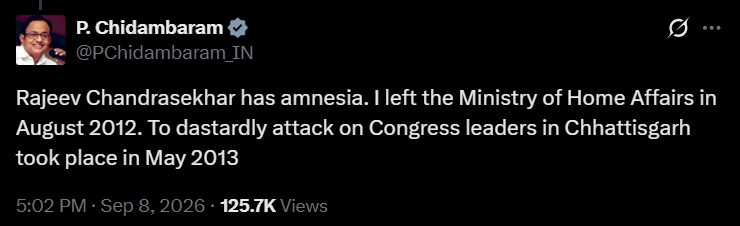
Chidambaram hit back, accusing Chandrasekhar of getting his facts wrong. He pointed out that he had left the Union Home Ministry in August 2012, while the attack on Congress leaders in Chhattisgarh took place in May 2013.
“Rajeev Chandrasekhar has amnesia. I left the Ministry of Home Affairs in August 2012. To dastardly attack on Congress leaders in Chhattisgarh took place in May 2013,” he wrote.
Chandrasekhar, however, did not back down. He acknowledged that Chidambaram was no longer Home Minister when the attack took place but argued that the Naxal leadership responsible for the attack had developed during his tenure.
“Granted that you were not Home Minister on the exact day or the hour of the Naxal attack that brutally killed your partys state leadership.
For almost 4 years you were Home Minister.
The Naxal terrorists who slaughtered your Congress colleagues in May 2013 did not magically appear the day you moved to the Finance Ministry, @PChidambaram_IN.
They grew, armed themselves, and gained strength under your watch – an admitted #DimaghiNaxal – thriving in a security “doctrine” of inaction, created by your elitist political idealogy and the UPA’s #DimaghiNaxals.”
Granted that you were not Home Minister on the exact day or the hour of the Naxal attack that brutally killed your partys state leadership.
For almost 4 years you were Home Minister.
The Naxal terrorists who slaughtered your Congress colleagues in May 2013 did not magically… https://t.co/BArzuwiLWB
— Rajeev Chandrasekhar 🇮🇳 (@RajeevRC_X) September 8, 2026
Chandrasekhar further accused Chidambaram of insulting the memory of the Congress leaders killed in the attack by pointing to the fact that he had already moved to the Finance Ministry.
“Saying ‘I changed cabins by then,’ when you were the architect of the DimaghiNaxal idealogy and doctrine that cost the lives of your own colleagues, is an insult to their memory.”
He also attacked the Congress-led UPA government over both security and economic policies, writing:
“As Home Minister you celebrated Naxals, as Finance Minister encouraged Cronies – is it any wonder the Cong decade was a disaster for India’s security and economy?”
Reolying to his own post, Chandrasekhar accused Chidambaram of attempting to shift responsibility for the Naxal situation onto his successor, Sushilkumar Shinde.
“And theres another message in Mr @PChidambaram_IN aka #DimagiNaxal’s response. He wants to dump the complete onus onto his successor Sushil Shinde – his own Cong Colleague. Pathetic!”
And theres another message in Mr @PChidambaram_IN aka #DimaghiNaxal‘s response.
He wants to dump the complete onus onto his successor Sushil Shinde – his own Cong Colleague. Pathetic! #DimaghiNaxals
— Rajeev Chandrasekhar 🇮🇳 (@RajeevRC_X) September 9, 2026
Chidambaram’s 2010 Stand On Maoist Talks
In May 2010, in the immediate aftermath of the brutal Dantewada massacre where 76 CRPF personnel were killed by Maoists, then Union Home Minister P. Chidambaram found himself at the centre of India’s most pressing internal security debate. On one hand, the UPA government had launched Operation Green Hunt to confront the armed insurgents; on the other, Chidambaram was under pressure to open a dialogue with the Naxals.
That month, Chidambaram took his case directly to students at Jawaharlal Nehru University (JNU), traditionally a stronghold of Left politics. The event, organised by the Congress-backed National Students’ Union of India (NSUI), was titled “Naxalism: Threat to Indian Democracy and Internal Security.” Speaking at the packed School of Social Sciences auditorium late in the evening, the Home Minister received a mixed reception of applause and protests.
Addressing the Maoist insurgency, Chidambaram described it as both a serious law-and-order issue and a problem rooted in socio-economic grievances. He assured students that the government was prepared to review mining contracts in tribal areas and that New Delhi was not blind to the economic causes feeding the rebellion.
But his most striking line came when he made clear that the government’s invitation for talks did not require Maoists to first surrender their weapons.
“It is a serious law and order issue. There are socio-economic causes that we will address, the talks for dialogue. The government is willing to relook at the mining contracts. I was the first minister in this government who said we are ready for talks, we are not asking you to lay down arms because we know you won’t do that, because you believe in armed liberation struggle, you will not lay down arms,” Chidambaram told the students.
Subscribe to our channels on WhatsApp, Telegram, Instagram and YouTube to get the best stories of the day delivered to you personally.