America loves to lecture other nations about religious freedom. The U.S. Commission on International Religious Freedom (USCIRF) regularly denounces countries like India for allegedly persecuting Christians, demanding they be designated as “Countries of Particular Concern.” Yet here’s the uncomfortable truth: the American government is simultaneously creating task forces to privilege Christianity at home while Hindu Americans face harassment at the highest levels of government. This is not hypocrisy but a calculated use of religious freedom rhetoric as a geopolitical weapon.
The USCIRF: A Tribunal For Thee, But Not For Me
The mechanism for this hypocrisy is official and well-funded. The U.S. Commission on International Religious Freedom (USCIRF) acts as a global moral arbiter, annually publishing reports that name and shame other nations for their failures. It recommends designating countries as “Countries of Particular Concern” and lectures the world on the path to tolerance.
Yet, this moral authority rings hollow. How can we credibly condemn the suppression of religious minorities abroad when, domestically, we see a concerted push to impose a majoritarian Christian culture? The same political ecosystem that supports USCIRF’s mission often champions a vision of America where non-Christian faiths are treated as foreign, suspect, or simply in need of conversion.
The Vance Case: A Microcosm Of Assimilation
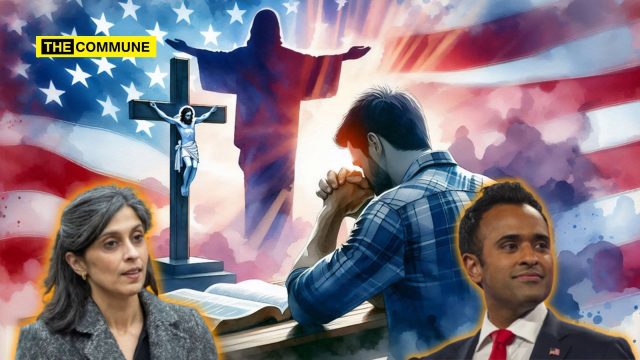
Look no further than the personal story of JD and Usha Vance. Usha Vance has spoken with clarity about her Hindu upbringing, stating it shaped her parents into “really very good people.” Yet, in the public square, her faith has been systematically erased and targeted.
Her husband, the vice president, did not defend her heritage when it was mocked by trolls in his own political base. Instead, he publicly diminished her religious background and expressed his hope that she would “eventually” embrace Christianity. Vance just made a public statement that signals a disturbing norm: your faith is welcome only as a waystation on the road to ours.
This is the domestic reality of “religious freedom” for many in the US: not the liberty to practice one’s faith in peace, but the pressure to assimilate into the dominant Christian identity to be fully accepted.
The Ramaswamy Test: Conditional Acceptance For A “Model Minority”
The experience of Vivek Ramaswamy further exposes the conditional nature of this acceptance. He ran for president as a staunch Hindu, but to be palatable, he was forced to perform a delicate dance. He constantly framed his Hindu beliefs as an echo of “Judeo-Christian values,” a testament to the unspoken rule that to be legitimate, a faith must be validated through a Christian lens.
Despite his compliance, he still faced naked bigotry. When commentator Ann Coulter told him, “I still would not have voted for you because you’re an Indian,” it laid bare the ultimate barrier. His faith, no matter how he packaged it, and his ethnicity were, for a significant portion of the electorate, disqualifying. His story proves that for non-Christians, acceptance is often provisional and can be revoked at any time by the forces of pure prejudice.
Digital Demonization: When Hindu Gods Become Targets
Beyond policy and politics, the cultural hostility toward Hinduism plays out most visibly in the digital sphere. On social media, a network of ultra-Christian zealots — often based in the U.S. — regularly circulate abusive caricatures of Hindu gods and goddesses, depicting them as “demons,” “false idols,” or “Satanic figures.” Organized evangelical pages and YouTube channels openly call for “breaking the idols of India,” echoing a colonial-era contempt dressed up as modern evangelism.
Platforms like X (formerly Twitter), Facebook, and Instagram are flooded with memes that mock Hindu deities, equating sacred symbols like Om, Shiva, and Durga with devil imagery. These attacks rarely face moderation, even as the same companies swiftly censor perceived “hate speech” against Christianity or Islam. Hindu Americans who call out such bigotry are dismissed as “Hindutva extremists,” while their abusers hide behind the language of “religious freedom” and “free speech.”
Alexander Duncan, a Republican leader from Texas, posted on social media:
“Why are we allowing a false statue of a false Hindu God to be here in Texas? We are a CHRISTIAN nation!”
He was referring to the 90-ft statue of Lord Hanuman at the Sri Ashtalakshmi Temple in Sugar Land, Texas.
The statue continues to face online attacks from MAGA supporters since its unveiling in 2024.
This is not fringe behavior — it reflects a deeper ecosystem that normalizes the vilification of Hinduism while presenting Christianity as the universal moral standard. The irony is stark: the same America that lectures India about tolerance harbors online crusaders who actively dehumanize Hindu belief, often with silent approval from the very institutions claiming to defend religious liberty.
The Great American Sham
This is the great American sham. They cry freedom of religion through USCIRF in other countries, pointing fingers at nations that privilege a state religion or a majority faith. Yet, simultaneously, a powerful movement in their politics seeks to do the very same thing in their country – impose a Christian identity on their laws, their culture, and their national self-concept.
Until America extends genuine religious freedom protection to its own minorities, until it stops lecturing other nations, until a Vice President can’t publicly hope his wife converts, until Hindu candidates aren’t subjected to religious tests for office, American preaching about global religious freedom will remain what it truly is: cynical geopolitical theatre masquerading as principle. The hypocrisy isn’t incidental. It’s the entire point.
Subscribe to our channels on WhatsApp, Telegram, Instagram and YouTube to get the best stories of the day delivered to you personally.