Tamil Nadu occupies a unique and exalted place in the civilizational consciousness of Bharatvarsha. More than merely a political or geographical entity, it stands as one of the greatest living repositories of Hindu spiritual heritage, temple culture, sacred art, philosophy, music, dance, ritual traditions, and monastic lineages. From the towering temples of Madurai, Chidambaram, Srirangam, Rameswaram, Kanchipuram, and Thanjavur to the innumerable mutts, ashrams, Siddha traditions, and centres of Vedic learning that continue to thrive across the land, Tamil Nadu has for centuries served as a luminous pillar of Sanatana Dharma. The spiritual pulse of this sacred region has profoundly shaped the religious, cultural, and philosophical life of Bharatvarsha itself. Any political transformation in Tamil Nadu, therefore, carries significance beyond electoral arithmetic; it inevitably touches a land deeply intertwined with the Hindu civilizational continuum of India.
Having closely followed Tamil Nadu’s political evolution for over four decades, and as someone whose mother tongue is Tamil, I have witnessed the steady decline of the Indian National Congress alongside the rise and consolidation of Dravidian forces led by the Dravida Munnetra Kazhagam (DMK) and the All-India Anna Dravida Munnetra Kazhagam (AIADMK). For much of this period, the structure of politics in the state remained broadly stable despite shifts in leadership and alliances. The developments surrounding the 2026 election, however, suggest a decisive break from that trajectory indicating a deeper churn in the political consciousness of the electorate, where long-held loyalties are being questioned and new alternatives are being actively explored.
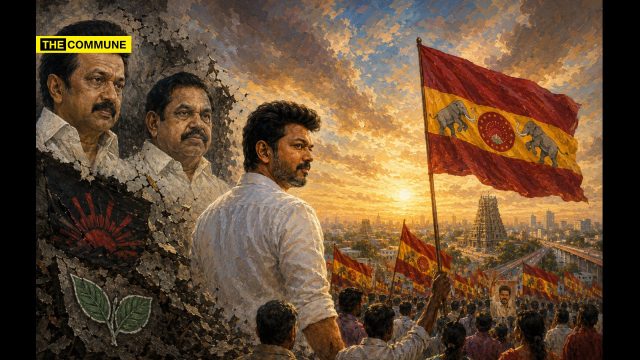
The 2026 Assembly election stands out as one of the most consequential disruptions in Tamil Nadu’s political history. For nearly six decades, power alternated between the DMK and the AIADMK, creating a durable duopoly that shaped governance and political discourse. That equilibrium has now been significantly shaken. The emergence of actor turned politician Joseph Vijay, and his Tamilaga Vettri Kazhagam (TVK) has altered the political landscape, compelling established parties to reassess their strategies. The verdict was not merely electoral; it reflected a broader dissatisfaction with a political culture perceived as stagnant and unresponsive.
The scale of the shift is evident in the numbers. In the 234-member Assembly, TVK secured 108 seats, just short of the 118 required for a majority, yet emerged as the single-largest party. The DMK won 59 seats, the AIADMK 47, the Congress 5, and the Pattali Makkal Katchi (PMK) 4, effectively breaking the long-standing DMK-AIADMK binary.
The results also exposed structural weaknesses across the political spectrum: internal divisions within the AIADMK, a weakening organisational hold of the DMK, an inconsistent strategy by the Bharatiya Janata Party (BJP) in the state, and the Congress party’s opportunistic repositioning. Many observers viewed the outcome as a rejection of entrenched political patterns, marked by arrogance in power, dynastic entitlement, corruption fatigue, and ideological stagnation.
The verdict, in that sense, went far beyond a routine electoral shift. It signalled a deeper rupture in Tamil Nadu’s political order, challenging a system that had dominated the state’s imagination since the late 1960s. Voters appeared to move away from entrenched loyalties and familiar binaries, opting instead for disruption over continuity. What unfolded was not merely a rejection of incumbency, but a broader questioning of a political culture perceived as insular, repetitive, and increasingly disconnected from emerging aspirations.
At the same time, Vijay’s rise has sparked wider debates on identity politics, minority consolidation, the influence of celebrity-driven mobilisation, and the future direction of Tamil Nadu’s politics.
Collapse of the Dravidian Certainty
For decades, politics in Tamil Nadu followed a familiar and emotionally charged pattern. The DMK embodied a strand of Dravidian ideology anchored in linguistic pride, rationalist discourse, and expansive welfare politics, while the AIADMK relied on a more personality-driven model shaped by charismatic leadership and populist delivery. The passing of J. Jayalalithaa and M. Karunanidhi, however, marked a decisive turning point, after which both formations began to lose ideological sharpness and emotional resonance.
Under M.K. Stalin, the DMK retained its organisational strength and alliance network, but criticism mounted over increasing centralisation, bureaucratic functioning, and the perception of entrenched family influence. Allegations of corruption, concerns over law and order, and accusations of an anti-Hindu posture from certain quarters contributed to a gradual erosion of its once formidable aura.
The AIADMK, meanwhile, struggled to regain coherence after Jayalalithaa’s death. Persistent factionalism, leadership disputes, and the absence of a unifying figure weakened its organisational depth and electoral appeal. By the time of the 2026 elections, these vulnerabilities had become starkly visible.
The verdict reflected a clear shift in voter sentiment. The DMK was unable to generate the emotional momentum needed for a renewed mandate, while the AIADMK failed to present itself as a credible alternative. Across constituencies, there was a discernible willingness among voters to look beyond traditional alignments. The emergence of TVK as the single largest party marked a watershed moment, pushing both Dravidian majors onto the defensive and signalling a disruption of long-standing political certainties.
The election underscored what many had begun to sense over the past decade that the emotional and ideological coherence of the Dravidian framework was weakening. The long-standing appeal of identity-driven mobilisation and rhetorical binaries appeared less persuasive to a generation more focused on governance outcomes. Voters increasingly evaluated political choices through the lens of performance, credibility, and responsiveness rather than inherited ideological affiliations.
Cinema Meets Political Vacuum
Tamil Nadu’s political landscape has long been shaped by the crossover appeal of cinema. From MG Ramachandran to J Jayalalithaa, film personalities have successfully translated screen charisma into electoral capital. Against this backdrop, actor Vijay’s political foray was initially dismissed by many analysts as yet another celebrity experiment unlikely to withstand electoral scrutiny. That judgment proved misplaced.
Vijay’s rise was facilitated by a palpable political vacuum and growing public discontent. A broad coalition of support began to take shape – young and first-time voters, sections of the urban middle class, segments of minority communities, and voters disillusioned with the DMK all gravitated towards him as a credible alternative. His campaign effectively fused cinematic appeal with a clear anti-establishment narrative. Moving away from conventional Dravidian idioms, he positioned himself as a reform-oriented leader, emphasising administrative efficiency, anti-corruption measures, job creation, and the promise of a “new political culture.”
Mass rallies drew significant crowds, while social media sharply expanded his outreach. Crucially, his extensive fan base evolved into a disciplined, booth-level mobilisation network, lending organisational depth to what initially appeared to be a personality-driven campaign. Equally significant was the misreading by rival parties. The DMK sought to frame him as inexperienced, the AIADMK underestimated his electoral traction, and the BJP alternated between muted criticism and strategic ambiguity. By the time the scale of the TVK surge became evident, the political ground had already shifted decisively.
More significantly, Vijay’s emergence reflected not just the power of celebrity appeal but the crystallisation of accumulated public discontent. His campaign became a vehicle through which anti-establishment sentiment found expression, cutting across traditional political alignments. In doing so, it disrupted the emotional monopoly that established parties had long exercised over the electorate.
Minority Consolidation and Christian Votes
One of the most debated aspects of the election was the minority consolidation behind Vijay. Political analysts, opposition leaders, and social commentators observed that sections of Christian and Muslim voters appeared more inclined toward TVK in several constituencies, particularly after the Indian National Congress shifted its political positioning and anti-BJP sentiment intensified.
The minority consolidation became politically significant because Vijay himself is a Christian and because TVK increasingly came to be viewed as a viable anti-BJP force capable of challenging both the DMK and the AIADMK in several seats. This perception strengthened after the Congress moved toward supporting Vijay, distancing itself from its ally, the DMK. Political observers accused the party of abandoning ideological consistency for immediate political survival, arguing that the Congress leadership sensed the weakening position of the DMK and saw better future prospects in aligning with the rising force of Vijay. Supporters of Vijay argued that minority voters simply chose the most viable alternative in a changing political environment, while opponents claimed that identity-based consolidation played a significant role in accelerating TVK’s rise; the truth likely lies somewhere in between.
Post-election analysis of the 2026 Assembly elections in Kerala, Tamil Nadu, and Puducherry shows that Christian voters remain electorally important where they are regionally concentrated, institutionally organised, or embedded in coalition politics. Their influence was strong in Kerala and visible in Tamil Nadu and Puducherry. A precise count of Christian winners by party and gender is not officially available, as the Election Commission of India does not classify candidates or MLAs by religion; such identifications are therefore based on public identity and party nominations.
Christian identity carried some weight in Tamil Nadu, where Christians are a small but influential minority in southern districts and within educational networks. Vijay’s Christian background gave TVK greater minority visibility, but his success rested on a broader anti-incumbency wave and a youth-driven appeal.
The number of Christian candidates fielded by TVK has been widely discussed in political circles as significant, though no verified final list by religion is available from official sources. One notable Christian woman winner in Tamil Nadu was Leema Rose Martin, wife of Coimbatore-based businessman ‘Lottery King’ Santiago Martin. Contesting on an AIADMK ticket, she won from the Lalgudi constituency. Her son, who floated his own party in neighbouring Puducherry, also won, while her son-in-law secured victory in Tamil Nadu as a Vijay ally.
Beyond Leema Rose Martin, Tamil Nadu produced no other widely prominent Christian woman political figures in this election, reflecting a broader pattern in which Christian representation in Indian politics remains largely male-dominated and often mediated through parties, church networks, family linkages, and caste-community dynamics.
Compared with previous Assemblies, Christian influence rose in Kerala as the United Democratic Front’s comeback restored Christian-dominated central Kerala to a pivotal role in government formation. In Tamil Nadu, the rise was more symbolic, as Vijay’s TVK gave Christian identity new public visibility without making it sectarian. In Puducherry, however, the influence remained limited. In this election cycle, Christian political weight was clearly significant in Kerala and visible in Tamil Nadu, while remaining minimal elsewhere.
Congress and the Politics of Survival
The role of the Indian National Congress during and after the election drew sharp scrutiny. For years, the party’s presence in Tamil Nadu has been sustained largely through alliance politics, most notably under the umbrella of the DMK. However, as electoral trends began to favour the rising TVK, Congress leaders appeared to swiftly recalibrate their strategy, prompting allegations of abandoning an ally at a politically sensitive moment.
Observers pointed out that the Congress no longer commands an independent mass base in the state capable of securing electoral success on its own. Its relevance, therefore, has increasingly hinged on aligning with formations that demonstrate electoral viability. The party’s post-election positioning reinforced perceptions of opportunism, with critics arguing that strategic survival seemed to outweigh ideological consistency.
For the DMK, the episode proved particularly uncomfortable. A long-standing partner appeared willing to reposition itself as political currents shifted, raising questions about the durability of alliance loyalties in an evolving electoral landscape.
The episode also highlighted a broader pattern in Tamil Nadu politics, where national parties have struggled to sustain independent relevance. In the absence of a strong grassroots base, their strategies have increasingly revolved around aligning with dominant regional forces. This dependence has often blurred ideological distinctions and reinforced perceptions of tactical, rather than principled, political engagement.
A Party Without Direction
The most consequential setback of the election arguably befell the AIADMK. Entering the contest with hopes of capitalising on anti-incumbency against the DMK, the party instead found itself squeezed between an eroding traditional vote base and the rapid ascent of TVK. Its leader, Edappadi K. Palaniswami, struggled to project the kind of statewide charisma needed to galvanise voters at a moment of flux.
The post-election phase proved even more damaging. A trust vote in the Assembly exposed deep fissures within the party, as several MLAs defied the official line to back the Vijay-led government. The episode underscored not just dissent, but a broader uncertainty within the organisation about its political direction.
Multiple fault lines became visible. One faction appeared inclined towards tactical cooperation with Vijay to retain relevance, while another pushed for a more confrontational opposition stance. A third group reportedly remained uneasy with both the party’s alignment with the BJP and the leadership approach of Palaniswami.
The cumulative effect was organisational drift. Once defined by centralised authority and tight discipline under J. Jayalalithaa, the AIADMK now appeared fragmented and vulnerable. Several commentators suggest that the 2026 verdict may, in retrospect, mark not just an electoral defeat but the onset of a deeper structural unravelling.
BJP’s Dilemma in Tamil Nadu
The election outcome once again raised searching questions about the long-term approach of the Bharatiya Janata Party in Tamil Nadu. In recent years, K. Annamalai had emerged as one of the party’s most visible and energetic faces in the South, leveraging an aggressive campaign style, anti-corruption messaging, and strong media presence to expand the BJP’s visibility in the state.
Yet, during the election, sections of the party’s own support base expressed concern that his political trajectory had been inconsistently handled. There appeared to be a lack of clarity over alliances, leadership projection, campaign messaging, and tactical priorities. Reports of internal unease—particularly among those wary of Annamalai’s rapid rise disrupting established equations—added to the perception of drift.
Analysts pointed to a deeper strategic ambiguity: whether the BJP intended to cultivate an independent political identity in Tamil Nadu under Annamalai’s leadership, or continue relying on alliance arithmetic, particularly with the AIADMK. This unresolved question appeared to blunt the party’s effectiveness. The BJP neither consolidated itself as a strong standalone force nor managed to shape the broader electoral narrative in a decisive manner.
Subsequent developments surrounding K. Annamalai’s resignation from the BJP have generated considerable discussion among political observers. However, as eminent thinker and editor of Thuglak, S. Gurumurthy, aptly observed, Annamalai’s resignation should not be viewed as a full stop but merely as a comma in a larger political journey. Significantly, throughout this transition, the BJP’s central leadership displayed remarkable maturity and restraint. Not a single senior leader publicly criticised or spoke disparagingly about Annamalai, reflecting both organisational discipline and respect for a leader who contributed substantially to the party’s growth in Tamil Nadu. Equally noteworthy was Annamalai’s own conduct.
Despite speculation and commentary in various quarters, he refrained from making any adverse remarks against the BJP, Prime Minister Narendra Modi, or the party leadership. This mutual display of dignity and restraint stands in sharp contrast to the acrimonious departures often witnessed in Indian politics and suggests that the relationship between Annamalai and the BJP remains one of shared commitment rather than estrangement. Many within the broader nationalist ecosystem therefore continue to view his current step not as an end, but as a transition to a new phase of public service and political engagement.
Criticism also emerged from within the wider ideological ecosystem, with some questioning the dilution of Annamalai’s assertive positioning at key moments. Others argued that the party underestimated the emotional and cultural resonance of Vijay among younger voters. Ultimately, the BJP’s limited expansion beyond selects pockets underscored the enduring challenge it faces in navigating Tamil Nadu’s deeply entrenched regional political landscape.
The outcome further illustrated the structural challenges faced by national parties attempting to expand in Tamil Nadu. Decades of entrenched regional identity politics have created a political ecosystem that resists external narratives unless they are carefully adapted to local sensibilities. Breaking through this framework requires not only organisational strength but also a calibrated understanding of the state’s cultural and political nuances.
DMK’s Crisis of Confidence
For the DMK, the setback went beyond electoral arithmetic, striking at its long-held psychological dominance in the state’s political discourse. A party that once set the ideological tone of Tamil Nadu politics appeared, during this election, increasingly vulnerable and on the defensive.
As Chief Minister MK Stalin, though regarded by supporters as an experienced administrator, was unable to generate the emotional momentum needed to counter the surge around Vijay. The party’s campaign often seemed reactive, shaped more by the need to respond to public discontent, social media criticism, and anti-incumbency pressures than by a forward-looking narrative.
Observers noted a broader shift in voter sentiment, particularly among younger demographics who appeared less invested in the traditional ideological vocabulary of Dravidian politics. Long-standing binaries that once energised the electorate seemed to carry diminished resonance. Instead, voter priorities increasingly centred on governance, corruption, employment, infrastructure, and leadership credibility.
At the same time, critics accused sections of the party ecosystem of displaying intolerance towards dissent, especially on cultural and religious questions. This perception is believed to have eroded support among segments of Hindu communities and sections of the conservative middle class. Compounding these challenges, the rise of Vijay introduced a new variable, fragmenting the anti-BJP space that the DMK had long sought to consolidate.
Joseph Vijay and the Challenge of Governance
Winning an election is one challenge; governing a state as politically layered and administratively demanding as Tamil Nadu is quite another. Within days of assuming office, the administration led by Vijay began facing criticism from multiple quarters. Opposition parties questioned the circumstances surrounding the trust vote, while concerns were raised over cabinet composition, administrative experience, and policy direction.
Critics argued that the new government appeared overly reliant on personality-driven politics, with insufficient institutional depth. Questions were also raised about the relative inexperience of some ministers and reports of uncertainty within sections of the bureaucracy. A section of commentators suggested that cinematic symbolism continued to shape the leadership’s public posture even after the transition to governance.
At the same time, others urged caution against early judgment, noting that any new administration requires time to stabilise and that entrenched political interests may seek to test or unsettle it in its initial phase.
The larger challenge, however, is structural. Vijay must convert a movement powered by charisma and public enthusiasm into a coherent system of governance. Tamil Nadu’s electorate is both politically aware and exacting in its expectations. Sustained public support will depend less on symbolic appeal and more on administrative delivery. If governance falters, the same electorate that propelled his rise could just as swiftly withdraw its mandate.
Taken together, these developments suggest that the 2026 election may mark a shift not only in political leadership but in the underlying grammar of Tamil Nadu politics. The electorate’s willingness to challenge established formations indicates a transition toward a more fluid and competitive environment, where traditional assumptions can no longer be taken for granted.
The End of an Era
The 2026 election marks a watershed in Tamil Nadu’s political evolution. For the first time in nearly six decades, the state has witnessed a tangible disruption of the entrenched Dravidian power structure dominated by the Dravida Munnetra Kazhagam and the All India Anna Dravida Munnetra Kazhagam. The rise of TVK underscores a growing willingness among voters to explore alternatives when established formations appear fatigued.
Beneath the headline outcome, the election revealed deeper structural shifts: the erosion of automatic loyalty to legacy parties, the growing centrality of personality-driven politics, the fragmentation of traditional alliance frameworks, the expanding influence of youth-led digital mobilisation, and a perceptible weakening in the emotional pull of long-standing ideological narratives.
Yet, the moment raises as many questions as it answers. Can TVK evolve beyond a personality-centric platform into a durable political institution, or will it remain tied to the appeal of Vijay? Is the DMK capable of ideological and organisational renewal? Can the AIADMK navigate its internal fractures and reassert coherence? Will the BJP translate cultural visibility into electoral traction? And does the INC have a future beyond alliance dependence?
The larger question looms over all of these: is Tamil Nadu entering a genuinely post-Dravidian phase, or does this moment represent a temporary disruption within a still fundamentally Dravidian political culture? The answer will unfold over time.
What emerges from this transition is a more unsettled but potentially more dynamic political landscape. The erosion of long-standing certainties has opened space for new actors and ideas, but it has also introduced volatility. For all political formations, the message is clear: adaptability, credibility, and delivery will matter far more than legacy or rhetoric in shaping the next phase of Tamil Nadu’s politics.
For now, one conclusion stands out. Tamil Nadu politics has entered one of its most fluid and unpredictable phases in recent memory. Established certainties have weakened, familiar equations have shifted, and the political map has been redrawn. Across the spectrum, victors and losers alike, there is a growing recognition of a new reality: the electorate is no longer bound by tradition alone and is increasingly willing to recalibrate its choices.
As Tamil Nadu moves through this phase of political transition and uncertainty, the deeper civilizational significance of the state cannot be overlooked. This is a land where centuries-old Hindu practices continue to define the cultural soul of society. Tamil Nadu remains one of the strongest bastions of Hindu civilization preserving an unbroken continuity of sacred traditions that have nourished India’s spiritual identity for millennia.
The future political direction of the state will therefore have implications not merely for governance, but for the preservation, interpretation, and continuity of one of the richest Hindu cultural landscapes in the world. In many ways, the story of Tamil Nadu is inseparable from the larger story of India’s civilizational endurance itself.
Pradeep Krishnan is a multilingual author and journalist whose writings explore faith, society, culture, and public affairs.
Subscribe to our channels on WhatsApp, Telegram, Instagram and YouTube to get the best stories of the day delivered to you personally.