The NEET examination has remained in the political limelight for years, particularly in Tamil Nadu. Every examination cycle is accompanied by protests, political statements, and wall-to-wall media coverage. One would think that NEET is among India’s biggest public crises. But is it really? Or has the issue been magnified far beyond its actual significance? More importantly, who benefits from keeping the controversy alive?
Let us begin with the numbers. Around 1.4 lakh students appeared for NEET in Tamil Nadu last year. Even if we assume that each student represents two voting parents, this issue directly affects roughly 2.8 lakh voters. In a state with nearly six crore voters, that amounts to less than half a percent of the electorate. By conventional political arithmetic, this is hardly a vote bank large enough to dominate political discourse. Yet, political parties continue to invest enormous energy opposing NEET. Why?
The answer, in my view, lies beyond electoral calculations.
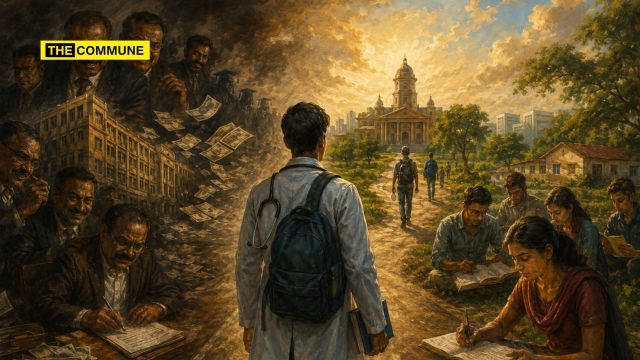
Many influential political families and supporters of major political parties have interests in private medical colleges. Before NEET, India had nearly 400 private medical colleges, many of which operated under a system where admissions were influenced by management quotas, capitation fees, and high tuition fees. A college admitting around 200 students annually would have nearly 1,000 students enrolled across the five-year MBBS program. At capitation fees reportedly touching ₹25 lakh to 1 crore per student and tuition fees of a similar magnitude, the revenue generated was enormous.
NEET fundamentally changed this ecosystem. Admissions are now based on a common national entrance examination, and fee regulation has significantly reduced the scope for discretionary admissions. Under the revised rules, management quota admissions have been substantially restricted, with only a limited number of NRI seats permitted at higher fee structures. For institutions that had built their financial model around the old system, the impact has been considerable. Apparently, a single institution incurred a loss of revenue to the tune of 400 crores from Capitation fees, and 250 crores from tuition fees, according to a known source. Across nearly 400 private medical colleges, the cumulative financial implications run into thousands of crores of rupees. When reforms disrupt an entrenched economic ecosystem, resistance is inevitable.
This, I believe, explains why the campaign against NEET continues long after its implementation. It is presented as a student movement, but the principal beneficiaries of abolishing NEET would arguably be those seeking a return to the earlier admission model. Ironically, the greatest beneficiaries of NEET have been students from ordinary families. A single national examination has eliminated multiple entrance tests, reduced application costs, standardized admissions through the NCERT syllabus, and made it significantly harder for wealth alone to determine who gets a medical seat. Every student writes the same examination regardless of family income, and qualifying candidates become eligible for central and state financial assistance. For countless talented students from rural and economically weaker backgrounds, NEET has opened doors that were previously closed.
NEET is only one example of a larger pattern. Over the past decade, the Modi government has challenged several entrenched interest groups through reforms affecting sectors such as healthcare, defense procurement, energy, and welfare delivery. Direct Benefit Transfers have removed layers of intermediaries who once profited from government schemes. Every reform that eliminates rent-seeking creates powerful losers alongside millions of ordinary beneficiaries.
India’s rise has also altered geopolitical equations. By pursuing strategic autonomy instead of aligning exclusively with any global bloc, India has emerged as an increasingly influential power. This inevitably creates discomfort among interests that benefited from earlier arrangements. In my opinion, these geopolitical realities have encouraged external actors to amplify India’s internal divisions wherever possible. Issues such as the CAA protests, the farmers’ protests, the wrestlers’ protests, and more recently the “cockroaches” controversy are often projected internationally as evidence of widespread public unrest, even when the underlying issues are not.
Every protest has genuine participants and legitimate concerns. However, protests can also become vehicles through which vested interests, ideological groups, NGOs, political intermediaries, and sections of the media amplify narratives that extend well beyond the original grievance. The ordinary protesters become the foot soldiers, while those directing the narrative often pursue entirely different objectives.
India’s experience, however, differs from countries such as Sri Lanka, Bangladesh, Nepal, or Egypt, where prolonged governance failures created widespread public anger that could easily be mobilized into mass movements. Despite its challenges, India today continues to witness economic growth, expanding infrastructure, digital governance, and welfare delivery that directly benefits millions of citizens. Consequently, attempts to transform every policy disagreement into a national political crisis are unlikely to achieve the intended outcome.
The NEET debate, therefore, is no longer just about medical admissions. It has become a proxy battle involving political interests, economic stakeholders, and competing ideological narratives. The real question is not whether NEET can be improved – it certainly can – but whether the sustained political campaign against it is truly about students or about restoring a system that benefited powerful interests far more than deserving young aspirants.
Dr. Santha Kumar is an education leader, author, and public commentator on civilizational history, geopolitics, and contemporary issues affecting Sanatana Dharma.
Subscribe to our channels on WhatsApp, Telegram, Instagram and YouTube to get the best stories of the day delivered to you personally.