Hindu issues often seem to have few champions in public discourse. Whether one agrees with that perception or not, many Hindus feel that concerns relating to temple administration, religious institutions, and the preservation of their cultural heritage rarely receive sustained attention. If that is indeed the case, then Hindus themselves must become informed, engaged, and willing to participate in these conversations. No one else is likely to do it for them.
Recent developments in Tamil Nadu illustrate why this debate continues to resonate.
The present TVK government came to power promising to rise above the divisions of religion, caste, and gender, presenting itself as a genuinely secular alternative. Many voters placed their faith in that vision. Yet, in my view, its approach to issues concerning Hindu temples has reflected more continuity than change. Like several governments before it, it appears to embrace an interpretation of secularism that many Hindus believe has resulted in the unequal treatment of their religious institutions.
A recent example is the government’s handling of the Thiruparankundram Deepam issue. Responding to questions, Minister and Thirupparankundram MLA CTR Nirmal Kumar said that the government would maintain the existing practice, citing the need to preserve peace and prevent communal tensions. Whether one agrees with that position or not, it is consistent with the government’s broader approach to religious and temple-related issues.
More concerning, in my opinion, is the Karur temple land issue, where the government decided to lift registration restrictions on 3,085 acres of encroached land associated with four major temples. Such decisions weaken protections for temple properties and raise legitimate questions about how these assets are safeguarded.
The issue extends far beyond one or two temples.
Take the Vedaranyeswarar Temple, which historical records indicate owns approximately 28,609 acres of land. Despite being one of Tamil Nadu’s largest temple landholders, activists have alleged that substantial portions of these properties remain poorly protected and inadequately managed. They further allege that government agencies leased temple-owned salt pans to commercial entities while the resulting revenue accrued to government agencies rather than to the temple itself. There have also been long-standing allegations of encroachments and minority educational institutions functioning on temple lands without those properties being restored.
Questions have also been raised regarding the management of temple jewellery. The HR&CE Department informed the Madras High Court that five lakh kilograms of gold ornaments from temples were melted into gold bars and deposited in banks. However, concerns have been expressed about maintaining comprehensive inventories of these ornaments, and there have been frequent reports of missing jewellery. Similarly, at the Adikesava Perumal Temple in Thiruvattar, allegations of missing temple jewellery and a golden Sivalinga dating back to 1992 have prompted the Madras High Court to appoint a judicial commissioner to investigate the matter.
These are not isolated controversies. They point to a broader governance issue that deserves transparent public scrutiny.
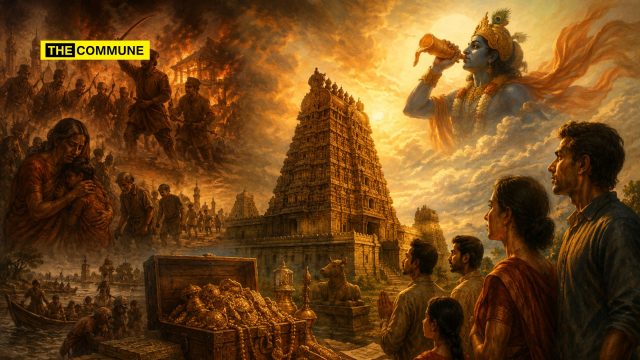
For many Hindus, this is not merely about land or jewellery. Temples have historically been centres of education, art, music, charity, and community life. Resources donated over centuries were intended to sustain these institutions and support society. The central question is whether those resources are today being managed in a manner consistent with the intentions of the devotees who entrusted them.
Looking further back in history, many Hindus believe that their community has repeatedly found itself without effective political or institutional support during moments of crisis. In 1946, Kojagari Purnima – the sacred night when Bengali Hindus celebrate Lakshmi Puja – fell on October 10. As Hindu families gathered in worship in Noakhali (now in Bangladesh), Gholam Sarwar, the hereditary Pir of Daira Sharif, unleashed his brutal militia, the Miyar Fauj. The violence began with the beheading of Rajendra Lal Roy Chowdhury, the Hindu zamindar of Noakhali, whose severed head was reportedly presented to Sarwar on a platter. Rajendra Lal Babu’s daughters, along with scores of Hindu women and girls, were abducted and never seen again. Nearly 400 Hindus were killed that night alone, and over the following days the Noakhali Hindu genocide claimed the lives of at least 5,000 Hindu men, women, and children. Thousands of women were raped, mutilated, and abducted, their suffering compounded by the silence and inaction that followed.
The massacre came just weeks after the Direct Action Day carnage in Calcutta, called by Mohammed Ali Jinnah and carried out under Huseyn Shaheed Suhrawardy, then head of the Bengal Muslim League government. As Noakhali burned, Suhrawardy failed to intervene, while the British administration looked away. Gandhiji and his entourage, too, did not publicly condemn the killings in unequivocal terms or take effective action to stop the violence. Instead, his response placed the burden of survival on the victims themselves—a position that has remained deeply controversial in historical assessments of the tragedy.
The Moplah Rebellion, as it came to be known, was one of the most prolonged and concentrated attacks on Hindus in the Malabar region, leaving deep scars on Hindu life, property, religious institutions, and personal dignity. Hundreds of Hindus were forcibly converted to Islam, and countless women suffered horrific atrocities. Gandhiji neither publicly rebuked the perpetrators unequivocally nor encouraged the Congress to take measures that could have prevented such violence from recurring. Instead, he questioned reports of widespread forced conversions, writing in Young India that there had been only one such case. When Hindus reacted to these massacres, Gandhiji continued to preach non-violence, declaring in one of his prayer meetings: “If they put all of us to the sword, we should court death bravely. May they even rule the world; we shall inhabit the world.”
When Pakistan invaded Jammu and Kashmir in 1947, Maharaja Hari Singh sought military assistance from the Government of India. According to several historical accounts, the Indian leadership agreed to provide that assistance after the Maharaja signed the Instrument of Accession, on the condition that Sheikh Abdullah be appointed Chief Administrator in the new dispensation. Nehru himself later acknowledged that this arrangement had been made in consultation with Gandhiji. This political decision shaped the future trajectory of Kashmir and contributed to many of the challenges that have persisted in the region for decades.
Massacres such as the Noakhali violence of 1946, the Moplah rebellion of 1921, Partition-era communal violence, and the political decisions surrounding Kashmir continue to shape how sections of the Hindu community interpret modern politics and state institutions.
🕯️ Noakhali Hindu Genocide — October 10, 1946
Today, 6 October, marks Kojagari Purnima, when Hindu Bengalis observe Lakshmi Puja.
In 1946, Kojagari Purnima fell on 10 October — the very night that became one of the darkest in Bengal’s history.In Noakhali (now in Bangladesh),… pic.twitter.com/nC16sLgxmb
— Amit Malviya (@amitmalviya) October 6, 2025
Historians, political thinkers, and public intellectuals have offered differing interpretations of these events, but they remain deeply embedded in the historical memory of many Hindus.
Whether one shares these interpretations or not, one conclusion increasingly resonates with many people: communities cannot afford to be indifferent to the institutions that shape their future.
That does not mean responding with anger or hostility. It means becoming informed, participating in public debate, understanding the law, questioning public policy, and holding governments accountable irrespective of which party is in power.
The Mahabharata offers a lesson that remains relevant today. Dharma ultimately prevails, but not through passive hope alone. It prevails through wisdom, courage, discernment, and purposeful action. Lord Krishna did not merely preach righteousness; he combined moral clarity with strategic thinking.
That is perhaps the lesson many Hindus should reflect upon today. Preserving one’s religious and cultural heritage requires more than devotion. It requires awareness, participation, and responsible civic engagement. If Hindus wish to shape the future of their institutions, they cannot wait for a Mahatma to do it for them.
Dr. Santha Kumar is an education leader, author, and public commentator on civilizational history, geopolitics, and contemporary issues affecting Sanatana Dharma.
Subscribe to our channels on WhatsApp, Telegram, Instagram and YouTube to get the best stories of the day delivered to you personally.