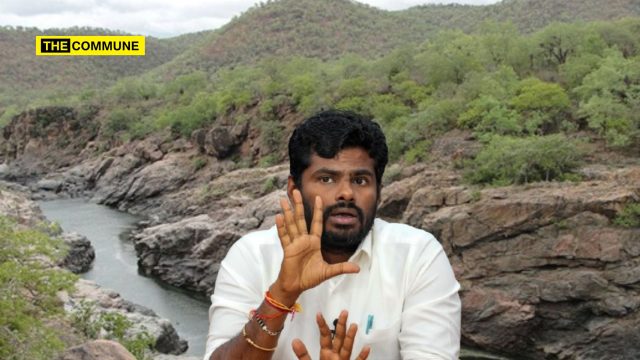
Former Tamil Nadu BJP president and We The Leaders founder member K. Annamalai has accused the BJP-led Central Government of ‘sacrificing the interests of Tamil Nadu’s farmers’ for “electoral gains in Karnataka” after the Ministry of Jal Shakti clarified in Parliament that the Supreme Court’s judgment dated 16 February 2018 does not expressly require Karnataka to obtain the consent of Tamil Nadu, Kerala or Puducherry before constructing any structure across the Cauvery River.
In a strongly-worded post on X, Annamalai described the Centre’s statement as a “U-turn” and questioned why the Union Government had departed from the position articulated by then Union Jal Shakti Minister Gajendra Singh Shekhawat in Parliament in August 2021. “This statement only exposes that the rights of the farmers of Tamil Nadu have been discarded from consideration by the BJP-led Central Government for electoral gains in Karnataka,” he wrote, urging the Centre not to “take the people of Tamil Nadu for granted.”
The Ministry of Jal Shakti in the Rajya Sabha yesterday said that in the Supreme Court Verdict dated 16.02.2018, there is no mention that the State of Karnataka has to obtain the consent of the other riparian states, namely Tamil Nadu, Kerala and the UT of Puducherry, to… pic.twitter.com/FvgxXO5a1R
— K.Annamalai (@annamalai_k) July 28, 2026
The controversy began when Minister of State for Jal Shakti Raj Bhushan Choudhary stated in Parliament that the Supreme Court’s judgment dated 16 February 2018, does not explicitly require Karnataka to obtain consent from lower riparian states – Tamil Nadu, Kerala, and Puducherry or constructing structures across the Cauvery.
The accusation, however, appears to rest on a fundamental conflation of two distinct legal questions. A closer reading of both parliamentary replies shows that the Ministry’s recent clarification did not alter the legal position on the Mekedatu project, nor did it dilute Tamil Nadu’s rights under the Cauvery Water Disputes Tribunal (CWDT) Award or the Supreme Court’s judgment. Instead, it merely answered a narrow question regarding what the Supreme Court’s 2018 verdict actually says.
The issue arose after PMK leader Dr. Anbumani Ramadoss sought clarification in the Lok Sabha on whether Karnataka required the consent of the lower riparian States before constructing the proposed Mekedatu balancing reservoir across the Cauvery. Responding to the question, Minister of State for Jal Shakti Raj Bhushan Choudhary stated that the Supreme Court’s judgment dated 16 February 2018 contains no express requirement that Karnataka obtain the consent of Tamil Nadu, Kerala or Puducherry before constructing any structure across the river.
In support of the reply, the Minister referred to Clause XVIII of the CWDT Award, which was upheld by the Supreme Court. The clause explicitly states that “nothing in the order of this Tribunal shall impair the right or power or authority of any State to regulate within its boundaries the use of water or to enjoy the benefit of waters within that State in a manner not inconsistent with the order of this Tribunal.”
🚨🚨Before anyone misrepresents facts, let me state this – Any structure that reduces Tamil Nadu’s allocated water will be inconsistent with the judgment and can be challenged🚨🚨
Do read this fully :👇👇
Presenting a factual statement from the Ministry of Jal Shakti as… pic.twitter.com/xl32vN96qv
— S Sundar Raman (@ssundarraman) July 28, 2026
That clarification was confined to the interpretation of the Supreme Court’s judgment. It was not a policy announcement, nor did it amount to approval of the Mekedatu project. In fact, the same parliamentary reply that Annamalai criticised makes it abundantly clear that Karnataka’s Detailed Project Report (DPR), submitted in 2019, has been returned by the Centre. The Union Government informed Parliament that Karnataka has been asked to submit a revised DPR in compliance with the CWDT Award and the guidelines of the Central Water Commission (CWC). If anything, the reply highlights that the project continues to remain subject to legal and technical scrutiny rather than suggesting that the Centre has given Karnataka a free hand.
U-Turn Allegation Does Not Hold Water
This is precisely where Annamalai’s “U-turn” allegation begins to unravel. The former BJP state president relies heavily on a parliamentary statement made by then Union Jal Shakti Minister Gajendra Singh Shekhawat on 5 August 2021, claiming that the Centre had then maintained that Karnataka required the consent of the lower riparian States. However, the 2021 statement addressed an entirely different issue. At the time, Shekhawat clarified that Karnataka had only been granted conditional permission to prepare the DPR and that before the project could proceed, the applicable statutory framework governing inter-State River projects including the necessary approvals under the Inter-State River Water Disputes Act and the approval of the Cauvery Water Management Authority (CWMA) would have to be complied with.
The recent parliamentary reply, by contrast, was not discussing the statutory approval process at all. It was answering a much narrower legal question: Does the Supreme Court’s judgment of 16 February 2018 itself contain a clause requiring Karnataka to obtain prior consent from Tamil Nadu? The Ministry’s answer was simply that it does not. There is no inconsistency between the two replies because they address different legal issues. One concerns what the Supreme Court judgment says; the other concerns what the law requires before an inter-State River project can actually be implemented. Treating these as contradictory positions creates a false narrative where none exists.
Equally significant is what the Supreme Court judgment actually guarantees Tamil Nadu. The protection available to Tamil Nadu’s farmers does not arise from a consent clause that is absent from the judgment. Rather, it flows from the Tribunal Award itself, the modified water allocation upheld by the Supreme Court, and the institutional mechanism created through the Cauvery Water Management Authority to monitor releases and enforce compliance. Any project that reduces Tamil Nadu’s allocated share or violates the water-sharing framework established by the Tribunal would still be inconsistent with the judgment and would remain open to legal challenge. The Centre’s parliamentary reply neither alters nor weakens these safeguards.
Why Not Criticize Karnataka Congress Govt?
The political framing adopted by Annamalai therefore raises another obvious question. If his concern is genuinely the protection of Tamil Nadu’s rights over Cauvery waters, why has his criticism been directed almost exclusively at the BJP-led Central Government for accurately restating the contents of the Supreme Court judgment, while remaining largely silent on the Congress government in Karnataka, which continues to pursue the Mekedatu project? The legal clarification came from the Union Government, but the project itself is being actively pushed by the Karnataka government. Targeting only the Centre while overlooking the state government advancing the proposal reflects selective politics rather than a consistent defence of Tamil Nadu’s interests.
It is also worth recalling that after the Supreme Court delivered its 2018 verdict and the Cauvery Water Management Authority was constituted, it was during the BJP government led by B.S. Yediyurappa in Karnataka that the CWMA’s directions were implemented and water was released to Tamil Nadu under the prescribed mechanism. Against that backdrop, portraying the BJP as having suddenly abandoned Tamil Nadu’s Cauvery rights is difficult to reconcile with the institutional record of the post-verdict period.
Bro is deliberately confusing a legal clarification with policy approval.
The question before Parliament was simple:
Does the Supreme Court’s judgment dated 16.02.2018 mandate that Karnataka must obtain the consent of the lower riparian States before constructing any structure… https://t.co/0dPhhqb6MU— Ashvathaman Allimuthu (@asuvathaman) July 28, 2026
Presenting a factual statement about the contents of the Supreme Court’s judgment as evidence that the Centre has “discarded Tamil Nadu farmers for electoral gains in Karnataka” is therefore a leap not supported by the parliamentary reply itself. The Ministry did not approve the Mekedatu project. It did not dispense with statutory approvals. It did not dilute the CWDT Award. It merely stated that the Supreme Court’s judgment does not contain a consent requirement that, in fact, is nowhere to be found in the text of the judgment.
Cauvery remains far too important an issue to be reduced to selective political narratives. Tamil Nadu’s rights will ultimately be protected not by attributing words to the Supreme Court that it never wrote, but by ensuring strict enforcement of the Tribunal Award, vigilant oversight by the CWMA, rigorous scrutiny of any revised DPR, and prompt legal action if any future project threatens the State’s allocated share. Political criticism is entirely legitimate, but it loses credibility when it is built on conflating a judicial interpretation with the statutory approval process governing an inter-State River project.
Subscribe to our channels on WhatsApp, Telegram, Instagram and YouTube to get the best stories of the day delivered to you personally.