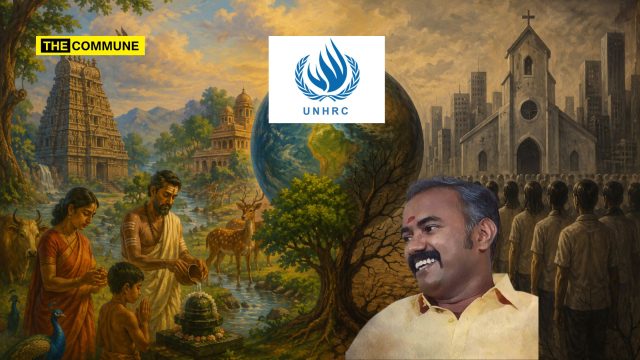
In a notable intervention at the United Nations Human Rights Council (UNHRC) in March 2026, BJP Tamil Nadu State Secretary Ashvathaman Allimuthu argued that the global fight against climate change cannot be confined to technological and industrial solutions alone, asserting that the preservation of ancient civilizations is equally vital for ecological sustainability.
Addressing the UNHRC via a live session on 12 March 2026, Ashvathaman said that global warming has an “ignored cultural dimension” and maintained that cultural diversity contributes significantly to ecological balance.
“Global warming is usually discussed from a technical and industrial point of view. But it also has a cultural dimension which is often ignored. Cultural diversity plays a vital role in ecological balance,” he said.
According to Ashvathaman, the existence of multiple cultures fosters diverse lifestyles and consumption patterns, thereby reducing pressure on the environment.
“If multiple cultures exist, multiple lifestyles will exist, multiple consumption patterns which reduce the pressure on the environment. This kind of cultural diversity is preserved by civilizations which have multiple gods, meaning multiple lifestyles,” he said.
He further argued that civilizations rooted in nature worship inherently safeguard natural resources by embedding them within sacred traditions.
Citing an example from his native town of Panruti in Tamil Nadu, he referred to the Gedilam River, which is traditionally believed to have been created for the abhishekam of Lord Vishnu.
“Most importantly, natural aspects are protected by civilization in the name of nature worship. For instance, in my native Panruti in Tamil Nadu, we have the Gedilam River, which is believed to have been created for the abhisheka of Lord Vishnu,” he said.
Ashvathaman also drew a distinction between “civilizations” and “religions,” arguing that many modern religions promote a uniform way of life that, in his view, places greater strain on the environment.
“The world must understand the difference between civilizations and religions. Most religions are based on a one-God ideology which promotes the same pattern of lifestyle, increasing the pressure on the environment,” he stated.
Referring to the decline of ancient civilizations, he said, “We have already lost ancient civilizations like Egypt and Rome due to religious conversions. It is crucial for the world to protect existing civilizations.”
Describing India as one of the world’s oldest living civilizations, Ashvathaman urged the UNHRC to take measures to address religious conversions in regions with longstanding civilizational traditions.
“India is one of the oldest living civilizations. Hence, the submission seeks to take necessary steps to curtail the rapid religious conversions in lands where the oldest civilizations still exist. This is not for cultural protection. This is for world protection from global warming,” he said.
This is the best video you will find today on internet
First time in history, the religious conversion issue was raised at the UNHRC in Geneva.
BJP State Secretary @asuvathaman became the first to speak against forced religious conversions on this global stage, asserting that… pic.twitter.com/cWC8sflyRh
— STAR Boy TARUN (@Starboy2079) July 26, 2026
His remarks framed the preservation of indigenous civilizations not only as an issue of cultural continuity but also as a component of global environmental policy, linking civilizational diversity with ecological resilience. The address drew attention for presenting climate change through a civilizational lens and for advocating anti-conversion measures before an international human rights forum.
Subscribe to our channels on WhatsApp, Telegram, Instagram and YouTube to get the best stories of the day delivered to you personally.