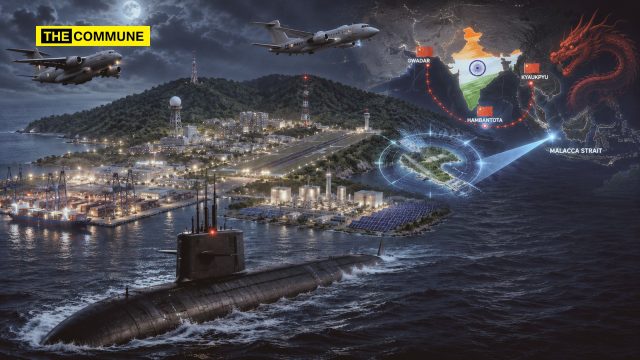
It is midnight in the Indian Ocean. The abyssal waters of the Bay of Bengal are pitch-black, hiding secrets that satellite arrays can only guess at. Beneath the crushing weight of the waves, a hostile nuclear attack submarine glides silently, slipping past international maritime boundaries. Its acoustic signature is muffled, its mission clandestine. For over a decade, this has been the unspoken reality of the geopolitical chessboard. Beijing has been meticulously, ruthlessly weaving its ‘String of Pearls’, pumping billions of dollars into a sprawling network of mega-ports and listening posts across Pakistan’s Gwadar, Sri Lanka’s Hambantota, and Myanmar’s Kyaukpyu.
The objective has always been chillingly clear: encircle India. The plan was to slowly tighten a maritime noose around the Indian peninsula, choke its vital trade routes, and trap the Indian Navy in its own backyard should a full-scale conflict ever erupt. To the rest of the world, looking at the map of the Indo-Pacific, it appeared that New Delhi was cornered. Diplomatic cables whispered that the Indian elephant had been successfully caged by the Chinese dragon.
But wars of the future are not won by those who make the loudest moves; they are won by those who command the shadows. While the world watched the trap ostensibly close, New Delhi was quietly orchestrating a tectonic shift.
The Silent Awakening of an Unsinkable Carrier
The ultimate weapon in India’s modern arsenal isn’t a newly minted hypersonic ballistic missile, nor is it a multi-billion-dollar fighter squadron purchased from the West. It is a dormant, densely forested landmass at the absolute southernmost tip of the Andaman and Nicobar archipelago, a place long forgotten by mainland conversations. It is awakening to become India’s unsinkable aircraft carrier: Great Nicobar.
Look at a nautical map, and the sheer audacity of this geographic weapon becomes apparent. Great Nicobar lies a mere 40 nautical miles from the Strait of Malacca. This narrow, congested waterway is the undisputed jugular vein of the global economy. More importantly, it is China’s greatest vulnerability, the famed “Malacca Dilemma.” A staggering 80% of China’s crude oil imports and the lion’s share of its commercial mega-ships must transit through this 1.5-kilometer-wide chokepoint.
By deciding to militarize and economically hyper-charge Great Nicobar, India is effectively placing a loaded gun directly against the Dragon’s windpipe. Through a staggering ₹72,000-crore mega-project, a forgotten island is being transformed into an impregnable maritime fortress.
The Four Pillars of a Geopolitical Juggernaut
To understand the sheer scale of the Great Nicobar Project, one must look at the four gargantuan pillars being driven into the island’s bedrock. This is not merely a military base; it is a sovereign ecosystem designed to outlast, outgun, and outmaneuver any adversary.
1. The Megaport: International Container Transhipment Terminal (ICTT)
At Galathea Bay, an economic behemoth is rising. The planned International Container Transhipment Terminal is not a standard dock; it is designed to handle an earth-shattering 14.2 million TEUs (Twenty-Foot Equivalent Units) annually. But the true terror for adversaries lies beneath the water line. The terminal boasts a colossal natural draft depth of over 20 meters.
In peacetime, this means the world’s largest commercial leviathans can dock here, wresting India’s supply chains away from foreign transshipment hubs like Colombo or Singapore. In wartime, this deep-water haven transforms into a naval citadel. India’s aircraft carriers and lethal nuclear submarines can dock, rearm, and deploy right at the mouth of the Malacca Strait. They no longer have to retreat thousands of kilometers to the mainland for logistical support.
2. The Fortress in the Sky: The Greenfield Airport
Naval dominance means nothing without absolute air superiority. To that end, an expansive, dual-use Greenfield Airport is being carved out. Designed to initially handle a million passengers and scale up to 10 million, its strategic purpose is far more lethal. In the event of an incursion, India can no longer wait for mainland reinforcements.
This airport will feature runways capable of operating heavy military lifters like the C-17 Globemaster, dropping elite paratroopers and heavy armor within hours. More critically, it will serve as the launchpad for the deadly P-8I Poseidon submarine hunters and advanced fighter squadrons. It transforms the island into a forward-operating watchtower, providing a 360-degree radar and strike umbrella that can neutralize subsurface and aerial threats before they even breach Indian waters.
3. The Unfailing Heartbeat: The 450 MVA Power Plant
The greatest vulnerability of any remote island fortress is its umbilical cord to the mainland. What happens if a full-scale naval blockade severs fuel and supply lines? A base without power is just a concrete tomb.
New Delhi has engineered a failsafe. A mammoth 450 MVA (Megavolt Ampere) gas and solar-based power plant is being established on the island. This ensures that the military command centers, the radar arrays, and the commercial hubs remain fully operational and entirely self-reliant. It is off-grid survival on a geopolitical scale. Even in the darkest hours of a war, the heartbeat of Great Nicobar will not falter.
4. The Shadow City: The 16,610-Hectare Township
To breathe life into this massive military-industrial complex, you need a living, breathing population. A sprawling 16,610-hectare smart township is being meticulously planned. This will not be a temporary camp, but a sovereign Indian city in the middle of the ocean. It will house the military top brass, the maritime experts, the tech infrastructure specialists, and the massive workforce required to keep this geopolitical engine roaring. It establishes a permanent, unshakeable sovereign footprint.
Warcraft Meets Dharma: The Forest and the First Inhabitants
A true warrior does not burn down their own home to defeat an enemy. If the infrastructure represents the muscle of the Great Nicobar Project, its soul lies in its rigorous ethical and ecological framework. The transformation of this island is not a reckless conquest of nature; it is a meticulously balanced ‘Dharma Yuddha’ (righteous war), where national security does not cannibalize the region’s ancient heritage.
The Tribal Shield: Shompen & Nicobarese Welfare
Long before the geopolitical games of the 21st century, these dense tropical rainforests were guarded by the Shompen and Nicobarese tribes. These indigenous communities, who miraculously survived the 2004 tsunami through their ancient understanding of the earth, are the true keepers of the island.
The Indian government has locked the project under an ironclad “Zero Displacement” policy. Not a single tribal member will be relocated from their ancestral lands.
In a remarkable legislative move, the land re-notification process will actually result in a net increase in the legally protected tribal reserve area. Strict buffer zones will ensure that their sacred way of life, their isolation, and their culture remain completely untouched by the roaring jet engines and mega-ships miles away.
The Ecological Armor: Unprecedented Environmental Safeguards
Building a militarized mega-port inside a designated biosphere reserve demands environmental safeguards of unprecedented scale. Great Nicobar is home to the giant Leatherback turtles, Nicobar macaques, and incredibly fragile coral reef ecosystems.
While national defense necessitates the diversion of some forest land, India has triggered a colossal biological counter-offensive. A massive compensatory afforestation drive spanning 97 square kilometers (9,700 hectares) is being executed to replace the lost green cover.
Over 42 stringent environmental conditions have been legally mandated, covering marine acoustic limits to protect whales and dolphins, zero-liquid discharge protocols, and coral relocation programs. Independent scientific committees overseen by the nation’s top ecological institutes will act as the watchdogs. This is not a concrete jungle replacing a natural one; it is a futuristic fortress designed to breathe alongside nature.
The Himalayan Decoy and the Ultimate Checkmate
To truly appreciate the genius of the Great Nicobar Project, one must zoom out and look at the
last five years of global panic. For years, the world’s media, military analysts, and foreign policy think tanks have been obsessively fixated on the snow-capped, bleeding peaks of the Himalayas.
Border skirmishes in the freezing altitudes of Galwan, the standoffs in Pangong Tso, and the muscle-flexing in Tawang convinced everyone that the next great Sino-Indian clash would be a brutal, freezing land war in the mountains. But this was China’s grand illusion. The strategy was to drag India’s political and military gaze up to the icy borders, draining its resources and attention, while Beijing stealthily dominated the Indian Ocean beneath them.
But New Delhi never took the bait. While China forced India to look up at the Himalayan ridges, India quietly reached deep into the ocean and padlocked the only door China needs to survive.
By forging this unsinkable aircraft carrier, India has achieved something rare in modern statecraft: a perfect equilibrium. It has flawlessly balanced Strategic Dominance (choking the Malacca Strait), Economic Sovereignty (reclaiming billions in transshipment trade), Environmental Preservation (protecting a biosphere through massive afforestation), and Tribal Welfare (honoring the first inhabitants with zero displacement).
The Dragon thought it had successfully strangled the Elephant with a String of Pearls. It didn’t realize that while it was busy showing off its fangs in the mountains, the Elephant had calmly reached out, taken the most crucial pearl, and shoved it right down the Dragon’s windpipe. The checkmate is complete, and the waters of the Indian Ocean will never be the same again.
Shri Venkateshwaran is the Chief of Thuglak Digital.
Subscribe to our channels on WhatsApp, Telegram, Instagram and YouTube to get the best stories of the day delivered to you personally.