Home Blog Page 938

Bangladesh: Islamist Students Force Bangladeshi Hindu Professors To Resign
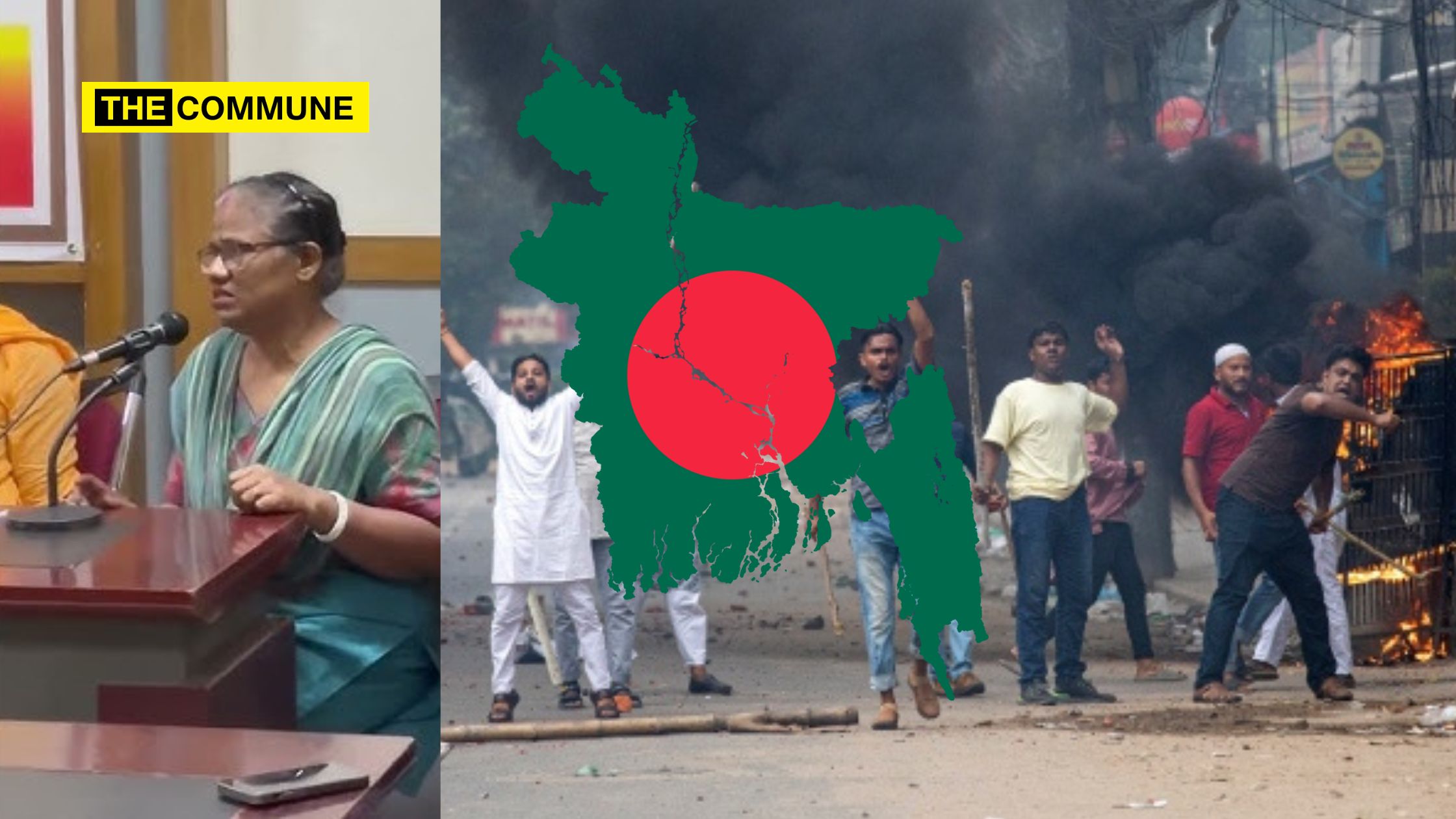
Islamists in Bangladesh are systematically forcing Hindu professors to resign amid escalating minority persecution. The campaign, which has led to the forced resignation of numerous Hindu educators, reflects a broader effort to marginalise and expel minority Hindus from the country. Reports highlight harrowing accounts of intimidation and coercion since the coup that ousted Sheikh Hasina.

Hindu Persecution in Bangladesh

The crisis in Bangladesh began on August 5, 2024, when a coup resulted in the ousting of Prime Minister Sheikh Hasina. In the chaotic aftermath, Islamists exploited the situation to launch violent attacks against the Hindu community. Minority Hindus in Bangladesh are facing daily persecution, including numerous deaths, rapes, and the widespread destruction of Hindu homes, shops, and temples. Further complicating the situation, student vigilante groups have emerged, enforcing strict Islamic practices and delivering sermons on “rightful conduct.” These groups have taken it upon themselves to police public behaviour, including warning smokers to quit and dictating that merchants limit their profits to a mere 5 taka per sale.

Hindu Teachers Forced To Resign

In the wake of these events, a disturbing trend has emerged targeting Hindu educators across the country. The forced resignation of Sonali Rani Das, an Assistant Professor at Red Crescent Nursing College in Dhaka, exemplifies the growing persecution faced by Hindu professionals in Bangladesh.

On August 19, 2024, Sonali Rani Das was the centre of a harrowing ordeal that led to her forced resignation. In a press conference held at Dhaka’s NatiDhaka’sess Club, Das recounted her traumatic experience with tears in her eyes. She described how students cornered her in her office, presented her with a pre-printed resignation letter, and demanded immediate resignation.

She said, “Students forced me to resign. They brought a printed resignation letter, gheraoed and intimidated me to resign. They grabbed my hand and took my thumb impression on the resignation letter.”

With tears” in her eyes, she continued, “They kept me captive in my office for 4-5 hours. They didn’t even let me use the washroom. I was told I could use the washroom only if I signed the resignation letter. Yet, I didn’t sign the letter. They forcefully took my thumb impression. I was humiliated, and they threatened me with physical harassment. After taking my thumb impression forcefully, they took the letter to the board’s chairman and submitted it. They harassed me, made videos, and posted those on social media.”

Sadly, Sonali Rani Das is not the only Hindu professor in Bangladesh to face this onslaught. Reports suggest that as many as 60 Hindu teachers, professors, and government officials in Bangladesh were forced to resign in recent days. This systematic targeting of Hindu educators appears to be part of a more extensive campaign of persecution against the Hindu minority in Bangladesh.

Hindu Teachers Targeted

Gautam Chandra Pal, a chemistry teacher at Azimpur Government College, was once felicitated as the best chemistry teacher and was forced to resign by Muslim students.

Students gheraoed Khuku Rani Biswas, who was in charge of Jessore Nursing Institute, in her office for five hours as they demanded her resignation.

https://twitter.com/hindu8789/status/1825483280503996629

Mihir Ranjan Halder, the Vice Chancellor of Khulna Engineering and Technology University, was forced to resign on August 12, 2024.

Islamist groups also forced Ratan Kumar Majumdar, the principal of Puranbazar Degree College in Chandpur, to step down.

Soumitra Sekhar, the Vice Chancellor of Kazi Nazrul Islam University in Moymonsingha district, was forced to resign on August 14, 2024.

https://twitter.com/hindu8789/status/1825179028611117083

Principal Subodh Chandra Roy and staff Nirmal Chandra Roy at Setabganj Government College in Dinajpur district are facing demands to resign.

Leaked Telegram Messages Confirm Planned Hindu Genocide

A few days ago, we reported about leaked Telegram messages from private Jamaat-e-Islami and opposition Bangladesh Nationalist Party (BNP) groups. These messages revealed a disturbing campaign to marginalise and expel Hindus from Bangladesh following the August 5 coup. These messages outlined a strategy to remove Hindu officials, frame their persecution as a political conspiracy, and exacerbate violence against the community.

One of the messages, allegedly circulated within a pro-Jamaat group and forwarded from a private BNP channel, outlined a chilling strategy: If we want to create a Bangladesh free from Hindus, we must first force all the major Hindu government officials to resign and ensure that Muslims are recruited instead. It will weaken the resolve of ordinary Hindus, and they will be forced to leave for India. We have started our work; if you know any such Hindu public servants, please help us by providing information.”

The situation has not improved under Muhammad Yunus’s Administration. Reports indicate that 363 municipal mayors, 60 district councils (Zila Parishad), and 493 upazila chairmen were removed, further destabilising the country.

As Bangladesh grapples with this crisis, the international community is still silent. Systematic targeting of Hindu professors and professionals in Bangladesh violates fundamental human rights. 

Subscribe to our TelegramWhatsApp, and Instagram channels and get the best stories of the day delivered to you personally. 
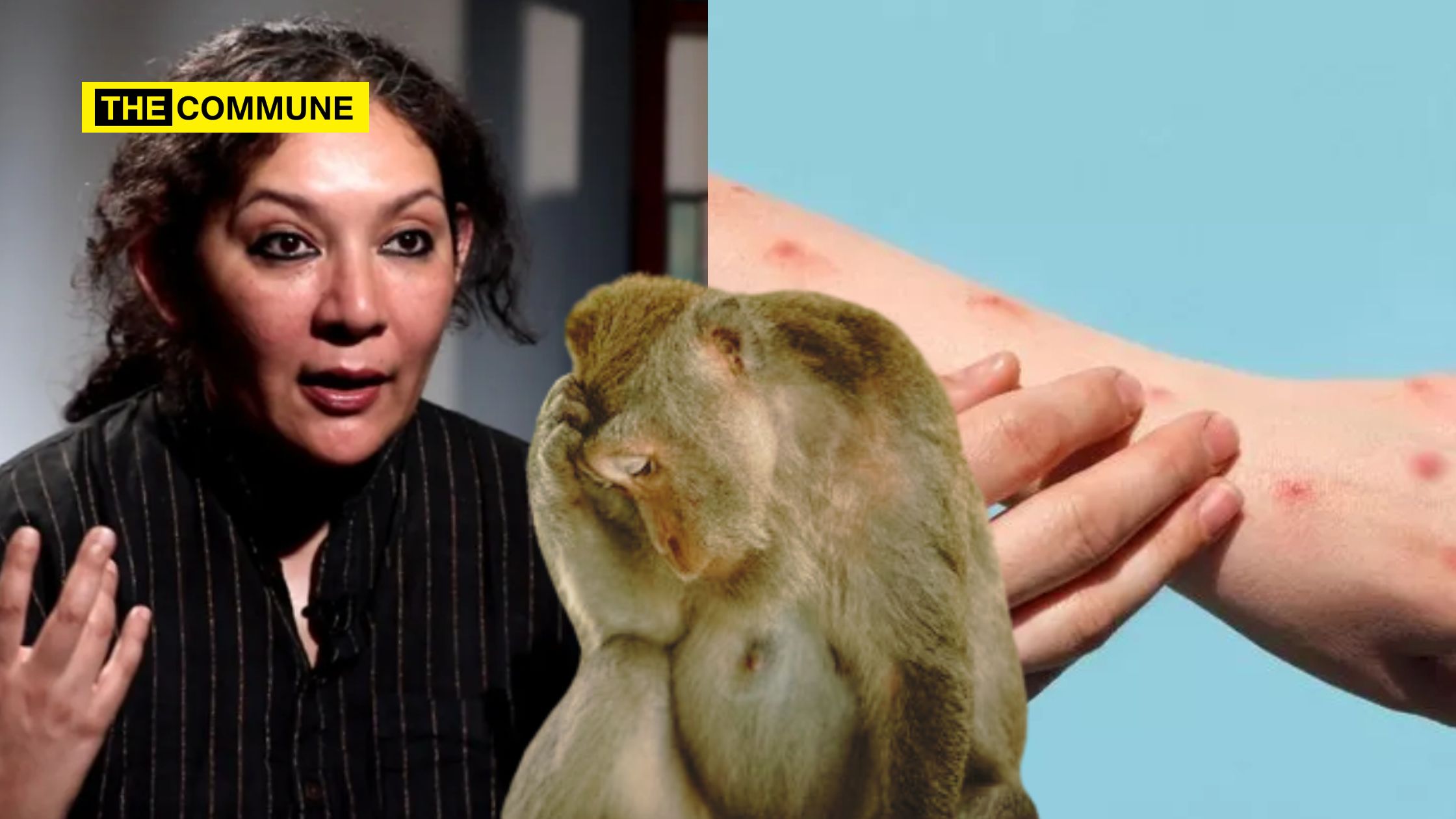
‘Monkeypox Caused By Monkeys’, Says Alleged Writer Saba Naqvi; Netizens School Her On Virus, Refuses To Accept Mistake

Alleged writer and a mouthpiece of the leftists and Islamists, Saba Naqvi, posted a series of ludicrous tweets about monkeypox, where she implied a connection between the virus and the rising monkey population in Delhi. Naqvi’s comments, which suggested that monkeypox is caused by monkeys and called for their population control plan, left netizens baffled and questioning her understanding of the virus.

Despite widespread ridicule and corrective responses from X users, Naqvi doubled down on her statements, citing the World Health Organization (WHO) to justify her erroneous claims. Her persistence in the face of factual errors raises severe concerns about the credibility of some of the voices shaping public discourse in India today.

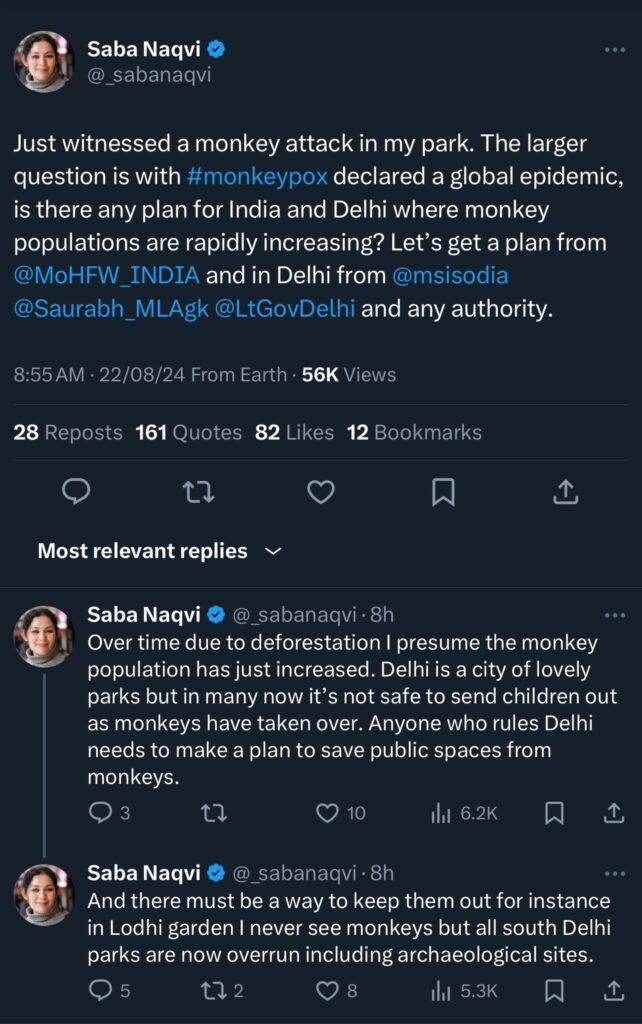
Taking to her official X handle, she wrote a thread as if she had made a discovery that no one had done yet. She wrote, Just witnessed a monkey attack in my park. The larger question is with #monkeypox declared a global epidemic, is there any plan for India and Delhi where monkey populations are rapidly increasing? Let’s get a plan from @MoHFW_INDIA and in Delhi from @msisodia @Saurabh_MLAgk @LtGovDelhi and any authority. Over time due to deforestation, I presume the monkey population has just increased. Delhi is a city of lovely parks but in many now it’s not safe to send children out as monkeys have taken over. Anyone who rules Delhi needs to make a plan to save public spaces from monkeys. And there must be a way to keep them out for instance in Lodhi garden I never see monkeys, but all south Delhi parks are now overrun including archaeological sites.”

Yes, you read that right.

According to theillustriousSaba Naqvi, monkeys cause monkeypox. She called for controlling the monkey population. Netizens were bewildered by reading her statements and questioned her knowledge and common sense.

Netizens Ridicule Naqvi

Some trolled her by saying that because Naqvi concluded that monkeys caused monkeypox, perhaps chickens caused chicken pox and cowpox by cows. One wonders what smallpox could be caused by—dwarfs? Small children?

Here are some reactions.


Naqvi Mis-cites WHO

Despite being corrected by netizens, Naqvi stubbornly clung to her erroneous views. She even attempted to back them up with a misinterpreted WHO reference.

Even though netizens trolled her for ignorance, Naqvi did not retract her post or accept her folly.

In another post she tried to justify her statements – with proof from WHO!! She wrote,From WHO site. The monkeypox virus was discovered in Denmark (1958) in monkeys kept for research and the first reported human case of mpox was a nine-month-old boy in the Democratic Republic of the Congo (DRC, 1970). Mpox can spread from person to person or from animals to people.”

What Is Monkeypox And How Is It Caused?

Monkeypox is a disease caused by the monkeypox virus (MPXV), but despite its name, it doesn’t originate from monkeys. The disease is not as common as other pox infections. The virus was first identified in 1958 from a monkey in Africa, leading to its misleading name. However, researchers now believe that rodents, particularly those in Central and West Africa, serve as the primary reservoir for the virus. In addition to rodents, the virus can also infect other animals, including certain non-human primates like anteaters, hedgehogs, prairie dogs, squirrels, and shrews.

Transmission: Monkeypox can spread to humans through direct contact with the blood, bodily fluids, or skin lesions of infected animals. Human-to-human transmission occurs primarily through respiratory droplets, contact with infected body fluids or lesions, or contaminated materials like bedding.

Symptoms: Monkeypox’s symptoms are similar to but milder than smallpox’s. They include fever, headache, muscle aches, and a distinctive rash that starts on the face and spreads to other body parts. The rash progresses through several stages, from macules to pustules, before forming scabs and eventually falling off.

Incubation Period: The incubation period for monkeypox is usually 6 to 13 days but can range from 5 to 21 days. During this time, the virus replicates in the body before symptoms appear.

Treatment: There is no specific treatment for monkeypox. The management of the disease is primarily supportive, focusing on relieving symptoms. Antiviral drugs like Tecovirimat (TPOXX) have been used experimentally in some cases. Vaccination against smallpox is about 85% effective in preventing monkeypox.

Despite being corrected, Naqvi remains unwilling to step down from her high horse. She couldn’t acknowledge her lack of knowledge with humility. If this is the standard amongjournalists,‘ ‘columnists,and writers in the country, it raises concerns about the quality and accuracy of the ‘facts’ they churn out.

Subscribe to our TelegramWhatsApp, and Instagram channels and get the best stories of the day delivered to you personally.
Hindu Munnani Thwarts Missionaries Attempting Conversion Of School Children In Perambalur

Hindu Munnani Thwarts Missionaries Attempting Conversion Of School Children In Perambalur

The Hindu Munnani has once again thwarted an attempt by Christian missionaries to distribute sweets and Bibles to schoolchildren at Perambalur Government Higher Secondary School, allegedly as an incentive for forced conversion.

Hindu Munnani Video On Missionaries

According to a statement from the Hindu Munnani on their official X account, there have been increasing incidents of forced Christian conversion in Perambalur. On 22 August 2024, near the Perambalur Government Higher Secondary School and District HQ Hospital, missionaries were reportedly conducting a religious campaign by handing out sweets and Bibles to students on their way to school. Hindu Munnani representatives who were passing by questioned the missionaries about their activities. When asked if they were attempting to convert the children, the missionaries reportedly responded with threats before leaving in their vehicle.

A Hindu Munnani functionary said, “You are going door to door distributing books, and we are continuously stopping you.” The missionary then returned to his car, opened the back door, and revealed a pile of cardboard boxes filled with Bibles. He opened one box and approached the functionary with a bible to distribute it. When confronted, the missionary tried to retreat to the car.

As the missionary attempted to retreat, another Hindu Munnani functionary said, “Sir, give us that book; it’s our evidence.” The missionary replied, “What evidence? Take my face as evidence,” and tried to push the Hindu man. The exchange of words escalated, and the missionary hastily retreated, driving off in his car.

The Hindu Munnani has criticized the police for not addressing these activities in predominantly Hindu areas. The party questioned police actions if someone were distributing books like Thiruvasakam and Shiva Purana among Muslims and Christians.

They have called for introducing the Prohibition of Compulsory Conversion Act to prevent such activities.

Missionaries in Tamil Nadu

Missionaries have recently adopted a troubling new strategy of targeting young, naive children for conversion, a tactic that follows previous interventions by The Hindu Munnani. Previously, Hindu Munnani had stepped in to halt alleged conversion efforts aimed at underprivileged children through Sunday summer classes. Now, missionaries are reportedly focusing on young children in Theni and Madurai districts in Tamil Nadu, attempting to convert them to Christianity without their parent’s knowledge by promoting the teachings of Jesus Christ. The Hindu Munnani has successfully intervened in these attempts.

The first incident took place in the Keerathurai area of Madurai city. Christian missionaries were conducting ‘Sunday classes’ for underprivileged Hindu boys and girls, during which they preached that “Jesus is good and has come to save the world.” Once locals became aware of these activities, they alerted The Hindu Munnani, who quickly intervened and stopped the classes. An FIR was filed at the Keerathurai police station, and the children were safely returned to their parents.

In another case in Chinnamanur, Theni District, missionaries held a summer class for Hindu boys at an unauthorized prayer hall near Potiyamman Temple. During this class, these missionaries attempted to convert these students to Christianity. The boys were reportedly given crowns with Jesus’ image and name badges featuring Jesus stickers. Christian missionary James Raja was identified as orchestrating this illegal conversion effort involving over 30 children. Hindu Munnani activists intervened, halted the conversion process, and alerted the parents to the potential conversion attempts.

Subscribe to our TelegramWhatsApp, and Instagram channels and get the best stories of the day delivered to you personally.

TISS Bans “Progressive Students Forum” Amid Allegations Of Misconduct And Anti-National Activities

On August 19th, the Tata Institute of Social Sciences (TISS) in Mumbai officially banned the Progressive Students Forum (PSF) student organisation. PSF is affiliated with the Left-leaning Students Federation of India (SFI). TISS issued a notice accusing PSF of misleading students and tarnishing the institute’s reputation. This action followed the earlier suspension of Ramadas Prini Sivanandan, a PhD student and PSF member, in April for repeated misconduct and activities deemed anti-national.

The notice, signed by Registrar Professor Anil Sutar, labelled PSF as an “unauthorised and illegal forum” on campus. It alleged that the group had been obstructing the institute’s operations, fostering division among students and faculty, and defaming the institution. The notice stated that PSF was misleading and distracting students from their academic focus and harmonious campus life.

According to a report by OpIndia, TISS warned PSF members of immediate consequences if they participated in any campus events. The institute also urged students to report any interactions with PSF members to campus security, assuring confidentiality in handling such reports. TISS emphasised its commitment to maintaining a safe and collaborative academic environment, warning that any student or faculty member found supporting or associating with PSF’s divisive ideologies would face disciplinary action.

Ramadas Prini Sivanandan

On April 18th, TISS suspended Sivanandan for two years for “repeated misconduct and anti-national activities.” His suspension followed his involvement in a protest against the Centre’s policies. The institute viewed this participation as a violation of discipline.

The suspension also barred him from TISS campuses. A show-cause notice questioned his actions, including screening controversial documentaries and organising unauthorised events. Ramadas, also an SFI member, allegedly used TISS resources for political purposes. The administration claimed such actions damaged the institution’s reputation.

PSF – A History Of Controversy

According to a report by the Indian Express, PSF members were surprised by the timing of the ban. TISS issued the ban minutes before a PSF signature campaign complaining to the TISS Chancellor regarding various issues.

PSF has been involved in several contentious events over the past few years. In January 2023, they screened the banned BBC documentary “India: The Modi Question.” They also protested outside the director’s residence in March 2023 for cancelling a lecture featuring speakers Harsh Mander and Aishe Ghosh.

PSF has also opposed changes to TISS’s admission process, specifically discontinuing its entrance test in favour of CUET results. Social media activity reviewed by OpIndia revealed that PSF has consistently supported the “Palestinian cause” and posted anti-Israel content, including the controversial slogan “From the river to the sea, Palestine will be free.” This post appeared five days after a terrorist attack by Hamas that killed 1,300 Israelis and foreigners.

Additionally, PSF expressed solidarity with Newsclick’s Prabir Purkayastha. Officials arrested Purkayasthan under the Unlawful Activities Prevention Act (UAPA) for allegedly receiving funds from China for anti-India activities.

PSF and five student organisations issued a statement in April 2024 against TISS’s circular on the Model Code of Conduct (MCC) for the 2024 Lok Sabha Elections. PSF has been active on campus for over a decade. Several PSF members, including the outgoing vice president, hold positions in the Student Union.

Subscribe to our TelegramWhatsApp, and Instagram channels and get the best stories of the day delivered to you personally.
Mistakes In Vijay’s TVK Flag Design & Anthem Video: African Elephants, Wrong Flower, And Spelling Errors Spotted, Vijay Badly Needs A New Comms Specialist

Vijay TVK First State Conference

Actor Vijay’s much-anticipated launch of the Tamizhaga Vettri Kazhagam (TVK) flag and anthem on 22 August 2024 was mocked online for various design flaws. Netizens spotted several mistakes, including similarities to other states’ flags and the Bahujan Samaj Party (BSP) emblem.

The TVK flag design also inaccurately depicts Asian elephants and the Vaagai flower. Such revelations on social media prompted concerns about the party’s brand management and communication strategy.

Design Flaws in TVK Flag

On 22 August 2024, actor Vijay launched TVK’s flag and anthem in Chennai amid huge expectations and anticipation. While the anthem and flag looked appealing, several shortcomings became visible upon observing them closely.

Let’s take a look at the flag first.

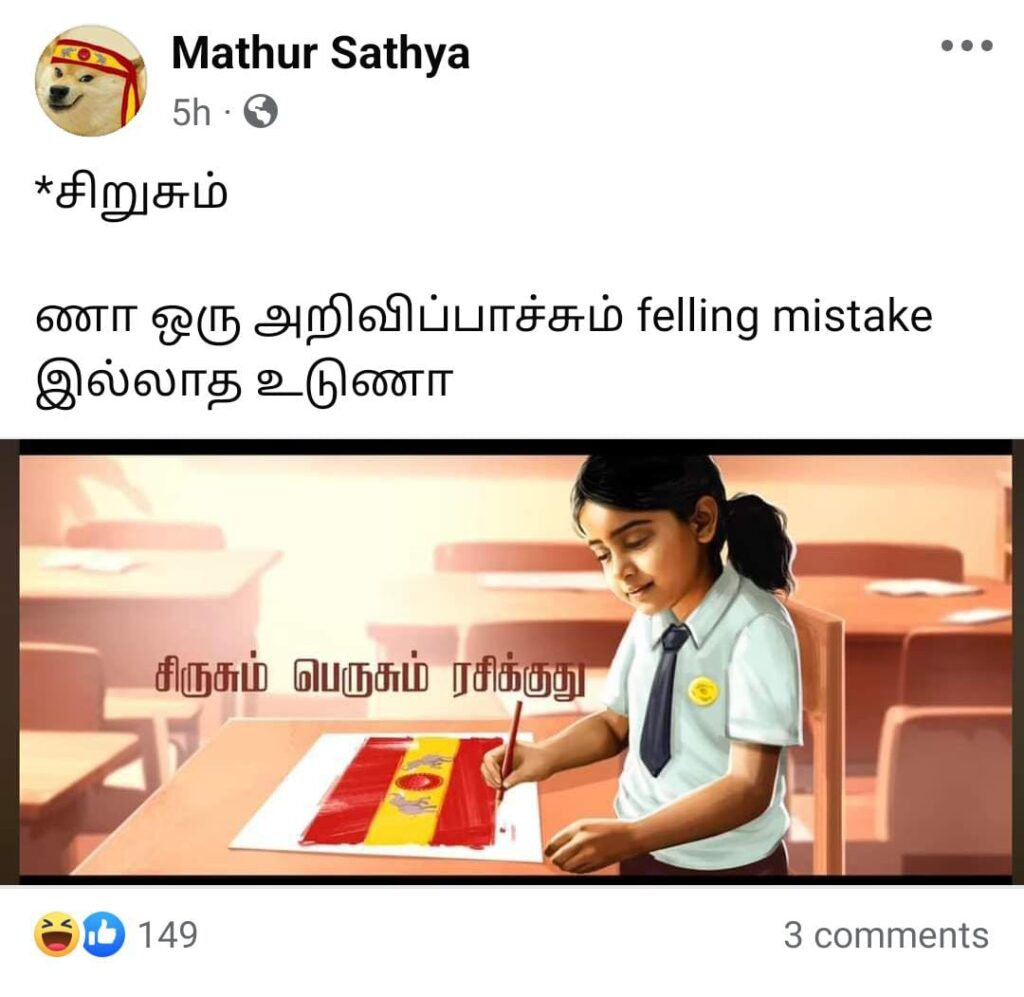
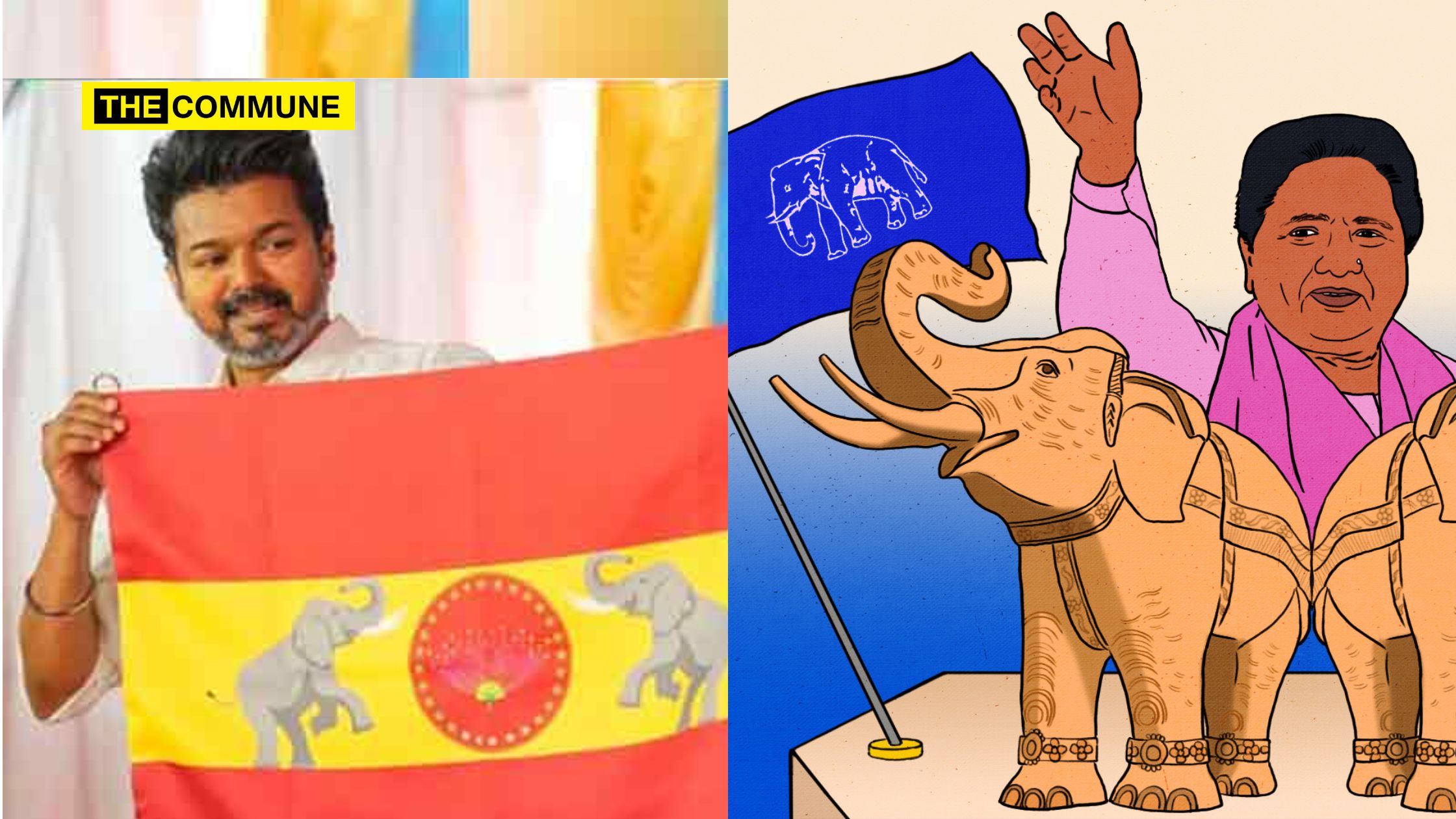
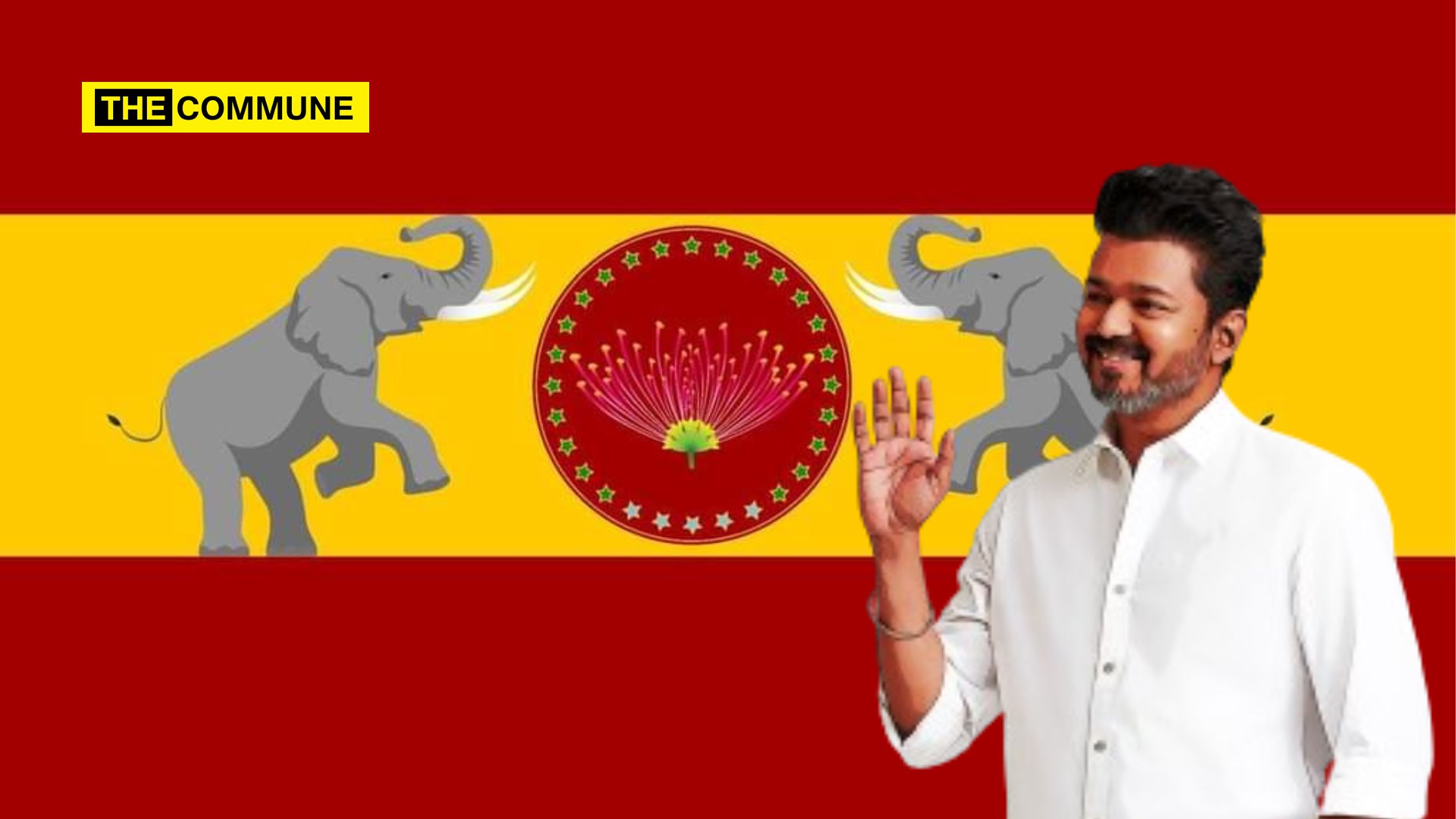
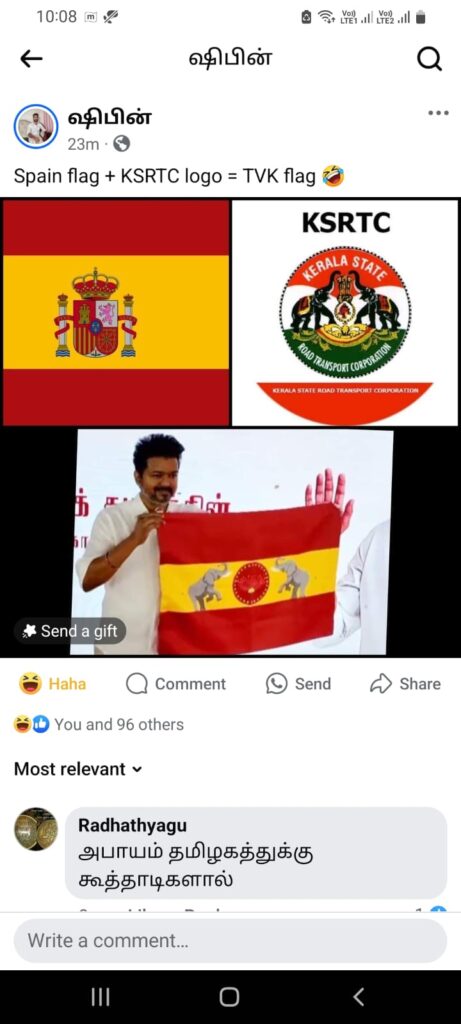
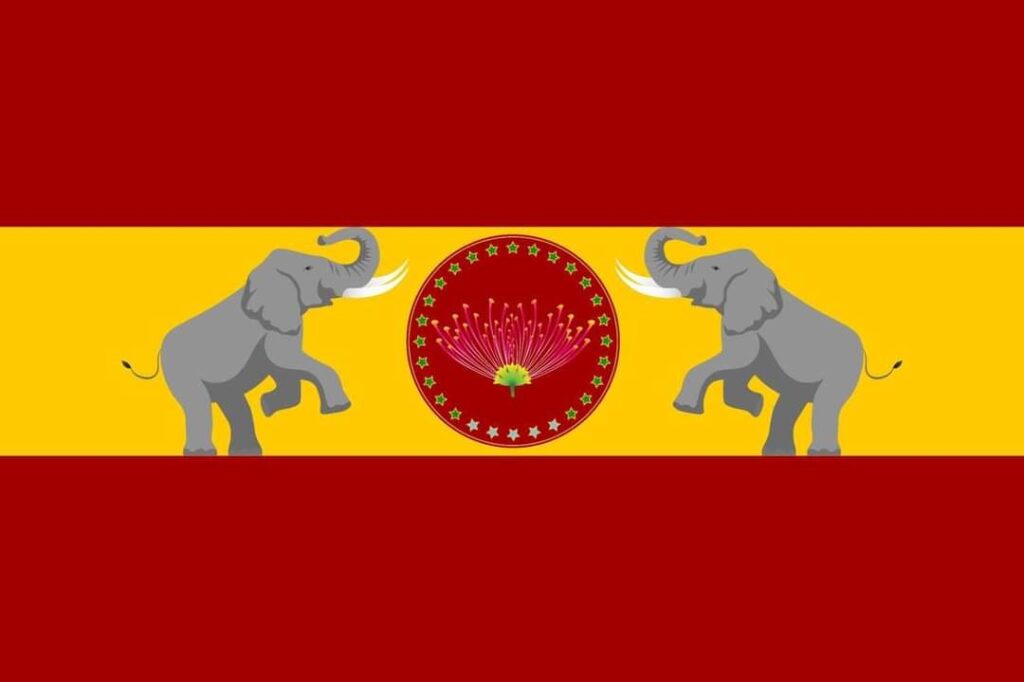
The flag has three stripes: the top and bottom ones are red, while the middle stripe is yellow. While it does not wear the Dravidianist colour black, the red and yellow stripes remind one of the Spanish national flag.

Some netizens also pointed out that the flag’s colours matched those of the Karnataka state flag, and the logo—two elephants trumpeting—was similar to that of the Kerala state government!

Some even stated that the two elephants reminded one of the Fevicol logo!

Coming to the finer aspects of the logo on the flag, the two elephants in the video and the flag do not essentially look like Asian elephants. Looking at the video closely, one would be quite sure that the elephants in the frame are, in fact, African elephants!

Additionally, the Bahujan Samaj Party, whose party symbol features the elephant, has condemned using the elephant symbol on TVK’s flag. They claimed it violates election regulations due to its similarity to the BSP’s blue elephant emblem. The BSP’s Tamil Nadu branch has issued a warning demanding the immediate removal of the elephant imagery from Vijay’s flag. They have threatened to file a complaint with the Election Commission and pursue legal action if their demands are unmet.

Vaagai Or Thoongumoonji?

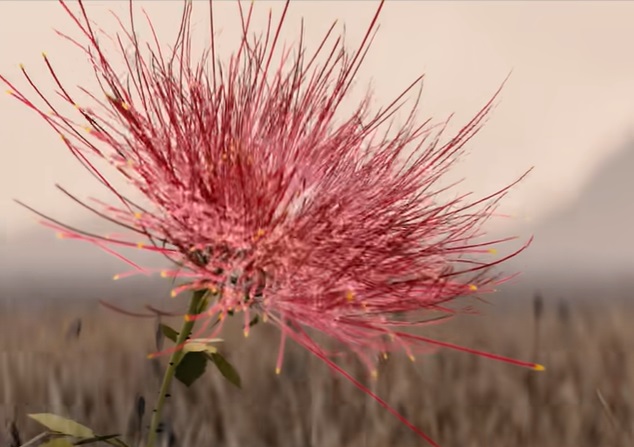
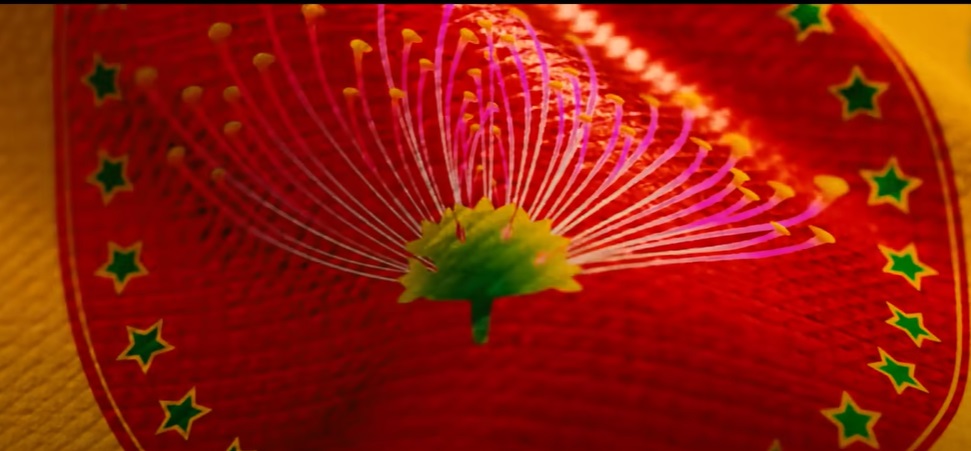
The logo also features a pink flower, which is said to be the Vaagai flower (Siris tree/Albizia lebbeck).

However, the team seems to have mistaken the Monkeypod tree (Raintree/Samanea saman) flower for the original Vaagai flower. Soldiers wore garlands of Vaagai flowers after a victory during ancient times. Colloquially, the monkeypod tree is called ‘Thoongumoonji Maram’ which in Tamil translates to “Drowsy Face Tree”, as the tree’s leaves droop when the sunshine is less. Its bright pink flower resembles the white Vaagai flower.

In the video, some spelling mistakes were also found. Here is one example.

The party anthem features music by Thaman and lyrics penned by Vivek.

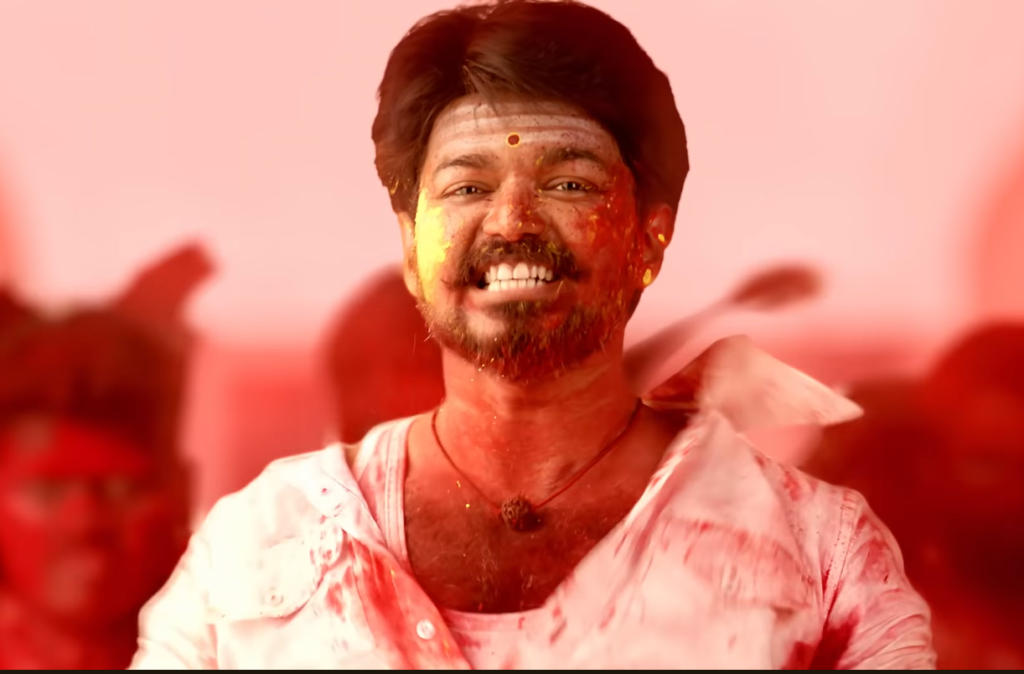
Overall, the TVK anthem reminds the listener of the “Aalaporaan Tamizhan” song from Mersal (2017) in visuals as the anthem video has shades of yellow and red splattered throughout the song.

But its tune is similar to the song Chillax from Velayudham.

Why Vijay Needs A New Comms Specialist

Vijay launched the TVK flag and logo amid much anticipation from the public, the fans, and political parties alike. In the era of deep internet penetration, everyone will scrutinise every aspect of any new launch, be it a film, political party, or any brand.

When he announced his party through a press release, many pointed out the grammatical error in the Tamil name of the party. It should’ve been Tamilaga Vettrik Kazhagam instead of Tamilaga Vettri Kazhagam. He later rectified the mistake with the party’s general secretary approaching the ECI for name correction.

A few concentrated glances at the TVK video and the flag design gave us so many points to nitpick. With the exposure and availability of resources, Vijay’s team could have done a better job with the logo and flag design, let alone the anthem.

If Vijay wants to make an impact in Tamil Nadu’s political arena, his core team needs to be strong, and he needs a better brand manager and a Communications Specialist. We hope Vijay pays heed to the criticisms and the team makes the necessary changes swiftly.

Subscribe to our TelegramWhatsApp, and Instagram channels and get the best stories of the day delivered to you personally.
Vijay’s TVK Flag Stirs Controversy: BSP Threatens Legal Action Over Elephant Symbol

BSP Threatens Legal Action Over Elephant Symbol in TVK flag

Kollywood actor Vijay has found himself in hot water just before releasing his party’s official flag for the Tamizhaga Vettri Kazhagam (TVK). The flag, which features a striking combination of yellow and red, prominently displays two elephants and the alleged Vaagai flower. However, this design has raised concerns because the Bahujan Samaj Party (BSP), a national political party, uses a similar elephant symbol. BSP representatives are now calling for removing or modifying the elephants on the TVK flag, threatening legal action if their demands are not met.

Vijay Launches TVK Flag, Anthem

Vijay launched TVK in February 2024 and intends to run in the 2026 assembly elections. After General Secretary Bussy Anand officially registered the party with the Election Commission of India on 2 February 2024, Vijay remained relatively inactive in the political sphere.

Instead, the actor focused on issuing statements for birthdays and other similar occasions, which led to online criticism and mockery of his political ambitions. Even then, his involvement was limited to traditional Dravidian party stances in Tamil Nadu. Finally, amidst growing criticism from netizens, Vijay eventually participated in a student appreciation “meet-and-greet” function organized by TVK, marking his engagement with the party.

On 21 August 2024, Vijay announced that he would unveil his party’s official flag the following day, much to the delight and excitement of his fans. The next day, he hoisted the TVK flag at the party’s office in Panaiyur. The flag, adorned with red and yellow, prominently features two elephants flanking a Vaagai flower, symbolizing victory. Additionally, Vijay introduced the party’s new song during the event.

TVK Flag Controversy

Online critics are mocking TVK for their lack of knowledge and basic research. Critics pointed out that despite claims of safeguarding Tamil heritage, the party seems confused about the difference between the Vaagai flower and the monkey pod flower. They also seem ignorant about the difference between Asian and African elephants which feature on the flag.

They went on to say TVK had copied the “Fevicol ad”. This has led to humorous trolling of the party on social media.

BSP Objections Over TVK Flag

Meanwhile, the BSP is taking a more serious approach.

The Mayawati-led party has condemned using the elephant symbol on TVK’s flag. BSP claims the TVK flag symbol violates election regulations because it is similar to the BSP’s blue elephant emblem. The BSP Tamil Nadu unit has issued a warning demanding the immediate removal of the elephant imagery from Vijay’s flag. They have threatened to file a complaint with the Election Commission and pursue legal action if their demands are unmet.

Subscribe to our TelegramWhatsApp, and Instagram channels and get the best stories of the day delivered to you personally.
‘Prolific And Disturbing’ Predator: Oumair Aejaz, Indian-Origin Physician Charged With Shocking Sex Crimes Against Children & Adults In Michigan

Oumair Aejaz, Indian-Origin Physician, Charged With Shocking Sex Crimes In US

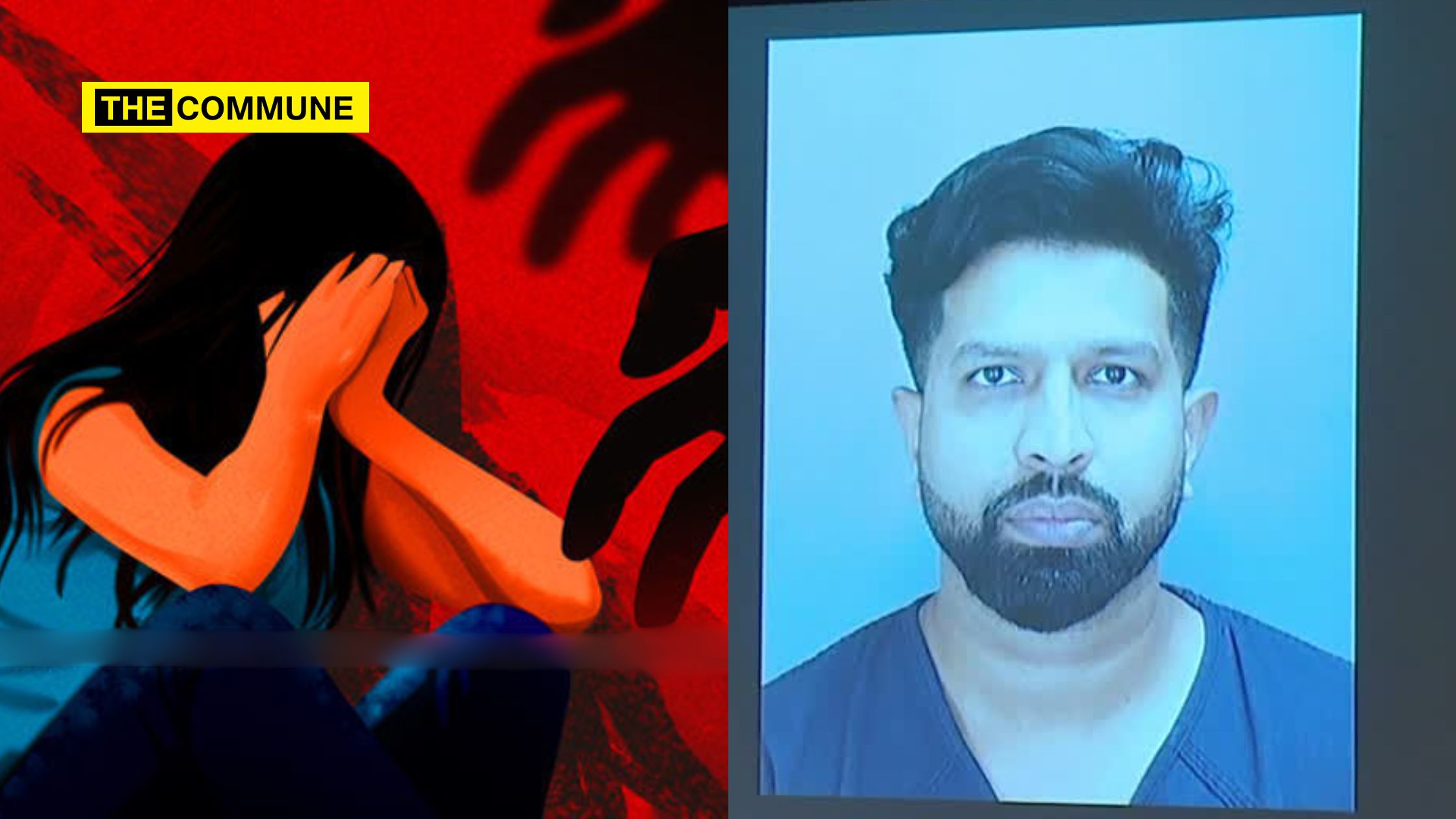
Dr. Oumair Aejaz, a 40-year-old physician of Indian origin, has been charged with a series of sex crimes involving children and adults in Oakland County, Michigan. The charges include child sexual abuse, secretly filming minors and adults, and other related offences. Authorities have described him as a “prolific and disturbing sexual predator.”

Charges Against Oumair Aejaz

Oakland County Sheriff Michael Bouchard, who led the investigation, called Aejaz “one of the most disgusting, potentially prolific and disturbing sexual predators” he has encountered. Authorities discovered thousands of videos in Aejaz’s residence, with one hard drive alone containing 13,000 videos. Investigators estimate it could take months to examine all the digital evidence thoroughly.

Officials formally charged Aejaz on August 13 in the 52-3 District Court in Rochester Hills. The charges against him include:

  • One count of child sexually abusive activity.
  • One count of using a computer to create or reproduce child sexually abusive material.
  • Two counts of capturing/recording nude children under 18.
  • Two counts of capturing/recording nude women over 18.
  • Four counts of using a computer to commit a crime.

The investigation revealed that Aejaz allegedly placed hidden cameras in various locations, including changing rooms, bathrooms, bedrooms, closets, and hospital rooms. Among the most disturbing incidents was the recording of children and their mothers in the changing rooms of the Goldfish Swim School in Rochester in 2023.

His Depravity Has No Limits

Oakland County Prosecutor Karen McDonald expressed her outrage, stating, “From a 2-year-old boy to grown women, no one is immune from his disgusting predatory behaviour.”

She emphasized the severity of the crimes, saying, “Violating children in safe spaces as they change for a fun swim or sexually violating women who are still under sedation from a medical procedure shows his depravity has no limits.”

https://twitter.com/trunicle/status/1826426376532230653

Background And Investigation

Dr. Oumair Aejaz, a native of India, has been living and working in the United States on a visa since 2011. He completed his residency at Detroit’s Sinai Grace Hospital, moved to Alabama and returned to Michigan in 2018.

Aejaz primarily worked as a contract physician at Ascension Genesys Hospital in Grand Blanc. He also worked at Henry Ford Macomb Hospital in Clinton Township. However, investigators believe his activities may extend to other locations and states.

The investigation into Aejaz’s activities began after his wife provided concerning materials to the authorities. Then, on August 8 2024, the Oakland County Sheriff’s Office got a search warrant. This search led to the seizure of six computers, four cell phones, and 15 external storage devices. Sheriff Bouchard noted that the investigation could take up to six months due to the extensive digital evidence.

He also said that Aejaz’s criminal activities may date back at least six years. 

Sheriff Bouchard stated, “It’s not just children; it’s not just women. It’s not just men. It goes from a 2-year-old to a grown woman. The victimization is so broad, and the perversion is so great that we’re just beginning to wrap our arms around it.”

Oumair Aejaz is held on a $2 million bond in the Oakland County Jail. As the investigation continues, authorities urge anyone who believes they may have been a victim to contact the County Sheriff’s Office.

Mainstream Media Silence

This case has already sparked widespread concern and highlights the importance of vigilance in public and private spaces in Detroit. However, the news was reported only on local channels, and Indian mainstream media has yet to pick up on this issue.

A pattern of secularizing news stories, especially if the perpetrator involved is an Islamist, is seen in Indian news media. It is visible when it comes to reporting crimes committed by members of a specific community in India with leftist mouthpieces such as The News Minute, The Wire, Quint, etc, leading from the front.

However, such mouthpieces do not shy away from exposing the victim or the perpetrator’s caste/religion if it were a Hindu.

The West is coming to terms with the activities of the Islamists in their countries, and it seems that they still have not realized how one specific community can create havoc. We have seen it in India over the years, but the West needs to open its eyes before it’s too late. There is an urgent need for media globally to report facts without whitewashing them.

Subscribe to our TelegramWhatsApp, and Instagram channels and get the best stories of the day delivered to you personally.
‘The Hindu’ Secularizes Moradabad Rape Of 20 Year Old Nurse By Concealing Identity Of Accused Doctor

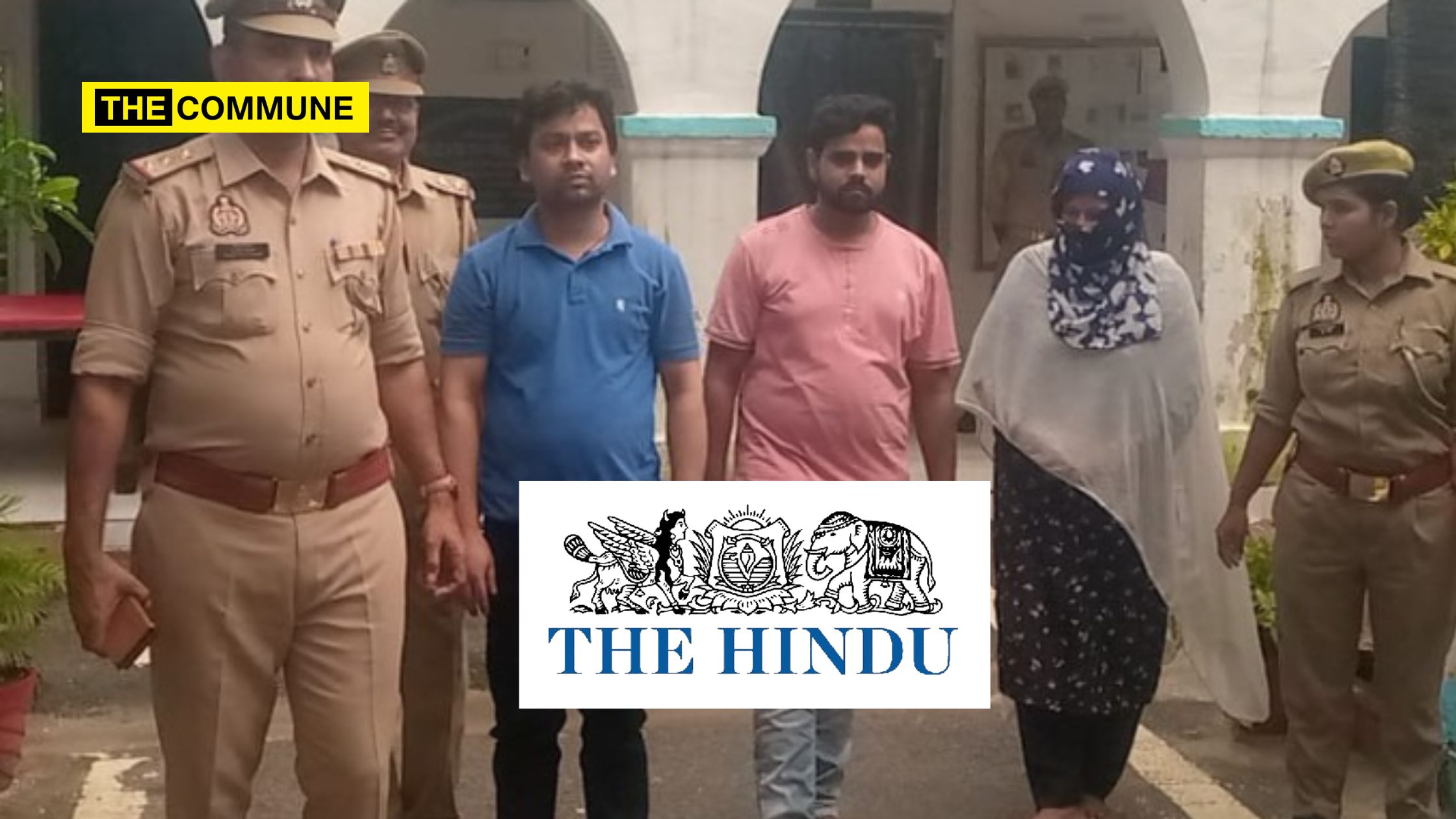
Dr. Shahnawaz and ward boy Junaid, arrested for raping Dalit nurse in Moradabad hospital.

A doctor named Shahnawaz and his ward boy Junaid allegedly raped a 20-year-old Dalit nurse after they held her captive at a private hospital in the Moradabad district. This incident, along with the recent brutal rape and murder of the Kolkata doctor, raises serious concerns about the safety of female medical professionals across the country.

Another Nurse Complicit

According to a complaint lodged by the nurse’s father, the assault occurred during the night of 17 and 18 August 2024 while the nurse was on duty. The complaint states that she began her shift at 7 p.m. on 17 August. Later that night, another nurse named Mehnaz instructed her to meet Dr. Shahnawaz in his room. When she declined, Mehnaz, along with a ward boy named Junaid, forcibly took her to a room on the top floor of the hospital and locked her inside.

Dr Shahnawaz then entered the room, locked it from the inside, and allegedly raped her. The complaint further claims that he threatened her life and used casteist slurs. Following the complaint, the Moradabad Police registered an FIR under relevant sections of the Bhartiya Nyay Sanhita (BNS) and the SC/ST Act. Dr. Shahnawaz, Mehnaz, and Junaid were arrested.

Moradabad Superintendent of Police (SP) Rural, Sandeep Kumar Meena, confirmed that they filed a case and all suspects are in custody. He added that the woman had undergone a medical examination, the officials sealed the hospital, and they will take further actions based on the investigation’s findings.

In a statement to the Uttar Pradesh Chief Minister Yogi Adityanath, the nurse’s father has called for the death penalty for the accused. He explained that his daughter, who is also pursuing her graduation, had been working at the hospital for the past ten months without a salary, only receiving travel expenses. While she was on a night shift on 17 August, Mehnaz and Junaid sent her to the doctor’s room, where the assault took place.

After the incident, the nurse reported it to the morning shift nurse and subsequently informed her family, leading to the filing of the FIR.

‘The Hindu’ Secularizes Crime

The Hindu, while reporting the Moradabad rape, ensured that the caste of the nurse was made clear while concealing the identity of the perpetrators. There seems to be a pattern in mainstream reporting where they are comfortable revealing the victim’s caste if they are Dalits. However, such outlets are almost always reluctant to reveal the identity of the perpetrator if it is a Muslim. In this case, details about the Muslim doctor, the Muslim ward boy and the Muslim nurse who facilitated the crime have been left out seemingly by The Hindu.

While the article mentions details of the perpetrators somewhere in the paragraphs, they have left this detail in the headline that grabs the most attention. This type of narrative setting is prevalent in reportage by leftist mouthpieces like The News Minute and The Wire, which ensure the secularisation of crimes is done to a tee. The Hindu has also joined the bandwagon of such secular mouthpieces.

Islamist Violence Against Dalits

While Islamist violence against Dalit women remains an agonising and persistent issue in India, the media must report such incidents with accuracy. It is their responsibility to present facts as they are to ensure justice for the victims and accountability for the perpetrators.

However, The Hindu has chosen to obscure the identities of the accused in the Moradabad rape case, potentially leading readers to assume the perpetrator was from the majority community wrongly. This deliberate omission misrepresents the situation and fails to address the reality that individuals from other communities often commit such crimes.

In the Moradabad rape case, the accused doctor not only inflicted harm but also used casteist slurs against the nurse, underscoring the specific caste-based nature of the violence.

(With inputs from India Today)

Subscribe to our TelegramWhatsApp, and Instagram channels and get the best stories of the day delivered to you personally.
Bangladesh Media Blames India For Flooding, US “Defence Analyst” Amplifies; India Refutes Claim

Even as torrential rains engulf eastern Bangladesh, leaving millions displaced and infrastructure devastated, a bitter dispute with India has erupted over the cause of the flooding. While the Bangladeshi government blames India for releasing water from dams upstream, India vehemently denies the allegations, pointing to the unprecedented rainfall as the primary culprit.

Already reeling from a wave of violent protests that have left a trail of destruction and suffering, Bangladesh now faces an even more formidable adversary: the relentless onslaught of devastating floods. The flood-stricken region has been grappling with rising water levels for weeks, submerging entire villages and cutting off essential services.

The government has launched a massive rescue operation, deploying the army, navy, and air force to reach stranded individuals. However, the situation remains dire, with many fearing for their lives and livelihoods.

Flooding In Bangladesh

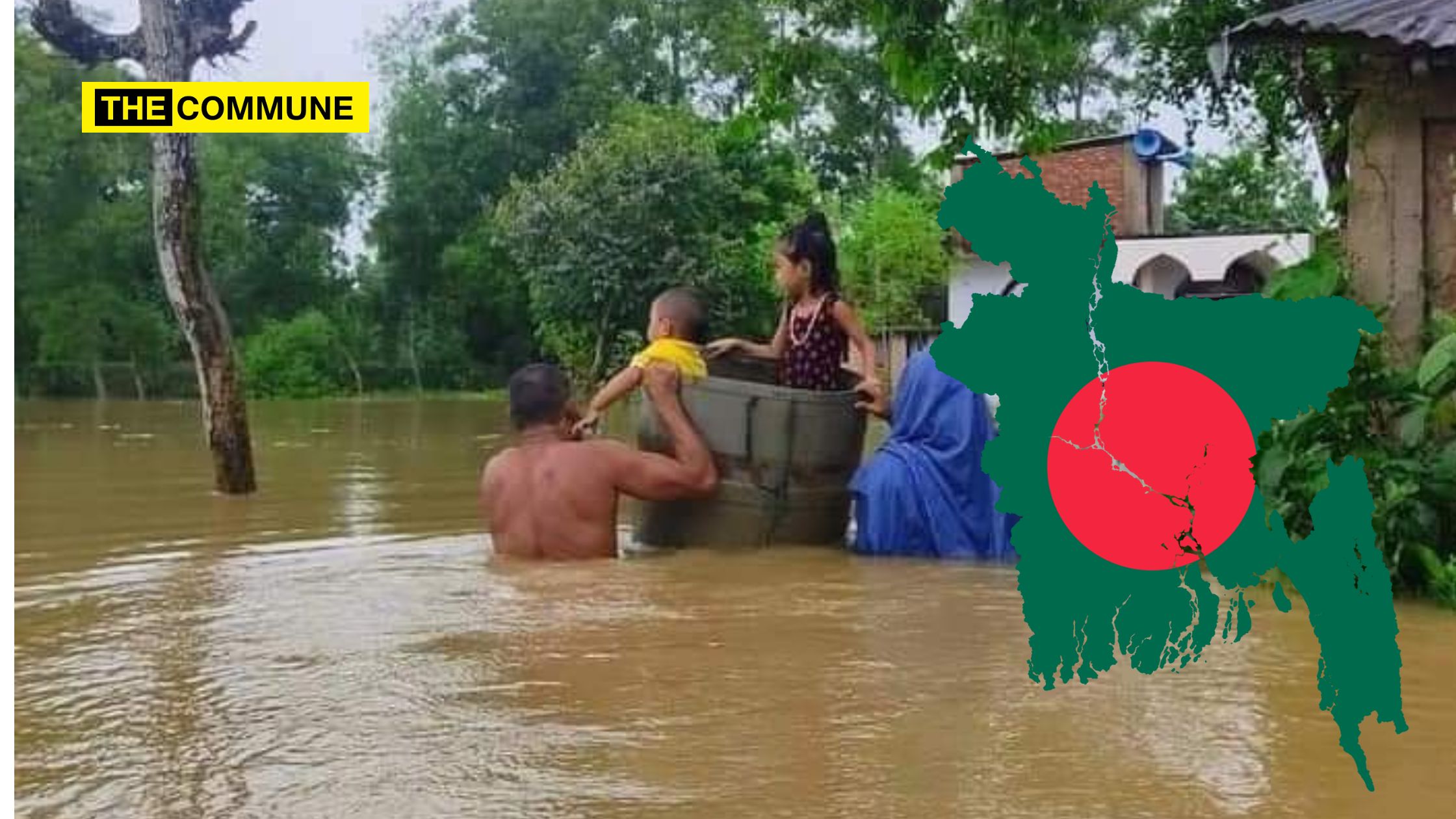
Severe flooding has struck eight districts in eastern Bangladesh, submerging hundreds of villages and leaving millions stranded. The affected districts include Sunamganj, Moulvibazar, Habiganj, Feni, Chittagong, Noakhali, Comilla, and Khagrachhari. Described by some as the worst flood in living memory, the disaster has caused significant damage to infrastructure and agriculture.

Meteorologist Mostofa Kamal Palash identified three primary factors contributing to the floods: a persistent monsoon low-pressure system, a robust Madden-Julian Oscillation, and the jet stream’s current position over Central Asia. The Bangladesh Meteorological Department (BMD) attributed the flooding to a low-pressure system formed in the southern part of the country.

Water levels have risen by up to three meters in some areas within 24 hours. Rivers like the Muhuri, Juri, and Khowai have reached record-high levels. The Flood Forecasting and Warning Centre reported at least seven rivers flowing above their danger marks at nine points across the affected regions.

The flooding has submerged agricultural lands, destroyed fish and poultry farms, damaged flood protection dams and roads, inundated parts of the Dhaka-Chattogram highway, and disrupted emergency health services in some areas.

Bangladesh Rescue Mission

Authorities have mobilized the army, navy, coast guard, and fire service for rescue missions. Helicopters are being used to airlift stranded individuals. Flood shelters have been opened in educational institutions and government offices. The Bangladesh Red Crescent Society has set up control rooms and formed rescue teams.

In Feni, 200 villages are flooded, with water levels reaching up to 12 feet in some areas. Moulvibazar’s Kamalganj upazila has seen 25 villages inundated and about 1,000 hectares of paddy fields submerged. Cumilla is experiencing rapid swelling of the Gomati River. In Brahmanbaria, 30 villages in Akhaura are inundated. Noakhali estimates that 90% of the district is underwater, affecting about 20 lakh people.

Experts suggest the flood situation may improve quickly due to the nature of flash floods. However, concerns remain about long-term impacts on affected communities.

Bangladeshi Media Blames India For Floods

Several media houses, aided by anarchist elements, attribute the flooding to the opening of gates at India’s Dambur hydroelectric project in Tripura. They claim this action has contributed to flooding in bordering Bangladesh districts. Water released from the Dumboor hydroelectric dam in India’s Tripura state has allegedly impacted the Gumati River basin in Bangladesh. Additionally, recent damage to a hydropower dam on the Teesta River in Sikkim, India, has raised concerns about potential flooding impacts downstream in Bangladesh. Here are some media ‘reports’ blaming India for the inundation.

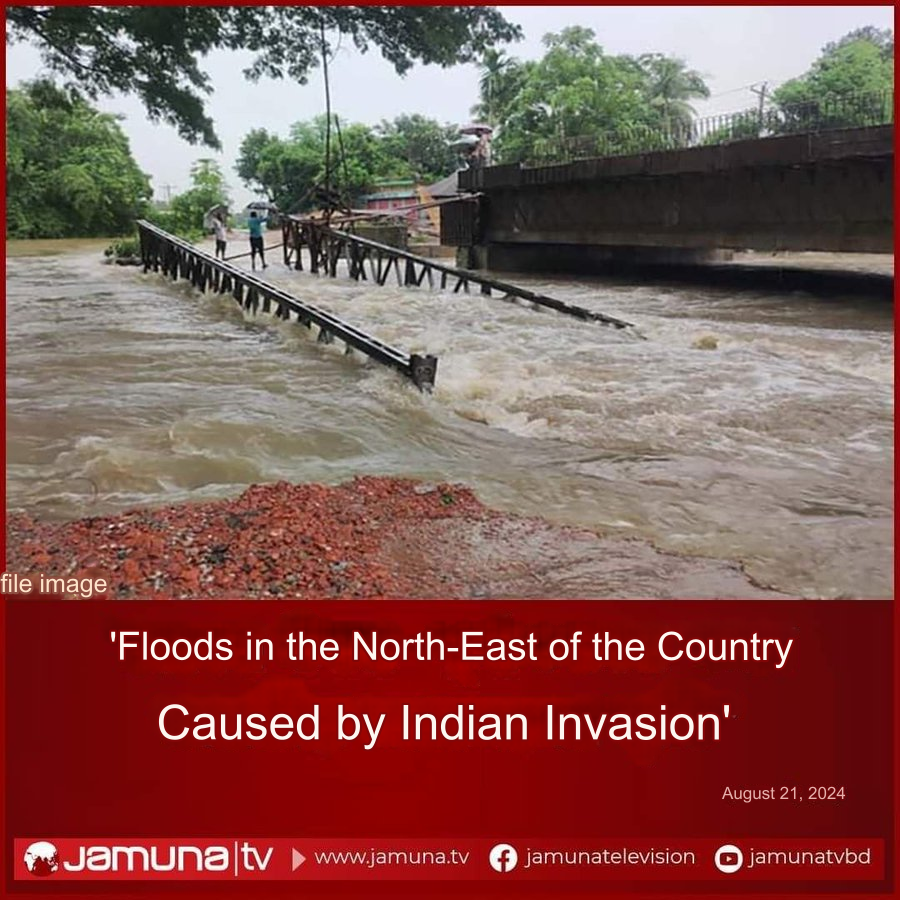
Popular Bangladeshi channel Jamuna TV blamed ‘Indian aggression’ for the flooding in the North-eastern region of Bangladesh.

Another report claimed that India opened the dam in Tripura which led the water to flood Bangladesh.

Derek Grossman, a ‘senior defence analyst’ who has been repeatedly nitpicking every move India makes and setting a narrative in the global media, also endorsed the Bangladeshi reportage of India wantonly opening the dam to cause flooding in the country.

MEA Denies Claims 

The Ministry of External Affairs (MEA) of India has refuted allegations that the opening of the Dumbur dam in Tripura caused the current flood situation in Bangladesh’s bordering districts. The MEA labelled these claims as “factually incorrect” and emphasized the need for cooperative efforts to manage shared water resources.

According to the MEA, however, the flooding is primarily due to “some of the heaviest rains of the year” in the catchment areas of the Gumti River, which spans both India and Bangladesh.

“We have seen concerns being expressed in Bangladesh that the current situation of flood in districts on the eastern borders of Bangladesh has been caused by opening of the Dumbur dam upstream of the Gumti River in Tripura. This is factually not correct,” the MEA stated in a release.

The MEA further clarified that Bangladesh’s floods are the result of natural water flow from extensive catchment areas and reiterated that floods on shared rivers are a common issue affecting both nations. The ministry stressed the importance of “close mutual cooperation” in addressing and resolving such challenges.

“Floods on the common rivers between India and Bangladesh are a shared problem inflicting sufferings to people on both sides, and requires close mutual cooperation towards resolving them,” the MEA added.

The MEA underscored that river water cooperation is crucial to bilateral relations between India and Bangladesh. These two countries share 54 rivers. The ministry reaffirmed its commitment to resolving water resource issues through ongoing consultations and technical discussions.

Tripura Power Minister Comments

In response to these allegations, Tripura Power Minister Ratan Lal Nath asserted that Dumbur dam gates were closed. He explained, “No gate has been opened for Gomti Hydro Electric Project. The reservoir’s storage capacity is up to 94 meters. Once the water crosses this level, it will automatically exit through the gate. Again, the gate will automatically close when the reservoir’s water level falls below 94 meters.”

(This article is based on a thread by Sensei Kraken on X)

Subscribe to our TelegramWhatsApp, and Instagram channels and get the best stories of the day delivered to you personally.
Madurai Bench Of Madras HC Upholds Secularism In Govt-Aided Minority Schools, Calls For Transparent Hiring Amid Tirunelveli Diocese Dispute

Madurai Bench Of Madras High Court Seeks Centre, TN Response On Regulatory Body For Christian Institutions, Cites Fund Misuse conversion to christianity

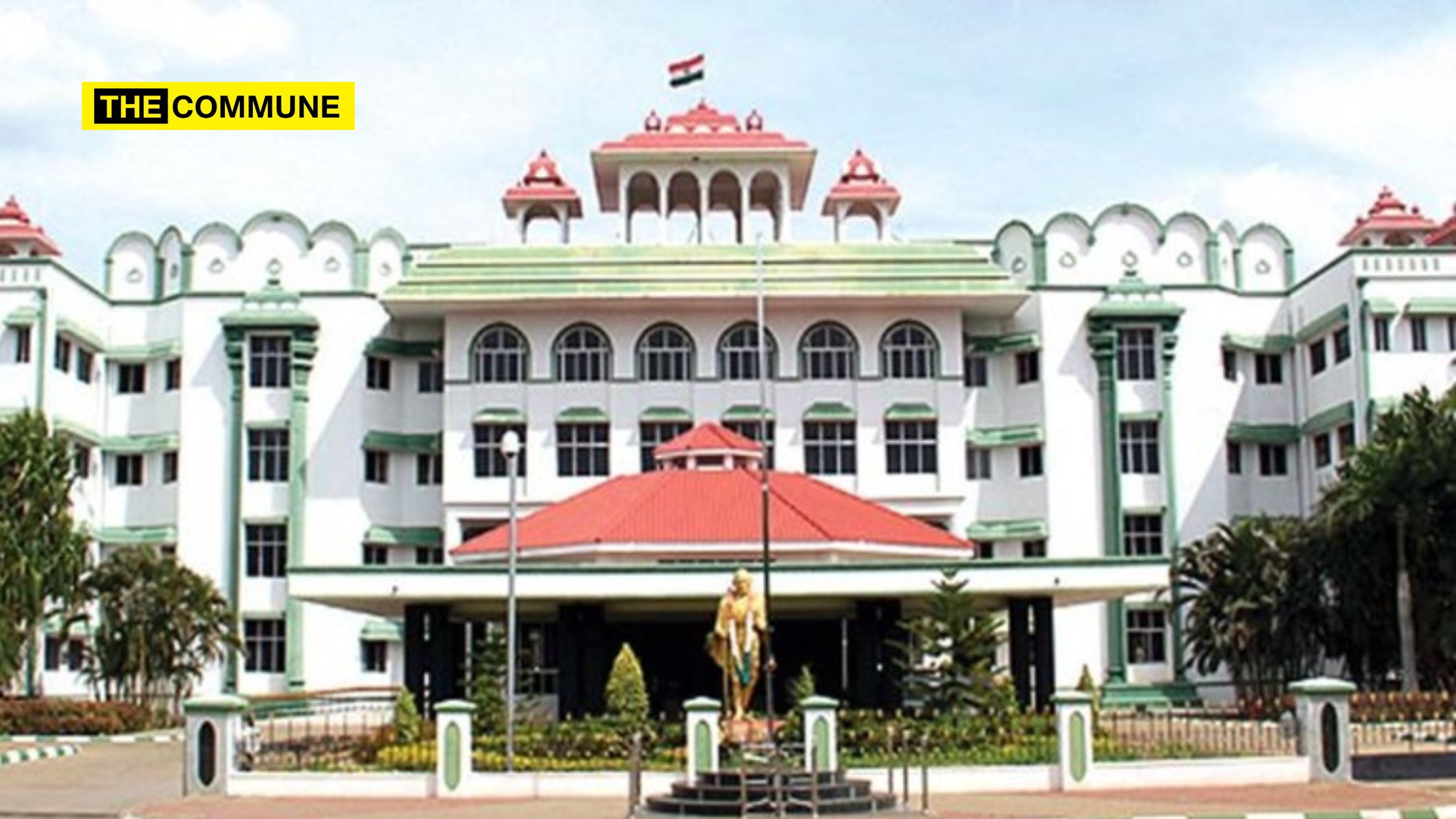
In a significant ruling, the Madurai Bench of the Madras High Court has underscored the need to uphold secularism during staffing in government-funded minority educational institutions. The court emphasized that when schools receive state financial support, their staffing must reflect the state’s secular principles, allowing candidates from diverse religious backgrounds to be considered.

Justice G.R. Swaminathan, who issued the judgment, stressed the constitutional responsibilities of these government-funded minority educational institutions.

He stated, “When the state funds salaries, the fundamental tenets of secularism require that the hiring process be open to all qualified candidates. Restricting applications to individuals of a specific religion contradicts constitutional ethics.”

Suggestions

Justice Swaminathan also suggested that new legislation is necessary to address this issue. He proposed creating a “Transparency in Appointments of Staff in Private Aided Educational Institutions Act” to ensure equitable and secular recruitment practices. This recommendation arose from a petition filed by C. Manohar Thangaraj, the elected treasurer of the Tirunelveli Diocese, who sought to prevent the Bishop from making unilateral decisions regarding hiring teachers and administrators in diocese-run schools.

The judge was clear in his criticism of the alleged flaws in the appointment process within these institutions. He noted, “It is well-known that commercial interests often influence appointments in aided private schools, though some exceptions exist. It is fair to expect that receiving state aid for teaching comes with a duty to hire the most qualified teachers.” While acknowledging the right of minority institutions to manage their appointments, Justice Swaminathan insisted that job openings must be advertised widely to allow all qualified candidates, regardless of caste, religion, or denomination, to apply.

In the case at hand, the judge deemed the diocese’s plan to appoint individuals from its seniority list unconstitutional. Consequently, the court upheld the petition and set a new standard for future cases.

The issue of religious favouritism in government-supported minority institutions has been a contentious matter in Tamil Nadu. Critics, including political pressure groups such as Hindu Munnani, have accused these institutions of hiring based on religious affiliations rather than merit, intending to advance religious agendas under the guise of education. They argue that these institutions while receiving government funds, impose restrictions on students’ religious expressions, such as wearing wristbands or religious symbols, while not imposing similar limits on items like hijabs or rosaries.

Similar Ruling By the Supreme Court

This ruling by the Madurai Bench aligns with earlier precedents. In January 2020, the Supreme Court ruled that government-aided minority institutions do not possess absolute rights in teacher appointments. The court upheld the West Bengal Madrasah Service Commission Act, 2008, establishing a panel for teacher appointments in government-funded madrasas. The Supreme Court found that the Act was constitutional as it ensured a merit-based selection process while accommodating the interests of the institutions.

In contrast, a June 2024 judgment from the Delhi High Court granted government-aided minority institutions complete autonomy in staff appointments. Justice C. Hari Shankar ruled that these institutions have the exclusive right to select their staff, with the Directorate of Education’s role limited to setting qualifications and experience requirements for key positions.

(With inputs from Organiser)

Subscribe to our TelegramWhatsApp, and Instagram channels and get the best stories of the day delivered to you personally.