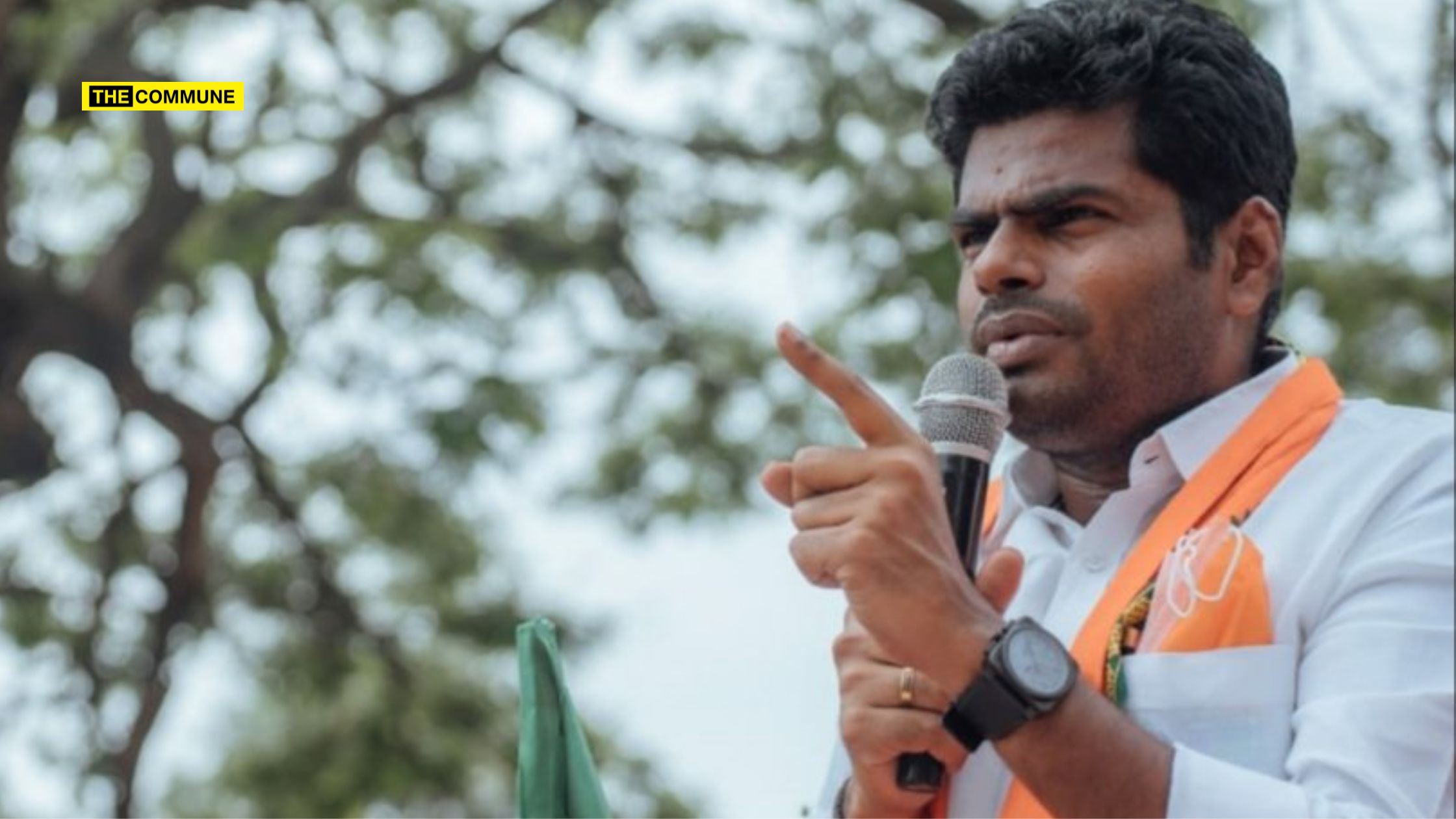
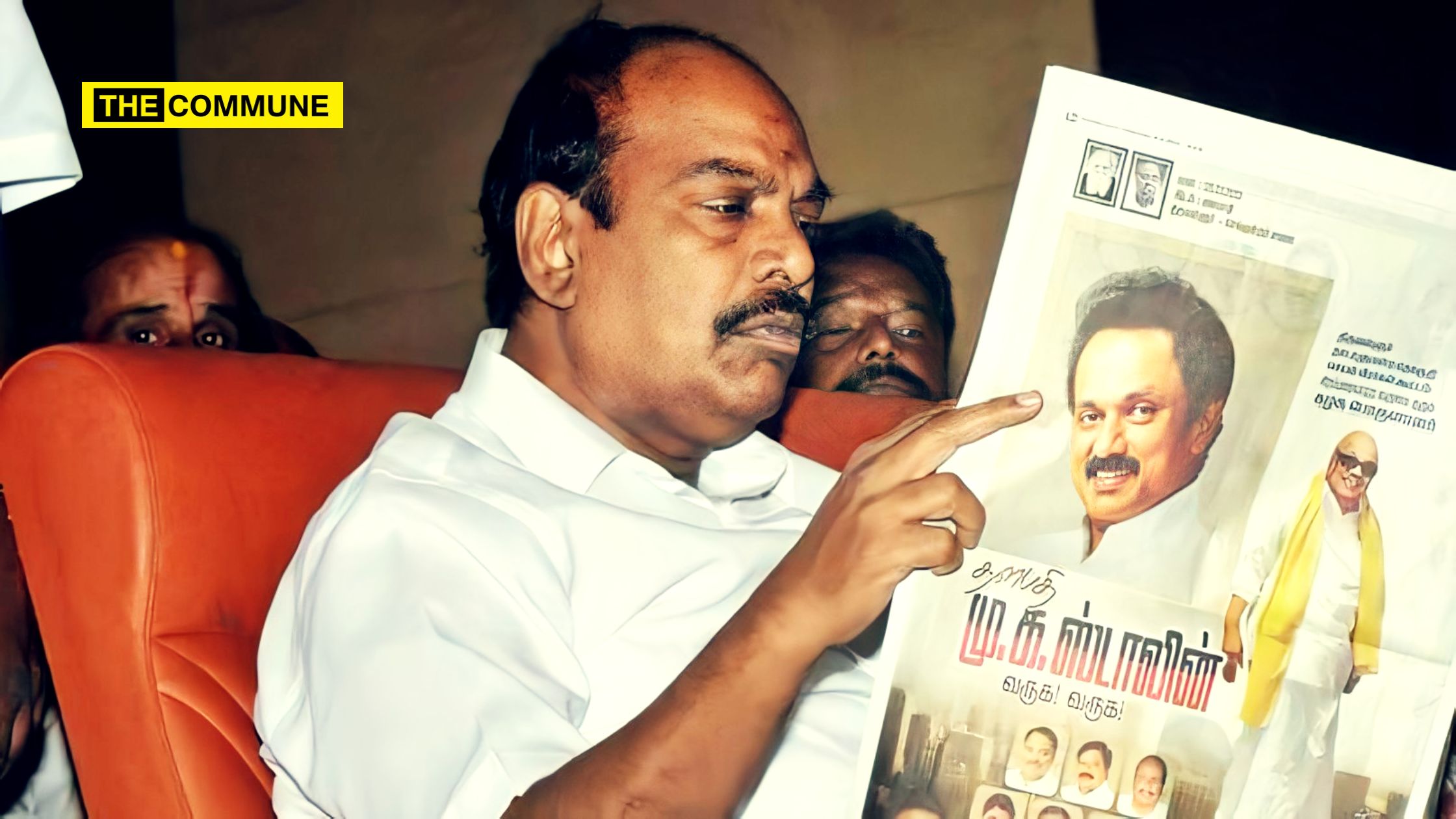
TN BJP State President Annamalai’s trip to London recently sparked curiosity and raised questions about his leadership amidst his absence. However, this move is not a sign of disengagement but rather a strategic decision. Much like other leaders who effectively managed their roles virtually, Annamalai remains actively involved in his party affairs. Through digital means, he ensures his influence within the BJP remains strong.
With the party’s robust structure and the upcoming Rural Local Body Elections on the horizon, Annamalai’s leadership continues to be secure, demonstrating the adaptability of modern political strategy.
Annamalai’s London trip
The BJP chief’s trip has created a lot of buzz and raised many questions. Let’s understand its impact on the ground.
In the current non-election period, the need for daily political activities and constant presence on the ground is less critical. This downtime allows leaders to pursue personal development, strategic planning, or even much-needed rest without impacting the functionality of their parties or governance. This approach is not new and has been effectively utilized by various leaders.
Former CM J Jayalalithaa
For instance, the late J. Jayalalithaa, during her tenure as the Leader of the Opposition, often retreated to her residences in Kodanadu and Hyderabad. She remained firmly in control despite being physically away, with party meetings and decisions continuing seamlessly from her preferred locations. This example underscores that leadership effectiveness is tied to physical presence, strategic oversight, and communication.
Chief Minister M.K.Stalin
M.K. Stalin’s “Namakku Namme” initiative further illustrates this principle. He spearheaded this campaign for just a year leading up to the 2016 Assembly Election. He focused his efforts strategically rather than spreading them thinly over time. This targeted approach allowed him to build momentum precisely when needed, demonstrating that timing and strategy often outweigh continuous, hands-on involvement.
The Chief Minister’s recent trip to the United States for investment purposes shows a similar approach. Even while abroad, the government and the DMK party have continued to operate smoothly under his guidance, facilitated by today’s technological advancements that make remote leadership more feasible than ever.
Virtual Management
TN BJP State President Annamalai finds himself in a similar position. He has chosen to pursue a course in the UK, but this does not mean his leadership or influence over the party’s affairs will wane. In the digital age, managing responsibilities from afar has become the norm. Annamalai is well-positioned to utilize tools like Google Meet and Zoom to stay connected with his party’s activities back home in India. Virtual meetings, remote planning sessions, and digital strategy discussions have become integral to modern political management, and Annamalai’s temporary relocation to the UK does not diminish his capacity to lead.
Moreover, the BJP has a robust organizational structure with a strong Core Committee led by General Secretary (Organisation) Keshava Vinayakan Ji. This committee ensures that the party’s day-to-day functions and strategic planning continue without disruption, regardless of Annamalai’s location. The party’s resilience and ability to operate smoothly under decentralized leadership underscore its preparedness for scenarios where leaders might be temporarily unavailable.
Rural Local Body Elections
It’s also important to consider the timing of the upcoming Rural Local Body Elections, slated for December this year. Annamalai’s course will conclude well before these elections, allowing him ample time to return and engage directly with campaign activities. His brief absence will not impact the party’s preparations or strategy for these elections, and his leadership role remains intact and unchallenged.
For those who speculate or hope that Annamalai’s London trip might lead to his removal or weaken his position within the BJP, such thoughts are far from reality. Annamalai’s leadership is secure and reinforced by his ongoing active involvement, whether from India or abroad. The BJP’s solid organizational framework and Annamalai’s adaptability ensure that the party remains on course, focused, and cohesive.
Conclusion
Annamalai’s absence is a strategic decision, not a sign of disengagement. It reflects a broader trend in modern political leadership, where a leader’s effectiveness is measured not by their physical presence but by their ability to guide, inspire, and manage from any location. In an era where technology bridges distance and facilitates real-time communication, leaders like Annamalai can continue to wield significant influence and direction, no matter where they are.
Therefore, it remains a dream for those desiring Annamalai’s downfall or speculating on his sacking. His position is unshakeable and continues to be a driving force for the BJP, both now and in the future. The modern political landscape accommodates adaptable leaders, and Annamalai exemplifies this adaptability. His commitment to his party and his strategic approach to leadership make him a formidable figure whose role is far from being compromised, even in the most speculative scenarios.
Samaniyar Nagaraj is a techie-turned-political analyst.
Subscribe to ourTelegram, WhatsApp, and Instagram channels and get the best stories of the day delivered to you personally.
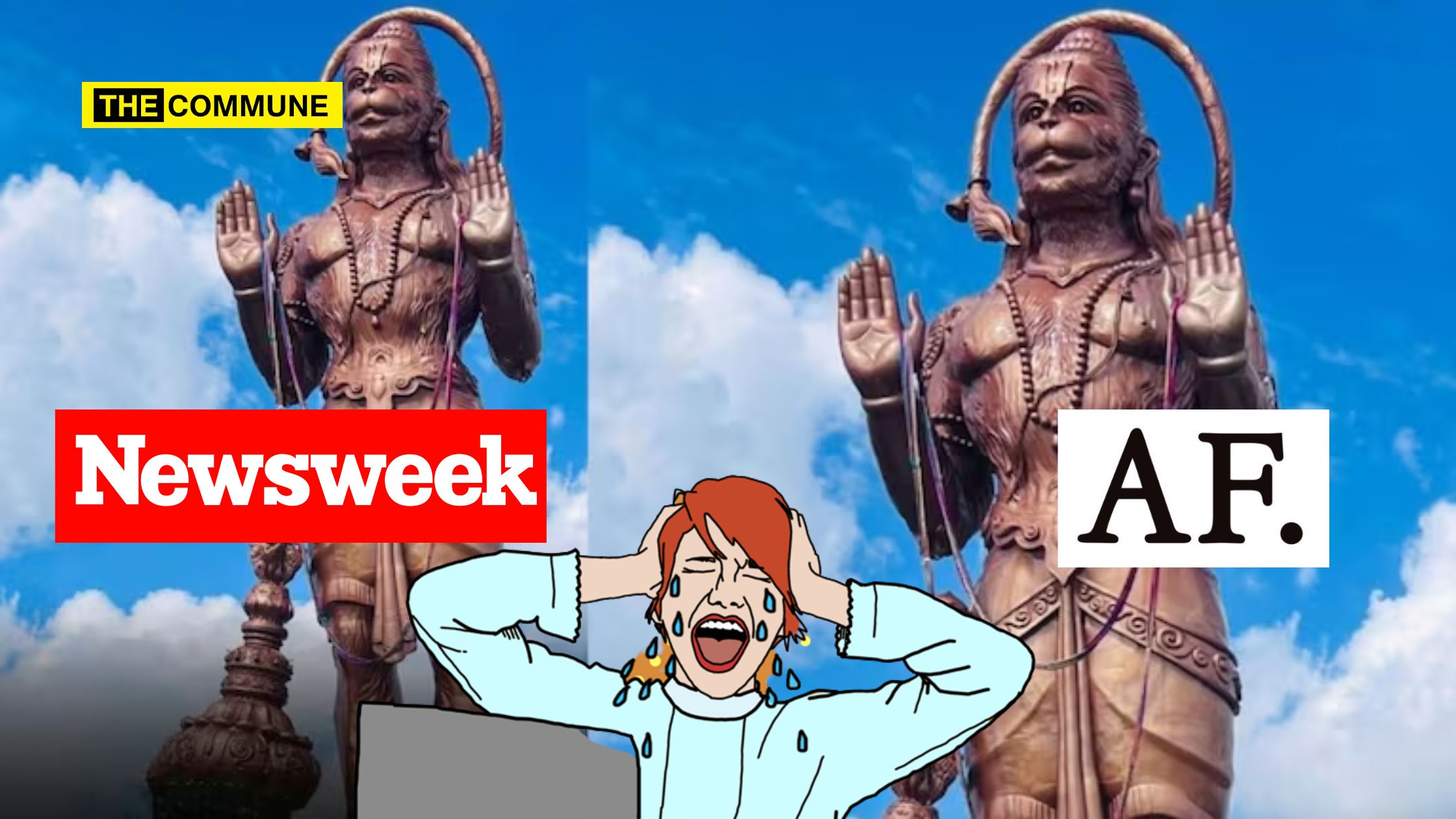
A gigantic 90-foot panchaloha statue of Lord Hanuman, known as the Statue of Union, has been unveiled near Houston in Texas, marking a significant spiritual landmark in the United States. This murti is not only one of the tallest statues in the world but also stands as the tallest Hanuman statue outside India, the tallest statue in Texas, and the third tallest in the United States, following the Statue of Liberty in New York (151 feet) and the Pegasus and Dragon in Hallandale Beach, Florida (110 feet).
Unveiled at the Sri Ashtalakshmi Temple in Sugar Land, approximately 35 km from Houston, the Statue of Union was dedicated during the Prana Prathishta Mahotsavam from 15 August to 18 August 2024. The organisers stated that the statue symbolizes “selflessness, devotion, and unity. ” They also highlighted that the murti’s name reflects Lord Hanuman’s vital role in reuniting Lord Ram and Sita.
The visionary behind this awe-inspiring project is His Holiness Sri Chinna Jeeyar Swamiji, a Padma Bhushan awardee and renowned Vedic scholar. According to a statement released by the organizers and reported by PTI, he envisioned this statue as a spiritual epicentre for North America.
The celebrations commenced on 15 August 2024, coinciding with India’s Independence Day, and culminated on 18 August 2024 with the grand Pran Prathistha ceremony. Sri Chinna Jeeyar Swamiji and a large group of Vedic priests and scholars led the rituals, which were a profound display of devotion and spirituality.
The ceremony featured a helicopter showering flowers upon the statue, sprinkling sacred water, and placing a 72-foot-long garland around Lord Hanuman’s neck as thousands of devotees chanted the names of Shri Ram and Hanuman in unison.
How US Media Reported The Event
There were reports of church groups protesting at the venue.
A local church group entered temple property to "protest" the recently built Hanuman idol in Texas on Sunday.
About 15-20 of protestors were uttering some demonic curses praying for the downfall of "non-believers" and proselytizing on temple grounds harassing temple goers… pic.twitter.com/F8TtdrwNNL
This was seemingly aided and abetted by the media in the country which reported extremely disrespectfully.
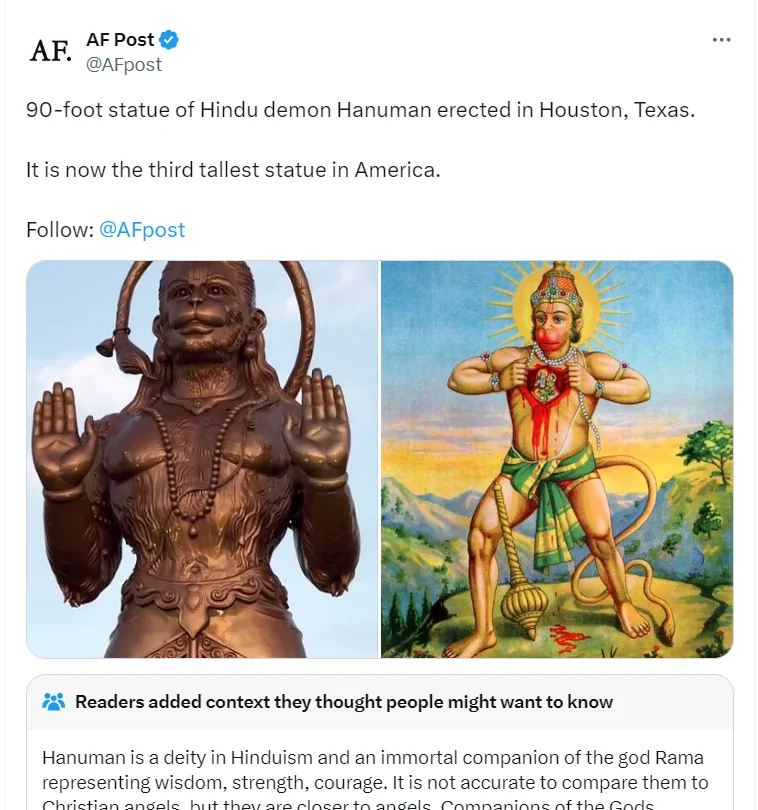
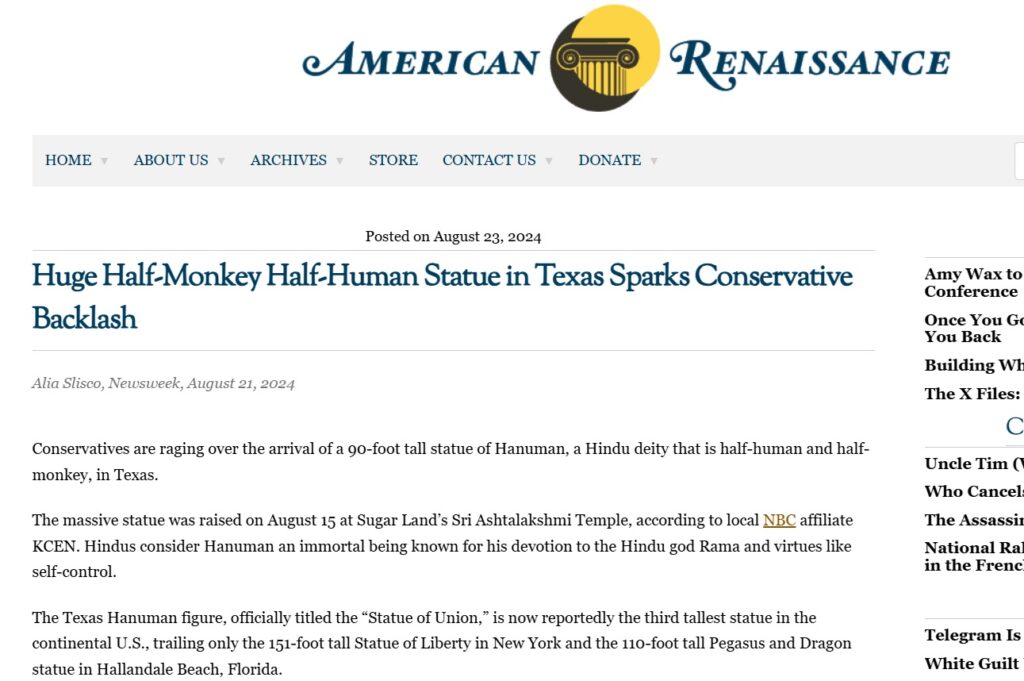
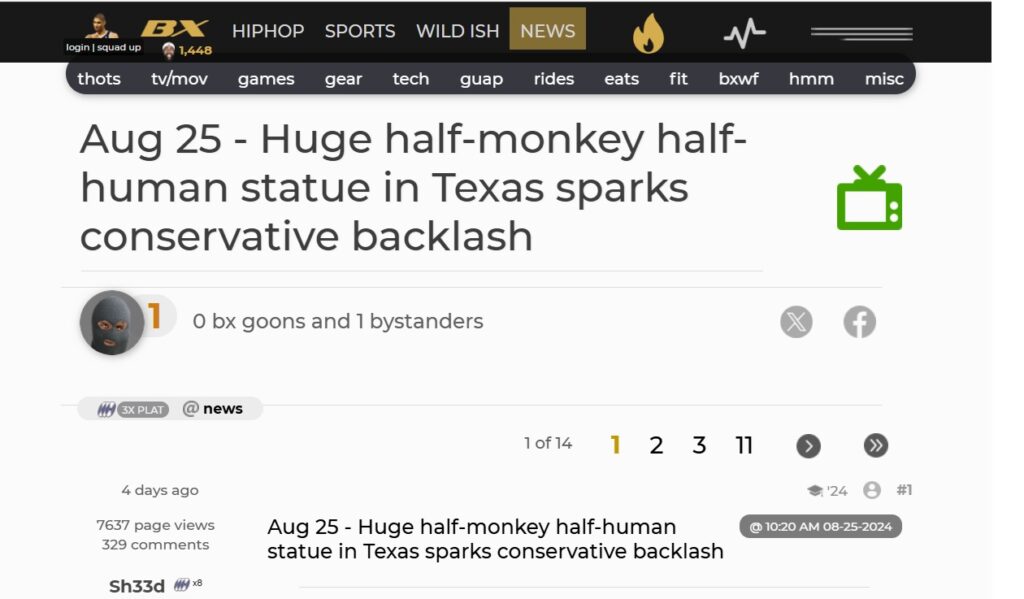
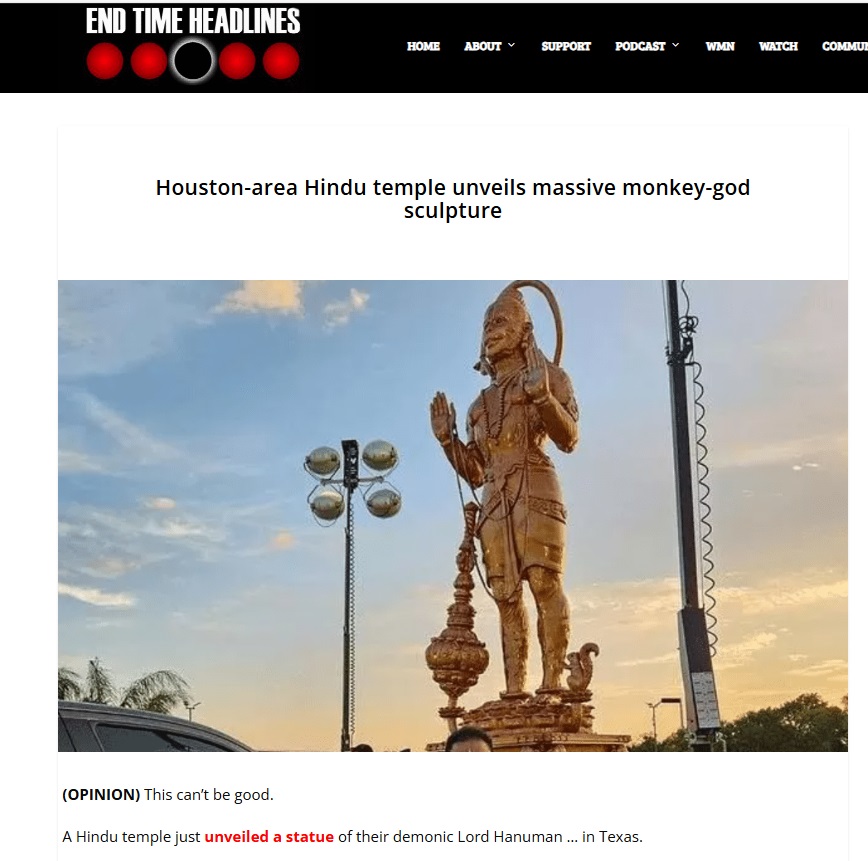
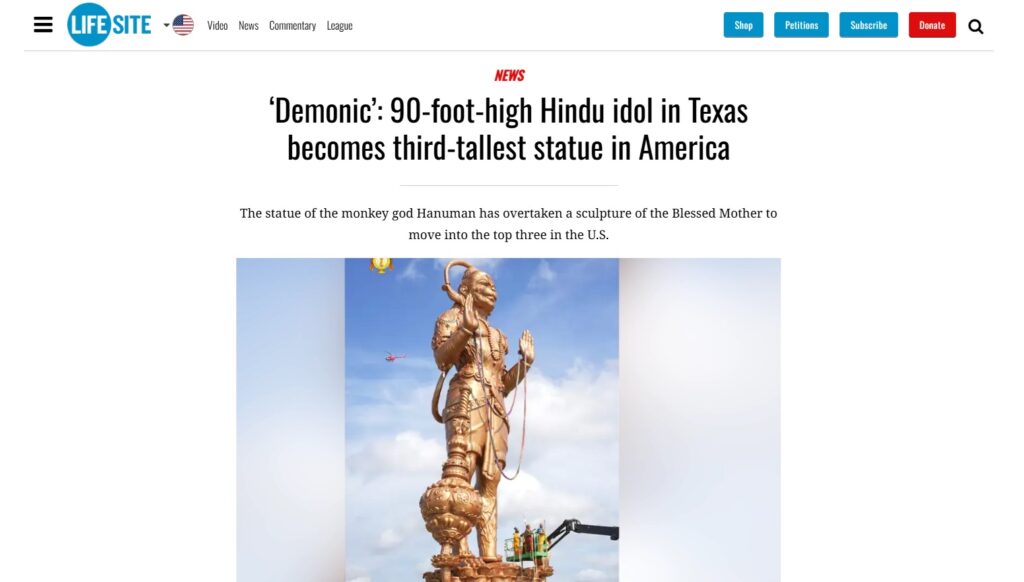
Here are some screenshots of news reports from media houses in the United States – they either called it demonic, demon god or half-monkey half human statue.
NewsweekAF PostAmerican Renaissance
Boxden
End Time HeadlinesLife Site
US – A So-Called Secular But Rather Intolerant Country
The movements for the separation of church and state in the United States have shaped modern secularism, with the United States being the first nation in history to establish an explicitly secular government. The United States is said to be a secular country in its truest sense however the Christian population there, while preaching tolerance, practicing intolerance, and disrespecting other faiths.
Here are some reactions from American netizens who seem to be Christian fundamentalists.
In Texas there is a 90 ft statue of Hanuman, a Hindu monkey god. What is the United States anymore? A nation with no culture, now that the enrichers are prominent in the census. pic.twitter.com/UvbU7ammXo
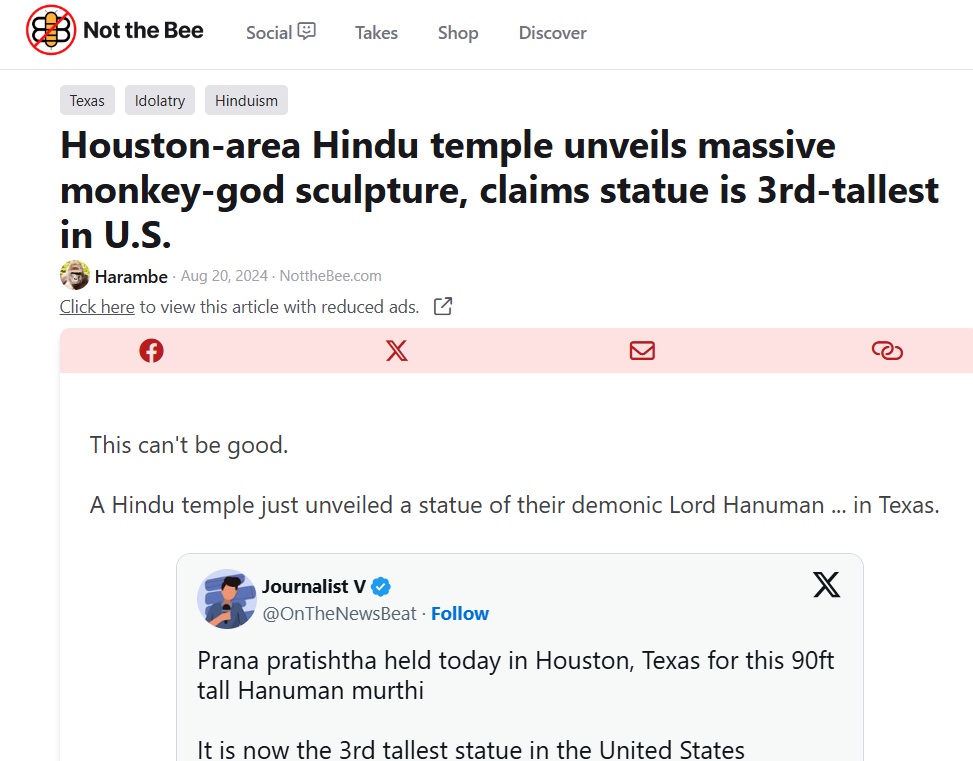
A ‘right-wing humour-based news” website called Not the Bee published an article on the statue, cautioning against provoking “the wrath of the One True God by building massive demonic idols everywhere.”
Not The Bee
Additionally, some conservative X users made racist remarks, drawing comparisons between the statue and George Floyd, a Black man who was a victim of police violence. They wrote, “Gigantic 90ft George Floyd statue unveiled in Houston, Texas. The massive dark chocolate-coated statue, officially named ‘Saint Floyd of Fentanyl’, was unveiled by BLM and the Harris Walz campaign. It is now the 3rd largest statue in the United States.”
Gigantic 90ft George Floyd statue unveiled in Houston, Texas.
The massive dark chocolate coated statue, officially named ‘Saint Floyd of Fentanyl’, was unveiled by BLM and the Harris Walz campaign.
Sharing an Indian Express article, a netizen wrote, “Monkey Pox and now the Monkey God – Perfect timing considering the times that we are in. “
Monkey Pox and now the Monkey God – Perfect timing considering the times that we are in. https://t.co/ZSxXolszZU 90-foot tall bronze statue of Lord Hanuman becomes new landmark in Texas. Called the "Statue of Union," this impressive statue is now the third tallest in the…
Yet another netizen found the timing uncanny. They wrote, “Anyone else find it odd the timing of the unveiling of the statue in Texas of the Hindu god Hanuman which just happens to be half monkey and half human This occurred just a few days after the WHO declared “monkeypox” a global health emergency Talk about a coincidence“
Anyone else find it odd the timing of the unveiling of the statue in Texas of the Hindu god Hanuman which just happens to be half monkey and half human
This occurred just a few days after the WHO declared "monkeypox" a global health emergency
Imagine a scenario wherein Hindus protest the opening of a church here in our country. Imagine headlines describing Jesus as a bearded dead body hanging on a cross. Well, that would wreak havoc across the world, and given the power of the Church, such things would not even make the news. India is home to over 28000 churches and a lot more chapels. In India, churches are built on public land and this Hanuman statue was built on private land.
Do you know how many churches are there in India officially? 28,278. Plus thousands of chapels. Catholic church is the largest landowner in India after the Indian govt. Conversions by force, deceit will face action. Islamists will be dealt with. Read up on Bharat. Won’t hurt. https://t.co/TtY3UDJ4FB
Just the sight of a Hindu deity makes them go bonkers, the Hanuman Chalisa rightly says, “Bhoot Pishach Nikat Nahi Aave, Mahabeer Jab Naam Sunave“. Here’s hoping Lord Hanuman will protect the Hindus in the US from external forces.
Subscribe to our Telegram, WhatsApp, and Instagram channels and instantly get the day’s best stories.
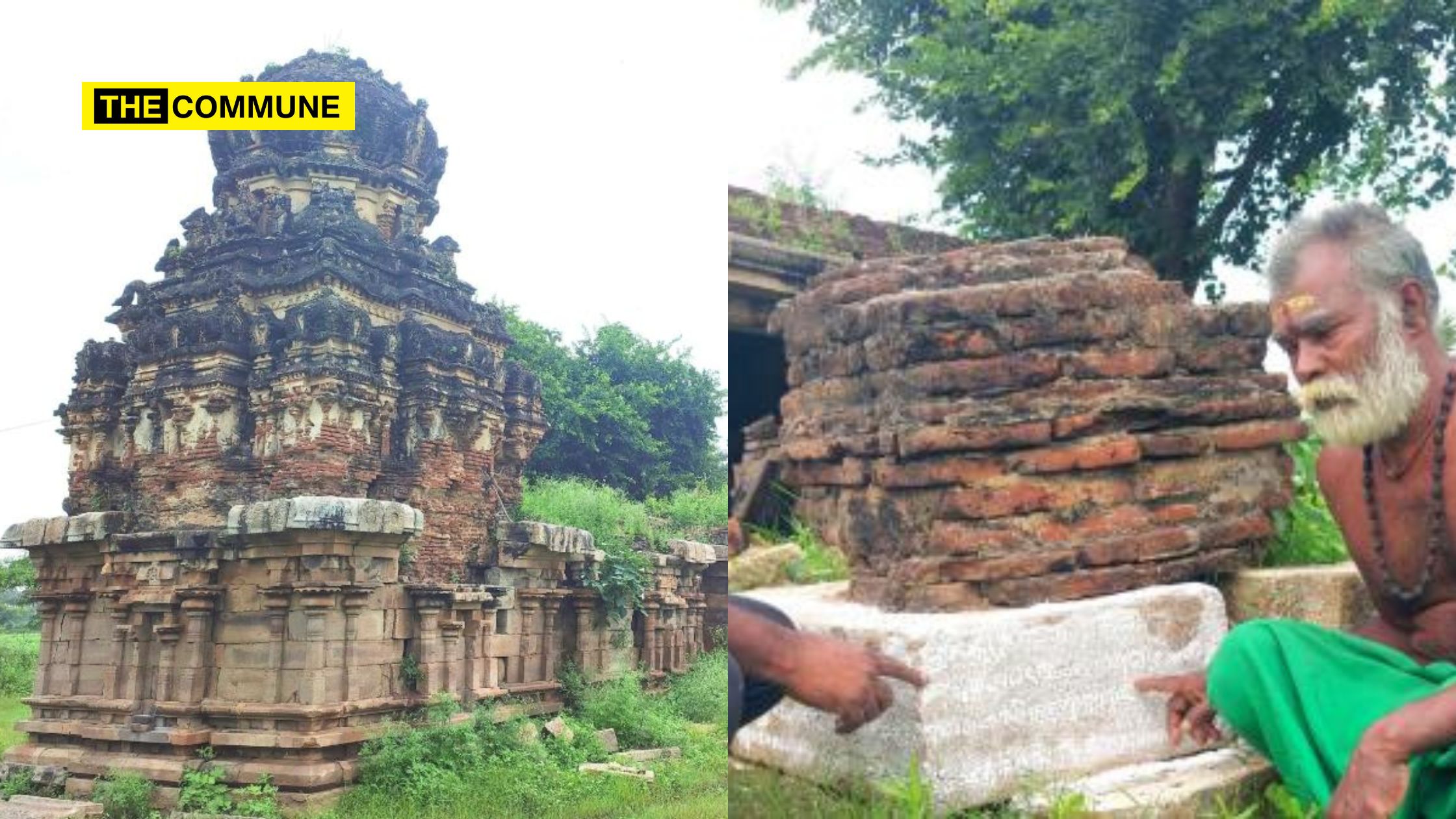
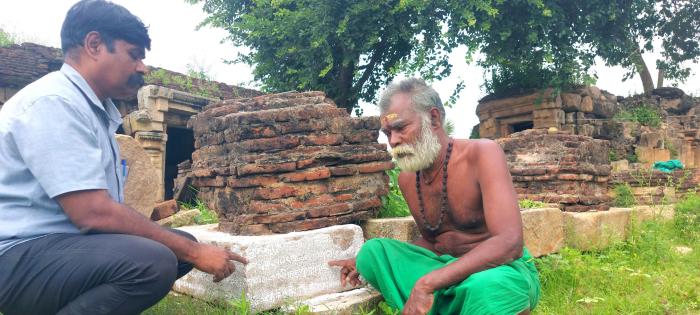
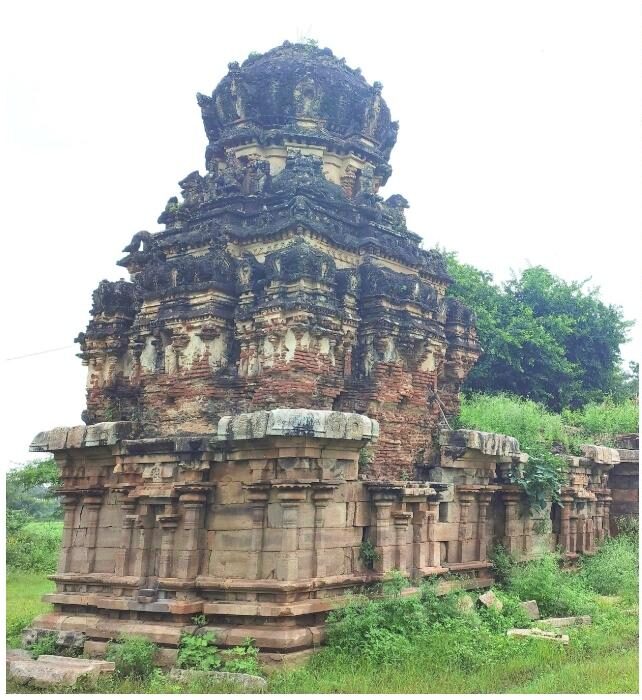
The saying that “Tamil Nadu’s rich culture is embedded deep within its ancient Hindu temples” has been recently validated by the Ramanathapuram Archaeological Research Foundation with the uncovering of two 13th-century Pandya period inscription fragments at the Kallikottai Shiva temple in the Ramanathapuram district.
V. Rajaguru, president of the research foundation, discovered the new fragmentary inscriptions while examining the crumbling Kallikottai Shiva temple. An archaeological team led by Amarnath Ramakrishna had previously documented six fragmentary inscriptions at the Shiva shrine and one at the Amman shrine. The newly found inscriptions are located in the basement of the ruined Mukhamandapa of the Shiva shrine, with one fragment on the side of the Jagathi and another on top, Rajaguru reported on Monday.
Rajaguru explained, “These inscriptions date back to the 13th century and are from the Pandya dynasty, one of two-line inscription refers to Srikomarapanmarana Tribhuvana Chakravathi, who might be Maravarman Sundara Pandya I.” Another four-line inscription details a levy of half a ‘kalam’ (a measurement unit) collected in Aippasi kuruvai and (sandhi) Vigrakaperu, mentioning Mizhalai Kootram and Thirukanapper Kootram.
The inscriptions suggest that these records are from the reign of Maravarman Sundara Pandya I, particularly in the context of his opposition to Kulothunga Chola III’s attempts to conduct Veerabhishekam in the Pandya region, which led to conflicts at Mattiyur and Kallikottai.
An inscription from 1538 AD at the Amman shrine refers to the village as Nadamangalam, also known as Sundarathol Nallur, and the deity as Nainar Thavachakravartheeswaramudaiya Nainar. Additionally, small sculptures of Narthana Ganapathy, Lord Muruga, and Lakulisa Pashupatha in a standing posture were found carved on the half-pillars of the Amman shrine. The sculpture of Lakulisa Pashupatha with four hands is particularly rare, as most such figures are depicted seated.
The Golaki Mutt, a sect of Pasupatha, Lakulisha Pasupatha, and Kalamukha, which was involved in teaching monks in Saiva monasteries, was associated with this ancient temple. A fragmentary Pandya inscription mentions the Golaki Mutt, including its preceptors and disciples. It is likely that Maravarman Sundara Pandya I built the Pallipadai temple after the Pandya-Chola war. Based on these findings, Rajaguru has urged the HR&CE Department to renovate and preserve the temple, emphasizing its significance in the history of the Pandya and Chola dynasties.
Unfortunately, many ancient temples today are in disrepair, with trees and bushes encroaching upon their structures and causing further damage. Maintenance largely relies on a few local devotees, as the HR&CE department, responsible for their administration, has not taken sufficient steps to preserve these cultural treasures. This is despite the department’s claims, often highlighted by the minister, of having conducted numerous kudamuzhaku and kumbabhishekam ceremonies.
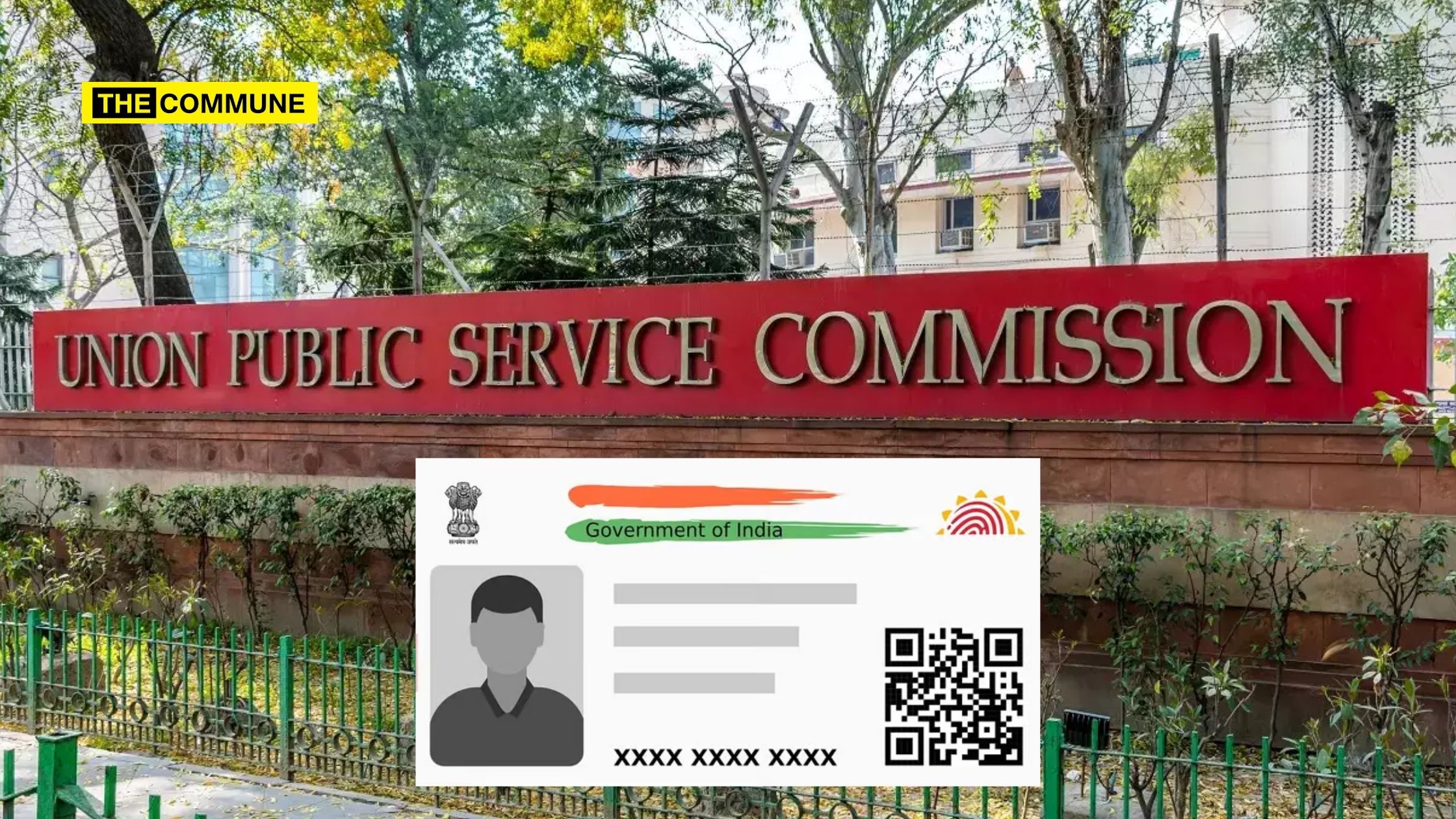
In an unprecedented move, the Centre has allowed the Union Public Service Commission (UPSC) to use Aadhaar-based authentication to verify candidates’ identities voluntarily, both at the time of registration and during several stages of examinations and recruitment.
The Ministry of Personnel, Public Grievanves and Pensions said, “In pursuance of sub-clause (ii) of clause (b) of sub-section (4) of section 4 of the Aadhaar (Targeted Delivery of Financial and Other Subsidies, Benefits and Services) Act, 2016, (as amended) read with rule 5 of the Aadhaar Authentication for Good Governance (Social Welfare, Innovation, Knowledge) Rules, 2020, Ministry of Personnel, Public Grievances and Pensions, Department of Personnel and Training, having been authorised by the Central government, hereby notifies that the Union Public Service Commission (UPSC) is allowed to perform Aadhaar authentication, on voluntary basis, for verification of identity of candidates at the time of registration on ‘One Time Registration’ portal and various stages of examination/recruitment test, using Yes/No or/and e-KYC authentication facility.”
“Union Public Service Commission (UPSC) shall adhere to all provisions of the Act, the rules and regulations made there under, and directions issued by the ‘Unique Identification Authority of India’,” the Ministry of Personnel, Public Grievanves and Pensions said.
This significant move follows after the UPSC, in July, cancelled Puja Khedkar’s provisional candidature as a provisionally recommended candidate for the Civil Services Examination 2022 and permanently barred her from all future exams and selections.
Khedkar, a probationary IAS officer who secured an All India Rank of 821 in the UPSC exams, has been accused of misusing her authority. She faces several allegations, including claims that she demanded a separate cabin and staff during her Pune posting, faced an unexpected transfer to Washim district, and used a private Audi car with a red-blue beacon light and VIP number plate.
Moreover, she allegedly occupied the ante-chamber of Additional Collector Ajay More without permission, removed office furniture without consent, and requested unauthorised facilities. The UPSC conducts Civil Services Examinations( Preliminary, Main, and Interview/Personality Test) for recruitment to the Services and Posts such as Indian Administrative Service, Indian Foreign Service, Indian Police Service, Indian Audit and Accounts Service, Group ‘A’, Indian Civil Accounts Service, Group ‘A’, Indian Corporate Law Service, Group ‘A’, Indian Defence Accounts Service, Group ‘A’, Indian Defence Estates Service, Group ‘A’, Indian Information Service, Group ‘A’, Indian Postal Service, Group ‘A’, Indian P&T Accounts and Finance Service, Group ‘A’ and others.
The Delhi High Court in August issued notices to the Delhi Police and the UPSC concerning the anticipatory bail plea of suspended IAS officer Puja Khedkar. Khedkar approached the Delhi High Court to challenge a district court’s decision that denied her bail. The FIR alleges that she falsified her identity to secure additional attempts in the civil services exam.
This story is based on an IANS-syndicated feed.
Subscribe to our Telegram, WhatsApp, and Instagram channels and instantly get the day’s best stories.
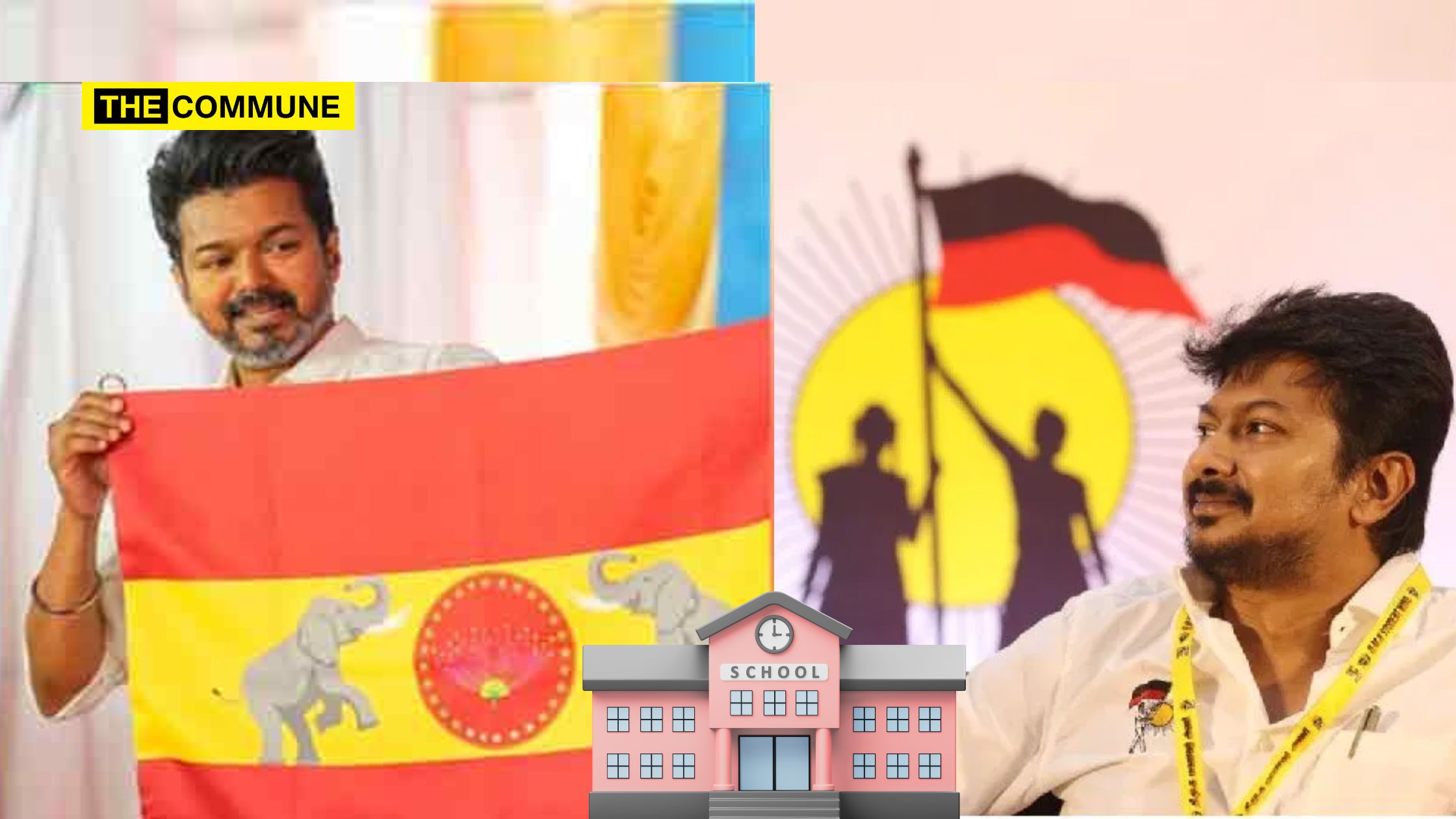
Political parties have traditionally relied on their student wings in colleges to influence young adults. However, their approach is shifting. Political parties aim to reach school students who have not been exposed to any political ideology. The ruling DMK, for instance, plans to introduce “Tamil associations” to counter the influence of actor Vijay and his political party, Tamilaga Vettri Kazhagam (TVK), on these younger students.
When actor-turned-politician Vijay launched TVK, the party experienced a significant surge in online membership, with lakhs of students joining. An influx of youths and fans followed him. Vijay strengthened his appeal by awarding academic prizes and incentives to top-performing students in the 10th and 12th-grade exams across 234 assembly constituencies under his party’s banner.
This idea seems to have struck the DMK that if a student wing is established for DMK, its ideology could grow beyond its present levels.
To counter this growing influence, the DMK, under its scion Udayanidhi Stalin, is set to implement a strategy to attract students to its ranks. This includes forming a Tamil Student Council system within educational institutions.
DMK’s Students’ State Secretary, Ezhilarasan MLA, via his official X account, stated that a meeting of State—and district-level representatives will occur on 6 September 2024 at the party’s head office in Chennai.
This meeting will address the recruitment and organization of student leaders for various levels, including union, city, regional, and district positions. Deputy General Secretary A. Raja and Organizing Secretary RS Bharathi will present the Tamil Student Union Admission Application Forms and Union Identity Cards and deliver an address during the event.
கல்வி நிலையங்களில் “தமிழ் மாணவர் மன்றம்” அமைப்பு ஏற்படுத்துதல், ஒன்றிய, நகர, பகுதி, பேரூர் ஆகிய அமைப்புக்கான மாணவர் அணி நிர்வாகிகளுக்கான நேர்காணல் நடத்துவது குறித்தான ஆலோசனைக் கூட்டம் வருகிற 6-9-2024 வெள்ளிக்கிழமை, காலை 11.00 மணியளவில் அண்ணா அறிவாலயம் “கலைஞர் அரங்கத்தில்”… pic.twitter.com/DjhbjvLfq1
Political Ideology Disrupting College Student Life – Kerala HC Case Study
Whether students should be involved in politics is a complex debate. It was brought up in February by a Public Interest Litigation (PIL) filed in the High Court of Kerala. The petitioner, N. Prakash, a former High Court employee, cited recent violent incidents at Maharaja’s College in Kochi. At the college, an SFI leader and a disabled professor were stabbed by students linked to the Fraternity Movement, leading to the college’s temporary closure. The petitioner cited such instances as evidence of the dangers of campus politics.
In response to these incidents, the High Court has issued notices to various parties, including the state government, the higher education department, and several student organizations. This isn’t the first time the judiciary has scrutinized campus politics. In 2003, the High Court allowed private colleges to ban politics on campuses, a directive that many institutions followed. In 2017, the court reaffirmed that politics had no place in educational settings, and by 2020, it deemed campus agitations illegal.
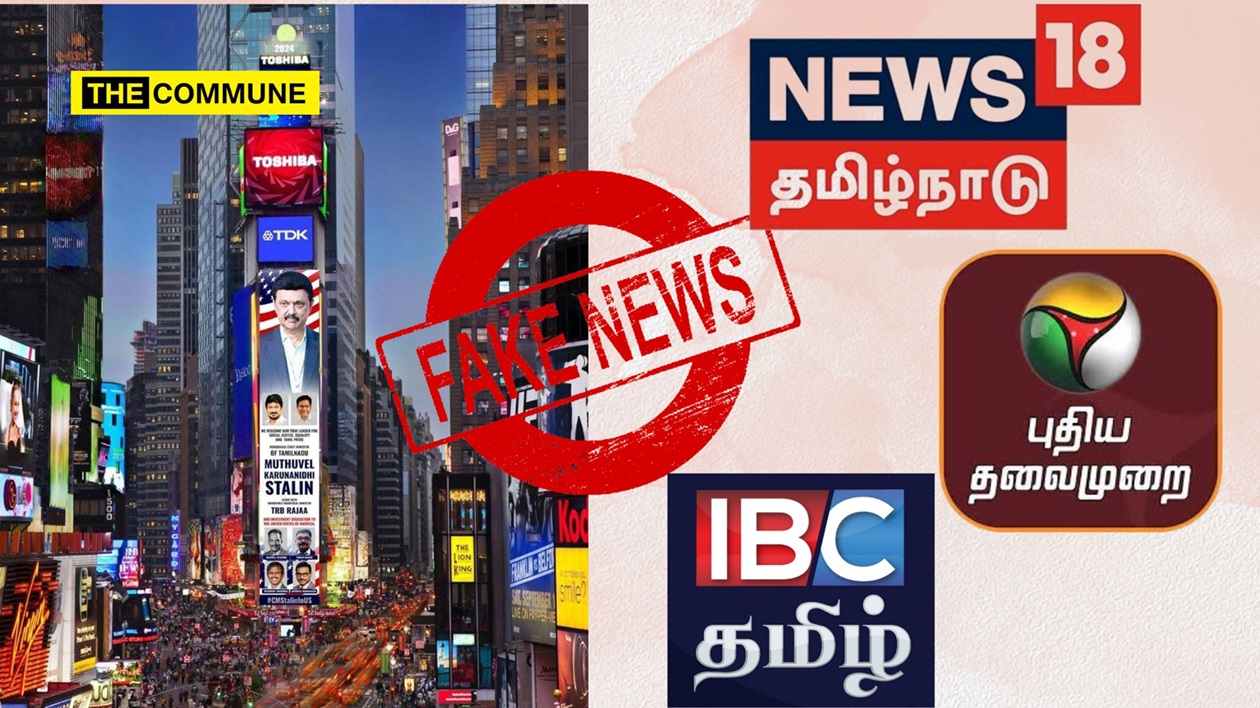
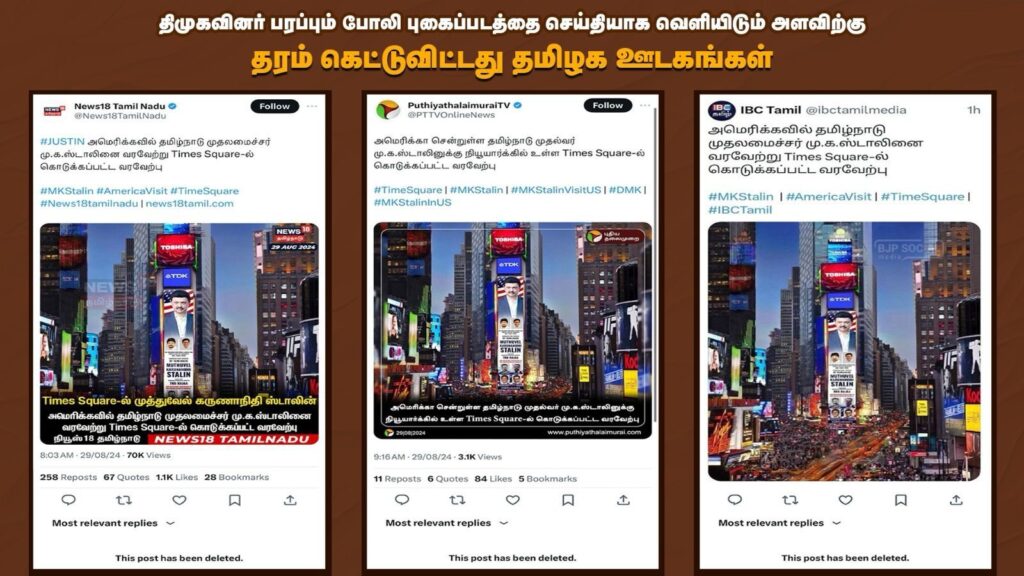
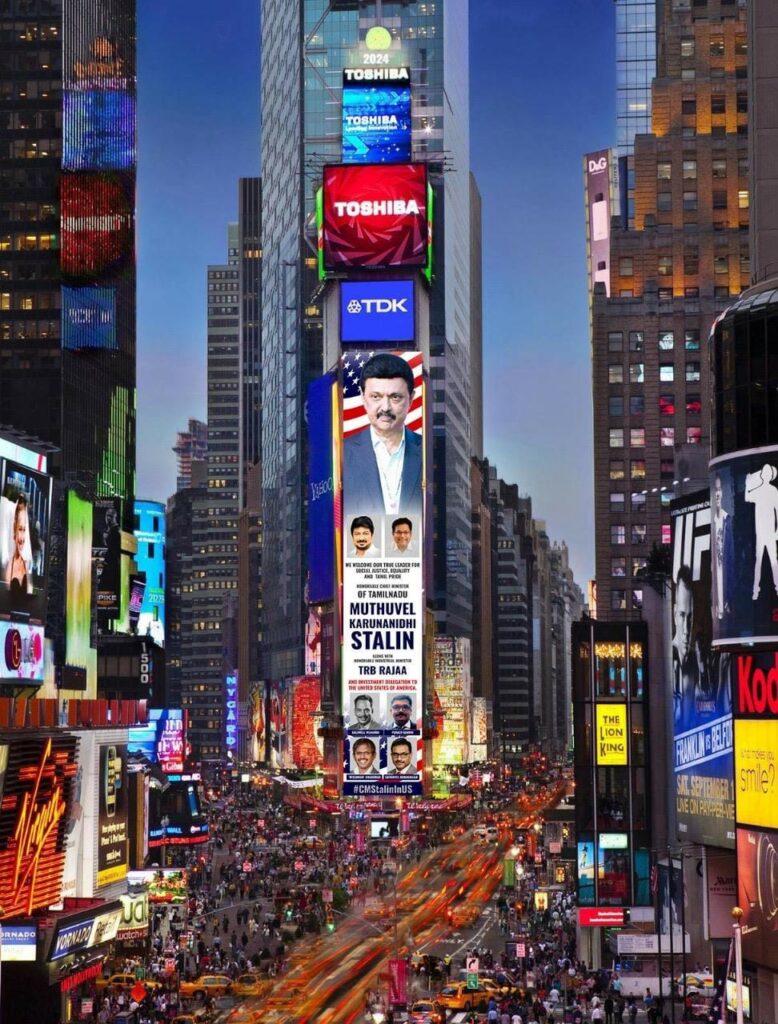
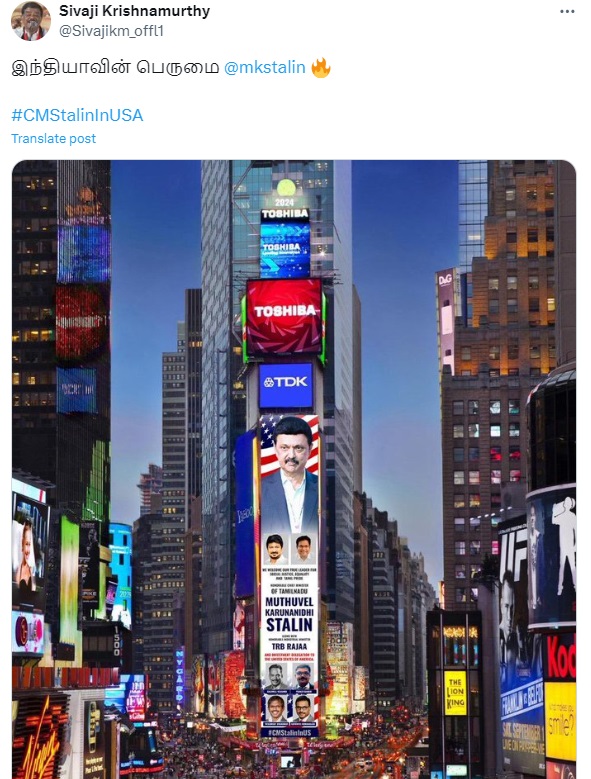
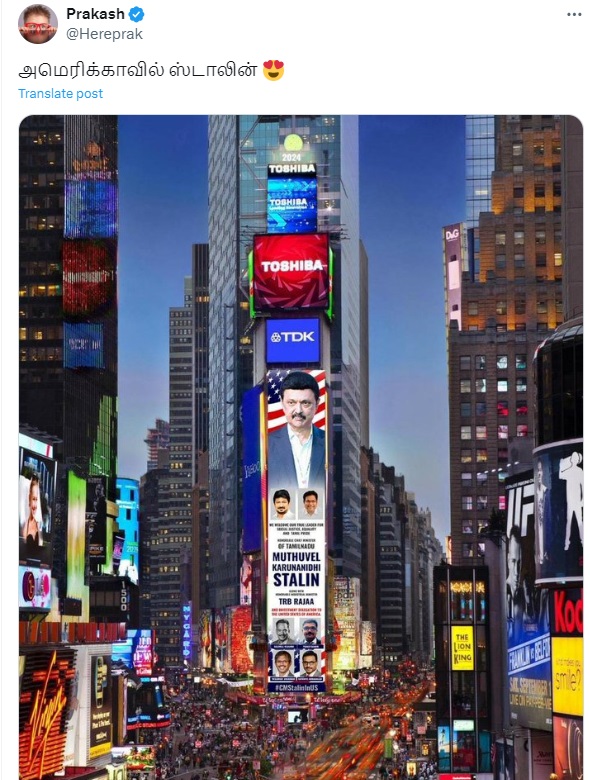
A viral photo claiming to show Tamil Nadu Chief Minister MK Stalin’s portrait displayed prominently at New York’s Times Square has been making rounds on social media, with several Dravidianist media outlets like News 18 Tamil Nadu, IBC Tamil and Puthiya Thalaimurai sharing it as a grand welcome for him in the US. However, a reverse-image search and subsequent analysis by fact-checker Newschecker Tamil revealed that the photo is a doctored image, not an authentic display.
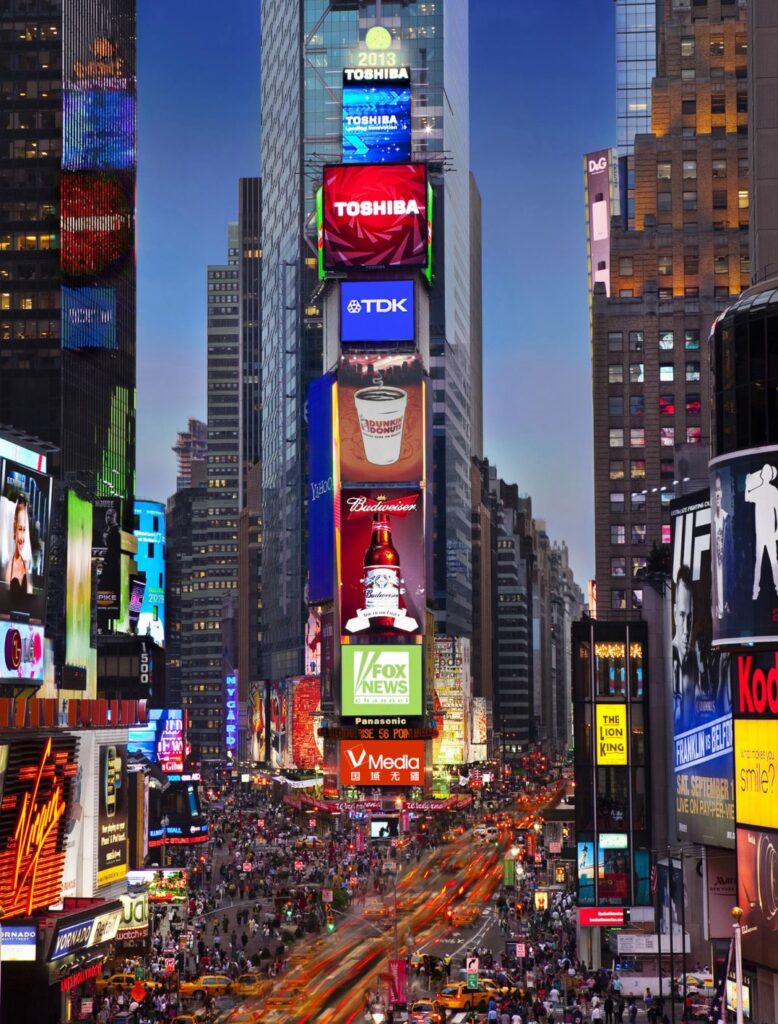
Upon investigating the viral photo, it was discovered that the image had been altered. A reverse-image search led to a similar Times Square photo found on The Clio, a reputable source. When compared with the viral photo, showed that the image of Chief Minister MK Stalin had been edited over existing advertisements of other companies.
Further research unearthed a 2015 photo from the Nantucket Preservation website featuring Times Square but with different advertisements. The analysis suggests that the original photo, likely taken during a New Year’s Ball Drop event at Times Square, had been digitally manipulated to include Stalin’s portrait.
Original Picture
This doctored image has been circulating online for several years, misleading many.
Doctored image
The evidence clearly indicates that the viral photo claiming to show MK Stalin’s image in Times Square is fabricated, and Dravidianist media outlets like News 18 Tamil Nadu, IBC Tamil, and Puthiya Thalaimurai have unfortunately contributed to spreading this misinformation.
Amplified By DMK Members
The fake post was shared by a DMK handle and amplified by DMK MLA and minister for industries TRB Rajaa.
Don't be surprised to see Stalin's life size picture on New York's Times Square. Today the entire Indian diaspora is standing to welcome him because the one who has defeated Modi not once but three times in Tamil Nadu and who does not allow an inch of… pic.twitter.com/Y6uYpJZQmc
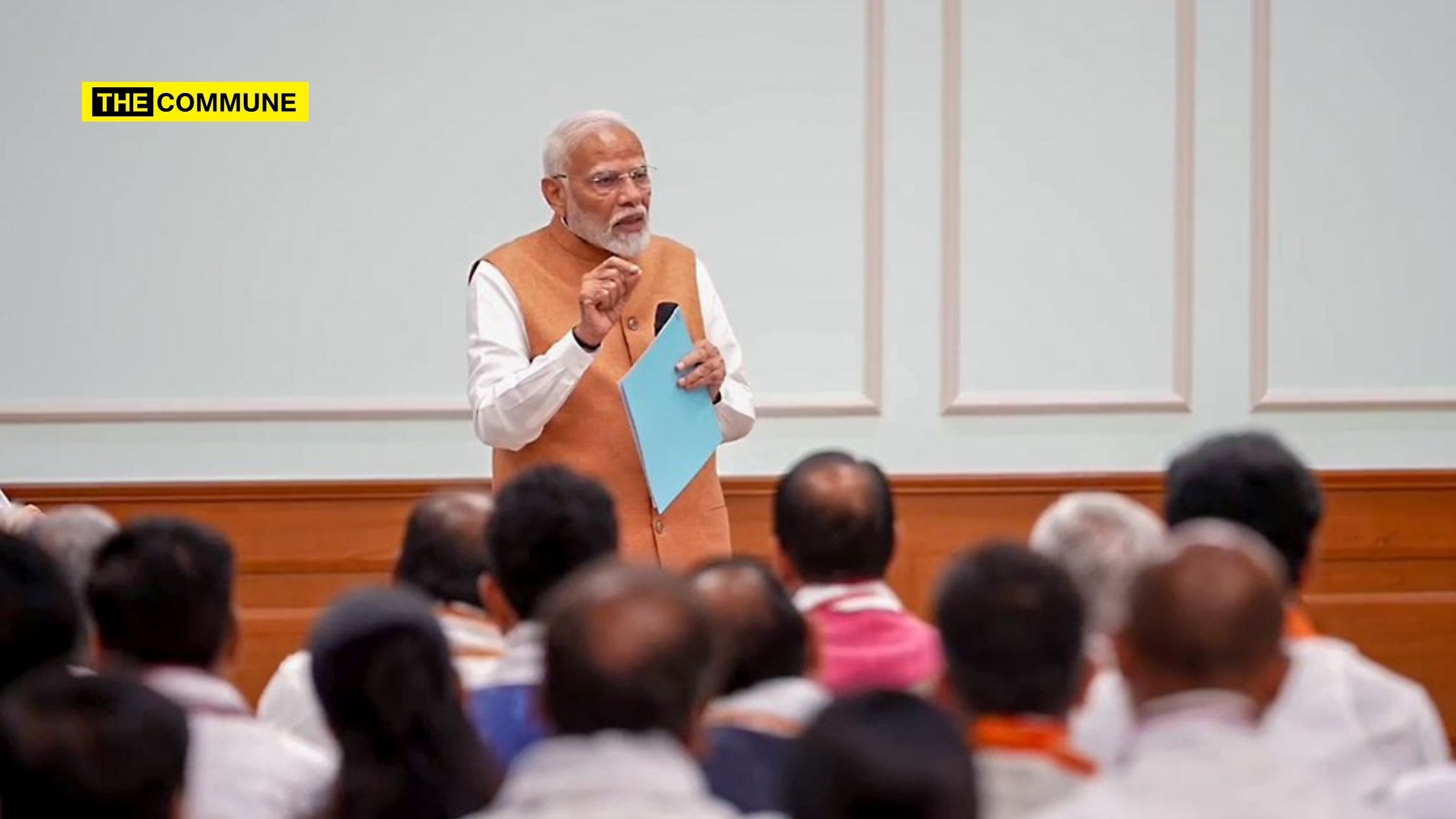
Prime Minister Narendra Modi, chairing a marathon meeting with his ministers to review his government’s functioning, pressed them to work without rest and gave them a new four-point mantra of “Perform, Reform, Transform, Inform.”
According to sources, the meeting at the Sushma Swaraj Bhavan on Wednesday (28 August 2024) lasted more than five hours. In an address to his colleagues, PM Modi dwelled upon the government’s functioning, its achievements, their propagation and publicity, welfare measures, and other key issues, which lasted around 40 minutes.
PM Modi also asked the ministers to connect with people through social media platforms to communicate that the government works responsibly. He also asked for people’s responses to be expedited on social media so that his government is seen as responsive.
Sources said the ministers have been asked to provide information about ten major decisions of their respective Ministries on the completion of 100 days of the Modi 3.0 government and propagate them on a mass level.
PM Modi also specifically asked for faster and better communication of his government’s decisions. He specifically spoke to the new ministers who had been inducted into his cabinet for the first time.
According to sources, the meeting discussed in detail the Budget announcements made by Union Finance Minister Nirmala Sitharaman in the Parliament. It was also decided that the welfare schemes launched by the PM Modi-led Union government that have completed 10 years will be celebrated on September 5.
According to sources, in the meeting, Cabinet Secretary Rajiv Gauba also presented 73 major and important decisions taken in the first 85 days of the third term of the PM Modi-led government at the Centre.
In addition, two more presentations were shown in the meeting regarding improvements in the country’s health, education, and infrastructure sectors.
After the meeting, PM Modi also told the Ministers in a light vein that this was just a small dose and that he expected them to get used to his nonstop working methods.
This story is based on an IANS-syndicated feed.
Subscribe to our Telegram, WhatsApp, and Instagram channels and instantly get the day’s best stories.
The Enforcement Directorate (ED) has imposed a hefty fine of ₹908 crore on Arakkonam DMK MP S. Jagathrakshakan and his family members for breaching the Foreign Exchange Management Act (FEMA). This substantial penalty comes as part of an ongoing investigation that also led to the seizure of various movable and immovable assets, amounting to ₹89.19 crore, held in the names of Jagathrakshakan and his relatives.
The ED announced on 28 August 2024 that after a thorough review of the violations and the responses provided by the involved parties, it was determined that the infractions were well-substantiated. Consequently, Jagathrakshakan and his family were penalized for each identified violation.
ED via its official X account stated, “The properties worth Rs. 89.19 Crore which was seized in terms of Section 37A of FEMA was also ordered for confiscation, and penalty of Rs.908 Crore (approx.) is levied vide Adjudication Order passed on 26/08/2024.”
The properties worth Rs. 89.19 Crore which was seized in terms of Section 37A of FEMA was also ordered for confiscation, and penalty of Rs.908 Crore (approx.) is levied vide Adjudication Order passed on 26/08/2024.
The case against Jagathrakshakan, his family, and an associated company began in 2021, focusing on breaches related to foreign exchange regulations. The allegations include an investment of ₹42 crore into a Singapore-based shell company in 2017, the acquisition and transfer of Singaporean shares among family members, and an additional investment of ₹9 crore into a Sri Lankan entity. Despite receiving show cause notices and the opportunity for a personal hearing, which their legal counsel represented, the Madras High Court dismissed their writ petitions in July 2024.
Who Is Jagathrakshakan?
S. Jagathrakshakan, an Indian businessman and politician serving as the current member of the Lok Sabha representing the Arakkonam constituency in Tamil Nadu, a position he has held three times since 1999. Jagathrakshakan was also the Minister of State for Commerce and Industry from November 2012 to March 2013. In addition to his political career, he is the chairman of Shree Balaji Medical College and Hospital and owns Dr. Rela Hospital and Institute. He has authored 30 books, including one that Mother Teresa released.
Jagathrakshakan’s political career includes a tenure in the Tamil Nadu state assembly in 1980 and election to the Lok Sabha in 1984 with the Anna Dravida Munnetra Kazhagam (ADMK) party. He also led the ADMK parliamentary party from 1985 to 1989. He won the Arakkonam Lok Sabha seat in the 1999 and 2009 elections under the Dravida Munnetra Kazhagam (DMK) party. In 2004, he founded the Veera Vanniyar Peravai, a caste-based party renamed Jananayaga Munnetra Kazhagam and merged with the DMK in 2009.
Accusations Against DMK MP Jagathrakshakan
Jagathrakshakan has faced several controversies, including allegations related to the Coal Scam in March 2012, where he was accused of leveraging his political influence for illegal coal allocations in 2007. His asset value reportedly soared from ₹5.9 crore in 2009 to ₹78 crore in 2014, marking the highest percentage increase in assets among central cabinet ministers. Additionally, a sting operation in June 2009 revealed that one of his medical colleges was charging ₹20 lakh for MBBS admission. Recently, a short video clip of a boy went viral confirming the allegation wherein he revealed that he paid ₹25 lakhs to secure a seat for pursuing an MBBS degree in DMK MP Jagathrakshakan-owned medical college. He also added that entire course expenses at the medical college owned by DMK leader would tally up to ₹1.5 crores, which economically poor students cannot afford.
Further reports suggest that Jagathrakshakan may have misused his authority during his tenure as an MLA, MP, and minister. His influence reportedly extends to the supply of liquor to TASMAC, with 85-90% of the liquor supplied coming from his distilleries irrespective of whether the DMK or AIADMK is in power. His empire also encompasses hospitals such as Anusha Hospital, Shri Royal Blue Hospital, Jagath Super Speciality Hospital, and JR Super Speciality Hospital, pharmaceutical manufacturing firms for cancer drugs, cement factories, a sugar mill, and even a rumoured (in the works) private airline venture.
Current ED Focus – Silver Park International Pte. Ltd
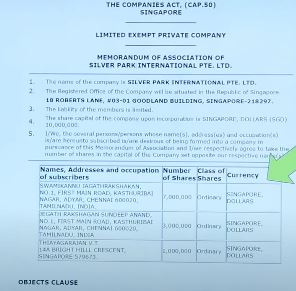
Investigations revealed that on 15 June 2017, Jagathrakshakan and his son Sundeep Aanand had subscribed to 70,00,000 shares and 30,00,000 shares respectively (valued at Singapore $ 1/- per share) of Silver Park International Pte. Ltd., Singapore, without obtaining the approval of the Reserve Bank of India. The company is registered in Singapore as a limited exempt private limited company under the Companies Act. The memorandum of association is provided below.
A sting operation revealed that funds flowing to Silver Park International were linked to the coal scam exposed in 2012. The scam reportedly began in 2007 with creating and allocating power projects to JR Power Generations, a company allegedly founded by Jagathrakshakan, which had no prior experience. Another company, KSK Energy Ventures, based in Mauritius, acquired 51% of shares, mirroring Jagathrakshakan’s JR Power, again creating Accord Generation Corporation, which obtained a license but did not execute the project. According to the sting operators, creating and selling companies with licenses is more profitable for politicians than receiving bribes for the licenses themselves. In 2016, 99.86% of the funds were sold to KSK Energy Ventures. This transaction highlights a contemporary method of bribery employed by DMK politicians.
They conclude that black money parked in Mauritius is systematically brought back and converted into legitimate funds through companies acquiring shares, all in plain sight, they allege.
Jagathrakshakan and his family have various business interests, including oil refineries, educational institutions, and Elite Distilleries Pvt Ltd. The DMK MP, who controls the Singapore company Silver Park International Pvt Ltd, along with the Oman Oil Ministry, owned by India’s Accord Group, had agreed to build a $3.9 billion, 200,000 barrel per day oil refinery next to the Chinese-controlled Hambantota port.
Three of the four directors in Silver Park International, which is registered with Singapore’s national regulator Accounting and Corporate Regulatory Authority (ACRA), are Jagathrakshakan Sundeep Anand (son), Jagathrakshakan Sri Nisha (daughter) and Jagathrakshakan Anusuya (wife). The investigation into his mega oil refinery deal has also revealed that he has embarrassed the Sri Lankan government when reports emerged that Oman’s Oil Ministry denied being part of a $3.9 billion plan.
Jagathrakshakan’s Empire
Jagathrakshakan’s vast portfolio includes over 50 educational institutions including Bharath University, Jagath University, Bharath Medical College, Balaji Medical College, Tagore Medical College, and numerous others, over 6 star hotels such as Accord Hotel and Kaldan Samudhra – a Rajasthan-themed luxury hotel in ECR, coal mines, power generation stations, distilleries such as Elite Distilleries, Fortune Distilleries, and AM Breweries, and a myriad of other businesses. Three of these medical colleges constituted 950 medical seats. All these educational institutions allow him a chance to connect with politicians, industrialists, and people in power. Here is a list of some of the properties and businesses Jagatrakshakan and his family own:
Universities
Bharath University – built on an area spanning 350 acres in Chennai
Jagath University – Dehradun
Medical Colleges
Bharath Medical College and Hospital (BMCH), Chennai
Sree Balaji College of Nursing, Chennai
Sree Balaji Medical College and Hospital (SBMCH), Chennai
Sree Balaji College of Physiotherapy
Sri Lakshmi Narayana Institute of Medical Sciences (SLIMS), Puducherry
Tagore Medical College, Chennai
Bharat Dental College, Chennai
Tagore Dental College, Chennai
Engineering Colleges
Bharath Institute of Science and Technology, Chennai
Balaji Institute of Engineering and Technology, Chennai
Tagore Engineering College, Chennai
Jerusalem Engineering College, Chennai
Lakshmi Ammal Engineering College, Chennai
Sri Ramanujar Engineering College, Chennai
Bharath Institute of Law, Chennai
Bharath Agriculture College, Chennai
Bharath School of Architecture, Chennai
Bharath School of Arts and Science, Chennai
Tagore College Of Arts And Science, Chennai
Balaji Women’s Arts and Science College, Chennai
Bharath Institute of Management, Chennai
Bharath Polytechnic College, Chennai
Sri Balaji Polytechnic College, Chennai
Lakshmi Ammal Polytechnic College, Chennai
Bharath Institute of Catering Technology & Hotel Management, Chennai
Sree Balaji College Of Hotel Management & Catering, Chennai
Bharath College of Nursing, Chennai
Sree Balaji College of Nursing, Chennai
Tagore Nursing College, Chennai
Bharath School of Physiotherapy, Chennai
Sree Balaji College of Physiotherapy, Chennai
Tagore College of Physiotherapy
Balaji College of Pharmacy, Chennai
Tagore College Of Pharmacy, Chennai
Bharath Institute of Education
Balaji College of Education, Chennai
Balaji Teacher Training Institute
Kilton Teacher Training Institute, Chennai
Lakshmi Ammal Memorial Matriculation HSS, Chennai
Kilton Matriculation HSS, Chennai
Bharath Vidyaashram, Chennai (CBSE)
Bharath Vidyaashram, Puducherry (CBSE)
Madras Vocational Training Institute, Chennai
Tagore Institute of Allied Health Sciences
Bharath College of Allied Health Sciences
Five-Star Hotels
The Accord Metropolitan, Chennai
The Accord Metropolitan Ltd, Puducherry
Accord Highlands, Ooty
J Hotels Pvt Ltd, Chennai
J Hotels Pvt Ltd, Puducherry
JAM Hotels & Resorts, Bengaluru
Kalden Samudra – Resort in ECR
Breweries/Distilleries
Elite Distilleries, Chennai
AM Breweries, Chennai
Fortune Distilleries, Goa
Coal Companies
JR Coal Mines, Madhya Pradesh
JR Coal Mines, Odisha
Power Generation Companies
JR Power Gen Pvt Ltd, Madhya Pradesh
JR Power Gen Pvt Ltd, Odisha
Accord Energy Corporation India Pvt Ltd
KSK Companies – Mines & Electricity
Investments Abroad
Oil company worth 23000 crores in Sri Lanka
Silver Park International Pvt Ltd, an investment vehicle owned by Accord Group
It is alleged that in the Chromepet area of Chennai, 100 acres of land where a company named Chrome used to function is said to have been bought by Jagathrakshakan, where most of the colleges have been built. He is also said to own 56 houses/properties in Chennai.
ஜெகத்ரட்சகன் சொத்துக்களை பார்த்து மிரண்ட அதிகாரிகள்.. அந்த லிஸ்ட்ட படிக்கிறதுக்கே சாட்டை டயர்ட் ஆய்ட்டான் .. இந்த திருட்டு திராவிட கும்பல் தான் எதுக்கெடுத்தாலும் அம்பானி, அதானினு தூக்கிட்டு வர்றவனுங்க…#திருட்டு_திமுக#திருட்டு_திராவிடம்pic.twitter.com/p4wmaw0gd0
— Johny Bhai(அண்ணாமலையின் வார் ரூம்)🇮🇳 (@Johni_raja) October 9, 2023
The first part of the DMK Files released by the Tamil Nadu BJP President K. Annamalai detailed the assets owned by DMK MP S. Jagathrakshakan including JR Super Speciality Hospital (₹444.79 cr), Grand Accord Pvt ltd (₹4.06 cr), Accord Energy Corporation (₹343.02 cr), JAM hotel and resorts (₹66.81 cr), Sri Lakshmi Ammal Educational Trust (₹1239.80 cr) and others.
This is not the first time Jagathrakshakan‘s name figured is a scam. Under the UPA regime, his name was prominent in the Coal scam that shook the then-Manmohan Singh Government. He is also believed to be a significant funding source for DMK’s election campaigns. In the 2019 Indian general election, he was re-elected to the Lok Sabha from the Arakkonam constituency as a member of the DMK and is currently continuing as an MP.
Subscribe to our Telegram, WhatsApp, and Instagram channels and instantly get the day’s best stories.
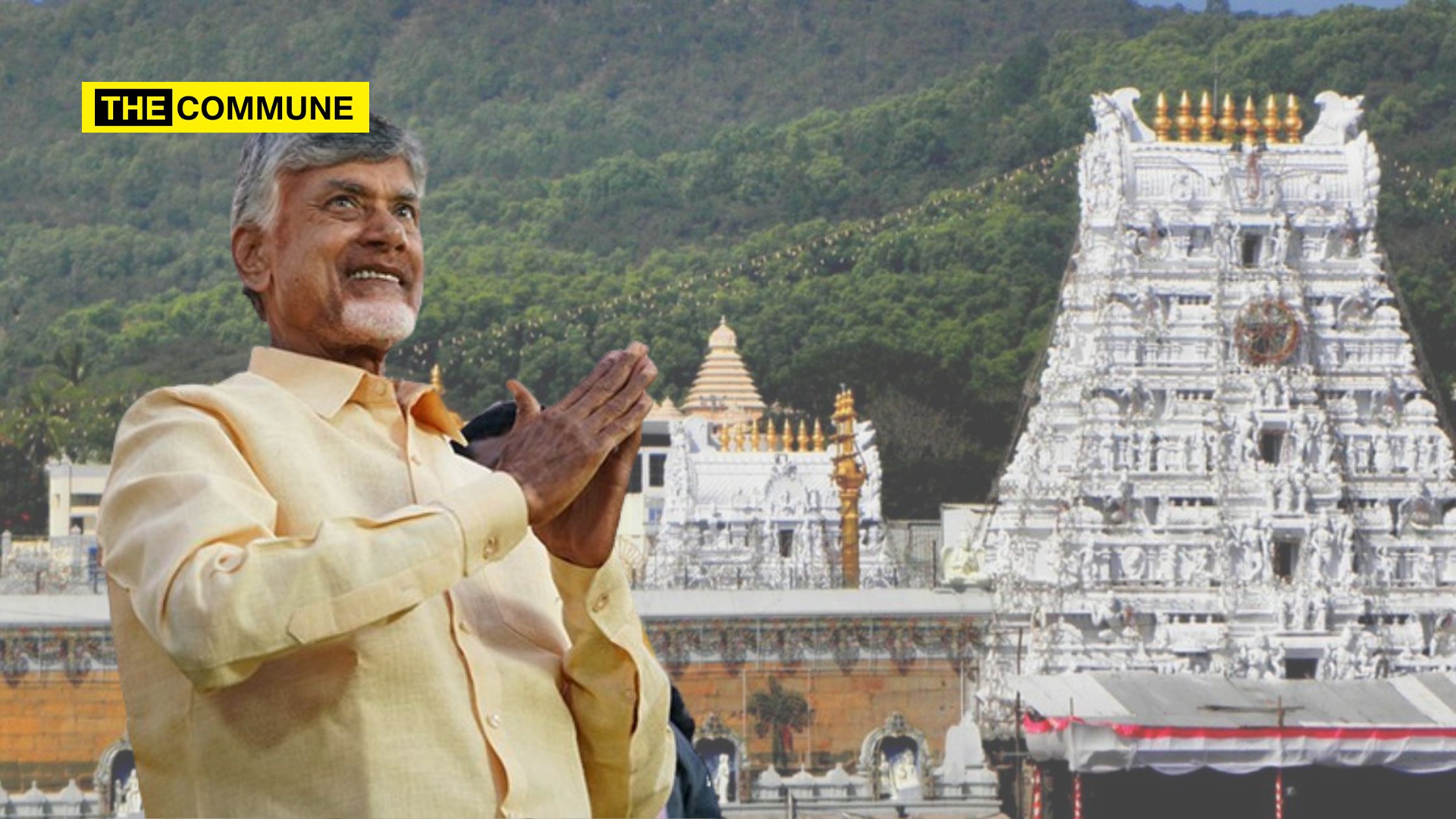
Andhra Pradesh Chief Minister Nara Chandrababu Naidu has launched a bold initiative to protect Hindu jobs within temples, ensuring that temple positions are reserved exclusively for those of the Sanatana faith. At a key meeting with the Hindu Religious Endowment Department, he emphasized this move as part of a broader strategy to prevent forced conversions and preserve the spiritual integrity of Andhra’s sacred Hindu sites.
Key Meeting To Boost Religious Meeting
CM Naidu, during a key meeting with officials from the Hindu Religious Endowment Department, laid out an extensive plan to revitalize temple management, promote religious tourism, and ensure spiritual and cultural integrity across Andhra Pradesh. The meeting, held at the Secretariat in Amaravati, underscored the importance of maintaining the sanctity of temples while introducing measures to enhance the overall experience for devotees.
Spirituality And Cleanliness At Forefront
Addressing the officials, Chief Minister Naidu emphasized the need for spirituality to flourish in every temple across the state. He insisted that temples and their surroundings be impeccably clean, ensuring the spiritual atmosphere remains intact. “Spiritual programmes should be conducted in such a way that devotees who visit the temple are inspired to return, without being extorted for money,” Naidu stated, highlighting the importance of creating a welcoming and serene environment for worshippers.
Temple Tourism
Recognizing the potential of temple tourism, especially in a state rich with religious heritage, Naidu announced the formation of a committee comprising officials from the Tourism Department, Hindu Charities Department, and Forest Department. This committee will oversee the development of temples, particularly those located in forested areas, ensuring that the natural beauty and spiritual significance of these sites are preserved while making them accessible to more visitors.
Strengthening Temple Trusts & Priests’ Welfare
In a significant move, the Chief Minister announced an increase in the number of trustees on the boards of temples that generate more than ₹20 crore annually, raising the number from 15 to 17 members. These additional members will include a Brahmin and a Nai Brahmin, ensuring a more inclusive representation within the temple management.
Naidu also addressed the financial welfare of priests and temple staff. He announced a wage increase for archakas from ₹10,000 to ₹15,000 per month, benefiting 1,683 priests across the state. Additionally, the monthly allocation for Dhoopa Deepa Naivedyam (ritual offerings) in smaller temples will be doubled from ₹5,000 to ₹10,000. This measure is expected to improve the quality of offerings and enhance the spiritual experience for devotees.
The government will provide a monthly incentive of ₹3,000 for Vedic scholars facing financial difficulties, and the minimum wage for Nai Brahmins (barbers, musicians) will be set at ₹25,000. These steps reflect the Chief Minister’s commitment to preserving and promoting traditional Hindu practices and supporting those who uphold them.
Combating Forced Conversions & Protecting Jobs In Temples
During the meeting, Naidu strongly condemned the incidents of attacks on Hindu temples during the previous Y.S. Jagan Mohan Reddy administration, including the burning of a temple chariot.
CM Naidu called for strict action against those responsible for such crimes and emphasized that forced religious conversions would not be tolerated in Andhra Pradesh. Jobs in Hindu temples will not be offered to people from other faiths.
“Forced conversion should not happen in Andhra Pradesh. Hindu temples do not offer jobs to people of other faiths,” he asserted, underlining the need to protect the religious identity of the state’s temples.
Naidu also announced that 87,000 acres of temple land currently occupied illegally would be reclaimed through legal action. “A visible change should be effected on temple premises to win the confidence of devotees,” he added, stressing the importance of restoring and safeguarding temple properties.
Naidu also proposed melting down silver offerings made to temples and converting them into coins bearing the images of the temple’s presiding deities. These coins would then be sold to devotees, providing them with a unique memento of their visit while generating additional revenue for the temples.
The Chief Minister also emphasized the need to develop online systems for temple services, making it easier for devotees to book pujas and other rituals. He suggested improving accommodations near temples, potentially in partnership with private hoteliers, to encourage devotees to stay longer.
Furthermore, Naidu ordered an inquiry into any irregularities in temple management during the past five years, ensuring transparency and accountability in the administration of temple affairs.
It is noteworthy that upon being sworn in as the Chief Minister of Andhra Pradesh, Naidu first visited the Tirumala Tirupati temple and vowed to free TTD of corruption. He also criticised the previous YSRCP government, led by Jagan Mohan Reddy by accusing them of commercializing the Tirumala Tirupati Devasthanam (TTD) and mismanaging its affairs.
Naidu highlighted concerns about the quality and pricing of religious offerings, stressing the need to prevent black market activities around ticket sales for temple visits. He pledged to address these issues, emphasizing the importance of maintaining the sanctity of the shrine. Expressing dismay at the alleged transformation of the temple into a hub for undesirable activities, Naidu vowed to initiate corrective measures starting from the Tirupati Temple.
Subscribe to our Telegram, WhatsApp, and Instagram channels and instantly get the day’s best stories.
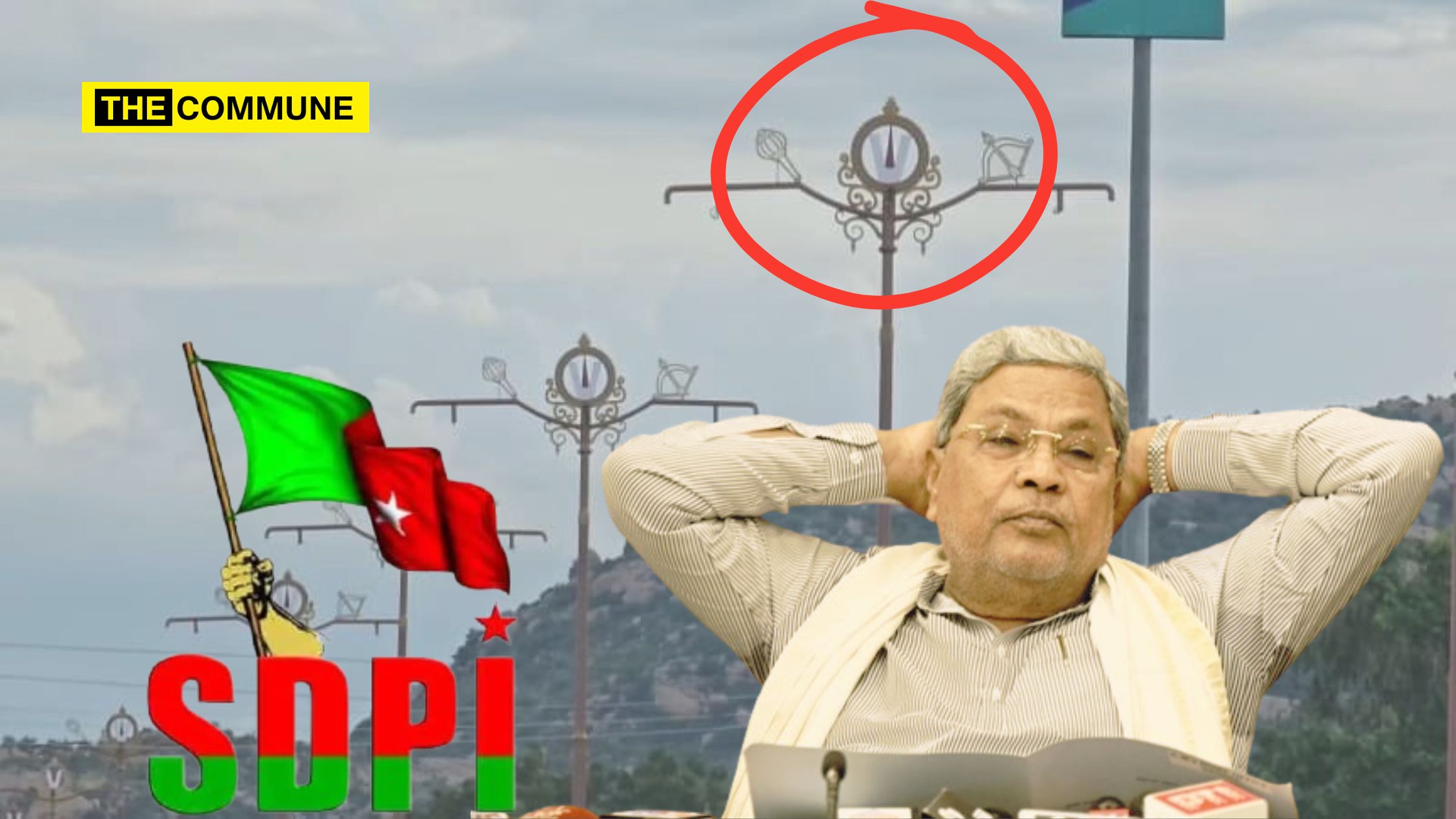
In a move that has sparked widespread dissension, the Congress-led Karnataka government has ordered the removal of bow and arrow symbols from newly installed streetlight poles in Gangavathi, Koppal district. The decision came after the local unit of the Social Democratic Party of India (SDPI) raised objections, claiming that the symbols, installed as part of a town beautification project, were ‘non-secular’ and ‘posed a threat’ to communal harmony.
Muslim leaders under the SDPI protested against the installation of electric poles in the shape of bows and arrows on the roads of Kishkende, Gangavati city, the birthplace of Anjaneya Swami, the god worshiped by millions of Hindus & they demanded to remove such symbols. pic.twitter.com/KUxXnCPJg5
The streetlights, designed by Karnataka Rural Infrastructure Development Limited (KRIDL), were installed in July 2024 between Nagar Cross and CBS Circle in Gangavathi, a region of significant cultural and religious importance, revered as the birthplace of Lord Hanuman. The poles featured symbols such as a mace, abow, and the name of Tirupati Thimmappa, a revered Hindu deity, reflecting the area’s deep spiritual heritage. These designs were similar to streetlamps installed in Ayodhya and Tirumala; areas known for their religious significance.
However, the local SDPI unit, led by President Mohammad Ali, filed a complaint with the Gangavathi municipality in August, arguing that the symbols were a “provocation” that could disrupt the town’s social harmony. They demanded the immediate removal of the poles, asserting that the designs were an unnecessary religious display in a public space.
Bowing down to the SDPI’s demand, the Karnataka Congress government issued a directive to remove the symbols through the Tehsildar’s office in Gangavathi. The decision was based on a verbal order from the District Collector of Koppal, who instructed that the poles be cleared to prevent any disturbance to public peace. The order stated that the symbols were installed in a manner that could potentially offend religious sentiments and disturb communal harmony in the city.
Congress govt. in Karnataka surrendered to SDPI and Muslim leaders?.
The Congress govt. ordered the removal of the bow and arrow symbols installed on the electronic pole on Gangavati in Anjaneya's birthplace, Kishkinde Hampi.
Tehsildar’s office also requested that the Karnataka Rural Infrastructure Development Corporation (KRIDL) submit a compliance report and take appropriate action against those responsible for the installation. Copies of the order were sent to various officials, including the Collector of Koppal, the Sub-Divisional Officer of Police in Gangavathi, and the Municipal Commissioner of Gangavathi, for further action.
The decision to remove the symbols has been met with strong opposition from Hindus as well as local Hindu organizations, who argue that the streetlamps were a celebration of the town’s cultural and religious heritage. Critics of the SDPI’s objection have accused the party of using communal harmony as a pretext to erase symbols that are part of the local community’s identity. They argue that the installation of religious symbols in public spaces is a common practice across India and reflects the country’s diverse spiritual landscape.
Speaking to The Organiser, Basavarajappa of the Bajrang Dal defended the installation of the streetlights, pointing out that similar designs in Ayodhya have not led to communal tensions. He criticized the SDPI’s demands as an attempt to suppress Hindu cultural expressions, citing the daily Muslim call to prayer (Azan) as an example of religious practices that the Hindu community tolerates without complaint.
Critics argue that the Congress government’s decision to oblige the SDPI’s demands undermines the secular fabric of the nation and sets a concerning precedent for the future.
Subscribe to ourTelegram, WhatsApp, and Instagram channels and get the best stories of the day delivered to you personally.