Home Blog Page 83

How Ultra-Woke Leftist Self-Styled Feminist Chinmayi Sripada Whitewashed The TCS Nashik Muslim Gang Grooming Case
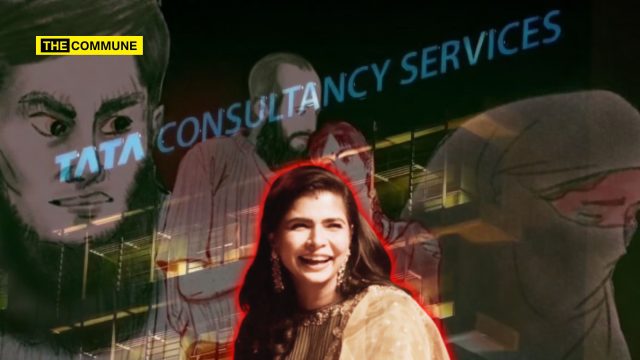
There is a version of feminism that shows up on time, speaks loudly, and names names. Then there is the version that checks who the accused are before deciding how much noise to make. And then there is the version of Chinmayi Sripada.

Chinmayi Sripada is a women who built significant ‘public credibility’ by portraying her as a victim of sexual harassment and and outraging on women’s rights issues. But it is important to check the identities of the perpetrator and victim so that her highness can somehow gaslight Hindus.

When netizens called her out for not speaking about the TCS Nashik Muslim Gang Grooming Case where Hindu women were targeted, subjected to repeated sexual harassment, molestation, mental abuse, and blatant religious persecution, she could’ve stayed silent. But what she did was far worse – deflect.

Woke Whataboutery

Chinmayi Sripada wrote her own words. But read them carefully and you will find that the entire piece is a lesson in deflection. She spent more words talking about Asaram Bapu’s parole and Ram Rahim’s treatment than she did about the eight women in Nashik who were allegedly coerced, harassed, and converted. She questioned whether people had completed their POSH workshops. She reminded us that men face harassment too.
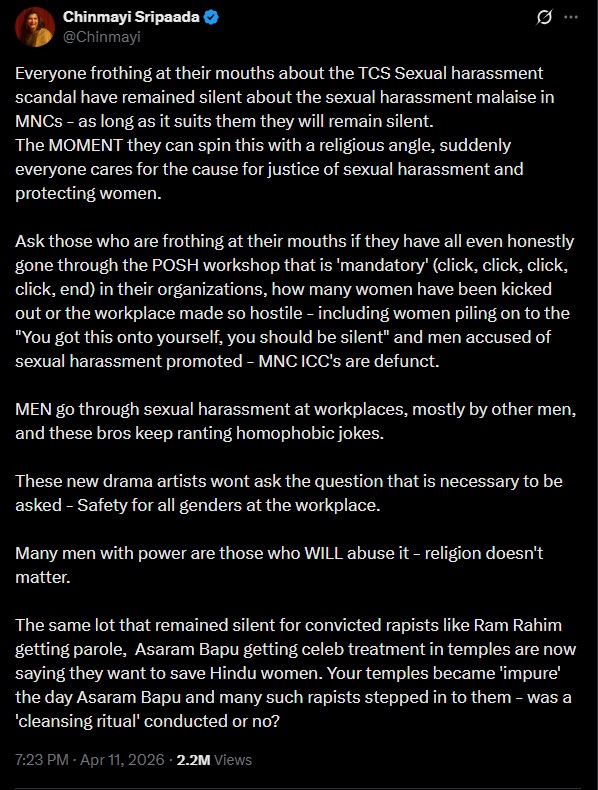
All of these are legitimate points but in a different article, on a different day.

When directly asked why she wasn’t naming the perpetrators, she pivoted to Asaram Bapu. That is not activism. That is not advocacy. That is a woman with a large platform using her words to bury a story under a pile of whataboutery.

Her core argument, that people only care about sexual harassment when there is a religious angle, would be worth engaging with if she had not herself used that exact argument to avoid engaging with the religious angle in this specific case. The perpetrators here are not Hindu. The accused HR manager is a woman. The institutional failure is real. And instead of a sharp, targeted call for accountability, we got a philosophy lecture.

And guess what, a few moments later, she reshares a post about another case from Nashik.
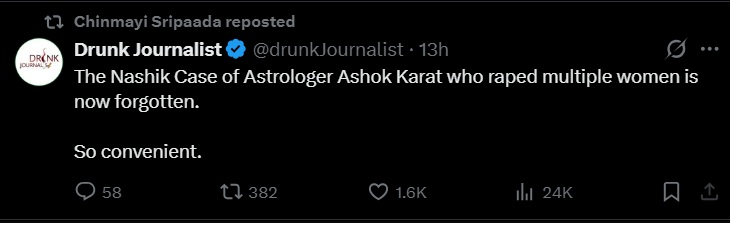
Not once did she mention till date about the perpetrators of the IT firm harassment case.

The Test Is Simple

Here is the test that exposes selective feminism every single time: does your outrage follow the victim, or does it follow the perpetrator’s identity?

When a Hindu rapes and more so if the person is an alleged godman, the like of Chinmayi and Faye go bonkers. Chinmayi tweets threads. When a convicted rapist gets parole, they’re are loud, correct, and present. That is not being questioned here. The question is: where is that same energy when the accused are not Hindu, what happens when they are Muslims? When the religious angle cuts the other way, the posts become sanitized. The language becomes “systemic.” The attention shifts to POSH policies and workplace culture in MNCs writ large.

The Nashik victims did not get a systemic failure. They got specific men and at least one woman who allegedly harassed them, coerced them, and weaponised religion against them. They deserve specific outrage. They got generalized sociology.

And Then There Is Monalisa Bhonsle

A teenager taken across state lines. Her family saying they cannot reach her. A POCSO case filed. A court-protected accused. The likes of Faye D’Souza and Chinmayi Sripada who have loudly championed child safety and women’s protection have said nothing publicly about Monalisa Bhonsle. Nothing. The case does not fit a convenient narrative, so the child does not exist in their timelines. Why? The man in question is Mohammad Farmaan Khan. Had it been a Hindu name, they would have gotten their BP levels hit the peak.

The Point

Nobody is asking them to be anti-Muslim. Nobody is asking them to frame every crime through a communal lens. What women across this country deserve is the simple, non-negotiable assurance that their suffering will be acknowledged with equal urgency, regardless of who hurt them.

If your feminism comes with a religious eligibility clause for the accused, it is not feminism. It is just the ‘blood for me, tomato chutney for you’ logic – politics with better branding.

Subscribe to our channels on WhatsAppTelegram, Instagram and YouTube to get the best stories of the day delivered to you personally.
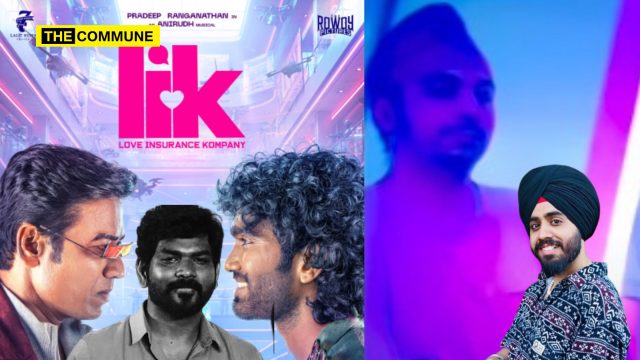
Vignesh Shivan’s Latest Flop Film LiK Gets Called Out For Scene Humiliating Sacred Turban Of Sikhs

A viral video by Amanjot, a Sikh-Punjabi Instagram influencer known for his Tamil-language content, has sparked fresh conversation around a scene in the recently released Tamil film directed by Nayanthara’s husband Vignesh Shivan – LIK, in which a Singh character’s turban is pulled off during a confrontation sequence, played for laughs in theatres.

The film also features Pradeep Ranganathan who acted in the film Dude which glorified adultery and deranged moral decay.

What the Scene Shows

In the second half of LIK, antagonist SJ Suryah’s character gets into an argument with a staff member. The staff member is portrayed as a Singh character. During the altercation, the character is shoved, falls to the ground, and his turban is pulled off, his hair exposed, before he scrambles to cover himself again. Amanjot says that when this scene played in the theatre, the audience laughed. He and his cousins did not.

“Flat. We watched it and thought – what is this? Why was this done? What is the relevance?” Amanjot said in his video, posted on Instagram. “To show SJ Suryah as powerful? As a villain? They could have hit any other character. Or if they wanted the Singh character, they could have hit him on the face, on the shoulder. Why did they have to touch the turban?”

Why the Turban Is Not a Prop

Amanjot then played a clip from a Punjabi film showing a foreigner being confronted aggressively after touching a Sikh man’s turban to illustrate the gravity of what LIK’s scene had casually dismissed as comedy material.

“You must not touch a Punjabi’s head. That’s the simple take. No matter the place, no matter who the employer is, this is sentiment. This is our identity, our faith, our beliefs as a Punjabi, as a Sardar,” he said.

The dastar, the Sikh turban, is not merely an accessory. It is a deeply sacred article of faith, representing honour, self-respect, and spiritual commitment. Having it forcibly removed is considered one of the gravest humiliations a Sikh person can experience.

“We Are in 2026, Not The 90s”

What makes Amanjot’s critique particularly pointed is his reference to the long history of Sardar stereotyping in Indian cinema and the slow, hard-won progress made in moving away from it.

“We were slowly moving away from those stereotypes, the ‘Balle Balle’, ‘Ae Shawa Shawa’, those typical portrayals. But now they are doing this again, just for the sake of laughter. It’s not funny, brother. It’s not funny,” he said.

His frustration is directed not just at the director, but at the broader filmmaking system. “If you don’t know anything about a community, first learn about them. Then create the scene,” he said, adding a direct appeal: “This is my humble request to all directors and casting directors, if you are casting a Singh character in any Tamil, Hindi, or Malayalam film, please do not cross the line of their beliefs and faith”.

Subscribe to our channels on WhatsAppTelegram, Instagram and YouTube to get the best stories of the day delivered to you personally.
Rajdeep Sardesai Peddles DMK Cadres’ Opinion On 3-Language Policy As Vox Pop, Video Shot Inside DMK Party Office

Rajdeep Sardesai's 3-Language Policy Survey Reportedly Featured DMK Member?

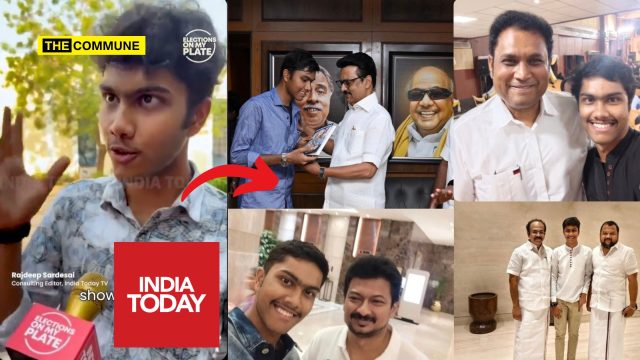
A video segment published by India Today on 12 April 2026, just days before Tamil Nadu goes to polls on April 23, shows India Today journalist Rajdeep Sardesai interviewing young people in Chennai about the three-language policy and Hindi imposition. The clip was presented as a candid “ground interaction” capturing the organic views of Tamil Nadu’s youth.

But questions are now being raised about where exactly it was filmed and who those “ordinary youth” actually are.

Filmed Inside Arivalayam – DMK’s Own Headquarters?

Multiple observers who viewed the video have pointed out that the background and premises visible in the footage match the compound of Anna Arivalayam – the official headquarters of the ruling DMK party in Chennai. Arivalayam is not a public space. It is the party office of the ruling establishment, where CM M.K. Stalin conducts party business and where high-profile political inductions have taken place.

If the interview was indeed conducted inside or within the compound of the DMK headquarters, it was not a random street survey. It was a curated interaction on partisan turf, presented to a national audience as if it were spontaneous public opinion.

The “Youth” Has Been Spotted With DMK Leaders

Adding to the concern, one of the young men featured in the video has reportedly been identified in photographs with DMK functionaries and leaders. None of this was disclosed in the video or its caption.

India Today’s post described it simply as Sardesai interacting with “youth in Tamil Nadu to understand their views on learning Hindi”. No mention of party affiliation, no disclosure of location, no acknowledgment of who arranged the interaction.

This is a significant editorial omission. A journalist conducting a survey of public opinion on a politically sensitive issue — nine days before a state election — has a basic obligation to disclose if the respondents are party workers or if the venue is a party office.

The Timing Is Not Incidental

The three-language policy and Hindi imposition are among the most emotionally charged electoral issues in Tamil Nadu. With voting scheduled for April 23, the DMK has strong political incentive to amplify anti-Hindi sentiment – a vote consolidation tool the party has used for decades. An India Today segment, broadcast nationally, showing Chennai youth uniformly and articulately opposing Hindi functions as free, credible-looking campaign content at the most critical moment of the election cycle.

In a state of 80 million people with diverse views on language policy, the statistical probability of interviewing seven people who hold near-identical opinions is low, unless the sample was not random at all.

That doesn’t mean the views expressed are wrong, it means that India Today is only showing one side of the opinions. The problem is not the message – it is the manufacturing of the messenger. Presenting DMK-affiliated youth inside a party office as “Chennai’s youth” to a national audience, nine days before an election, without a single line of disclosure, is not journalism. It is political communication with a press badge attached.

Subscribe to our channels on WhatsAppTelegram, Instagram and YouTube to get the best stories of the day delivered to you personally.
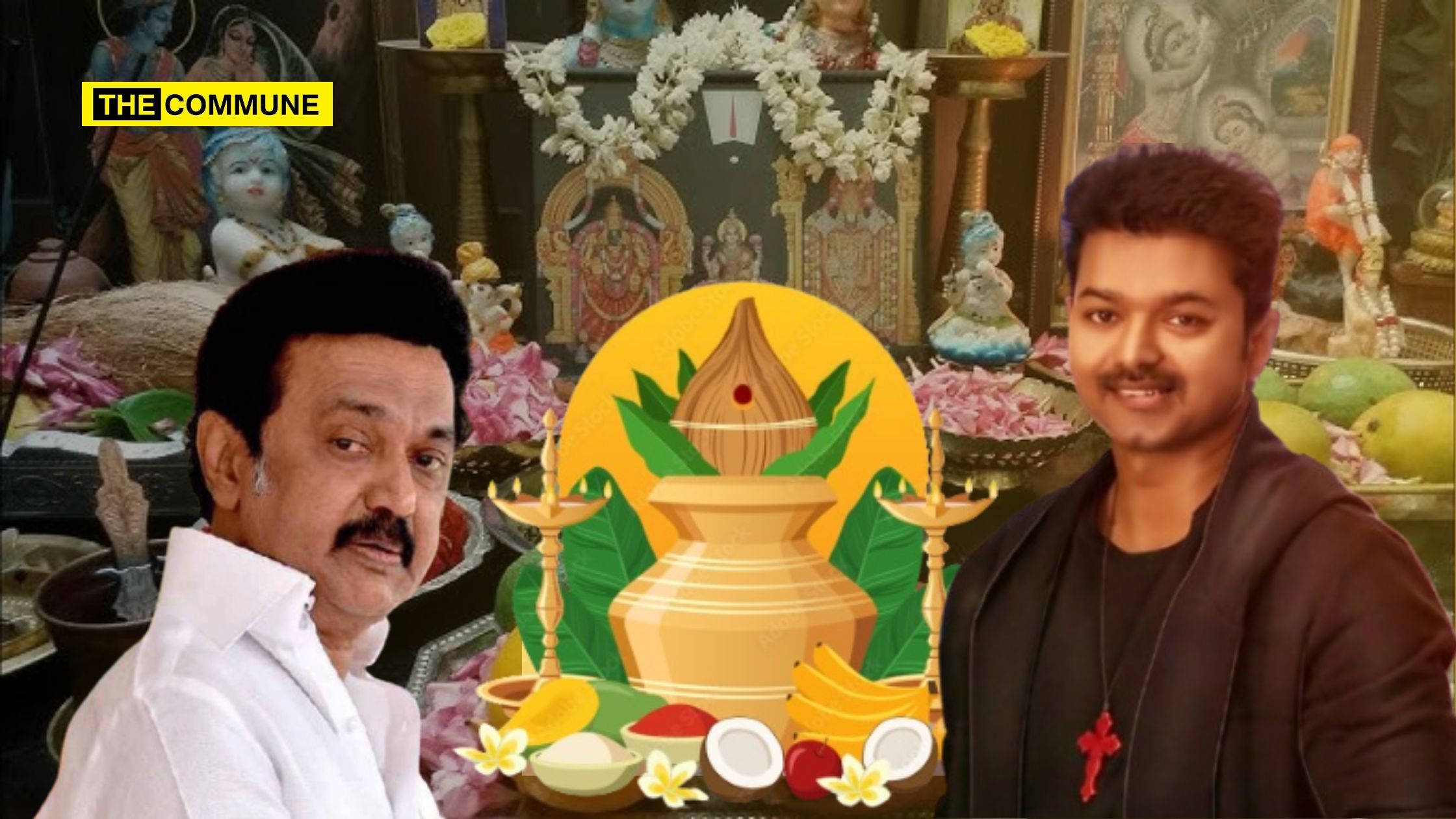
Christutva Politics: Joseph Vijay Goes The DMK Way, Doesn’t Wish For Tamil New Year

Tamil Puthaandu Is On Chithirai 1 And Not Thai 1, Dravidoids' Attempt To Christianize The Festival Must Be Rejected Lock, Stock & Barrel

Today is Tamil New Year – Puthandu. Across Tamil Nadu, millions of families welcomed the new year with prayer and tradition. From the Prime Minister to local elected representatives, wishes poured in from all corners. But two names were conspicuously absent from the Puthandu greeting list – DMK and Tamilaga Vettri Kazhagam (TVK) chief Joseph Vijay.

It is not a coincidence. It is a pattern.

The DMK Template

The DMK under MK Stalin has a well-established practice of not wishing on April 14 Tamil New Year, anchored in the Dravidian ideological position that the “real” Tamil New Year is Thai Pongal in January, not Chithirai Puthandu in April. Accordingly, DMK cadres and leaders flood social media on January 14 with Tamil New Year wishes, while April 14, observed by millions of Tamils as Varusha Pirappu, passes without official acknowledgment.

DMK chief Stalin had wished for Telugu/Kannada New Year – Ugadi on 19 March 2026.

The irony is thick: the same party that champions Tamil pride, Tamil language, and Tamil culture systematically refuses to wish Tamil people on the festival that the overwhelming majority of Tamils and indeed Tamils worldwide celebrate as their New Year. But they will wish Telugus.

Joseph Vijay Follows Suit, Again

Joseph Vijay, who launched TVK promising a break from old Dravidian politics, has now mirrored the DMK’s silence on Tamil New Year for the second consecutive year. In 2024, when TVK was newly launched, Vijay was criticised for skipping Tamil New Year wishes while his party’s handle posted Ambedkar birth anniversary greetings on the same day. At the time, defenders argued it was an oversight. In 2026, with Vijay fully embedded in electoral politics, the silence is harder to explain away.

Notably, Vijay had no such hesitation when it came to wishing on Ramzan – a fact that critics have pointedly highlighted. In January 2026, he did wish on Thai Pongal, carefully using the Dravidian framing of it as Tamil New Year, signalling that his silence on April 14 is deliberate, not accidental.

Interestingly, TVK followed DMK in wishing for Ugadi and not wishing for Tamil New Year.

The Christutva Dimension

What distinguishes Vijay’s case from DMK’s is the additional layer of his personal religious identity. Joseph Vijay is a practising Christian. His refusal to wish on Tamil New Year, while readily participating in Muslim festival greetings and Christian observances, reflects a Christutva political calculus: using cultural identity to consolidate minority votes while distancing from Hindu-associated festivals, even those rooted in Tamil tradition.

Puthandu is not a Brahminical festival imposed on Tamils. It is the Tamil astronomical New Year, rooted in the Chithirai solar transit observed by Tamil Hindus alike across Sri Lanka, Singapore, Malaysia, and the Tamil diaspora globally.

The Double Standard Is the Message

The comparison is revealing. When Vijay’s film Beast released on 13 April 2022, the eve of Tamil New Year, he had no hesitation in wishing fans for Tamil New Year as part of his promotional messaging. But the moment he became a political leader seeking votes, Tamil New Year suddenly ceased to exist on his calendar.

What changed? His political constituency. And that, more than any ideology, explains the silence.

Subscribe to our channels on WhatsAppTelegram, Instagram and YouTube to get the best stories of the day delivered to you personally.
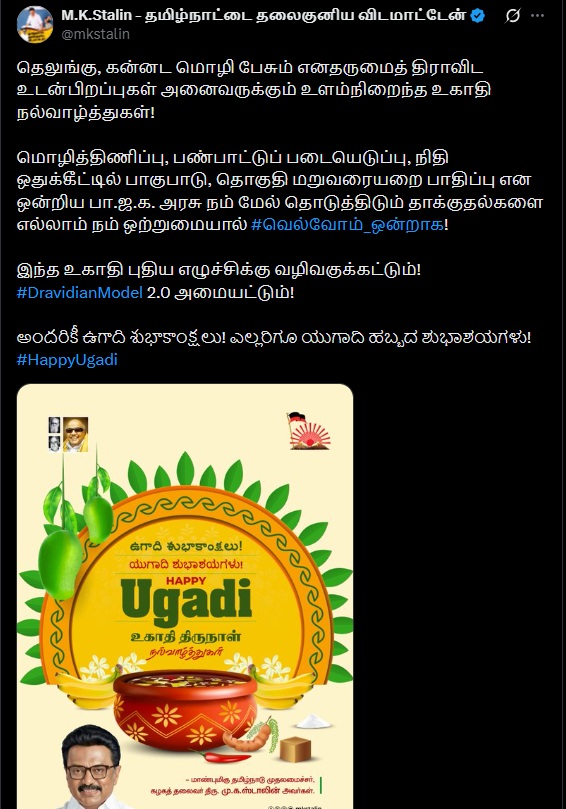
“Drinks Late At Night, Wakes Up Late, Roams Around, Drinks Poison To Suicide, No Maturity At All”: Jose Charles Martin Attacks DMK Scion Udhayanidhi Stalin

Jose Charles Martin, founder of the LJK, on Monday launched a sharp attack on Tamil Nadu Deputy Chief Minister Udhayanidhi Stalin, dismissing his criticism over the alleged reintroduction of lottery and accusing him of lacking political maturity.

The remarks came after Udhayanidhi, while campaigning in Lalgudi, alleged that Martin’s family entering politics was aimed at regaining control and reintroducing lottery operations in Tamil Nadu. Responding to the charge, Martin defended his mother Leema Rose and said the criticism was misplaced.

Addressing reporters, Martin said, “No, he doesn’t have that level of understanding. Only if he stays here in his own place would he know. He goes off to Dubai and keeps to himself with a few friends there. What does he really know about what’s happening here?”

When asked about the DMK’s past association with lottery operations and alleged funding, Martin shifted the focus to the ruling party leadership. He said, “No, it is Mr. Stalin who should answer that. Because the DMK itself has accepted it. They have said that they received ₹500 crore like this. After you held this press meet, you should go and ask Mr. Stalin and Mr. Udhayanidhi—why did you take this money, for what purpose did you take it, and how was it used? You should be the one asking them.”

On being pressed further, he confirmed the transaction, stating, “Yes, it is true that the money was given. All of this is accounted money; there are proper transactions. That is why it was given. You should ask Mr. Stalin about it. Everything is there, there is online evidence, we also have the documents. These are all open documents.”

Martin escalated his criticism of Udhayanidhi, questioning his political seriousness and suitability. He said, “No, he keeps speaking incorrectly. For him, elections are just a way to pass time. Like a small child playing around, speaking casually and moving on. But when you look at it, they are supposed to be important leaders, he keeps saying they fell at someone’s feet and all that. His speech shows no maturity at all. He is not a person fit for politics. What this shows is dynasty politics, someone from the family comes into politics just because the father or grandfather was there, then the son, then the grandson. For them, politics is taken very lightly.”

Continuing his remarks, he added, “People generally fall in love, then get married, raise children well, educate them, and build their future. But he seems to fall in love only after marriage. After marrying, he falls in love, and when that love failed, he goes and drinks poison and attempts suicide. So, if such a person is to be brought as a future Chief Minister of Tamil Nadu, how will the people accept it? What benefit will he bring to the public?”

When asked about the DMK-Congress alliance, he said, “That’s what I’m saying—the alliance may look strong. But I’m saying Rahul Gandhi himself hasn’t even come. They claim the crowd is strong. If Rahul had come, he should have campaigned here. Instead, he went to Puducherry. One is doing separately, the other is doing separately. Then why call it an alliance? Why not go separately? Why didn’t Rahul Gandhi come? Was he not willing? When asked, what did they say? That after finishing in states like Kerala, he will come here. Look at the Prime Minister, he has come to Puducherry twice already. Within 30 days, he has come twice. What work does Rahul Gandhi have? Honestly, what work is he doing? What is he so busy with? What big work is he doing that he cannot come here? This shows seriousness or rather the lack of it. These people treat everything like a game. Udhayanidhi, Rahul Gandhi, these people are just passing time. They come through lineage, and they don’t understand the value of it or the struggles behind it. People are depending on them. He drinks at night and sleeps. He wakes up late in the morning. The next day he cannot go to work. He just roams around the town. Then suddenly he flies off to Dubai and comes back. He keeps four girlfriends. That is his life.”


Subscribe to our channels on WhatsAppTelegram, Instagram and YouTube to get the best stories of the day delivered to you personally.
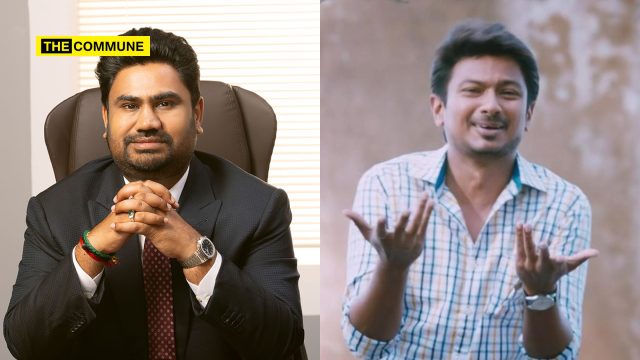
“India Will See The DMK Of 1950-60s”: MK Stalin Stokes Separatism? Threatens PM Modi That ‘Tamil Nadu’ Will Come To A ‘Standstill’

MK Stalin Blocks Yet Another Industrial Project For Tamil Nadu, Wants Centre To Cancel Tungsten Mining Rights Given To Hindustan Zinc

On 14 April 2026, Tamil Nadu chief minister MK Stalin issued a strongly worded video statement against the Centre’s proposed delimitation exercise, warning of statewide protests and invoking the legacy of the Dravidian movement, in remarks that have triggered sharp political reactions.

In a nearly four-minute address, Stalin described the proposed parliamentary move as a “grave danger” to Tamil Nadu and accused the Union government of attempting to push through a Constitutional amendment without consultation.

He said, “This video is to speak about the grave danger that has reached the doorstep of Tamil Nadu, and to issue a warning to the Union BJP government. Even though I am constantly on the run with election campaigning, I cannot avoid this duty. The day after tomorrow, April 16, a special session of Parliament is being convened. Rather than say it is being ‘convened’, I must say it is being forcibly called right in the middle of the Tamil Nadu and West Bengal elections. In this session, they are going to bulldoze a constitutional amendment related to delimitation – the redrawing of constituency boundaries. We have been continuously warning about this from the very beginning. The people must be made aware. Not just Tamil Nadu, we brought together Chief Ministers and major party leaders from all states across India who will be affected by this to Chennai, and convened a joint action committee meeting. The Union Government told us: ‘Control your population, have fewer children, practice family planning.’ We demanded that the Prime Minister give a guarantee on the floor of Parliament that Southern states will not be adversely affected. No answer. MPs from multiple parties asked for time to personally meet the Prime Minister to raise concerns. That too was not granted. Thus, ignoring everything we have said, without consulting not just the DMK, but any political party or any state, they are trying to do as they please. Yesterday, the respected Sonia Gandhi raised the very same questions we have been raising. Even the main opposition Congress has received no answer.”

He continued, “This hurried attempt to push delimitation is a blatant anti-democratic act by the BJP government. To go further, they have murdered the rights of states. We don’t even know how they are going to carry out this delimitation. They have not provided any explanation whatsoever about what the constitutional amendment actually entails. The fact that they are hiding it so carefully only strengthens everyone’s suspicion that something very dangerous is lurking inside it. The people of southern states are living in great fear. I am saying something important right now to the Union BJP government and to honourable Prime Minister Modi: Our MPs will participate in the upcoming parliamentary session.”

He further said, “But if anything is done that harms Tamil Nadu or that disproportionately enhances the political power of northern states, we in Tamil Nadu will not remain silent. Tamil Nadu will come to a standstill. Tamil Nadu will show its fierce resistance. Every family will take to the streets. Under my leadership as Chief Minister of Tamil Nadu, we will organise a massive agitation. Yes, it is election season. But do not even think for a moment that our attention is on that and you can quietly carry out delimitation from Delhi while we are distracted. I speak not merely as the Chief Minister of Tamil Nadu, I am the leader of the movement called Dravida Munnetra Kazhagam. You will have to witness a Tamil Nadu you have never seen before. India will have to witness the old DMK that it saw in the 1950s and ’60s. Don’t think I am threatening you, I am warning you. Even if you take it as a threat, we don’t care. Yes, this is a warning issued to you from Tamil Nadu. Elections, political power are all secondary for us. We are people of self-respect. For us, principles come first. State rights come first. That is the life-principle bequeathed to us by the great Arignar Anna and Muthamizh Arignar Kalaignar. If you think you can wrong Tamil Nadu and casually move on as usual, you are mistaken. On this day, the birthday of legal luminary Ambedkar, I swear upon him: If Tamil Nadu is harmed, we will make all of India take notice. Honourable Prime Minister Modi, I say again: This is the final warning issued to you from Tamil Nadu. Tamil Nadu will fight. Tamil Nadu will win.”

Subscribe to our channels on WhatsAppTelegram, Instagram and YouTube to get the best stories of the day delivered to you personally.
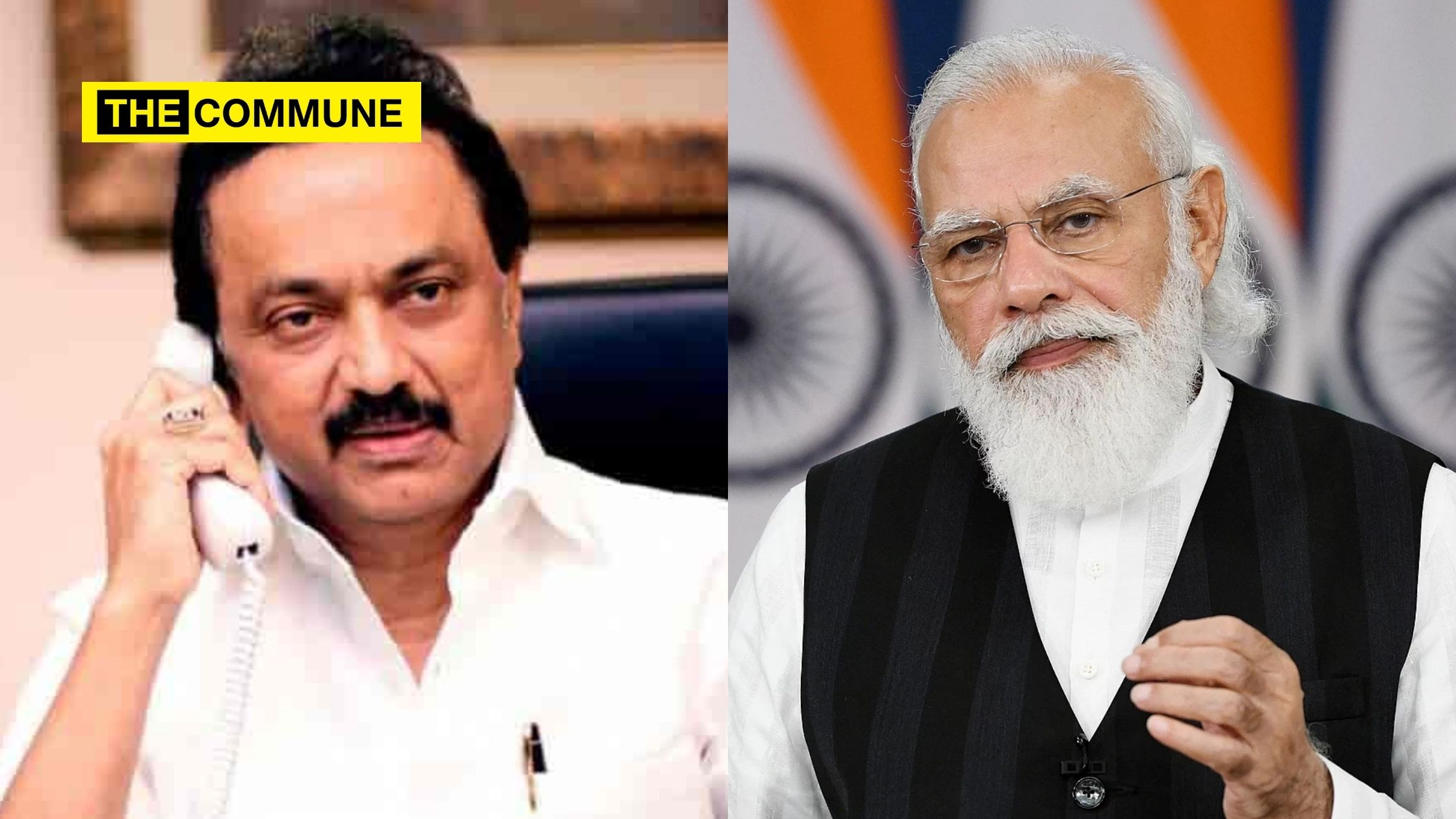
BJP Tamil Nadu Manifesto: A Welfare Blitzkrieg To Decimate DMK

BJP Tamil Nadu Manifesto: A Welfare Blitzkrieg To Decimate DMK

The Bharatiya Janata Party on Tuesday unveiled its much-anticipated Tamil Nadu Assembly election manifesto in the presence of Union Minister JP Nadda, signalling what party leaders described as a decisive “welfare blitzkrieg” aimed at dislodging the ruling Dravida Munnetra Kazhagam government.

Welfare Push at the Core

The manifesto positions itself as a sweeping welfare document targeting women, farmers, youth, and vulnerable sections, while simultaneously attacking the DMK government over inflation, governance, and corruption.

At the heart of the BJP’s pitch is a direct cash and subsidy model:

  • ₹2,000 monthly assistance for all women heads of households
  • ₹10,000 one-time financial support for every family
  • Three free LPG cylinders annually during major festivals

These measures, prominently outlined in the manifesto (pages 12-17), are framed as relief against rising costs of living and are intended to directly undercut the DMK’s welfare narrative.

Women, Safety, and Social Engineering

The manifesto places significant emphasis on women-centric policies, combining welfare with law-and-order measures:

  • Interest-free loans up to ₹50 lakh for women-led enterprises
  • 20% procurement quota for women-run businesses
  • “Zero-FIR” system and fast-track courts for crimes against women
  • 100% CCTV coverage in public transport and educational institutions

The party has also promised strict enforcement against drug trafficking, including the creation of a dedicated anti-narcotics wing and harsher penalties, projecting a law-and-order plank against the incumbent government.

Rural Economy and Farmer Outreach

In a clear attempt to consolidate rural votes, the BJP has rolled out an expansive agriculture and allied sector package:

  • Annual ₹9,000 assistance to farmers by topping up central schemes
  • ₹50,000 support for allied activities like dairy, poultry, and fisheries
  • Expanded storage infrastructure including silos and cold chains
  • Assured market support for key crops like banana, tomato, and chilli

The manifesto also promises enhanced compensation for fishermen and pension schemes, targeting coastal constituencies.

Youth, Jobs, and Industrial Push

The BJP has sought to address unemployment through a mix of state jobs, skilling, and entrepreneurship incentives:

  • One lakh government jobs
  • Interest-free loans up to ₹10 lakh for students and ₹15 lakh for startups
  • AI and robotics training centres across districts
  • New industrial parks under central schemes

The document also outlines large-scale infrastructure ambitions, including high-speed rail corridors, desalination projects, and expanded healthcare systems.

Cultural and Religious Signalling

In a notable departure from traditional Dravidian politics, the manifesto includes strong cultural elements:

  • Declaration of Thaipusam as a state festival
  • Restoration of temple traditions such as Karthigai Deepam at Thirupparankundram
  • Annual financial support for temple rituals and maintenance

This signals the BJP’s continued effort to blend welfare politics with cultural identity in Tamil Nadu.

Political Strategy: Targeting the DMK

The manifesto frames Tamil Nadu at a “turning point,” contrasting what it describes as dynastic and corrupt governance under the DMK with a development-driven alternative aligned with Prime Minister Narendra Modi’s Viksit Bharat 2047 vision.

A High-Stakes Electoral Gamble

With Tamil Nadu historically resistant to BJP’s expansion, the manifesto represents an aggressive recalibration combining direct welfare benefits, governance promises, and cultural positioning.

The scale and breadth of the promises suggest a calculated attempt to overwhelm the electoral narrative – a welfare-heavy offensive designed not just to compete, but to decisively erode the DMK’s support base ahead of the 2026 Assembly elections.

Subscribe to our channels on WhatsAppTelegram, Instagram and YouTube to get the best stories of the day delivered to you personally.
Complaint Seeks Probe Against Vizag Collector For Disbursing Public And Temple Funds To Foreign Nationals

Complaint Seeks Probe Against Vizag Collector Over Use Of Temple And Welfare Funds For Foreign Nationals

A formal complaint has been submitted to the Department of Personnel and Training and the Government of Andhra Pradesh seeking an immediate investigation into alleged misuse of public and temple funds by Visakhapatnam District Collector Muttimbaku Abhishikth Kishore, an IAS officer of the 2015 batch.

The complaint made by NGO watchdog Legal Rights Protection Forum (LRPF) calls for inquiry and prosecution over the disbursal of financial assistance to two Iranian nationals studying in India.

According to the complaint, multiple media reports dated 9 April 2026, stated that the District Collector sanctioned ₹50,000 each from the District Sanjeevani Fund to the two individuals. Additionally, an equal amount of ₹50,000 each was reportedly granted from the funds of the Sri Kanaka Mahalakshmi Temple in Visakhapatnam, bringing the total assistance to over ₹1 lakh per person.

The complainant has alleged that the District Sanjeevani Fund is strictly meant for providing emergency medical assistance to economically weaker Indian citizens and is governed by guidelines limiting its use to healthcare-related needs. It was argued that extending such funds to foreign nationals falls outside the scope of the scheme and constitutes a violation of financial norms and fiduciary responsibilities.

Further, the complaint raises objections to the use of temple funds, stating that resources of the Sri Kanaka Mahalakshmi Temple are governed under the Andhra Pradesh Charitable and Hindu Religious Institutions and Endowments Act and are intended solely for religious and temple-related purposes. The diversion of such funds for non-religious activities, particularly for the benefit of foreign nationals, has been described as a breach of statutory provisions and trust obligations.

The representation also contends that in cases involving foreign nationals, the appropriate course of action would have been to route assistance through the Government of India and the Ministry of External Affairs, or coordinate with the Iranian Embassy, rather than directly disbursing public or religious funds at the district level.

Alleging criminal breach of trust, misappropriation, and abuse of official position, the complainant has sought an independent inquiry, recovery of the funds, and initiation of disciplinary as well as criminal proceedings against the officer concerned.

Subscribe to our channels on WhatsAppTelegram, Instagram and YouTube to get the best stories of the day delivered to you personally.
Kerala High Court Grants Interim Protection To Farmaan Khan In ‘Minor Kidnapping’ Case Linked To ‘Mahakumbh’ Fame Monalisa’s Marriage

Kerala High Court Grants Interim Protection To Farmaan Khan In ‘Minor Kidnapping’ Case Linked To Monalisa Bhosle Marriage

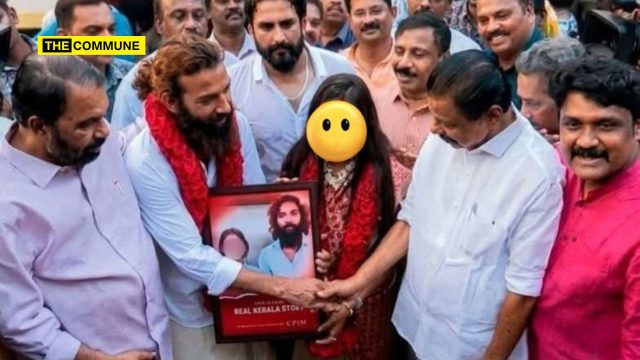
The Kerala High Court has granted interim protection from arrest to Mohd Farmaan Khan, husband of Kumbh Mela viral personality Monalisa in connection with a kidnapping case arising out of allegations that Monalisa is a minor and was abducted, as reported in LawChakra.

The matter, titled Moh Farmaan & Anr v State of Kerala & Ors, came before the Court on a plea seeking anticipatory bail and protection from possible arrest. The couple contended that Monalisa had already attained the age of 18 in January 2026 and was legally an adult at the time of their marriage in March.

According to their petition, they apprehended arrest in connection with a kidnapping case allegedly registered in Madhya Pradesh based on a complaint filed by Monalisa’s father. To rebut the allegation that she is a minor, the couple submitted documentary proof including their marriage certificate, Monalisa’s birth certificate, and Aadhaar card to establish her age and the legality of their marriage.

On 23 March 2026, Justice Kauser Edappagath passed an interim order granting protection from arrest, taking note of the documents and the couple’s claim that they were living together as husband and wife.

The Court observed, “Annexure AIII would show that the applicants got married on 11.03.2026. According to the applicants, they are now residing as husband and wife. In these circumstances, there shall be an order not to arrest the applicants till the next posting date.”

Subsequently, on 8 April 2026, the Court extended this interim protection until 20 May 2026, the next date of hearing, after the Senior Public Prosecutor informed the Court that a response from the Madhya Pradesh Police was still awaited.

Monalisa Bhosle had gained widespread attention during the Kumbh Mela 2025 after videos of her selling beads went viral on social media, turning her into an internet sensation. She later married Farmaan Khan on March 11 in Kerala, an event that drew significant media coverage. The couple stated that they met during the shooting of a Malayalam film, developed a relationship, and eventually got married.

However, the interfaith marriage soon became the subject of controversy, with certain groups alleging that Monalisa is only 16 years old and therefore not legally eligible for marriage. These claims triggered concerns regarding the possible invocation of the Protection of Children from Sexual Offences Act and led to an inquiry reportedly initiated by the National Commission for Scheduled Tribes.

In their plea, the couple further stated that Monalisa’s family had initially consented to the marriage but later opposed it, allegedly due to the influence of a relative.

Appearing for the couple, advocates M Sasindran, Satheeshan Alakkadan, and Mrinal Chand M argued that both individuals are adults and entitled to legal protection, asserting that the marriage is valid under law.

Subscribe to our channels on WhatsAppTelegram, Instagram and YouTube to get the best stories of the day delivered to you personally.
Official TN Govt Holiday But No Tamil Puthandu Wishes From CM Stalin; Had Wished For Ugadi

tamil new year puthandu dmk

Today, 14 April 2026, is Tamil New Year, Puthandu, a special day for Tamilians. It is even an official government holiday declared by the Tamil Nadu government itself.

Every government office is shut. Tamil families across the state are drawing kolam, cooking delicious feasts, and welcoming the new year. But Chief Minister MK Stalin has not issued a single public wish for Puthandu as of this morning.

Stalin Wishes For Ugadi

On 19 March 2026, Stalin posted in Telugu on X: “Happy Ugadi to all our Dravidian brothers and sisters who speak Telugu and Kannada! Let us #overcome_together with our unity all the attacks that the BJP government is launching against us, such as language oppression, cultural invasion, discrimination in financial allocation, and the impact of constituency redelineation! May this Ugadi pave the way for a new upsurge! May #DravidianModel 2.0 be established!”

He did this in 2025 as well.

The DMK has long created a non-existent internal ideological dispute over April 14. A section of the Dravidian movement, going back to Periyar, prefers January 14 (Pongal) as the Tamil New Year, viewing April 14 as linked to the Brahminical solar calendar. As recently as 2022, DMK’s Pongal gift bags avoided the phrase “Tamil New Year” entirely. April 14 remains on the government holiday list due to public pressure, not political conviction.

The Tamil Nadu government declares Tamil New Year a public holiday for administrative purposes, but its Chief Minister cannot post a single wish to mark it. Telugu communities got a message in their own language, is it because MK Stalin himself comes from a Telugu background? Tamils, on their own official holiday, in their own state, get silence.

Taking the Tamil voter for granted has never been more visible than it is today.

Subscribe to our channels on WhatsAppTelegram, Instagram and YouTube to get the best stories of the day delivered to you personally.