Home Blog Page 63

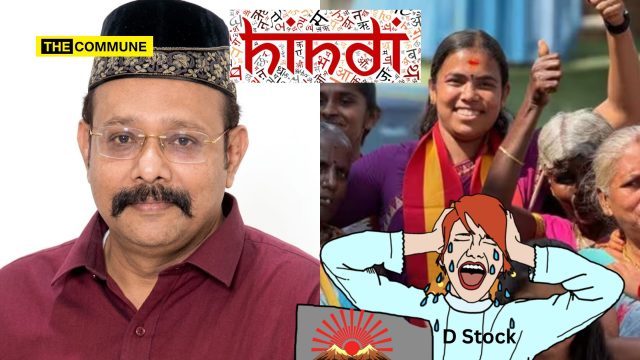
Rabid DMK Dravidian Stocks Suffer Meltdown As TVK MLAs Speak In Hindi

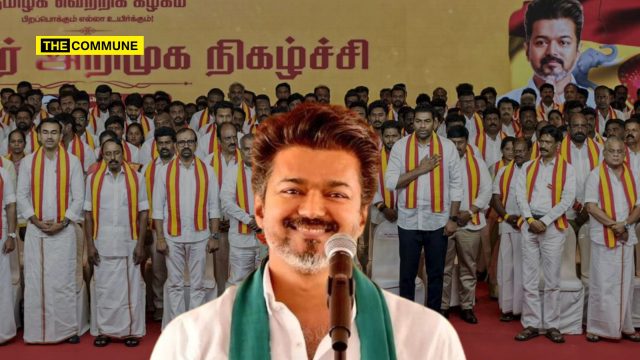
Now that the DMK has been routed out of power and TVK has emerged as the single largest party in the state, the Dravidianist/Dravidian stock meltdown has been reaching new peaks.

As the results came out, news media from Delhi interviewed the newly elected MLAs over the victory. Surprisingly, two of the MLAs spoke in Hindi with the media.

Madurai Central constituency winner Madhar Badhurudeen spoke to media on 5 May 2026 regarding who they will ally with since TVK did not gain a thumping majority. Noticing media from the north, Badhurudeen started speaking in Hindi. He said, “…TVK Chief Vijay will decide with whom we will ally…After the formation of our government, we will work for the upliftment of the poor, development…We have sent a letter to the Governor (staking claim to form the government)…”

In another instance, TVK winning candidate from Sivakasi constituency Keerthana also spoke in chaste Hindi to ANI. She said, “He told us that when he started this party, the hopes that people had from him have manifested in the form of votes. That hope should not be lost. Everyone will have to work according to that… People in Tamil Nadu need a change… At the time of DMK, women’s safety had become questionable. Women and youth have voted for us…” 

This resulted in severe meltdown among Dravidianists as if the world was crushing over their heads and it was the end of everything Dravidianists stood for. Here are some reactions.

Some even equated Hindi to a virus and that this will lead to ‘entry of Hindutva’.

Subscribe to our channels on WhatsAppTelegram, Instagram and YouTube to get the best stories of the day delivered to you personally.

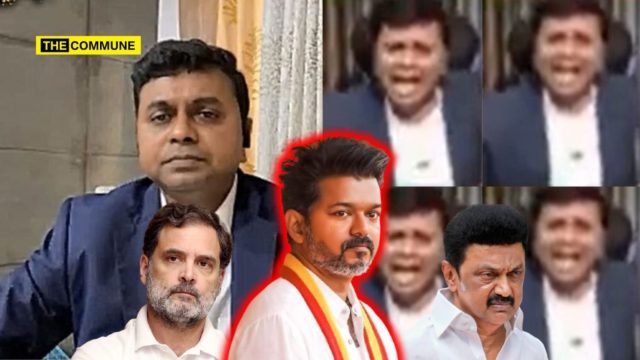
Melting Point Saravanan Suffers Meltdown As Congress Ditches DMK To Support TVK

DMK senior spokesperson Saravanan Annadurai suffered a meltdown once again and has triggered a fresh political controversy after referring to the Congress as “backstabbers” during a live television debate. The remark came amid questions over reported political outreach between the Congress and actor Vijay’s Tamilaga Vettri Kazhagam (TVK), a development that has fueled speculation over possible changes in opposition alignments ahead of the 2026 Tamil Nadu Assembly election.

Speaking in an NDTV programme, when the reporter asked DMK spokesperson Saravanan, how he reacted to the news that the Congress has received a request given that the Congress are allies of the DMK and were talking to the TVK.

‘Melting Point’ Saravanan suffered a meltdown and replied, “They are the backstabbers. Backstabbers. The five seats they have got is because they allied with us. Otherwise, they would have drawn a blank at the recent polls. And the TVK has never spoken a single word against the BJP or Mr. Modi. In fact, today, Mr. Vijay’s first thanks is not to the people of the state who elected him, not to his constituents who elected him, not to his members who worked for him to get him elected. His first thanks is to Mr.
Modi. And Mr. Rahul Gandhi wants to support this kind of a person. See, when we speak of an alliance, the I.N.D.I. alliance, it is an alliance based on ideology.”

When pushed back again about his harsh comments, he repeated his view and said, “It is for the Congress to decide. What has he got to say? It is Mr. K.C. Venugopal who is saying that it is for the local Congress Is this Is it how the Congress decides all these issues? The local units decide all these issues?

Subscribe to our channels on WhatsAppTelegram, Instagram and YouTube to get the best stories of the day delivered to you personally.
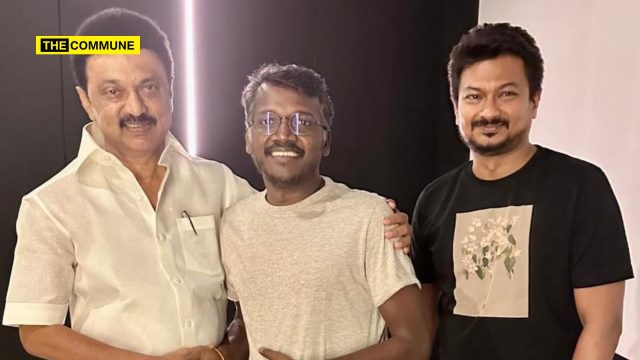
“Stalin’s Defeat Breaks My Heart”: DMK Stooge Filmmaker Mari Selvaraj Who Was Silent During Vengaivayal And Kallakurichi Hooch Tragedies Reacts To Party’s Humiliating Defeat

Director Mari Selvaraj has expressed sorrow over the defeat of Chief Minister M. K. Stalin in the 2026 Tamil Nadu Legislative Assembly election, stating that it “breaks his heart.”

In a post shared on X, Mari Selvaraj reflected on the election outcome and the changing nature of electoral politics in Tamil Nadu.

He wrote, “These election results have given me many shocks, surprises, and some hope – but they have also caused me deep pain. Chief Minister M. K. Stalin’s defeat is heartbreaking. Beyond the basic ideologies, principles, and doctrines of politics, it is possible to understand that mass public support, public affection, and the will of the people have exploded as the decisive force in electoral politics. In the very first election he contested, the people have bestowed such immense affection and expectation upon Tamilaga Vettri Kazhagam leader Vijay. Accordingly, I extend my congratulations to Mr. Vijay and Tamilaga Vettri Kazhagam, who are set to form the new government in Tamil Nadu. May their public service flourish.”

The same Mari Selvaraj did not probably find it heartbreaking when sanitation workers protesting for their rights were attacked, when the drinking water tank in Vengaivayal was contaminated with human faeces, when Dalit leader Armstrong was murdered in full public view, when Dalits were repeated killed in the name of caste in Tirunelveli, when honour killing and caste based killing became a norm in TN, when the government used the Adi Dravidar welfare funds reportedly for other purposes. Where was Mari Selvaraj then, ask people.

In the election, Tamilaga Vettri Kazhagam emerged as the single largest party by winning more than 105 constituencies. The Dravida Munnetra Kazhagam alliance secured 74 seats, while the All India Anna Dravida Munnetra Kazhagam alliance won 53 seats.

Stalin suffered defeat in the Kolathur constituency, marking one of the most significant setbacks for the DMK in the election.

Subscribe to our channels on WhatsAppTelegram, Instagram and YouTube to get the best stories of the day delivered to you personally.
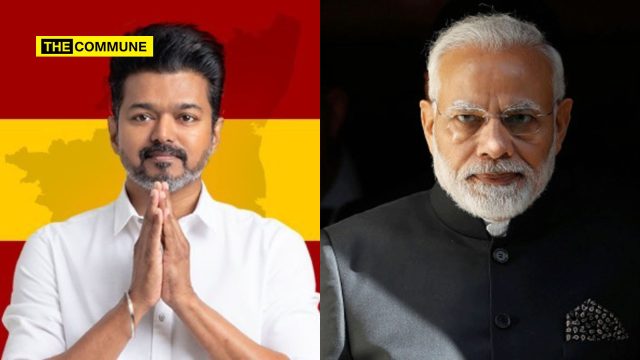
“We Look Forward To Union Govt’s Support”: TVK Vijay To PM Modi After Emerging As Single Largest Party In TN

“We Look Forward To Union Govt’s Support”: TVK Vijay To PM Modi After Emerging As Single Largest Party In TN

A day after results in Tamil Nadu polls were declared andTamilaga Vettri Kazhagam (TVK) emerging as the single largest party in the state, the party chief Vijay on Tuesday, 5 May 2026, expressed gratitude to Prime Minister Narendra Modi following the party’s strong debut in the Tamil Nadu Assembly elections, while asserting that the “well-being of people remains the party’s only goal.”

Sharing a post on X, Vijay thanked the Prime Minister for his message and indicated that he looked forward to cooperation from the Union Government.

“Thank you, Hon’ble @PMOIndia, for your greetings. The well-being of our people remains our only goal. Transcending politics, we shall focus on the State’s progress and the welfare of people of Tamil Nadu. We look forward to the Union Government’s support in this endeavor,” he wrote.

TVK won 108 seats in its debut election. The party, however, remains short of the majority mark and is expected to seek support from other parties to form the government, as reported in ANI.

Prime Minister Modi had earlier congratulated TVK for its performance and acknowledged the mandate received in the elections.

“Gratitude to the voters of Tamil Nadu who supported the NDA in the Tamil Nadu Assembly Elections. We will always remain at the forefront in addressing people’s issues and improving their lives. Congratulations to TVK on their impressive performance. The Centre will leave no stone unturned in furthering the progress of Tamil Nadu and the well-being of its people,” PM Modi said in a post on X.

In a separate message, Vijay also thanked Congress leader Rahul Gandhi for his call and wishes following the election results.

“My sincere thanks to the Honorable Leader of the Opposition in the Lok Sabha for the call and kind wishes! We shall remain committed to excellence in public service, and preserving the cultural ethos of our state which requires collective cooperation. Beyond politics, we shall…” Vijay wrote.

Rahul Gandhi had spoken to Vijay after the results were declared and stated that the mandate reflected the rising voice of youth that could not be ignored.

Earlier in the day, Vijay returned to his residence after chairing a meeting with the party’s newly elected MLAs at the party office in Chennai.

Meanwhile, TVK has sought an appointment with Tamil Nadu Governor Rajendra Arlekar as part of the process of government formation, according to party sources.

TVK sources indicated that discussions are underway with other political parties to secure the required support to cross the majority threshold.

In the election, Congress, a constituent of the DMK-led alliance, secured five seats. In a significant setback to the ruling DMK, Chief Minister MK Stalin lost the Kolathur constituency to TVK’s VS Babu, who won by a margin of 8,795 votes.

The results signal a potential shift in Tamil Nadu’s political landscape, which has traditionally been dominated by the DMK and AIADMK alliances for decades.

Subscribe to our channels on WhatsAppTelegram, Instagram and YouTube to get the best stories of the day delivered to you personally.
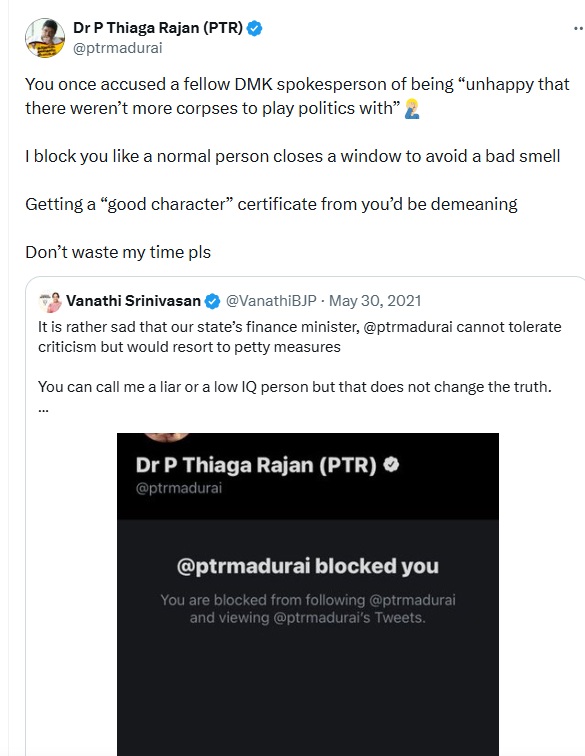
The ‘Decorum & Dignity’ Of ‘Pannaiyaar’ PTR: A Self-Trumpeting Foul-Mouthed DMK Leader Who Makes Casteist Abuses And Cyberbullies Anyone Whom He Dislikes

ptr madurai palanivel thiagarajan

One of the most satisfying defeats on the recently concluded Tamil Nadu Assembly polls is that of the self-aggrandizing, narcissist who thinks of himself as the most intellectual person on earth with no shred of humility. None other than the PTR Palanivel Thiagarajan, a man with a feudal mindset who just can’t stop self-trumpeting about his dynastic privilege and GRE scores.

PTR is known to be abusive and was tasked with running the DMK IT wing given that he has a track-record of cyberbullying.

However he’s portrayed as this “Dravidian Model” intellectual with sophistication just because he can mouth a few good words in English.

A case in point being – a journalist slammed DMK leader TRB Rajaa for helming the party’s IT wing that unleashed rabid trolls on political opponents and even journalists. But he gave a free pass to PTR Palanivel Thigarajan saying that the DMK IT wing under him maintained decorum and dignity.

However, Chandra Srikanth, an Editor with the financial and business news website Moneycontrol, quickly pointed out the vile human that PTR is.

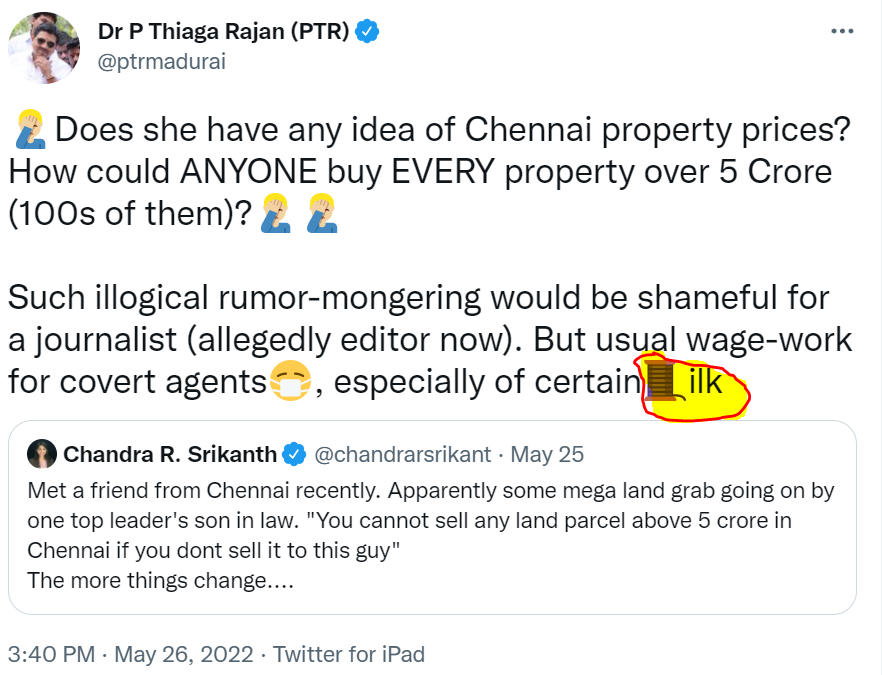
Chandra had put out a tweet on 25 May 2022 saying that a top leader’s son is involved in a mega land grab.

“Met a friend from Chennai recently. Apparently some mega land grab going on by one top leader’s son in law. “You cannot sell any land parcel above 5 crore in Chennai if you dont sell it to this guy” The more things change….”, the woman journalist wrote.

Responding to this tweet, Tamil Nadu Finance Minister PTR Palanivel Thiagarajan abused the woman journalist by invoking her caste identity.

He called her tweet as ‘illogical rumor-mongering’ and insinuated that her tweet was ‘usual wage-work for covert agents, especially of certain (thread) ilk’.

Many reminded that the ‘thread ilk’ in Palanivel Thiagarajan’s tweet is a vile reference to Brahmins.

This is the decorum and dignity with which PTR ran the DMK IT wing with him being the chief abuser.

That instance in 2022 was not the first time that Palanivel Thiagarajan who often boasts of coming from an illustrious family, having studied and worked abroad, has resorted to abusing woman journalists. He had earlier attacked Malini Parthasarathy, The Hindu Publishing Group’s Chairperson saying that she needed ‘counselling’. This attack came after Malini Parthasarathy shared an article of The Hindu which carried Isha Foundation’s response to Palanivel Thiagarajan’s abuses on Sadhguru Jaggi Vasudev.

In another instance, Palanivel Thiagarajan when he was the DMK IT Wing head indulged in denigrating a Ramnath Goenka Award Winning journalist Sandhya Ravishankar who had exposed some of the false rhetoric of the Pollachi Sexual Abuse case.

Palanivel Thiagarajan had also unleashed abuses and made personal attacks on Coimbatore South MLA Vanathi Srinivasan who had called out the former for insulting Goa during the 43rd GST Council meeting.

One may have studied in the best of institutions and scaled heights in their profession. But, education and experience must make a person humble. ‘Humility’ is a virtue that every person in public life should have. Sadly, Palanivel Thiagarajan’s behaviour shows that he is not just a disgrace but is also unfit to be in public life.

Subscribe to our channels on WhatsAppTelegram, Instagram and YouTube to get the best stories of the day delivered to you personally.
Bengal’s Decisive Shift: What Are The Forces Behind BJP’s Bengal Breakthrough?

Bengal’s Decisive Shift: What Are The Forces Behind BJP’s Bengal Breakthrough?

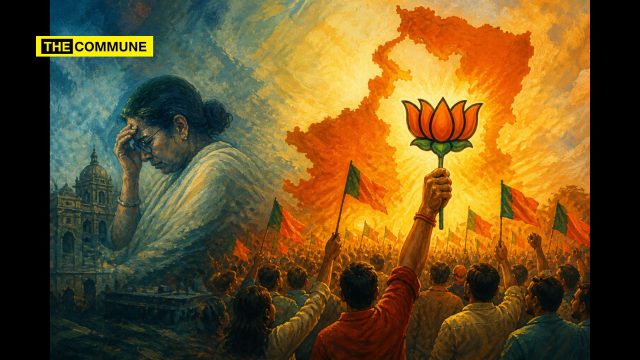
The 15-year regime of Trinamool Congress (TMC) rule is now a matter of history. The 2026 West Bengal Assembly election marks a significant political shift, widely interpreted as a decisive consolidation of Hindu voter support in favour of the Bharatiya Janata Party (BJP). The party is projected to secure a comfortable majority, paving the way for the formation of a ‘first’ saffron-led government in the state. This electoral outcome has been framed by its proponents as a rejection of allegations of corruption, political violence, Islamist uprise, Muslim appeasement and governance failures attributed to the incumbent Trinamool Congress (TMC). The BJP’s victory is thus positioned as a transformative moment in West Bengal’s political history, symbolizing a renewed emphasis on collective political confidence and a challenge to existing patterns of power and opposition within the state including an apprehended threat of demographic change in Bengal.

The majority of Hindu voters in West Bengal have summarily rejected the corruption, hooliganism, anti-nationalist, and pro-Muslim politics of the Trinamool Congress. The BJP’s resounding victory in West Bengal in 2026 is set to create new political history for Bengal, reviving a culture of collective confidence by challenging the rise of corruption, Islamic hooliganism, and the gagging of opposition voices.

Critics say that the rise of the BJP in Bengal is a silent revenge for the rape and murder of a trainee doctor at RG Kar Medical College and Hospital, as well as for the 56 BJP supporters who were killed in post-poll violence in 2021, allegedly perpetrated by the TMC. This is also a silent revenge for the brutal lynching of the innocent father-son duo, Harogobind Das and Chandan Das, in Samserganj by a Muslim mob during Waqf-related agitation, allegedly incited by the TMC in the state.

Electoral Outcome and Structural Shift

The 2026 West Bengal Assembly election concluded with a decisive victory for the Bharatiya Janata Party (BJP), which surely to cross the majority threshold of 148 seats. This outcome signifies not merely a change in government but a substantial shift in the structure of political mobilization within the state. The election evolved into a high-stakes contest in which identity, security, and perceptions of governance converged to reshape voter alignments in favour of the BJP.

A critical institutional dimension of the election was the debate surrounding the SIR (Special Intensive Revision) of electoral rolls. The Trinamool Congress (TMC) framed alleged discrepancies as a matter of democratic exclusion, while the BJP and its supporters interpreted the controversy as indicative of deeper irregularities within the political system. This contest over procedure contributed to a broader politicization of electoral legitimacy.

Cultural Mobilization and Religious Idioms

One of the most significant developments in this election was the expansion of religious-cultural expressions within political mobilization. While slogans such as “Jai Shri Ram” had gained traction earlier, the incorporation of “Joy Ma Kali” and “Joy Ma Durga” marked a strategic localization of political messaging within Bengal’s cultural context. This adaptation enabled the BJP to align broader ideological themes with regionally embedded devotional traditions, thereby enhancing its appeal among diverse segments of Hindu voters.

Public expressions of political identity became increasingly visible during the campaign. Slogans such as “Jai Shri Ram” and “Bharat Mata ki Jai” were widely used in rallies and gatherings, functioning as markers of collective affiliation and political enthusiasm.

The TMC’s campaign foregrounded Bengali identity as a culturally rooted and politically significant construct. Its slogan, “Jato karo hamla, ebar jitbe Bangla,” positioned the election as a defensive assertion of regional dignity. Welfare initiatives—particularly those targeting women and economically vulnerable groups—were central to its appeal, reinforcing a model of governance centered on social protection and state-led redistribution. Simultaneously, the party emphasized its support among minority communities, presenting itself as a guarantor of inclusivity and constitutional safeguards.

In contrast, the BJP advanced a campaign structured around the consolidation of Hindu identity, national integration, and political transformation under the banner of “Porivorton” (change). Its narrative challenged the TMC’s governance record while also seeking to reframe the basis of political mobilization in the state. The BJP’s messaging frequently critiqued what it described as “vote-bank politics,” arguing that electoral alignments based on religious minorities had historically shaped outcomes in West Bengal.

Statements by BJP state president Samik Bhattacharya and Leader of the Opposition Suvendu Adhikari (often discussed alongside senior state leadership figures) contributed to this framing. They characterized the electoral outcome as the “establishment of Shyama Prasad Mookerjee’s followers’ government on his land,” invoking the legacy of Mookerjee as foundational to West Bengal’s political identity. Within this rhetoric, the state was symbolically described as a “Hindu homeland,” and the election was interpreted as a reassertion of that historical vision.

In a similar vein, political discourse from of the BJP leadership led by Suvendu Adhikari introduced the metaphor of an “emergence of ‘Hindu EVM’ against ‘Muslim EVM.’” While not a literal claim about electoral technology, this formulation functioned rhetorically to suggest a shift away from conventional patterns of minority-focused electoral mobilization toward a consolidated Hindu voting bloc. Such language underscores how electoral behavior was interpreted through the lens of identity consolidation rather than solely through policy preferences.

The campaign also drew upon historical and ideological symbolism associated with Shyama Prasad Mookerjee, portraying the election as a continuation of his vision for the region. Within this narrative, the BJP’s victory was framed as a departure from entrenched patterns of political alignment and as a reconfiguration of electoral identity in West Bengal. References to popular slogans such as “Jai Bangla” and “Khela Hobe” were juxtaposed with the BJP’s own mobilizing idioms, highlighting the symbolic competition embedded in campaign rhetoric.

Security Concerns: Infiltration and Border Dynamics

Concerns regarding infiltration and border security emerged as a central electoral issue. Given West Bengal’s proximity to Bangladesh, the BJP emphasized cross-border migration as both a governance challenge and a demographic concern. This framing positioned the party as a defender of territorial integrity and administrative control.

Developments in neighbouring Bangladesh further shaped voter perceptions. Reports concerning the condition of Hindu minorities there were invoked in political discourse, contributing to a sense of vulnerability among sections of the electorate. This cross-border dimension fostered a preventive political outlook, wherein electoral choice was linked to the safeguarding of social and cultural stability within West Bengal.

CAA, Waqf Debates, and Communal Polarization

Debates surrounding the Citizenship Amendment Act (CAA) and issues related to Waqf properties became politically salient during the campaign. Sections of the BJP argued that these issues had been mobilized in ways that intensified communal tensions. Within this framework, the party positioned itself as advocating legal clarity and institutional balance, while attributing instances of unrest to political mismanagement.

These debates contributed to a broader polarization of the electorate, with identity and legal frameworks becoming intertwined in shaping political preferences.

Narratives of Governance, Violence, and Political Change

Allegations of political intimidation and violence played a crucial role in shaping electoral sentiment. The BJP repeatedly referenced incidents of post-poll violence following the 2021 Assembly election, including reported fatalities among its supporters, to argue that democratic processes in the state were under strain. Such claims were used to construct a narrative in which political change was necessary to restore governance, accountability, and public safety.

Statements by BJP leaders, including Samik Bhattacharya and Suvendu Adhikari, reinforced the perception of a historic turning point. Invoking the legacy of Shyama Prasad Mookerjee, they framed the victory as the establishment of a government aligned with his ideological vision. This narrative also emphasized a perceived shift away from earlier patterns of electoral mobilization.

Massive Support of the Middle Class for the BJP

A notable feature of the 2026 electoral outcome was the visible shift in support among segments of the Bengali middle class toward the Bharatiya Janata Party (BJP). This demographic, often regarded as politically conscious and sensitive to issues of governance, economic stability, and public order, appeared to align more decisively with the BJP’s campaign messaging. The party’s emphasis on administrative reform, law and order, and broader structural change resonated with middle-class voters seeking predictability and institutional accountability. Consequently, this shift in allegiance contributed significantly to the consolidation of support that underpinned the BJP’s electoral success in West Bengal.

Organizational Strength and Mass Mobilization

The role of the Rashtriya Swayamsevak Sangh (RSS) and the broader Sangh Parivar was instrumental in sustaining grassroots mobilization. Their efforts contributed to what supporters described as a jana jagaran (mass awakening), facilitating ideological outreach and voter engagement across constituencies.

The election witnessed an exceptionally high voter turnout of approximately 92 percent, indicating a heightened level of political participation. This level of engagement suggests that voters perceived the election as consequential not only for governance but also for broader questions of identity and belonging.

Reconfiguration of Electoral Politics

The BJP’s victory in the 2026 West Bengal Assembly election can be understood as the result of multiple converging factors: cultural mobilization, security concerns, institutional debates, and organizational strength. Together, these elements contributed to a reconfiguration of the state’s electoral landscape.

Ultimately, the election reflects an evolving political dynamic in which identity, governance, and historical narratives intersect. The outcome suggests that these forces, when effectively mobilized, have the capacity to significantly reshape voter behaviour and redefine political alignments in West Bengal.

In this emerging phase of West Bengal’s political trajectory, the aspirations of ordinary citizens appear to centre on peace, prosperity, and social harmony, reflecting the enduring cultural ethos of tolerance within Bengali society.

This article was originally published in HinduExistence.org and has been republished with permission.

Subscribe to our channels on WhatsAppTelegram, Instagram and YouTube to get the best stories of the day delivered to you personally.
DMK Dravidianists Rejoiced Over Brahmin-Free TN Assembly, Now 2 Brahmins Enter Thanks To TVK

DMK Dravidianists Rejoiced Over Brahmin-Free TN Assembly, Now 2 Brahmins Enter Thanks To TVK

2021 was probably the last time a Brahmin candidate contested in TN polls. AIADMK had fielded retired DGP R Natraj in Mylapore Assembly constituency. But he lost. In 2024, no major party fielded a Brahmin candidate for the LS polls.

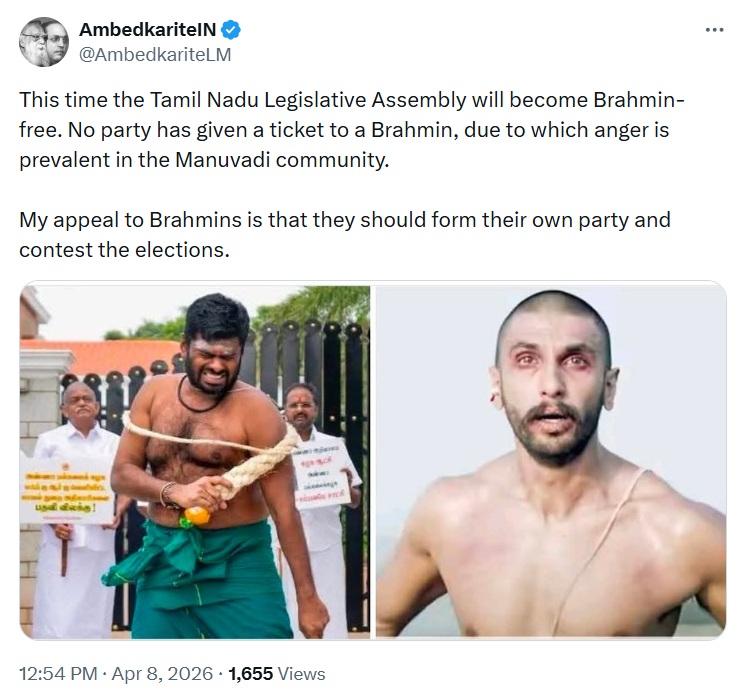
After 2021 elections, Dravidianists rejoiced that TN assembly would now be ‘Brahmin-free’. Social media handles, party mouthpieces, and Dravidianist influencers ridiculed and mocked the Brahmins and hailed the move as if it was a form of justice. Here is an example.

In 2026, none of the major political parties in Tamil Nadu – be it the DMK, AIADMK, Congress or BJP, fielded a Brahmin candidate. The surprise came from TVK and NTK. TVK fielded 2 – one in Mylapore and one in Srirangam while NTK fielded a historic 6 candidates.

TVK’s two candidates were victorious but NTK did not see any success, unfortunately.

The Anti-Brahmin DMK

The DMK and its ecosystem spent years – whether in power or out of power, just talking about social justice while practising social engineering. Anti-Brahmin memes and mockery touched its peak in the past 5 years. When PTR Palanivel Thiagarajan was the head of the IT wing, they resorted to casteist abuse; it went notches further under TRB Rajaa.

The ecosystem enabled abuse of Brahmins by the Dravidianists across the world hiding behind the cloak of anonymity on social media.

The so-called Dravidian movement was nothing but a hateful movement with targeted humiliation of a specific community – one that could be attacked freely because it lacked the political mass to retaliate at the ballot box.

That just changed.

Two Brahmin MLAs Will Now Enter TN Assembly

The 2026 Tamil Nadu Assembly election sees two Brahmin candidates sent to the Assembly by TVK. A first in many years.

One of them is Venkatraman, who has won from Mylapore.


P. Venkataramanan is the Treasurer of the Tamilaga Vettri Kazhagam. He has described anti-Brahminism as an “outdated ideology” and positioned TVK as a party of change.

TVK MLA Venkatraman

Another TVK MLA-elect is S. Ramesh who is also reportedly from a humble background.

Ramesh with Vijay

Vijay, by choosing the 2 Brahmin candidates seems to convey that every Tamil deserves representation, every community deserves dignity, and no identity is a legitimate target for a political party’s hatred. TVK fielded candidates across communities without making their caste their credential or their liability. And the voters responded.

Two Brahmin MLAs walking into the Tamil Nadu Assembly is not a Brahmin victory. It is a victory for the idea that a democracy cannot permanently exclude any of its citizens from representation.

What TVK’s Verdict Says

The entry of two Brahmin MLAs into the assembly is a small but symbolically enormous data point. It tells us that when the Dravidianist politics of hatred loses its grip, representation becomes possible again. It tells us that Tamil Nadu’s voters, given a genuine alternative, will choose dignity over division.

The Dravidianists who cheered over eliminating Brahmins in Assembly will now have to cope hard as a party that proclaims ‘EVR’ as one of the ideologues has 2 Brahmins winning through the democratic will of the people.

Subscribe to our channels on WhatsAppTelegram, Instagram and YouTube to get the best stories of the day delivered to you personally.
Dappa DMK Candidates: The Most Satisfying Defeats Of Tamil Nadu Assembly Polls 2026

Dappa DMK Candidates: The Most Satisfying Defeats Of Tamil Nadu Assembly Polls 2026

4 May 2026 will be one of the most memorable days in history for the public of Tamil Nadu who suffered for 5 years under the so-called Dravidian Model rule of the DMK government.

Thanks to the heavy anti-incumbency against the Stalin government and the Vijay wave, DMK didn’t just lose, sitting ministers were thrown out by the people.

Stalin Falls in Kolathur

The most shocking fall belonged to none other than Chief Minister MK Stalin himself. A man who had won from Kolathur three consecutive times, who had held the seat like a personal fiefdom, beaten by VS Babu, a TVK candidate who once wore the DMK’s own colours. The margin: 8,795 votes. After nine assembly contests, Stalin finally tasted defeat, and the symbolism could not be sharper. The party’s president, the state’s chief minister, toppled in his own backyard.

PTR’s Arrogance, Answered

IT Minister PTR Palanivel Thiagarajan, long regarded as the DMK’s sharpest but also the smuggest operator, lost Madurai Central to TVK’s Madhar Badhurudeen by a humbling 19,128 votes. For a minister who never missed a chance to talk down to critics, the voters of Madurai Central did the talking this time.

Ma. Subramanian’s Saidapet Collapse

Health Minister Ma. Subramanian, whose press conferences during COVID became a masterclass in self-congratulation, who claimed TN was a drug free state, under whose supervision TN’s government hospitals caused problem after problem to the public, was routed in Saidapet. TVK’s M. Arul Prakash defeated him by a massive 28,514 votes – one of the largest ministerial margins of defeat in this election.

Anbil Mahesh Swept Out of Thiruverumbur

School Education Minister Anbil Mahesh Poyyamozhi, often seen as a minister more interested in social media optics and being Udhayanidhi Stalin’s fan club president than school infrastructure, lost Thiruverumbur to TVK’s Vijayakumar by 8,705 votes. The students of Tamil Nadu, it seems, gave him a failing grade. His dramatic behaviour and tears after the Karur stampede failed to make any impact.

Duraimurugan’s Katpadi Curtain Call

DMK’s general secretary Duraimurugan, one of the party’s older leaders caught in sand smuggling cases, fell in Katpadi losing to TVK’s DR M. Sudhakar by 7,309 votes. A man who helped steer the DMK’s election machinery for decades couldn’t steer himself to safety.

Nasar’s Record Rout in Avadi

If there was a prize for the most emphatic individual defeat, Avadi’s S. M. Nasar won it, in reverse. He lost to TVK’s R. Ramesh Kumar by a staggering 74,829 votes, the highest margin of defeat among all fallen ministers. A number that speaks louder than any speech he ever gave.

Geetha Jeevan vs. Srinath: Cinema Meets Comeuppance

In Thoothukudi, minister Geetha Jeevan faced actor Srinath, a close associate of Vijay, and lost by 37,731 votes. The constituency chose the newcomer from the screen over the incumbent from the cabinet.

One Vote. One Verdict. Periyakaruppan’s Historic Loss

Perhaps the most cinematic loss of all came from Tiruppattur in Sivaganga district, where Minister K. R. Periyakaruppan lost his seat by exactly one vote. One. Single. Vote. Democracy, at its most precise.

TRB Rajaa Loses By A Narrow Margin

Industries minister TRB Rajaa lost in Mannargudi only by 1,566 votes to AMMK’s S. Kamaraj. His IT Wing wreaked havoc on dissenters and his loss was literally celebrated by many.

The Rest of the Fallen

Tourism minister R. Rajendran lost Salem North by 14,034 votes.

Adi Dravidar welfare minister Dr. M. Mathivendan was pushed to third place in Rasipuram, losing to TVK’s D. Logesh Dhanapal by 16,954 votes with BJP’s Premkumar finishing ahead of him too.

Housing minister S. Muthusamy lost Erode West by 22,250 votes.

TM Anbarasan fell in Alandur.

Moorthy P. lost Madurai East.

Another satisfying defeat is that of Thousand Lights MLA Ezhilan Naganathan, who is known for his rabid anti-Hindu and anti-Brahmin comments. He lost to TVK’s JCD Prabhakaran by 15,141 votes.

The DMK didn’t just lose the election, it lost its face, its senior leaders, and its chief minister in a single night. Tamil Nadu had voted. And it voted loudly.

Subscribe to our channels on WhatsAppTelegram, Instagram and YouTube to get the best stories of the day delivered to you personally.

Booth Collapse, Cadre Revolt: How Kolathur Brought Stalin Down

Booth Collapse, Cadre Revolt How Kolathur Brought Stalin Down dmk

In a stunning upset in the 2026 Tamil Nadu Assembly elections, Chief Minister M K Stalin was defeated in his Kolathur stronghold by TVK candidate V S Babu by a margin of 8,795 votes, overturning confident projections by DMK cadres who had expected a victory margin exceeding 75,000 votes, as reported in Times of India.

As the campaign drew to a close, DMK functionaries in Kolathur had publicly expressed strong confidence in Stalin’s re-election, citing extensive campaigning efforts and the implementation of development projects worth several hundred crores in the constituency. However, following the results, party insiders described the defeat as both unexpected and internally driven.

Kolathur area secretary Nagarajan stated that despite coordinated campaigning by party workers, the party failed to effectively manage booth-level operations. He acknowledged that the defeat exposed significant organisational lapses at the grassroots level.

Party sources pointed to internal discord as a decisive factor. A senior minister overseeing Kolathur (PK Sekar Babu) allegedly created parallel power centres, which disrupted coordination among local units.

This fragmentation reportedly prevented cadres from communicating grievances directly to the chief minister, leading to resentment within the party ranks. A DMK functionary indicated that this internal friction weakened mobilisation efforts during the election.

Political observers also noted the broader electoral context, including a strong wave in favour of actor-turned-politician Vijay and his party, Tamilaga Vettri Kazhagam (TVK), which emerged as a major force in the state, pushing both DMK and AIADMK to the margins in several constituencies.

V S Babu, who secured victory in Kolathur, leveraged his deep familiarity with DMK’s organisational structure. He had earlier played a key role during Stalin’s first win in Kolathur in 2011, serving as DMK’s North Chennai district secretary and as MLA from Purasawalkam between 2006 and 2011. After switching to AIADMK a decade ago, Babu joined TVK shortly before the 2026 elections, a move that proved strategically significant.

Opposition voices attributed Stalin’s defeat to governance failures at the local level. AIADMK North Chennai district minority wing secretary A Abbas stated that long-standing civic issues in Kolathur remained unresolved over the past 15 years. He cited persistent problems such as poor road conditions, sewage contamination in drinking water, and rainwater stagnation. Abbas alleged that the DMK government prioritised high-visibility schemes and publicity efforts without addressing these basic concerns, contributing to public dissatisfaction.

Historically, Kolathur has been a DMK stronghold. Parts of the constituency were earlier under Purasawalkam, which the DMK retained even during the 1984 elections held amid a strong sympathy wave for M G Ramachandran and the AIADMK. However, in 2026, a notable shift occurred as sections of traditional DMK voters reportedly switched allegiance, contributing to Stalin’s defeat.

The Kolathur result is being seen as emblematic of a larger political shift in Tamil Nadu, with TVK’s rise disrupting long-standing electoral equations and exposing vulnerabilities within established party structures.

Subscribe to our channels on WhatsAppTelegram, Instagram and YouTube to get the best stories of the day delivered to you personally.
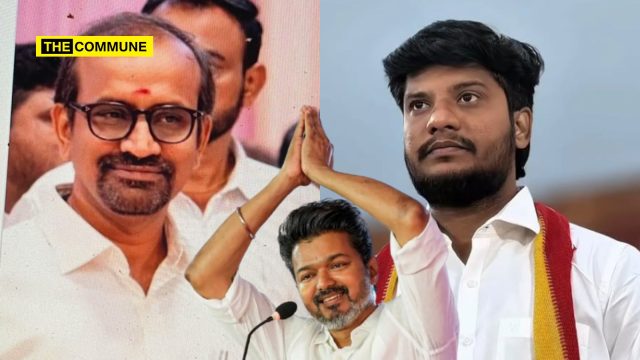
TVK Vijay Broke The Duopoly, Can He Build A Government?

vijay tvk

Thalapathy Vijay has done what most political veterans said was impossible. In its debut election, his Tamilaga Vettri Kazhagam has emerged as Tamil Nadu’s single largest party, leading in approximately 106–110 seats in a 234-member assembly – a result that has shattered the decades-old DMK-AIADMK duopoly overnight.

But leading is not governing. And the road to the Tamil Nadu Secretariat is considerably more complicated than the ballot count suggests.

The Hung Assembly Problem?

TVK’s lead is historic. Its majority is not. With 118 seats required and TVK currently short of that threshold, Tamil Nadu is staring at a hung assembly. The Governor will invite the single-largest party to prove its majority giving Vijay some time to demonstrate he commands the floor. That sets the clock ticking on a frantic post-poll negotiation that will determine whether his government is born stable or compromised from day one.

Congress had already signalled openness to supporting TVK – a party that Congress members were keen to ally with. The Left parties and VCK, long-suffering junior partners who felt humiliated by DMK’s seat allocation, have little reason to stay loyal to a sinking ship. PMK, currently in the AIADMK alliance, is reportedly already receiving feelers about switching sides in exchange for a ministerial portfolio. The arithmetic is available. The price is political debt.

The Manifesto He Must Now Fund

Vijay’s electoral promises were sweeping and specific: ₹2,500 monthly for women heads of households, six free LPG cylinders annually, farm loan waivers, five lakh government jobs, ₹15,000 annual school aid per child, ₹3,000 monthly pension for the elderly, 200 units of free power, and a ₹25 lakh family health insurance scheme. Every single one of these commitments has a price tag. Tamil Nadu already carries significant fiscal stress inherited from the outgoing DMK government. Delivering these schemes without either raising taxes or escalating debt will require a level of financial engineering that even PTR, with all his MIT Sloan credentials, struggled to execute, only to lead TN to nearly 10 lakh crore in debt.

The Inexperience Factor

Of TVK’s likely legislators, the overwhelming majority have never held public office. Many were recruited late, with no deep roots in party ideology. The internal power dynamics, between figures like Bussy Anand, John Arokiaraj, Aadhav Arjuna were already visible during candidate selection. A government where the CM is the singular centre of gravity, surrounded by first-time MLAs and competing power brokers, carries structural fragility that a well-organised opposition will ruthlessly exploit.

The DMK, now in opposition, retains its media network, its cadre machinery, and its institutional memory of exactly how to make a government bleed slowly. It will not rest.

The Opportunity

None of this means Vijay will fail. It means he has no margin for complacency. Tamil Nadu has handed him a genuine mandate for change, built on five years of public anger, broken promises, and a ruling family that confused dynasty with democracy. That mandate is real, and it is his to either honour or squander.

The question is not whether Vijay can win Tamil Nadu. He already has. The question is whether he can govern it. Will he last 5 years or break in a few? Only time will tell.

Subscribe to our channels on WhatsAppTelegram, Instagram and YouTube to get the best stories of the day delivered to you personally.