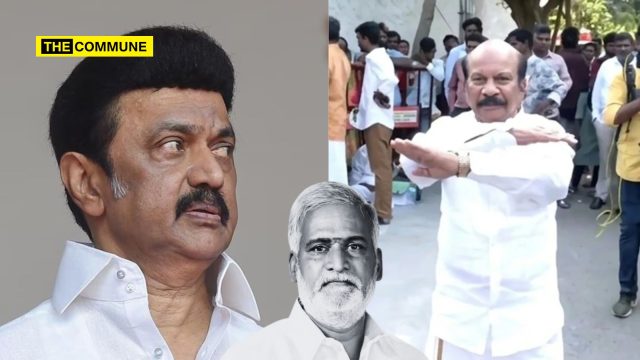
In a stunning upset in the 2026 Tamil Nadu Assembly elections, Chief Minister M K Stalin was defeated in his Kolathur stronghold by TVK candidate V S Babu by a margin of 8,795 votes, overturning confident projections by DMK cadres who had expected a victory margin exceeding 75,000 votes, as reported in Times of India.
As the campaign drew to a close, DMK functionaries in Kolathur had publicly expressed strong confidence in Stalin’s re-election, citing extensive campaigning efforts and the implementation of development projects worth several hundred crores in the constituency. However, following the results, party insiders described the defeat as both unexpected and internally driven.
Kolathur area secretary Nagarajan stated that despite coordinated campaigning by party workers, the party failed to effectively manage booth-level operations. He acknowledged that the defeat exposed significant organisational lapses at the grassroots level.
Party sources pointed to internal discord as a decisive factor. A senior minister overseeing Kolathur (PK Sekar Babu) allegedly created parallel power centres, which disrupted coordination among local units.
“A senior minister in charge of Kolathur created parallel power centres”
Why are you so scared to name PK Sekar Babu even now.
He’s no longer a minister, he can’t call and order editors/newspaper owners around. @TOIChennai @Arun_Ram @raguramanTOI pic.twitter.com/MYUxaE6Cgf— Siddharth Prabhakar (@Sidprabhakar7) May 5, 2026
This fragmentation reportedly prevented cadres from communicating grievances directly to the chief minister, leading to resentment within the party ranks. A DMK functionary indicated that this internal friction weakened mobilisation efforts during the election.
Political observers also noted the broader electoral context, including a strong wave in favour of actor-turned-politician Vijay and his party, Tamilaga Vettri Kazhagam (TVK), which emerged as a major force in the state, pushing both DMK and AIADMK to the margins in several constituencies.
V S Babu, who secured victory in Kolathur, leveraged his deep familiarity with DMK’s organisational structure. He had earlier played a key role during Stalin’s first win in Kolathur in 2011, serving as DMK’s North Chennai district secretary and as MLA from Purasawalkam between 2006 and 2011. After switching to AIADMK a decade ago, Babu joined TVK shortly before the 2026 elections, a move that proved strategically significant.
Opposition voices attributed Stalin’s defeat to governance failures at the local level. AIADMK North Chennai district minority wing secretary A Abbas stated that long-standing civic issues in Kolathur remained unresolved over the past 15 years. He cited persistent problems such as poor road conditions, sewage contamination in drinking water, and rainwater stagnation. Abbas alleged that the DMK government prioritised high-visibility schemes and publicity efforts without addressing these basic concerns, contributing to public dissatisfaction.
Historically, Kolathur has been a DMK stronghold. Parts of the constituency were earlier under Purasawalkam, which the DMK retained even during the 1984 elections held amid a strong sympathy wave for M G Ramachandran and the AIADMK. However, in 2026, a notable shift occurred as sections of traditional DMK voters reportedly switched allegiance, contributing to Stalin’s defeat.
The Kolathur result is being seen as emblematic of a larger political shift in Tamil Nadu, with TVK’s rise disrupting long-standing electoral equations and exposing vulnerabilities within established party structures.
Subscribe to our channels on WhatsApp, Telegram, Instagram and YouTube to get the best stories of the day delivered to you personally.