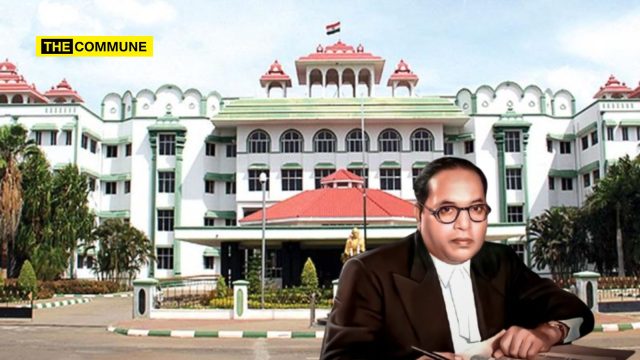
The Madras High Court has directed the Tamil Nadu government to take appropriate policy decisions to incorporate lessons on the life and contributions of Dr BR Ambedkar in the Social Science curriculum, emphasising his role in India’s freedom movement and democratic nation-building, as reported in LiveLaw.
Justice Victoria Gowri stated that the school system should not teach the Constitution merely as a set of “dry institutional facts,” but must present the constitutional journey of India through the lives of those who shaped it. The court observed, “The school system must not teach the Constitution merely as a set of dry institutional facts. It must teach the constitutional journey of India through the lives of those who shaped it. Among them, Dr. BR Ambedkar occupies a place of singular eminence.”
The court further stated, “To know him is to understand why the Constitution insists upon equality. To study him is to understand why democracy must be social before it can remain political. To remember him is to remember that the Republic is a moral project, not merely a territorial arrangement.”
At the same time, the court clarified that it was not within the judiciary’s domain to mandate specific policy decisions or dictate curriculum content. However, it emphasised that constitutional values such as fraternity could not be left to uncertain social transmission and that constitutional literacy must be recognised as a component of social responsibility.
“The seeds sown by our Constitution, particularly those of justice, liberty, equality and fraternity, must be consciously nurtured if they are to endure. The time has come for the State to recognise that constitutional literacy is itself a component of social responsibility,” the court stated, adding that such measures were necessary for shaping informed and constitutionally aware citizens.
The observations were made while hearing a plea seeking to quash criminal proceedings against two men, aged 26 and 29, accused of desecrating a photograph of Dr Ambedkar during his birth anniversary celebrations. According to the prosecution, the de facto complainant had pasted Ambedkar’s photographs at Pulikuthi Bus Stand, following which one of the accused allegedly tore a poster and urinated on it, while the other recorded the act and circulated the video on WhatsApp.
Based on the complaint, a case had been registered under provisions of the Scheduled Castes and Scheduled Tribes (Prevention of Atrocities) Act, 1989. The accused later approached the High Court seeking to quash the proceedings on the basis of a compromise with the complainant.
Since the offences were non-compoundable, the petitioners sought the court’s intervention under its inherent jurisdiction. During earlier hearings, the court had questioned the accused about their knowledge of Ambedkar’s life and found that while they were aware of his stature as a legal figure, they lacked a deeper understanding of his contributions to the Constitution and social reform.
The court then directed the petitioners to purchase 101 books each in Tamil on Ambedkar’s life, retain one copy, and distribute the remaining 100 copies each to students of Classes XI and XII at Murugappa Government Higher Secondary School in T. Kallupatti. They were also instructed to read the book and appear for an oral test.
At a subsequent hearing, the court noted that the petitioners had complied with the directions, demonstrated improved understanding, and expressed regret for their actions. The court recorded that their repentance appeared genuine and that their transformation was evident.
Observing that the justice system need not always choose between punishment and closure, the court stated that a reformative approach based on accountability, education, and social responsibility could be adopted in appropriate cases. It noted, “There exists, in appropriate cases, a narrow but valuable reformative path, one that insists upon accountability, repentance, education and social responsibility as prerequisites to judicial leniency.”
Holding that the corrective purpose of the law had been substantially achieved, the High Court quashed the criminal proceedings, stating that the ends of justice would be better served by doing so.
Subscribe to our channels on WhatsApp, Telegram, Instagram and YouTube to get the best stories of the day delivered to you personally.