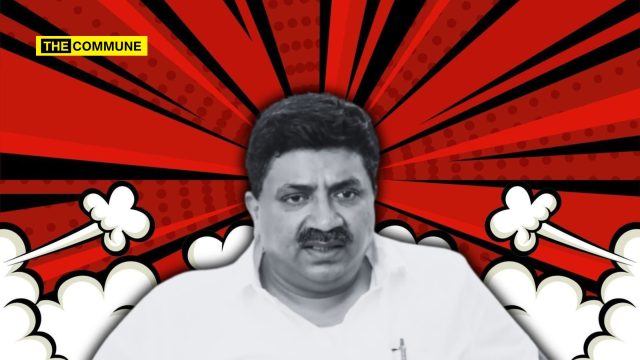
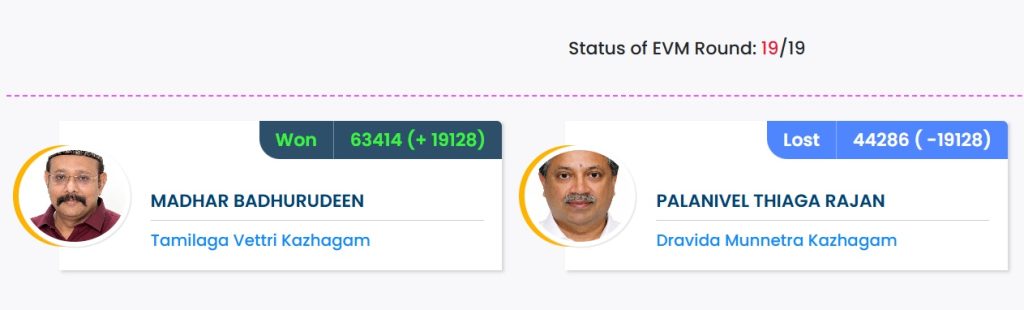
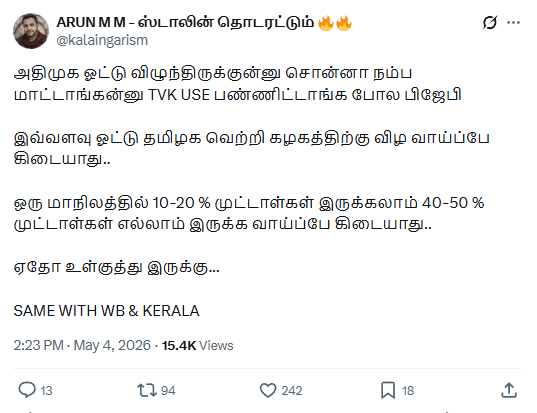
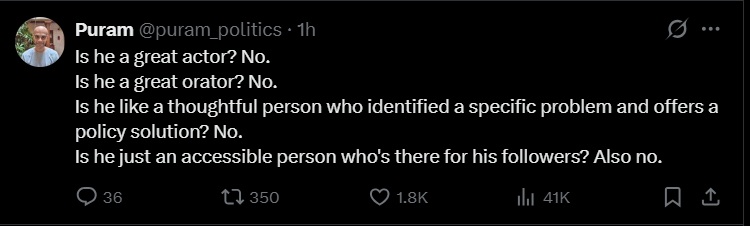
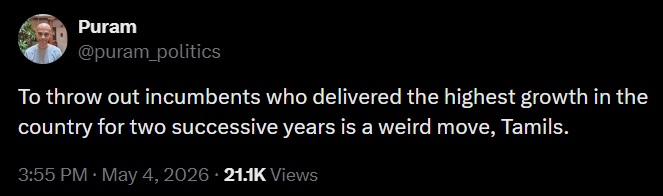
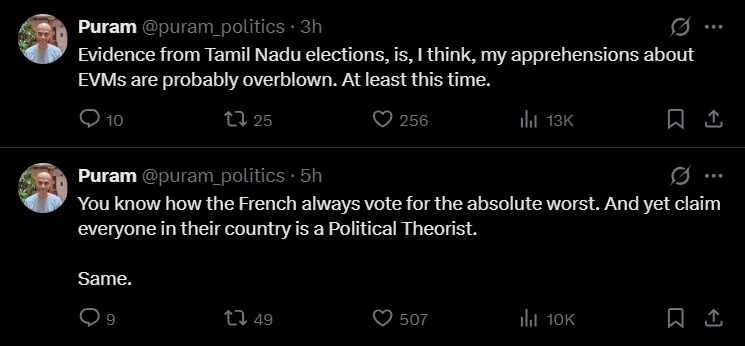
DMK has been trailing since the counting began this morning. One of the most satisfying defeats for many people across the state seems to be that of MIT Sloan educated Lehmann Brothers fame, ultra intellectual, double watch wearer and Pannaiyar – DMK’s Madurai central candidate PTR Palanivel Thiagarajan.
PTR wore his MIT Sloan badge like a badge of superiority. He kept dropping names like Lehman Brothers, USA, University of Buffalo, his experience as a banker, a financial whiz and his experience working in the US in an MNC at the drop of the hat – in every interview, at every opportunity he had. The same high-level PTR who behaves like a ‘Pannaiyar’ has now been defeated in his own constituency, he won twice before.
He was defeated not by a seasoned politician. Not by a veteran organiser with thirty years of booth-level work. But by a candidate from a party that did not exist three years ago.
How His Failures And Arrogance Caused His Downfall
Yes, we all agree PTR is an intelligent chap. That was never the problem. It was how he carried himself and his credentials. He did not do enough for his constituency, he claimed he was not able to do much because of ‘problems’ he couldn’t speak of.
He pooh-pooed his opponent Sundar C, ridiculed him, mocked him and called him names. He called Sundar C an outsider while he branded himself as ‘Maduraikaaran’. He called Sundar C a koothadi, a cinemakaaran, a cinema sanghi when he himself had to bring an actor Prakash Raj from another state to canvass for him.
He talked endlessly about controlling the state’s debt. Meanwhile, Tamil Nadu’s debt kept climbing every single year he was in charge. He quoted international economists and global frameworks in press conferences. Meanwhile, his own city was being ranked among the dirtiest cities in the country.
And when people asked him about it? He didn’t take responsibility. He pointed at the corporation. He essentially told the residents of Madurai: your city looks like this, but that’s not my problem, go complain to someone else.
Add to this, he wore Madurai malli flower garland on his wrist/arm when he went to vote – this made him the butt of many jokes.
Tamil Nadu’s voters, it turns out, understood perfectly. They understood that a man who treats citizens as an inconvenience to good policy is not a democrat. He is a pannaiyaar in a pant and shirt, ‘managing’ his constituency from a distance and wondering why the tenants are ungrateful.
What the Loss Means
PTR’s defeat is one where people are saying they will not condone arrogance and egoistic behaviour. It is Tamil Nadu telling the DMK’s intellectual aristocracy – give respect, take respect. The people do not vote for you for your fancy degrees but the humility you display and the work you do.
They trusted you for 2 terms and what did you give them – betrayal. You could not address even simple civic issues, you could not even hear their complaints, listen to their woes, you lived inside a grand house and guarded it with dogs at the gate, scaring people away.
People want an approachable person as their MLA – someone who will listen to them and not give lectures.
They owe you nothing. You owe them everything. That is the contract. PTR forgot it. And on 4 May 2026, an entire constituency reminded him in the only language that cuts through even the most sophisticated intellectual armour.
A ballot. Marked elsewhere.
Subscribe to our channels on WhatsApp, Telegram,Instagram and YouTube to get the best stories of the day delivered to you personally.
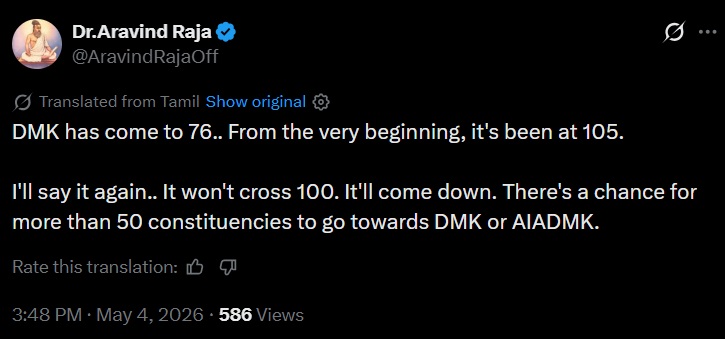
As the DMK found itself trailing for most part of the day of counting on 4 May 2026, the meltdown suffered by supporters or rather ‘Oopies’ was telling.
Celebrations were already planned in Arivalayam with tents set up and crackers ready. However, ADMK took the early lead and TVK was a close second in the first few hours of counting. Seeing this, everything was dismantled at the DMK HQ.
#WATCH | Tamil Nadu Assembly Elections | Tents are being removed from Anna Arivalayam, the DMK headquarters in Chennai, as the early trends show DMK at a distant third position.
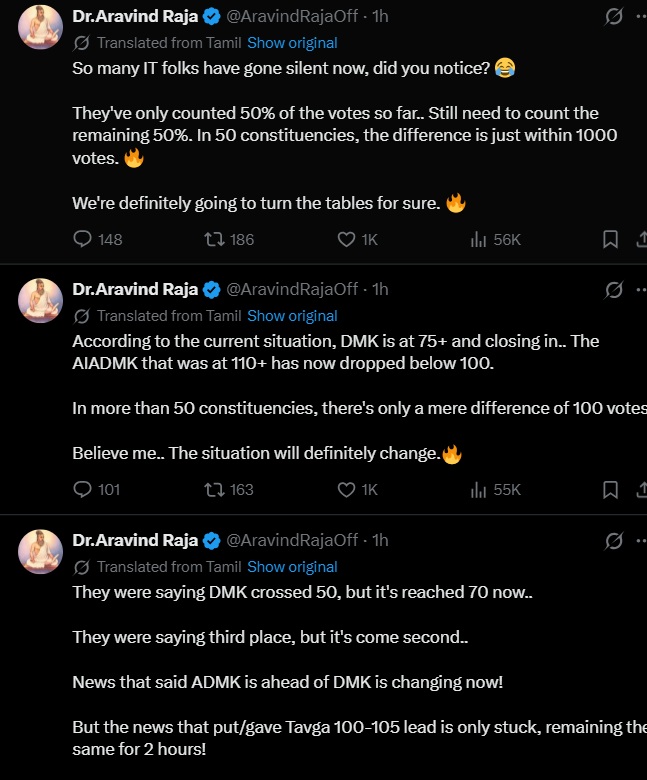
Several of its supporters on social media were in denial mode and kept maintaining that DMK would win.
One casteist and abusive handle on social media, a DMK supporter has been in severe denial mode since the morning. He continuously kept repeating that since voting was not over, TVK won’t form the government and DMK would, instead.
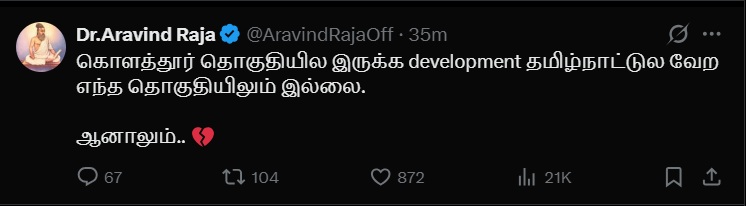
He claimed Kolathur constituency where MK Stalin is contesting had superior development. But the people were not loyal enough to vote for him.
Here are some more gems from the same handle.
The whining has been non-stop.
Now let’s look at a few others who suffered meltdown.
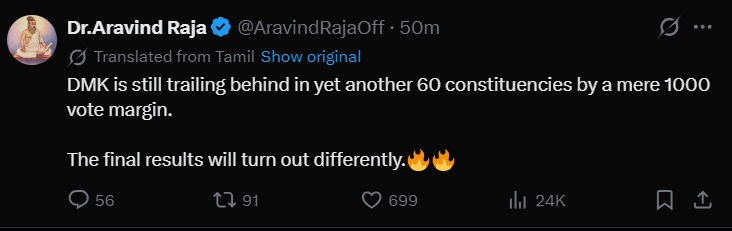
110 இடத்துல திமுக ரெண்டாவது இடம்.. அதுல 60 இடத்துல 1000 க்கும் குறைவான வாக்கு வித்தியாசம்.
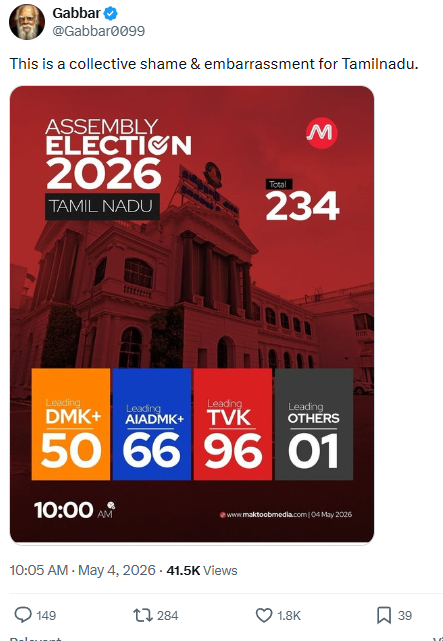
Some handles that are not from TN but have been pretending to be, also went from ‘TN is educated because of DMK’ to ‘collective shame and embarassment’ just because the state voted DMK out of power.
Image source: Tamil Labs
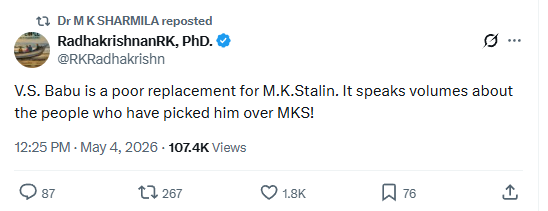
Since MK Stalin has been trailing in Kolathur, the supporters, ie, Oopies have started blaming the people.
Image source: Tamil Labs
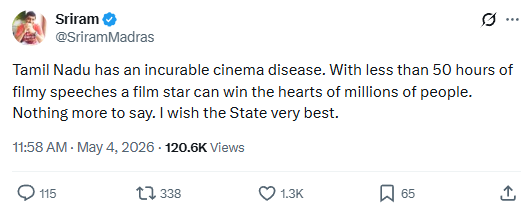
The DMK supporter/influencer oopie who lives in the US and abused TVK voters as ‘Otteri nari’ ‘Dumeel Kuppam Vavval’ suffered a meltdown calling people having a ‘cinema disease’. Well, the DMK itself used MGR’s cinema presence and fame to win the 1967 election. Karunanidhi was a scriptwriter, so was Annadurai. MK Stalin and Udhayanidhi Stalin launched themselves through cinema.
Image source: Tamil Labs
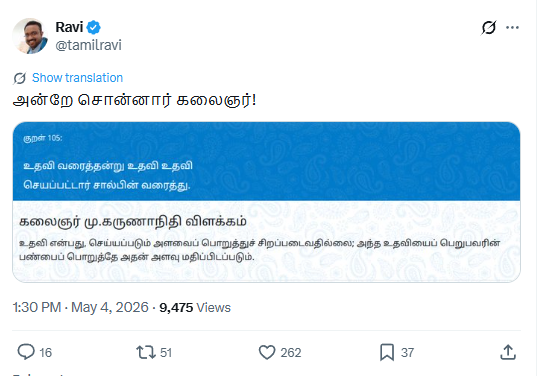
Another insufferable supporter even quoted Thirukural with Karunanidhi’s commentary shaming voters that said something like people were ungrateful. He was indicating that if one didn’t vote for the DMK, they were useless.
Image source: Tamil Labs
Some went on to claim that TN would now become a UP or Bihar.
Image source: Tamil Labs
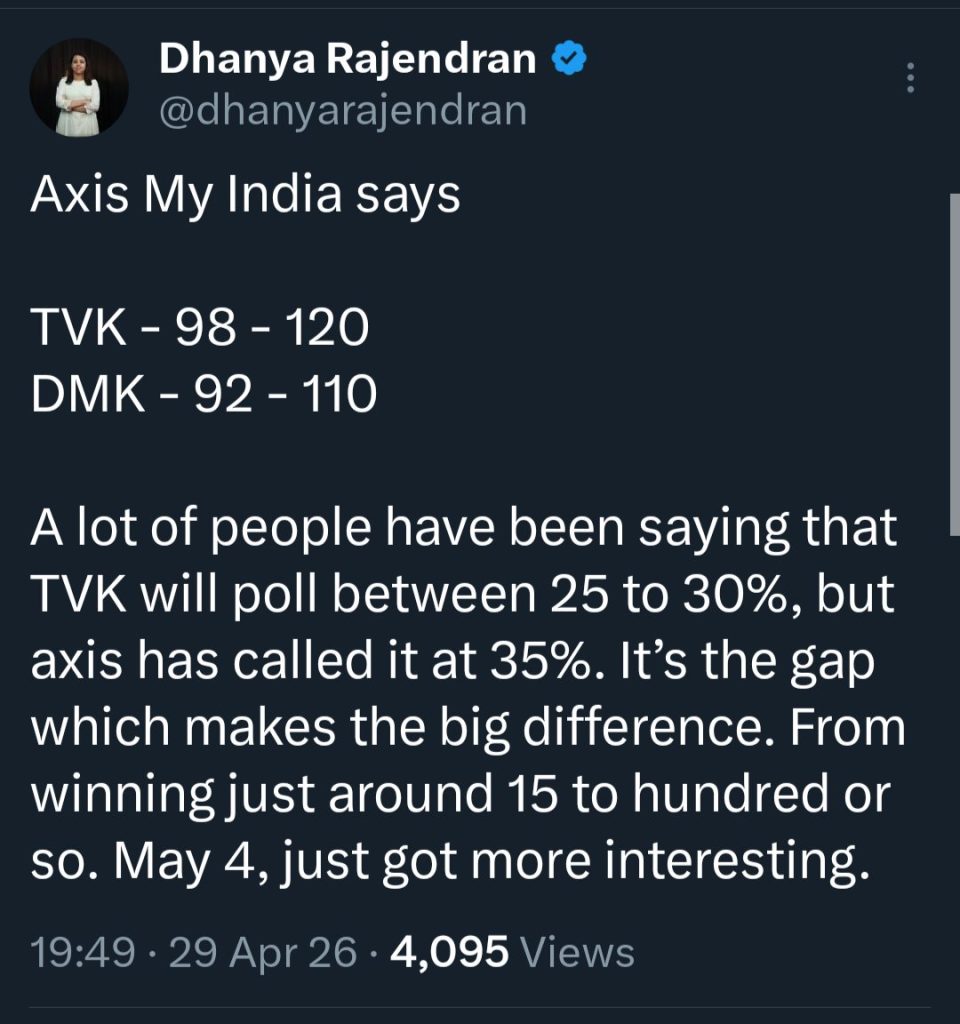
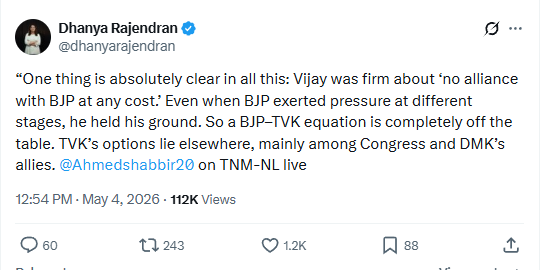
TNM editor in chief Dhanya Rajendran who almost rubbished the Axis My India exit poll earlier
seemed to have jumped ship to be on the good side of the incoming government.
Image source: Tamil Labs
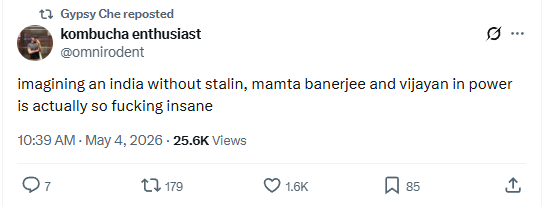
Here are a few more who pretend that the world would collapse because MK Stalin would not going to be Chief minister.
Image source: Tamil LabsImage source: Tamil Labs
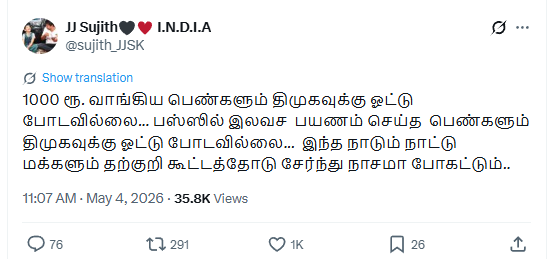
A few others again mocked the people for taking all the freebies from the DMK and still voting for TVK.
Image source: Tamil Labs
Another one abused the voters as idiots.
Image source: Tamil Labs
Here are a few more.
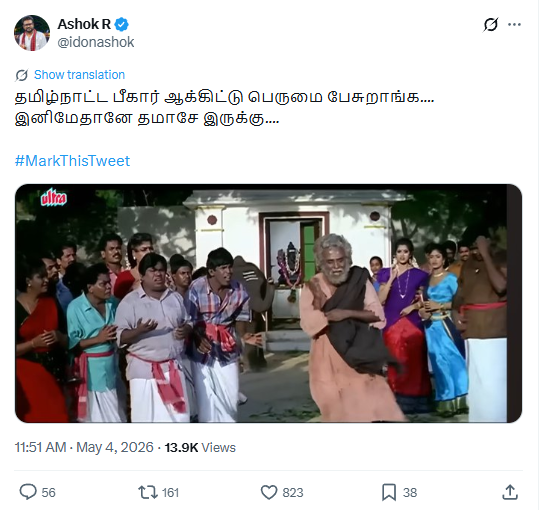
While the DMK is leading in about 56 constituencies and won 3, the supporters, ie Oopies will still take time to come out of denial and go through the five stages of grief before accepting reality.
Subscribe to our channels on WhatsApp, Telegram,Instagram and YouTube to get the best stories of the day delivered to you personally.
Tamil Nadu voted. And if the trends hold, the people have delivered a verdict not just against a party, but against a decade of arrogance dressed up as governance.
The DMK’s five years in power were not marked by governance. They were marked by the management of perception. Crores spent on advertising. A propaganda machinery so vast it confused noise for achievement. Meanwhile, the actual Tamil Nadu – the one with unemployed youth, unresolved government workers, broken government hospitals, law and order breaking down irreparably, and promises that expired quietly was told to look at the advertisements and feel grateful.
The breaking point didn’t come suddenly. It accumulated. It came when critics of the government were treated not as political opposition but as enemies to be crushed. When non-DMK leaning journalists who questioned the government found themselves frozen out, cases filed against them, vilified. When DMK supporters on social media operated as a digital militia, browbeating dissent with coordinated abuse. The party that once claimed the mantle of social justice, the opposers of ‘fascism’ began to resemble, in its conduct, exactly the fascist, hierarchical arrogance it claimed to oppose.
People were not fooled. They watched. They waited. And in April 2026, with an unprecedented 85% voter turnout, they spoke.
The Vijay Phenomenon
Thalapathy Vijay’s Tamilaga Vettri Kazhagam entered this election as a political newborn – no legacy machinery, no entrenched cadre network, no decades of booth-level organisation. What it had was something the DMK had spent five years destroying: trust.
Vijay’s appeal cut across the fatigue lines. Young voters, first-time voters, women, parents who had watched their families struggle while the government celebrated so-called ‘double-digit’ growth – they found in TVK not an ideology but an alternative. That is both TVK’s greatest strength and its most serious structural vulnerability. A party built on a leader’s personal magnetism has no immune system against the moment that leader disappoints.
The Verdict
TVK is leading in about 110 seats as of now, enough to form a government, with or without post-poll support. Vijay, who entered politics barely two years ago with no legislative experience, no party infrastructure, and no inherited vote bank, is on the verge of becoming Tamil Nadu’s Chief Minister. That is, by any measure, a seismic democratic moment.
But 110 seats mean TVK almost certainly does not have a standalone majority in the 234-seat assembly. The arithmetic of coalition will kick in immediately and the queue of parties offering “unconditional support” will include Congress, whose price has never truly been unconditional.
The Danger That Follows the Victory
Here is where Tamil Nadu must not mistake the relief of DMK’s exit for the arrival of safety.
The Congress party, TVK’s most likely coalition partner, has spent decades cultivating Tamil Nadu’s Christian community as its most reliable vote bank, especially in deep South Tamil Nadu which is Christian dominated. Congress’s ties to church hierarchies – Catholic, CSI, and Pentecostal denominations run deep and transactional.
TVK itself actively courted this same constituency during the campaign. Vijay did a ‘Samathuva Christmas’ event with church pastors and Christian preachers. There was a simmering anger of the Christians against the DMK for various reasons. George Ponnaiah had hinted at this. The Christian vote, concentrated in Tirunelveli, Kanyakumari, and parts of North Chennai, became a prize both DMK and TVK competed for aggressively.
A TVK government propped up by Congress support is not a theoretical concern. It is the arithmetic of Tamil Nadu’s coalition math and coalition debts in Indian politics are never paid in cash. They are paid in policy, in appointments, in administrative silence, and in the quiet looking-away that allows certain agendas to advance without ever appearing in a manifesto.
Southern Tamil Nadu – Kanyakumari, Tirunelveli, parts of Thoothukudi has been a live laboratory for this process for four decades. The demographic and religious composition of entire taluks has shifted within a single generation. This did not happen through persuasion alone. It happened because at critical moments, the administration was either complicit or absent.
A TVK government indebted to Congress’s church network will not reverse this. It will, at minimum, ensure the administration remains absent. That is all the space these networks need.
The Longer Game
The cruelest irony may be this: if a TVK-Congress government governs with an openly minority-appeasing, evangelical-networked agenda, the backlash will come, but after a decade. And a decade is enough time to reshape school syllabuses, alter demographic pockets, weaken temple administration further, and entrench the very networks that funded the political access.
Tamil Nadu’s Hindu majority, never organised, never politically consolidated the way minority communities have been, will absorb the damage quietly for years before the anger crystallises into votes. But the question is what Tamil Nadu looks like after those ten years.
The people of Tamil Nadu voted for change. Whether they get change or merely a change of hands on the same lever depends entirely on what Vijay does in the next 72 hours. Who he calls. What he agrees to. Whose support he accepts.
That phone call, not the ballot count, will define Tamil Nadu for the next decade.
Subscribe to our channels on WhatsApp, Telegram,Instagram and YouTube to get the best stories of the day delivered to you personally.
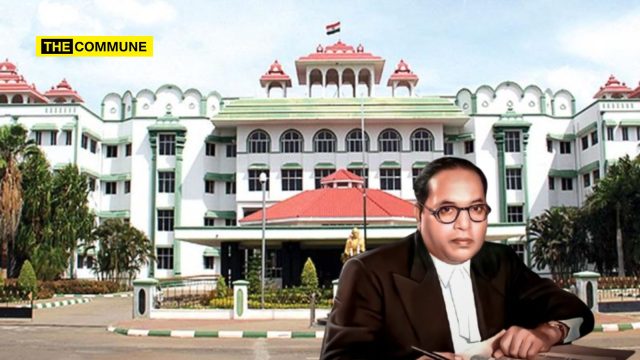
The Madras High Court has directed the Tamil Nadu government to take appropriate policy decisions to incorporate lessons on the life and contributions of Dr BR Ambedkar in the Social Science curriculum, emphasising his role in India’s freedom movement and democratic nation-building, as reported in LiveLaw.
Justice Victoria Gowri stated that the school system should not teach the Constitution merely as a set of “dry institutional facts,” but must present the constitutional journey of India through the lives of those who shaped it. The court observed, “The school system must not teach the Constitution merely as a set of dry institutional facts. It must teach the constitutional journey of India through the lives of those who shaped it. Among them, Dr. BR Ambedkar occupies a place of singular eminence.”
The court further stated, “To know him is to understand why the Constitution insists upon equality. To study him is to understand why democracy must be social before it can remain political. To remember him is to remember that the Republic is a moral project, not merely a territorial arrangement.”
At the same time, the court clarified that it was not within the judiciary’s domain to mandate specific policy decisions or dictate curriculum content. However, it emphasised that constitutional values such as fraternity could not be left to uncertain social transmission and that constitutional literacy must be recognised as a component of social responsibility.
“The seeds sown by our Constitution, particularly those of justice, liberty, equality and fraternity, must be consciously nurtured if they are to endure. The time has come for the State to recognise that constitutional literacy is itself a component of social responsibility,” the court stated, adding that such measures were necessary for shaping informed and constitutionally aware citizens.
The observations were made while hearing a plea seeking to quash criminal proceedings against two men, aged 26 and 29, accused of desecrating a photograph of Dr Ambedkar during his birth anniversary celebrations. According to the prosecution, the de facto complainant had pasted Ambedkar’s photographs at Pulikuthi Bus Stand, following which one of the accused allegedly tore a poster and urinated on it, while the other recorded the act and circulated the video on WhatsApp.
Based on the complaint, a case had been registered under provisions of the Scheduled Castes and Scheduled Tribes (Prevention of Atrocities) Act, 1989. The accused later approached the High Court seeking to quash the proceedings on the basis of a compromise with the complainant.
Since the offences were non-compoundable, the petitioners sought the court’s intervention under its inherent jurisdiction. During earlier hearings, the court had questioned the accused about their knowledge of Ambedkar’s life and found that while they were aware of his stature as a legal figure, they lacked a deeper understanding of his contributions to the Constitution and social reform.
The court then directed the petitioners to purchase 101 books each in Tamil on Ambedkar’s life, retain one copy, and distribute the remaining 100 copies each to students of Classes XI and XII at Murugappa Government Higher Secondary School in T. Kallupatti. They were also instructed to read the book and appear for an oral test.
At a subsequent hearing, the court noted that the petitioners had complied with the directions, demonstrated improved understanding, and expressed regret for their actions. The court recorded that their repentance appeared genuine and that their transformation was evident.
Observing that the justice system need not always choose between punishment and closure, the court stated that a reformative approach based on accountability, education, and social responsibility could be adopted in appropriate cases. It noted, “There exists, in appropriate cases, a narrow but valuable reformative path, one that insists upon accountability, repentance, education and social responsibility as prerequisites to judicial leniency.”
Holding that the corrective purpose of the law had been substantially achieved, the High Court quashed the criminal proceedings, stating that the ends of justice would be better served by doing so.
Subscribe to our channels on WhatsApp, Telegram,Instagram and YouTube to get the best stories of the day delivered to you personally.
A 28-year-old man allegedly attempted suicide in Tamil Nadu’s Krishnagiri district after reportedly being distressed by rumours related to actor-turned-politician Vijay and the outcome of the ongoing Assembly election, according to a report by Free Press Journal.
The incident was reported shortly before the commencement of vote counting, causing concern among local residents. The man, identified as K. Mahendran was stated to be a supporter of Vijay and his Tamilaga Vettri Kazhagam (TVK) party.
According to police, Mahendran became distressed after hearing unverified claims suggesting that Vijay might lose the election. Officials stated that, unable to cope with the anxiety, he allegedly attempted to take his own life by slitting his throat near his residence.
Eyewitnesses were reported to have intervened promptly and shifted him to the Krishnagiri Government Medical College and Hospital. A police official stated that bystanders rescued him and ensured he was taken to the hospital, where he was undergoing intensive treatment.
Hospital authorities indicated that Mahendran remains admitted and is under close medical supervision.
Police officials urged the public to avoid spreading or acting upon unverified information, particularly during sensitive periods such as elections. They also emphasised the importance of mental health awareness and advised individuals to seek support when experiencing emotional distress.
Subscribe to our channels on WhatsApp, Telegram,Instagram and YouTube to get the best stories of the day delivered to you personally.
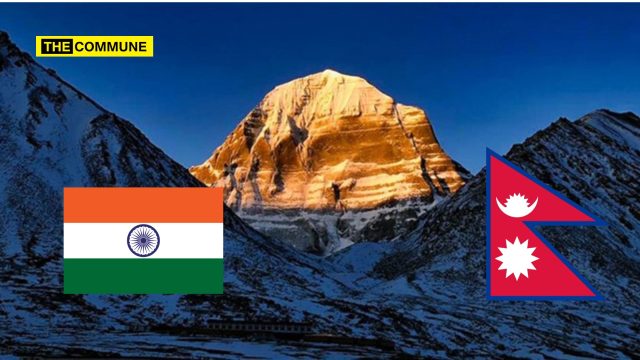
The Government of India, on 1 May 2026, announced that the Kailash Manasarovar Yatra for 2026 will be conducted between June and August, in coordination with the Government of the People’s Republic of China, according to a statement issued by the Ministry of External Affairs.
Kailash Manasarovar Yatra organised by the Ministry of External Affairs in coordination with the Government of the People’s Republic of China is set to take place during June to August 2026: India Statement pic.twitter.com/sU8VWbPwGW
The yatra is scheduled to be organised in multiple batches, with pilgrims travelling via designated routes including the Lipulekh Pass in Uttarakhand and the Nathu La route in Sikkim. The Ministry stated that applications would be processed through an online system, with yatris selected through a computerised and transparent process.
The announcement triggered a diplomatic response from Nepal, with its Ministry of Foreign Affairs issuing a statement objecting to the use of the Lipulekh route. On 3 May 2026, the Nepal government maintained that Lipulekh falls within its territory and asserted that any activities, including the Kailash Manasarovar Yatra, should not be undertaken through the region without its consent.
In its statement, Nepal reiterated its position that areas such as Lipulekh, Kalapani, and Limpiyadhura form part of its sovereign territory, citing historical treaties and maps as the basis for its claim. It also stated that it had conveyed its concerns to both India and China through diplomatic channels and urged restraint in undertaking activities in the disputed region.
Breaking: Nepal’s Balen Shah Govt tells India, China not to undertake Kailash Mansarovar Yatra through Lipilekh since it is ‘Nepal Territory’.
Responding to the development, India rejected Nepal’s claim over Lipulekh Pass and described it as a long-standing and established route for the Kailash Manasarovar Yatra. Ministry of External Affairs spokesperson Randhir Jaiswal stated that the yatra had been conducted through this route for decades, including since 1954.
He further stated that India’s position on the issue remained consistent and clear, adding that Nepal’s claims were not justified and were not supported by historical facts or evidence. He described what he termed as unilateral attempts to enlarge territorial claims as untenable.
At the same time, the spokesperson emphasised that India remained open to engaging with Nepal through dialogue and diplomatic channels to address all outstanding bilateral issues, including boundary-related concerns.
Subscribe to our channels on WhatsApp, Telegram,Instagram and YouTube to get the best stories of the day delivered to you personally.
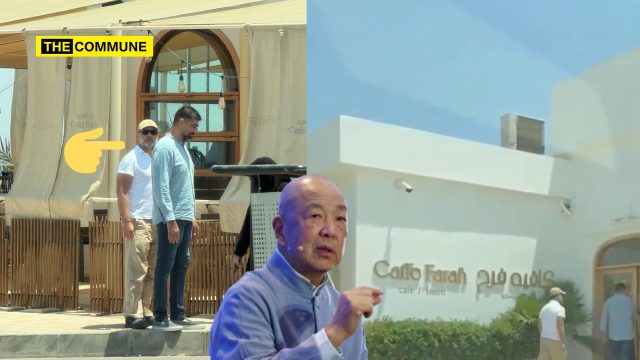
Three days before Kerala and other state election results were declared, Congress scion Rahul Gandhi was spotted at a beachfront café in Muscat, Oman. No press briefing. No official itinerary. No statement from the Congress party. The only record of the visit came from videos shot from passing cars on Azaiba Beach, clips that spread across social media within hours on 3 May 2026.
Gandhi was dressed casually – cap, sunglasses, civilian clothes. For a politician who had just delivered one of his most incendiary speeches on Indian soil less than a week earlier, the contrast was striking.
So this guy after spilling raita in Nicobar mid-election has now secretly ran away to Muscat, Oman
In late April 2026, Gandhi flew to Great Nicobar Island and publicly attacked the Indian government’s ₹81,000 crore holistic development project – a mega-infrastructure push involving a deepwater port, an airport, and strategic connectivity infrastructure at one of India’s most sensitive Indian Ocean locations. He called it environmental destruction, accused the Adani Group of land-grabbing, and demanded the project be stopped.
I travelled through Great Nicobar today.
These are the most extraordinary forests I have ever seen in my life. Trees older than memory. Forests that took generations to grow.
The people on this island are equally beautiful – both the adivasi communities and the settlers – but… pic.twitter.com/vYdBWdYfIJ
What Gandhi did not mention publicly is that Great Nicobar sits astride critical Indo-Pacific sea lanes and that the project is, in significant part, India’s strategic answer to growing Chinese naval and commercial presence in the region.
Days after that speech, he was in Muscat.
The café Gandhi visited Café Farah, also styled Caffe Farah, is operated by Al Zaman Hospitality LLC, a subsidiary of the Al Zaman Group, an Oman-based diversified conglomerate. Its Managing Director is Khalid Mohamed Zaman; a businessman whose name appears in multiple Gulf corporate registries. The café sits in the Azaiba area of Muscat, a zone known for its diplomatic density and international clientele, not a random roadside stop.
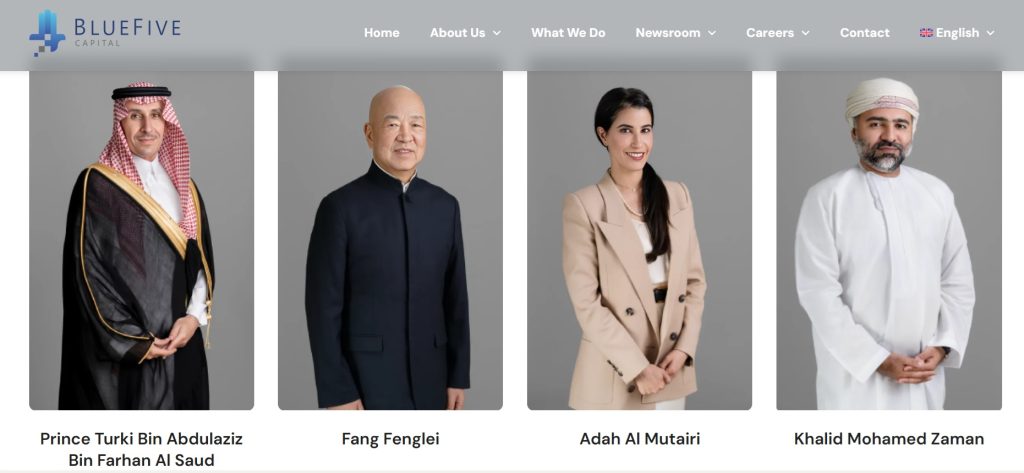
Khalid Zaman’s name surfaces in a more significant context beyond hospitality. He holds a board seat at BlueFive Capital – a private equity firm operating across Abu Dhabi, London, and Beijing, with a focus on Gulf economies and Global South investments. BlueFive made headlines in 2025 when it launched its $3 billion Onyx Fund and held its inaugural board meeting in Bahrain. Zaman has since been appointed Vice Chairman of BlueFive Leasing, a related Muscat-based entity.
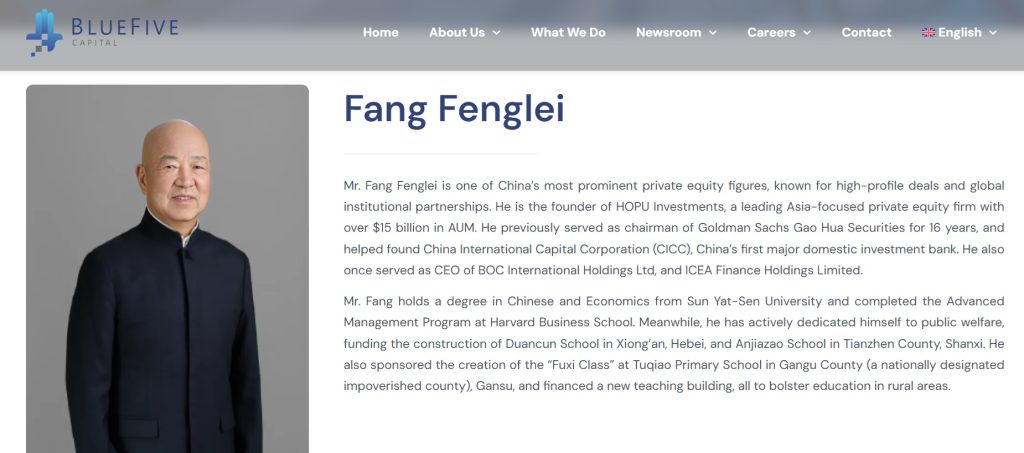
The BlueFive board is where the story gets complicated. Sitting alongside Zaman is Fang Fenglei – founder and chairman of Hopu Investment Management, one of China’s most powerful private equity firms.
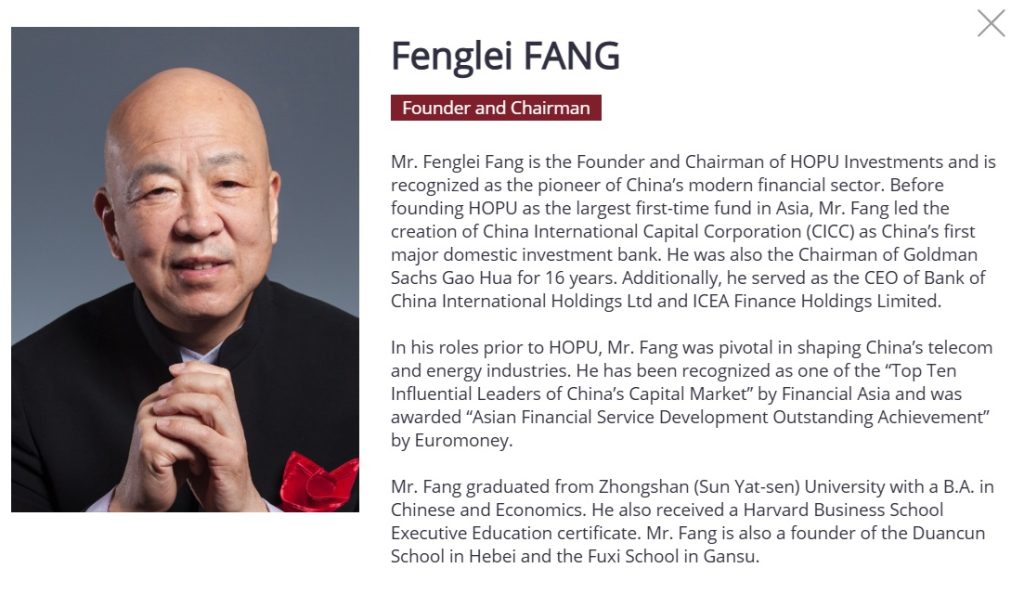
Fang is not simply a successful financier. He is the man who architected China’s modern investment banking infrastructure, served as non-executive chairman of Goldman Sachs China, and spent two decades leveraging that position to extract far more institutional knowledge and access than Goldman Sachs originally anticipated.
Fang Fenglei founded HOPU Investments
His father was an officer in the People’s Liberation Army. More consequentially, Fang built a personal friendship with Wang Qishan, currently China’s Vice President and Xi Jinping’s most trusted political enforcer, dating back to their shared years in Henan Province.
It was Fang who convinced Wang Qishan to establish CICC in 1995, China’s first joint-venture investment bank, which Goldman Sachs helped set up.
The regulatory implications of Fang’s network are not theoretical. India classifies direct investment from Chinese private equity entities, particularly those with documented CCP political links, as requiring extreme scrutiny in strategic sectors including technology, telecom, and financial services. Hopu Investments falls squarely within that classification.
The chain of connections that online researchers have mapped runs as follows: Xi Jinping’s inner circle, to Wang Qishan, to Fang Fenglei, to BlueFive board partner Khalid Zaman, to Café Farah, to Rahul Gandhi’s unannounced visit. Every single link in that chain is sourced from public corporate filings, BlueFive Capital’s own press releases, and established biographical records. None of it is invented.
A politician who just publicly opposed India’s most strategically sensitive infrastructure project, one designed in part to counter Chinese influence, then travels unannounced to a Gulf city and walks into a café owned by a man who shares a board table with one of the CCP’s most connected financiers. No explanation offered. No press access. No timeline provided.
Subscribe to our channels on WhatsApp, Telegram,Instagram and YouTube to get the best stories of the day delivered to you personally.
The Muslim Youth League (MYL) has renewed its demand for the bifurcation of Malappuram district, with its Tirurangadi constituency committee passing a resolution proposing the creation of a new district headquartered in Tirurangadi, as reported in OnManorama.
According to the proposal, the new district would be formed by combining the taluks of Tirur, Ponnani, Kondotty, and Tirurangadi. The existing Malappuram district would be reorganised with Malappuram town as its headquarters, comprising Eranad, Perinthalmanna, and Nilambur taluks.
As soon as the exit poll results were announced, the Muslim League revealed its true colour. 🚨
Muslim League has now come forward with a resolution demanding the division of Malappuram district.
The real aim behind the demand for a new district headquartered at Tirurangadi is… pic.twitter.com/sxoTKlchRq
The resolution stated that bifurcation would improve administrative efficiency, enable faster delivery of government services, reduce regional development disparities, and generate infrastructure and employment opportunities. It further noted that separate development policies could be effectively implemented for coastal, hilly, and urban regions under a reorganised administrative framework.
The MYL argued that Malappuram, with a population exceeding four million, remains the most populous district in Kerala, and that its size, geographical diversity, developmental imbalances, and limited administrative infrastructure have made governance increasingly difficult. It pointed out stark regional differences, including the hilly terrain of Nilambur, coastal belts such as Tirur and Ponnani, and rapidly urbanising regions like Kondotty and Eranad, adding that residents often face delays and inconvenience in accessing government services.
The organisation maintained that dividing the district into smaller administrative units had become a necessity and would ensure balanced regional development and improved governance. It also noted that the demand for bifurcation was not new, recalling that the Kerala Muslim Jamaat had earlier raised a similar demand citing public convenience.
The issue has since escalated into a wider political controversy, particularly as it emerged on the eve of election results, with the Indian Union Muslim League (IUML) facing criticism over both the bifurcation demand and leadership preferences for the chief minister’s post. The presence of senior leaders, including state president Sadiq Ali Shihab Thangal and general secretary P M A Salam, at the Tirurangadi event intensified the debate across Kerala.
Opposition parties, including Sangh Parivar organisations, alleged that the IUML was advancing a community-centric agenda ahead of a possible United Democratic Front (UDF) government. Activist K P Sasikala was reported as stating on social media that the political leadership in Kerala should prevent the League from gaining influence in government, warning of consequences if it played a decisive role, as reported in The New Indian Express.
Responding to the controversy, Salam stated that bifurcation was necessary given the district’s high population density, and added that other districts such as Thiruvananthapuram and Ernakulam could also be considered for division on similar grounds. He clarified that the IUML had not taken an official position on the matter, explaining that the resolution was passed by the Youth League constituency committee and that the party had not yet discussed it formally. He also stated that although he attended the programme, he had left after the inauguration.
Meanwhile, tensions within the UDF have reportedly increased following Thangal’s remarks suggesting that V D Satheesan was the most suitable candidate for the chief minister’s post, with him indicating that the final decision would be based on public sentiment.
SNDP Yogam leader Vellappally Natesan criticised the Muslim League, stating that it was inappropriate for the party to decide the Congress leadership and alleging that a UDF government could become a “religious dictatorship” of the League. He also warned of potential communal tensions.
Within the Congress, internal dissatisfaction has also been reported, with a senior leader indicating that the League’s stance on leadership had disrupted front-level coordination and worsened existing factional tensions.
Salam, however, rejected the criticism, alleging that the media had misinterpreted Thangal’s remarks and that attempts were being made to communalise the issue. He further stated that reports circulating on the matter were fabricated and that the Congress leadership had not raised objections to Thangal’s statement.
Subscribe to our channels on WhatsApp, Telegram,Instagram and YouTube to get the best stories of the day delivered to you personally.
In 1893, a 26-year-old Telugu man with ink-stained ambitions and a chemist’s curiosity launched a balm in Bombay. He wasn’t a doctor. He wasn’t a pharmaceutical magnate. He was a journalist who had spent time in apothecary shops, first in Madras, then in Calcutta, quietly learning how pain could be formulated into relief. His name was Kasinadhuni Nageswara Rao Pantulu. The balm was Amrutanjan. Together, they would outlast the Empire.
The Man Before The Balm
Born on 1 May 1867, in Elakurru village, Krishna district – a flat, fertile strip of the Telugu heartland, Nageswara Rao was not a man who fit into a single category. He graduated from Madras Christian College in 1891 under Dr. Rev. Miller, whose discipline produced a generation of sharp, self-possessed Indian graduates. His mind was already being shaped by the writings of Kandukuri Veeresalingam Pantulu, the father of the Telugu Renaissance, whose essays on social reform and national pride circulated in journals that the colonial press could not quite suppress.
He moved to Bombay to work at a European firm, William and Company, and rose steadily through the ranks. But salaried employment was never going to hold a man like this. He had watched too many of his people pay European prices for European medicine, for ailments that could be treated far more cheaply if only someone had the will to try.
The Yellow Formula In a Market Owned By Others
The Indian pain relief market in the late 1800s was not empty – it was occupied. Imported menthol rubs, British-distributed ointments, and brands like Vicks VapoRub (an American product that had found eager distribution channels across the British Empire) dominated pharmacy shelves and colonial households alike. These products were expensive, foreign, and carried the quiet authority of Western medicine – the implicit message being that anything made locally was inferior by definition.
What Nageswara Rao produced in 1893 was a camphor-and-menthol-based analgesic – yellow, pungent, and aggressive in the best possible sense. It smelled nothing like the odourless, “refined” imported balms. It smelled like a monsoon had passed through a eucalyptus forest. It hit harder, lasted longer, and cost a fraction of what the imported alternatives demanded. The British Patent Medicine Tax had made imported drugs expensive for ordinary Indians — Rao deliberately undercut that price point, putting effective pain relief within reach of people the imported brands had never even considered as customers.
He classified Amrutanjan as an Ayurvedic Proprietary Medicine – a categorisation that was legally precise and strategically brilliant. By proving that his ingredients were rooted in ancient Indian pharmacology while his manufacturing was modern, he navigated the complex colonial tax structure that crushed purely Western drug imports. He used the British legal system as a competitive weapon.
His marketing was pre-modern in form but post-modern in instinct. He handed out free samples at music concerts and Sabhas, letting the balm sell itself through sensation. He sponsored songs and poems about it. In a country with low literacy and high communal memory, he understood that a brand had to be felt, heard, and smelled, and not merely read. Where imported balms advertised sophistication, Amrutanjan advertised experience. The overpowering scent that the imported brands quietly mocked became its greatest asset – a sensory signature that no one who encountered it once could ever forget. For years, the word “Bombay” was pressed into every tin lid – a quiet, unapologetic declaration that this came from Indian hands, Indian soil.
By the early 1900s, Amrutanjan had done something that colonial commercial logic said was impossible: it had made Indian consumers actively prefer an Indian product over a Western one – not out of patriotic obligation, but because it simply worked better.
The Balm And The Newspaper
Amrutanjan made Nageswara Rao wealthy enough to ask the next question: what should wealth do?
His answer was to fund Telugu journalism at a moment when it was most dangerous to do so. In September 1908, he launched Andhra Patrika as a weekly from Bombay. The paper was not neutral. It was built on his fierce belief in political emancipation for India, and specifically for a separate Telugu-speaking Andhra state. When the First World War broke out and the political atmosphere shifted, he moved the paper to Madras and converted it into a daily – the first Telugu daily newspaper from Madras, rolling off the press on 1 April 1914.
In January 1924, he launched Bharati, a Telugu literary journal. In 1926, he established the Andhra Grandha Mala – a publishing house that produced books at deliberately low prices, covering modern works, classical texts, and scientific volumes, explicitly to put knowledge within reach of the ordinary man. He was simultaneously running a company, editing a daily newspaper, funding a literary journal, and running a publishing house. Every jar of Amrutanjan sold was, in some measure, funding all of it.
Mahatma Gandhi, who visited his residence in December 1932, called him “Viswadaata” – the universal donor.
Revolutionary, Prisoner, Philosopher
In 1931, Nageswara Rao was jailed for six months for participating in Gandhi’s Salt Satyagraha. While in prison, he wrote a commentary on the Bhagavad Gita, arguing it was not a sectarian religious text but a universal scripture for all of humanity.
He served as President of the Andhra Pradesh Congress Committee for four consecutive terms between 1924 and 1934. He established over 120 libraries across Andhra districts. He was not simply a man who made a balm and printed newspapers. He was systematically building the infrastructure of a literate, politically conscious Telugu public – one tin, one newspaper, one library at a time.
The Meeting He Chaired, The State He Never Saw
The Sri Bagh Agreement of November 1937, a foundational compact between Telugu leaders ensuring equitable development across all Andhra regions as a precondition for demanding statehood was signed at Nageswara Rao’s own residence in Chennai. He chaired that meeting.
Five months later, on 11 April 1938, he passed away.
The Andhra state he spent his entire life fighting for came into existence on 19 December 1952 – fourteen years after he was gone. That is the particular cruelty reserved for people who build things larger than their own lifetimes.
The Tin That Survived Everything
Amrutanjan became a public limited company in 1936, two years before its founder’s death. In 2007, it was renamed Amrutanjan Healthcare Limited and diversified well beyond the balm. It is still headquartered in Chennai. Vicks is now a Procter & Gamble brand worth billions. Amrutanjan is a 133-year-old company still run out of the city its founder chose.
The tin still says “Bombay.”
There is one footnote that history doesn’t quite know what to do with: chess legend Bobby Fischer once asked Viswanathan Anand to bring him Amrutanjan from India because he couldn’t find it in Iceland. A brand that a Cold War-era American grandmaster was hunting for in the North Atlantic. Nageswara Rao, a journalist, revolutionary, publisher, prisoner, philanthropist, would have appreciated that enormously.
Subscribe to our channels on WhatsApp, Telegram,Instagram and YouTube to get the best stories of the day delivered to you personally.
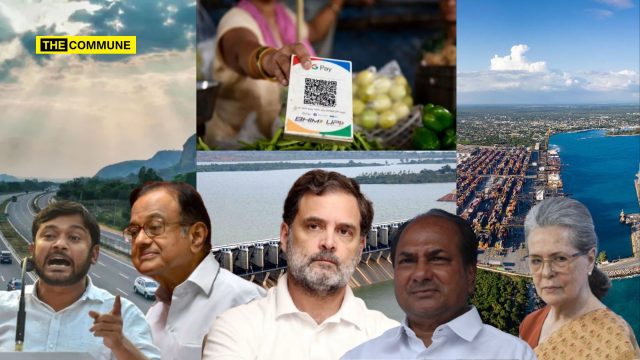
India is a country that, for decades, was told to wait. Wait for roads. Wait for ports. Wait for defence. Wait for bridges. The architects of that waiting were not always natural disasters or bureaucratic delays. Sometimes, they were political choices made deliberately, defended proudly, and occasionally admitted on the floor of Parliament.
The Congress party, its leaders and supporters have, over the years, opposed, stalled, or denounced some of India’s most consequential development projects. Here is the documented record – in their own words.
Ravish Kumar & Ganga Expressway (May 2026)
A video of Ravish Kumar reacting to the newly inaugurated Ganga Expressway has gone viral on social media, prompting widespread debate. In the clip, he is seen questioning the value of reduced travel time and expressing skepticism about the emphasis on infrastructure-led development in Uttar Pradesh.
In the video, he remarks, “Tell me, what will you do by reaching Prayagraj 5 hours earlier? The real enjoyment is in the road trip itself, not in reaching the destination. So why is the government building expressways and shortening people’s road trips?” suggesting that the experience of travel is more meaningful than reaching the destination faster.
🤡 रवीश कुमार अब पूरी तरह से पागल हो चुका है!
“गंगा एक्सप्रेसवे से 11 घंटे का सफर 6 घंटे में!”
रवीश: “अरे 5 घंटे पहले पहुँचकर क्या करोगे??” 😂
भाई, पूरा देश विकास से जश्न मना रहा है, तू रो रहा है कि लोग जल्दी पहुँच रहे हैं?
“An Undeveloped Border is Safer” – AK Antony, Parliament (September 2013)
No statement in independent India’s political history is more damning than this one, made voluntarily by UPA Defence Minister A.K. Antony on the floor of Parliament: “Independent India had a policy for many years that the best defence is not to develop the border. Undeveloped border is more safe than developed border. So many years, there was no construction of roads, airfields, nothing in the border areas. By that time, China continued to develop their infrastructure. Compared to us, infrastructure-wise, capability-wise in the border areas, they are ahead. I admit that. It is a part of history.”
Read that again. A sitting defence minister of the world’s largest democracy stood in Parliament and confessed that India’s official policy was to deliberately leave its borders undeveloped while China built roads, airstrips, and supply chains right up to the LAC. The result? Doklam. Galwan. Depsang. Decades of Chinese encroachment enabled, in part, by a Congress doctrine that mistook vulnerability for strategy.
“A Planned Misadventure” – Sonia Gandhi on the Great Nicobar Project (September 2025)
In a signed op-ed in The Hindu, Congress Parliamentary Party Chairperson Sonia Gandhi called India’s ₹92,000 crore strategic infrastructure project in the Great Nicobar Islands a “planned misadventure”: “It is being insensitively pushed through, making a mockery of all legal and deliberative processes… The collective conscience cannot, and must not, stay silent when the very survival of the Shompen and Nicobarese tribes is at stake… Unconscionably, one of the country’s most vulnerable groups may have to pay the ultimate price for it.”
The Great Nicobar project, comprising a transhipment port, international airport, power plant, and township, is positioned at the intersection of the Indian Ocean and the Malacca Strait, one of the world’s most strategically vital waterways. Defence analysts describe it as India’s single most important Indo-Pacific asset. A project that gives India power projection capability in the Indo-Pacific is, in Congress’s vocabulary, a “misadventure.”
“The Poor Don’t Benefit from Roads” – Rahul Gandhi, Madhya Pradesh (November 2013)
At an election rally in Dhar, Madhya Pradesh, then Congress Vice President Rahul Gandhi said: “It is not that we do not create infrastructure. But the opposition’s thinking is that you make roads and everything will be all right… (but) the poor don’t get benefit from the roads. Roads alone won’t give food to the child or a woman.”
He went on to describe how farmers watch aircraft from their fields while “roads and airports are used by the selective rich.”
This statement was made by a man who would go on to lead the Congress party openly dismissing road construction as a development tool. The irony: it was made in Madhya Pradesh, a state that had at that very time one of the worst rural road connectivity records in India, where villages were cut off during monsoons for months at a stretch. The people of MP needed roads desperately. Their future Congress leader told them roads weren’t the answer.
“Exorbitant and Electorally Motivated” – Congress on the Bullet Train (July 2018)
In Parliament, Congress called the ₹1.10 lakh crore Mumbai-Ahmedabad Bullet Train project “exorbitant” and dismissed it as an “election bullet train” launched, they claimed, with an eye on polls rather than public good. Congress MPs also attended protest meetings alongside farmers opposing land acquisition for the project. The Congress-Shiv Sena government in Maharashtra that came to power in 2019 immediately froze land acquisition, killing years of progress.
Opposing the Statue of Unity (2018)
Congress opposed the Statue of Unity, the world’s tallest statue, honouring Sardar Vallabhbhai Patel, the man Congress spent decades marginalising from India’s national memory. They alleged it was built with Chinese components, prompting PM Modi to respond: “I recently came to know about Congress’s claims that Sardar Patel’s statue is China-made. They have stooped so low that they have now started mud-slinging over Sardar Patel.”
The same Congress-JD(S) government in Karnataka that called the Statue of Unity “wasteful” simultaneously proposed a ₹1,200 crore Cauvery statue which they welcomed as “boosting heritage.”
₹18 Lakh Crore in Stalled Projects – The UPA Infrastructure Collapse
Finance Minister Nirmala Sitharaman presented data in May 2024 showing:
Capital expenditure as a share of total government spending fell from 23% in 2003–04 to an average of 12% between 2005–2014 under UPA
दुनिया भर में सरकारें गुणवत्तापूर्ण इंफ्रास्ट्रक्चर और परिसंपत्तियों के निर्माण के लिए पूंजीगत व्यय पर जोर देती हैं और ध्यान केंद्रित करने का प्रयास करती हैं। गुणवत्तापूर्ण बुनियादी ढांचा प्रत्येक नागरिक के लिए आराम, सुविधा और ‘Ease of Living’ लाता है।
— Nirmala Sitharaman Office (@nsitharamanoffc) May 15, 2024
Infrastructure projects worth ₹18 lakh crore were stalled between 2011-2014 alone.
India was classified among the world’s “Fragile Five” economies by 2013 – a direct consequence of chronic infrastructure neglect.
“Roads Are to Loot Bihar’s Water” – Kanhaiya Kumar on Bharatmala (March 2025)
Congress leader Kanhaiya Kumar, while opposing the Bharatmala highway expansion in Bihar, made a statement that left even his own supporters bewildered: “Construction of roads in Bihar is not infrastructure development, it is exploiting its valuable water resources.”
His claim: that the BJP was building roads in Bihar not to connect its villages and cities, but as a conspiracy to steal Bihar’s water. Roads, the most basic unit of economic development, the one thing Bihar has historically lacked and desperately needed, reframed as a plunder operation. If this is the Congress reading of infrastructure, it explains a great deal about what Bihar looked like under Congress-aligned governments for fifty years.
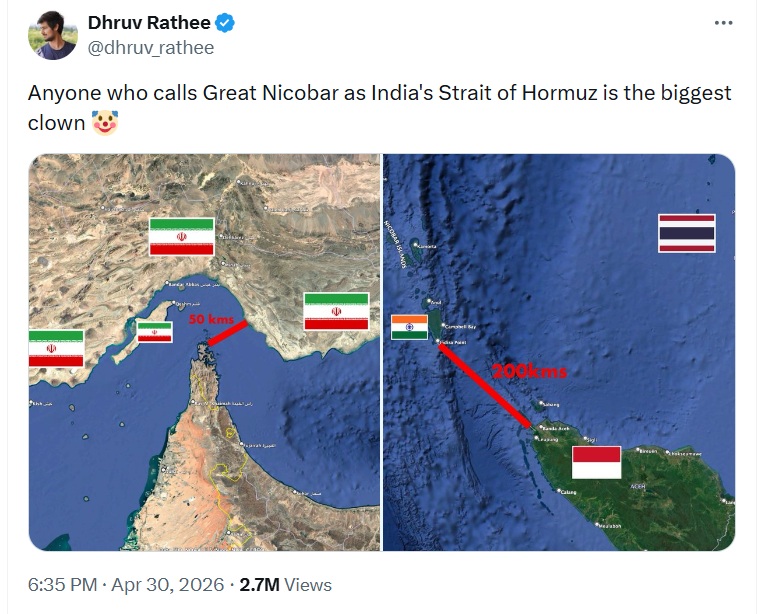
Dhruv Rathee Ridiculing Great Nicobar Project
Making a post on his X handle, Rathee mocked the Great Nicobar project saying, “Anyone who calls Great Nicobar as India’s Strait of Hormuz is the biggest clown “
Now here’s why he is wrong. The 6-Degree Channel south of Great Nicobar is the primary maritime corridor for vessels moving from the Suez Canal/Red Sea toward the Malacca Strait. Even though the water is 200 km wide, ships follow narrow, fixed shipping lanes for safety and efficiency meaning naval control doesn’t require blocking the entire sea surface.
With Anti-Access/Area Denial (A2AD) assets like the BrahMos missile (range: 300+ km), India can monitor and target any vessel within that 200 km span from Great Nicobar. In modern naval warfare, 200 km is well within strike range, Rathee applied outdated logic of “cannon range” geography.
~94,000 ships pass through annually and nearly 80% of China’s oil imports transit the Malacca Strait. A credible Indian military presence at Great Nicobar enables surveillance, rapid response, and interdiction capability even without physically “blocking” the channel. Adani Group has struck a deal with Indonesia regarding Sabang Port located at the southern tip of that very 200 km channel, meaning India effectively has strategic presence at both sides of the passage.
Only someone with low patriotism would post something like Rathee did.
“Digital India is Not a Priority for the Poor” — P. Chidambaram on Digital Push (2017–2018)
Senior Congress leader P. Chidambaram repeatedly questioned the government’s emphasis on digitisation in the aftermath of demonetisation and during the rollout of Digital India initiatives. In multiple public remarks and writings, he argued that India was “not ready” for a cashless or heavily digitised economy, stressing that:
“Large sections of India are not digitally literate… For millions, cash is still the only mode of transaction.”
He framed the digital push as exclusionary, suggesting it overlooked ground realities like internet access, digital literacy, and rural infrastructure.
While concerns about inclusion are valid in policy debates, the broader implication was clear: skepticism toward a nationwide digital transformation at a time when India was attempting to leapfrog into a tech-driven economy through UPI, Aadhaar integration, and direct benefit transfers.
Sonia Gandhi Opposing India’s Nuclear Power
After the 1998 Pokhran tests, Sonia Gandhi said that true power lies in restraint and not showing off power.
Chidambaram said that India becoming a nuclear power was against its ‘moral authority’.
During protests around the Kudankulam Nuclear Power Plant, Sonia Gandhi backed calls for heightened scrutiny and caution, reflecting a broader Congress stance that leaned toward public anxiety over nuclear expansion. Concerns raised by Congress leaders and echoed in party positions included:
Risks to local populations
Environmental and safety uncertainties
Questions over transparency and foreign collaboration
At the time, nuclear energy was being positioned as a critical pillar of India’s long-term energy security strategy—especially to reduce dependence on fossil fuels and meet rising power demands.
The hesitation and political signaling around projects like Kudankulam fed into delays and amplified public resistance, complicating India’s civil nuclear expansion despite international agreements like the Indo-US nuclear deal.
Subscribe to our channels on WhatsApp, Telegram,Instagram and YouTube to get the best stories of the day delivered to you personally.