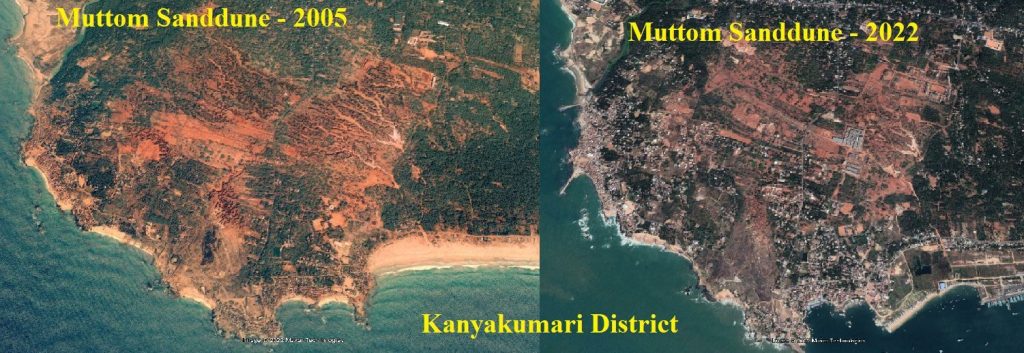
On old satellite frames, the land behind Muttom’s rocky shore glows a deep rust red. In 2005 imagery, an unbroken belt of dunes and valleys stretches inland from the sea, the surface etched with parallel ridges and scrub. Geologists call this a Teri dune complex – ancient wind‑blown, iron‑rich sands found in a few pockets of Tamil Nadu’s coast. In 2022 frames, the same area looks like a different planet: a grid of roads, campuses, real‑estate layouts and scraped‑pale patches where the red skin has been shaved off.
Over the last decade or so, most of Muttom’s unique red‑sand formations have been levelled and occupied by a cluster of church-run medical and education institutions and allied real‑estate projects. The irony is hard to miss: many of the church networks and priests behind these projects have built their public reputation by leading high‑profile protests against nuclear, hydrocarbon and industrial projects elsewhere in Tamil Nadu – all in the name of protecting nature.
A Rare Landscape, Mapped Then Erased
Teri dunes are not ordinary beach sands. Geological work describes them as Quaternary‑age marine deposits that have been reworked by wind, cemented into red aeolianite and then dissected by erosion into ridges, gullies and rock‑like outcrops. Older photo galleries by geologists show these formations just inland of Muttom, near today’s institutional belt.
Muttom in Kanyakumari had unique tall red-sand-dune sediment formation with large red-sand valleys. In the last 15yrs, they were destroyed by land mafias for KMMC hospital and college, Sun engineering college, B.ed college, TN lost Muttom landscape 3/3pic.twitter.com/LymCnOI9Yg
— Tamil Nadu Geography (@TNGeography) September 18, 2025
Before‑after satellite panels from 2005 and 2022 back that claim: most of the continuous dune belt has been replaced by built‑up clusters and bare earth where sand has been quarried or levelled.
As of now <15% of Muttom red sandstone formation exist now near Aala Moodu Isakki Amman Kovil, Esanthangu, will disappear in few yrs. From the common people to govt officer to Biz man to politicians are all expert land grabbers in TN, our unique landscape suffers 2/2 pic.twitter.com/aEQT6mRXxj
— Tamil Nadu Geography (@TNGeography) May 25, 2026
On the ground, only small pockets now survive – observers estimate less than 15% of the original formations – around Aala Moodu Isakki Amman Kovil and Esanthangu, north‑east of Muttom town. Here, red walls stand as narrow corridors between which a person can walk.
A video shared by Kairali TV about a decade ago shows the anchor walking through the sediment formation.
Muttom in Kanyakumari dt is very unique. It has three geographical features, like beach, rocky cliffs & red sand dune badlands. Red sand dune of Muttom is very unique, it goes to the height of 75m, give a look of badlands. In last 15yrs, 85% of unique sand dunes destroyed 😭. 1/4 pic.twitter.com/LymCnOIHNO
— Tamil Nadu Geography (@TNGeography) May 14, 2022
The anchor also spots JCBs working and the result we see today is a flattened red sand ‘desert’.
View this post on Instagram
DMI’s “Medi City” On The Dunes
The single largest new footprint on the former Teri belt is the Kanyakumari Medical Mission & Research Centre (KMMC) and its associated hospital and nursing college, branded as KMMC Medical College & Hospitals at “DMI Medi City, Muttom”. Admission material describes a “50‑acre campus at DMI Medi City, Muttom” with a 500‑bed multi‑super‑speciality hospital and 150 ICU beds. Hospital listings place KMMC Hospitals in Devasahayam Nagar, Muttom, operating 24×7 since 2021.
KMMC is part of the broader DMI Group, run by Catholic religious congregations – the Daughters of Mary Immaculate (DMI) sisters, MMI fathers and AMI associates – which runs schools, colleges and hospitals in multiple states. Diocesan records list KMMC Medical College, Muttom as a Catholic‑run medical institution within the orbit of the Roman Catholic Diocese of Kottar, which covers all four taluks of Kanyakumari district and counts nearly 2.5 lakh lay faithful.
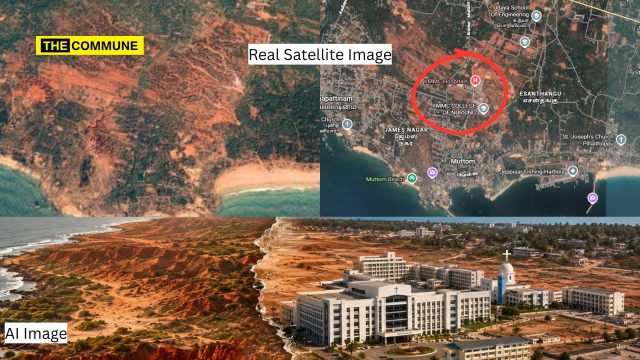
Satellite imagery shows large segments of the former red‑sand belt subsumed within this “Medi City” campus – wards, hostels, roads and parking replacing dune ridges and scrub. None of KMMC’s public material acknowledges that the campus sits on a geomorphologically unique landscape.
Bishop Agniswamy and the Christian Education Corridor
A short distance away stands Bishop Agniswamy College of Education, a B.Ed college in Muttom. It is described as “a self‑financed college of education in Muttom” administered by the Bishop of the Roman Catholic Diocese of Kottar and affiliated to Tamil Nadu Teachers Education University. Diocesan documents record that a 1975 Madras High Court judgment recognised the diocese as a minority with the right to run its own educational institutions.
The college forms part of a Christian education corridor that includes diocesan schools such as Bishop Remigius institutions and other Catholic colleges across the district. Together with KMMC, it anchors a band of church‑linked infrastructure across what was once continuous Teri terrain.
Further along the same belt lies Udaya School of Engineering, a self‑financing engineering college established by the R.V. Educational Trust in 2002. While not a church‑run campus, it sits within the same transformed landscape, marketed as an engineering college near Muttom in “a calm, scenic environment”. From the air, the combined effect is clear: a lattice of campuses and layouts on terrain that older images show as dune country.
Jeppiaar’s Harbour Becomes A Research Port
At the shoreline, another Church‑linked enterprise has hardened the coast from the sea‑side: Jeppiaar Fishing Harbour, Muttom Private Limited. Travel sites describe it as a private harbour, often called the first privately owned fishing harbour in India. YouTube vlogs and reels showcase neatly paved quays, auction halls and piles of prawns and fish under the Jeppiaar brand.
In July 2024, the Union Ministry of Earth Sciences announced that this same harbour would be upgraded into a research port to dock India’s ocean‑research vessels and serve as a test bed for blue‑economy studies. Officials explained that Muttom is well placed near the junction of the Bay of Bengal, Arabian Sea and Indian Ocean. The chancellor of Sathyabama Institute of Science and Technology, Mariazeena Johnson, said Jeppiaar Harbour would be turned into a full‑fledged research facility within a year.
With this, a private, Church‑linked harbour becomes part of the country’s deep‑sea science infrastructure, even as the surrounding dunes and inland formations are flattened.
From Protests Against Kudankulam To Silence On Muttom
The scale of Christian institutional power in Kanyakumari matters because of how strongly sections of the church have intervened in other environmental controversies. At Kudankulam, Church parishes and clergy provided organisational and symbolic support to the People’s Movement Against Nuclear Energy (PMANE), hosting protest camps in church premises and framing the anti‑nuclear agitation as a defence of the sea and coastal ecology. Christian networks and priests have also been visible in protests against Sterlite’s copper smelter in Thoothukudi and against methane and hydrocarbon projects in the Cauvery delta, invoking “creation” and “God‑given resources” in their messaging.
In Muttom, however, church‑linked institutions have been central actors in the destruction of a rare geological and ecological formation. The Kottar Diocese’s own education and medical arms – KMMC, Bishop Agniswamy College and a web of diocesan schools – sit on lands where red Teri dunes once stood. Jeppiaar’s Christian‑associated harbour infrastructure completes the enclosure from the sea‑side.
There has been no public church campaign about the loss of the Muttom dunes, no pastoral letters about the need to preserve Teri landforms, and no visible diocesan attempt to leave even a token part of the complex untouched as a protected heritage site. Instead, the dunes have been treated as “waste land” to be levelled into Christian‑branded campuses and harbour infrastructure, with the remaining fragments left to be nibbled away by small layouts around Aala Moodu Isakki Amman Kovil.
A Landscape Sacrificed Without A Hearing
For local residents and researchers, the contradiction is stark. The claim is not that Christians alone destroyed Muttom; non‑church developers and state agencies are also implicated. But Christian institutions, which claim moral authority on environmental questions elsewhere, are among the biggest beneficiaries of the levelling here.
Scientific literature still lists “Muttom Teri, Kanyakumari” as an example of a distinctive red‑sand dune system in Tamil Nadu. Satellite archives still preserve ghost images of the vanished ridges. On the ground, what remains is a shrinking maze of red corridors, a flattened desert and an institutional landscape that answers, silently, how much nature Tamil Nadu is willing to sacrifice when faith and capital converge on the same patch of land.
Subscribe to our channels on WhatsApp, Telegram, Instagram and YouTube to get the best stories of the day delivered to you personally.