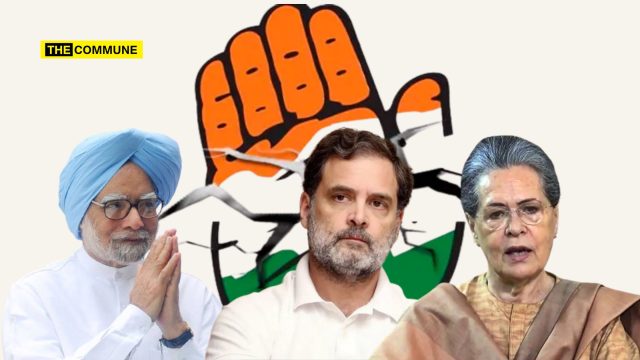
As several Congress leaders, including former Union Minister P. Chidambaram are grudgingly embracing the term “Intellectual Naxal” or “Dimagi Naxal” in response to Prime Minister Narendra Modi’s Independence Day speech, a decade-old position of the Congress-led UPA government has resurfaced.
A 2013 counter-affidavit filed by the then Congress-led UPA government before the Supreme Court had described certain urban organisations allegedly linked to the Communist Party of India (Maoist) as potentially “more dangerous” than cadres of the Maoist armed wing, as reported in Times of India.
The affidavit was filed by the Union government in November 2013 in the Kishore Samrite vs Union of India & Others case, when Congress leader Sushilkumar Shinde was serving as Union Home Minister.
View this post on Instagram
The document discussed the Maoist strategy of establishing and operating organisations in urban areas that, according to the government, maintained separate identities while remaining organically connected to the CPI (Maoist).
The affidavit stated that these organisations were generally manned by ideologues, including academicians and activists, who were allegedly committed to the Maoist party line.
According to the government’s submission, such organisations ostensibly worked on human-rights-related issues but were allegedly used to challenge security-force operations, influence public opinion and advance the Maoist cause.
The affidavit specifically stated that these organisations were “organically linked to CPI (Maoist)” and that their cadres were “in many ways more dangerous than cadres of the People’s Liberation Guerrilla Army (PLGA).”
The PLGA is the armed wing of the CPI (Maoist).
UPA Government’s ‘Urban Naxal’ Assessment
The 2013 affidavit described urban mobilisation as part of the CPI (Maoist)’s broader strategy.
It alleged that the Maoist organisation created “mass organisations” that maintained a separate identity from the party structure, thereby seeking to avoid direct legal liability while mobilising public opinion in favour of the Maoist movement.
The government claimed that such organisations were often led by ideologues, including academics and activists, who were allegedly “fully committed to the party line.”
It further alleged that these organisations used legal processes to challenge enforcement action against Maoists and attempted to undermine state institutions through what it described as propaganda and disinformation.
The affidavit also acknowledged the difficulty faced by enforcement agencies in initiating legal proceedings against such alleged ideologues.
According to the government’s submission, action against academics and activists allegedly linked to the Maoist movement could generate negative publicity for enforcement agencies because of the effectiveness of the Maoist propaganda machinery.
Allegations Of Propaganda
The UPA government’s affidavit also addressed the Maoists’ attempts to build support among sections of urban society.
It alleged that while Maoists had carried out violent activities, including the kidnapping of district collectors to obstruct the delivery of development programmes, their urban supporters and ideologues conducted a systematic campaign portraying the insurgents as champions of tribal rights.
The government described that portrayal as contrary to the Maoists’ actual actions.
The affidavit therefore drew a distinction between the armed component of the Maoist movement and organisations and individuals allegedly operating within urban spaces to build political, legal and ideological support for the insurgency.
Congress Leaders Now Invoke ‘Dimagi Naxal’
The resurfacing of the 2013 document comes amid a political controversy over the term “Intellectual Naxal”, or Dimagi Naxal.
Several Congress leaders, including P. Chidambaram, have used the expression while responding to Prime Minister Narendra Modi’s recent Independence Day remarks.
The term has triggered a political debate over whether intellectuals, academics and activists who criticise the government are being unfairly labelled as Naxals.
The 2013 affidavit, however, shows that the Congress-led UPA government itself had raised concerns before the Supreme Court about alleged Maoist-linked organisations operating in urban areas and had described certain such cadres as potentially more dangerous than members of the armed PLGA.
The document does not, by itself, establish that every academic, activist or human-rights organisation referred to in the broader debate was associated with the CPI (Maoist). Its claims were the government’s submissions in a particular Supreme Court proceeding.
Nevertheless, the affidavit provides a significant historical contrast: the concern over Maoist influence in urban and intellectual circles was not originally confined to governments led by the BJP.
In 2013, the Congress-led UPA government itself told the Supreme Court that organisations allegedly linked to Maoists could use intellectual, legal and propaganda networks as part of the insurgency’s broader strategy.
Subscribe to our channels on WhatsApp, Telegram, Instagram and YouTube to get the best stories of the day delivered to you personally.